The Relationship Between Wealth and Health

The BBC reports on fascinating new research, which concludes that “economic growth does not necessarily translate into improvements in child mortality.” There are two points I wish to make about this: First, it illustrates an important trend in the development literature regarding the correct metric to use to determine, and compare, levels of well-being worldwide. Historically, well-being has been captured by the crude instrument of Gross National Product (GDP) per capita, but the realization that, for many reasons, the measure was too crude to be a satisfactory indicator of well-being development led to the introduction of other measures, the most useful of which is the Human Development Index (HDI) put out by the United Nations Development Program (UNDP). (Why might GDP per capita be a misleading indicator of well-being?)

The second point follows from the first; one’s policy prescriptions vis-a-vis issues of development are to a large extent determined by just which indicator of well-being one believes best captures the essential nature of that elusive concept. As such, IGOs such as the World Bank, have focused attention on overall economic growth, while scholars such as Amartya Sen (who champions the “capabilities approach”) do not view growth tout court as a magical anti-poverty elixir.

From the BBC article:

Ten million children still die every year before their fifth birthday, 99% of them in the developing world, according to Save the Children.

A study comparing economic performance with child mortality reveals that some countries have not translated wealth into improvements across society.

Survival is too often just a “lottery”, said Save the Children’s David Mepham.

He said that even the poorest countries can cut child mortality by following simple policies, but at the moment “a child’s chance of making it to its fifth birthday depends on the country or community it is born into”.

Lagging behind

Angola comes at the bottom of a new “Wealth and Survival” league table drawn up by the UN Development Programme (UNDP).

The figures for child mortality in India are shocking
Shireen Miller
Save the children India

There are few countries in the world where there are such stark wealth contrasts as there are between the wealth of oil-rich coastal strip around the Angolan capital Luanda, and the war-ravaged interior.

UNDP statisticians calculate that more than half of the babies who die in Angola could be saved were the country to spread its wealth more fairly.

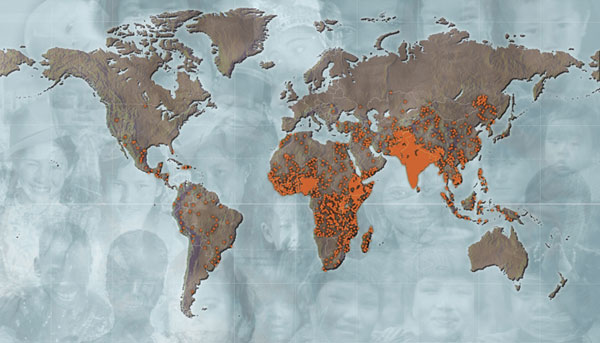
child_mortality_map.jpg

Click on the map to be taken to the Johns Hopkins Bloomberg School of Public Health’s Magazine for an article on child mortality.

[Each orange dot is equivalent to 5,000 child deaths.]
 

Pearl Jam and R.E.M

If I had to guess as to which theory of international relations the lead singers of two of my favorite bands, Eddie Vedder (Pearl Jam) and Michael Stipe (R.E.M.) would subscribe, I’d say radicalism, and radicalism, respectively. Here’s a version of what can only be characterized correctly as a protest song, Begin the Begin, from one of R.E.M.’s earliest albums. The lyrics are below. There’s certainly no compromise in this song; they argue, like all radicals, for radical systemic change; if you don’t like the system, “begin the begin.”

(chorus)
Birdie in the hand for life’s rich demand
The insurgency began and you missed it
I looked for it and I found it
Myles Standish proud, congratulate me

A philanderer’s tie, a murderer’s shoe

Life’s rich demand creates supply in the hand
Of the powers, the only vote that matters
Silence means security silence means approval

On Zenith, on the TV, tiger run around the tree
Follow the leader, run and turn into butter

Let’s begin again, begin the begin
Let’s begin again like Martin Luther zen
The mythology begins the begin
Answer me a question I can’t itemize
I can’t think clear, you look to me for reason
It’s not there, I can’t even rhyme here in the begin

A philanderer’s tie, a murderer’s shoe
Example: the finest example is you

(repeat chorus)

A philanderer’s tie, a murderer’s shoe
Let’s begin again, begin the begin
Let’s begin again

Human Effects on the World’s Oceans

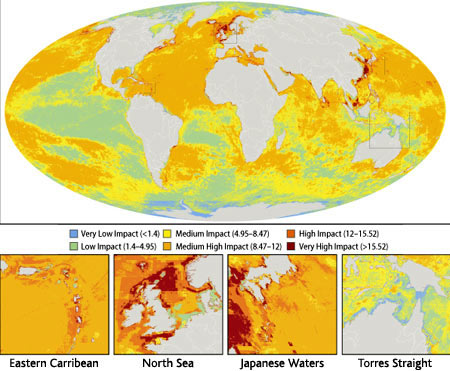
Here is a map that is unlike any of the maps of the world that I’ve posted previously. The obvious difference is that the whole of the world’s land mass is an undifferentiated white. What this map shows is the impact of human beings on (the destruction of) the world’s oceans and seas. From Science Now

ocean_impact_map.jpgFour years in the making, a groundbreaking new map of the state of the world’s oceans was released today, and its message is stark: Human activity has left a mark on nearly every square kilometer of sea, severely compromising ecosystems in more than 40% of waters.

The map, presented here at the annual meeting of the American Association for the Advancement of Science (publisher of ScienceNOW)–and published tomorrow in Science–combines 17 anthropogenic stressors, including coastal runoff and pollution, warming water temperature due to human-induced climate change, oil rigs that damage the sea floor, and five different kinds of fishing. Hundreds of experts worked to weigh and compare the stressors, overlaying them on top of maps that the scientists built of various ecosystems, with data obtained from shipping maps, satellite imagery, and scientific buoys. Then marine scientists modeled how different ecosystems would be affected by the stressors, mapping so-called impact scores onto square-kilometer-sized parcels worldwide. The scores correspond to colored pixels on the new map.

Ethnic Segregation in Kenya Continues Unabated

Kenya seems to be following the template set out in previous inter-ethnic conflicts (see a previous post on the results of residential segregation in Baghdad), where the ultimate result is a more ethnically segregated society.  The “un-mixing of peoples” continues unabated in that increasingly unstable state.  The New York Times reports:

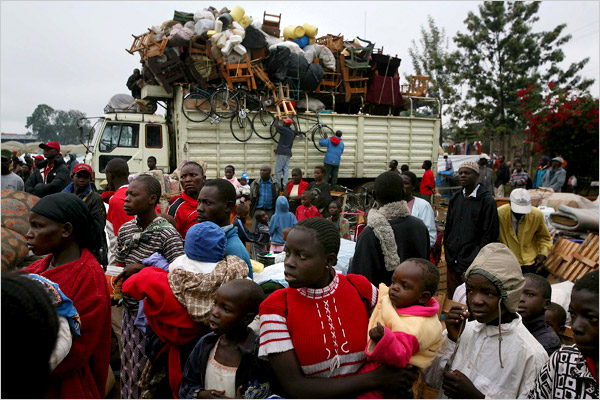
segregation_of_kenya.jpg

Following a flawed election, and a wave of ethnic and political violence, Kenya, once one of Africa’s most promising nations, is resegregating itself. Members of ethnic groups, like these Luos, left, waited for transportation to their ancestral homes.

Photo: Joao Silva for The New York Times

 OTHAYA, Kenya — Sarah Wangoi has spent her entire life — all 70 years of it — in the Rift Valley. But last month, she was chased off her farm by a mob that called her a foreigner. She now sleeps on the cold floor of a stranger’s house, seeking refuge in an area of Kenya where her ethnic group, the Kikuyu, is strong. It is, supposedly, her homeland.

“I am safe now,” said Ms. Wangoi, though the mob still chases her in her dreams.

Across the country, William Ojiambo sat in a field where the ground was too hard to plow. He, too, sought refuge with his ethnic group, the Luo. He used to live in an ethnically mixed town called Nakuru but was recently evicted by a gang from another ethnic group that burned everything he owned.

“We came here with nothing, like cabbages thrown in the back of a truck,” Mr. Ojiambo said.

Kenya used to be considered one of the most promising countries in Africa. Now it is in the throes of ethnically segregating itself. Ever since a deeply flawed election in December kicked off a wave of ethnic and political violence, hundreds of thousands of people have been violently driven from their homes and many are now resettling in ethnically homogenous zones.

Luos have gone back to Luo land, Kikuyus to Kikuyu land, Kambas to Kamba land and Kisiis to Kisii land. Even some of the packed slums in the capital, Nairobi, have split along ethnic lines.

Kosovo’s bid for Independence

From the BBC, we learn that the Albanian majority in Serbia’s southern region of Kosovo is expected to vote for independence from Serbia within days. The province has been controlled by the international community since the end of the NATO-led war against Slobodan Milošević ‘s regime in 1999. In PLSC250 yesterday, we discussed the Kurdish campaign for self-determination and noted some of the arguments for and against. The most comepelling argument for secession/independence is a deontological argument based on the inherent right of groups to decide for themselves their system of government. The most obvious argument against is a utilitarian one, voiced here by Serbia’s Foreign Minister, Vuk Jeremić :

[Independence for Kosovo] would lead to an uncontrolled cascade of secession

Here’s more from the article:

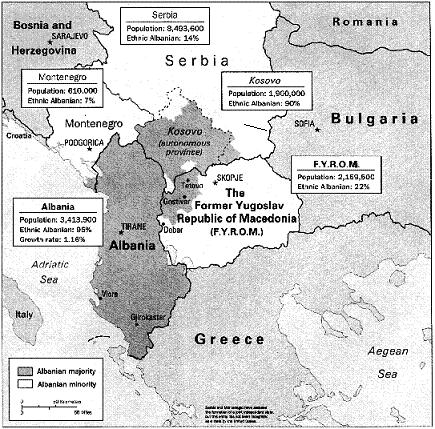
kosovo.jpgSerbia’s foreign minister has urged the United Nations Security Council to oppose the province of Kosovo’s expected declaration of independence.

Vuk Jeremic said Serbia would not use force to stop the secession but warned that allowing it would give a green light to other separatist movements.

The ethnic Albanian majority in Kosovo is expected to announce its breakaway from Serbia within days.

Russia has warned that recognition of Kosovo would be illegal and immoral.

Speaking after the closed session, Serbia’s foreign minister said that is was not too late for diplomats to prevent Kosovo’s unilateral declaration of independence.

The Fall and Rise of Torture Across Time and Space

Here’s the abstract from an interesting article* on the history of the use of torture by Christopher Einol. I think we’ll read this near the end of the semester. (The subject of the illustration is water-boarding (about which the current US Attorney General does not know whether it is torture or not) during the Spanish Inquisition.)

water_torture.jpgTorture was formally abolished by European governments in the 19th century, and the actual practice of torture decreased as well during that period. In the 20th century, however, torture became much more common. None of the theories that explain the reduction of torture in the 19th century can explain its resurgence in the 20th. This article argues that the use of torture follows the same patterns in contemporary times as it has in earlier historical periods. Torture is most commonly used against people who are not full members of a society, such as slaves, foreigners, prisoners of war, and members of racial, ethnic, and religious outsider groups. Torture is used less often against citizens, and is only used in cases of extremely serious crimes, such as treason. Two general 20th-century historical trends have caused torture to become more common. First, an increase in the number and severity of wars has caused an increase of torture against enemy guerrillas and partisans, prisoners of war, and conquered civilian populations. Second, changes in the nature of sovereignty have caused an expansion in the definition of acts constituting treason.

* CHRISTOPHER J. EINOLF, “The Fall and Rise of Torture: A Comparative
and Historical Analysis”, Sociological Theory 25:2 June 2007. You should have access to the article if you are on campus.

Individuals Having an Impact on IR

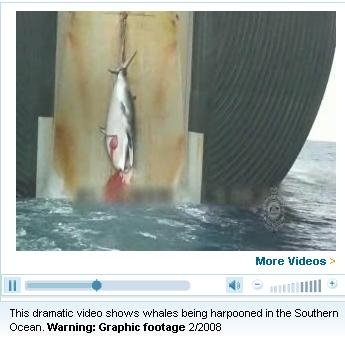
In a previous post, I asked you to consider not how international relations affects you, but how the way in which you behave, and the actions that you take have an effect on IR. Here’s a story about how changing individual attitudes in Japan may be having a greater impact on the whaling industry than the combined efforts of states and NGOs over the last couple of decades. You can see a graphically disturbing video of whales being killed at the link above.

JAPAN’s whalers are going broke and have been forced to slash prices because no one wants to eat their growing mountain of whale meat.

whale_slaughter.jpgThe farcical truth of Japan’s whaling industry was exposed yesterday by Japanese media reports that the Institute for Cetacean Research is struggling to repay $37 million in government subsidies.

The report came as Japanese embassy officials made a stern protest in Canberra over the Federal Government’s release of shocking whaling photographs.

The ICR, responsible for Japan’s lethal “research operation”, is flooding Japan with cheap whale meat that it cannot sell, according to the reports in respected newspaper Asahi Shimbun.

Meat and other parts of whales killed during ICR “scientific research” in the Southern Ocean is sold to a private fisheries company Kyodo Senpaku, which manages the sale of whale meat in the Japanese market. But while ICR has consistently increased the number of whales it kills – by 30 per cent between 2005 and 2006 – there has been no rise in domestic demand for whale meat or products.

Greenpeace Australia Pacific whales campaign director Rob Nicholl said the losses were further proof that there was no market for whale meat in Japan.
“It’s standard economics. There is an oversupply. They’ve had to reduce the price but they still can’t get rid of the stuff,” he said.

Do you think that this story can shed any light on a potential solution to the drug and human trafficking industries? How specifically?

“Truman lost China” and the effect of “the stuff of politics” on IR

In our discussion of the international (or system) level-of-analysis in IR, we noted some of the strengths and weaknesses of focusing explanation and description at that level. While system-level explanations are helpful in that they are comprehensive and holistic, a major disadvantage of that level is that it misses, or neglects, the “stuff of politics.” What does that mean?

ping_pong_diplomacy.jpgHere’s an explanation by way of example. The image below is of Richard Nixon and Mao ZeDong engaging in “ping pong diplomacy”* with Chinese Prime Minister Zhou Enlai looking on approvingly [why is Mao using a “Western” grip?]. Those of you who know a little bit about US-China diplomatic history understand the importance of the “Nixon goes to China” moment. The most significant point, for our purposes, is that this meeting signaled the re-establishment of diplomatic relations between the United States and “Red China”, after they had been cut off due to the 1949 victory of Mao’s Communists in the Chinese Civil War. It was not surprising that it was Nixon–a Republican–who was able to make this diplomatic gesture, since it would have been politically impossible for a Democratic president to have done the same. This is because President Harry S. Truman, and the whole of the Democratic party by association, had been vilified for having “lost China” to Communism. This is the kind of “stuff of politics” that is ignored when looking at IR from only an international (or system-level) perspective. Here is a clip from a documentary analyzing Nixon’s visit to China:

*Nixon and Mao never did play ping-pong (as far as I know), but their meeting was given the name “ping-pong diplomacy” since the first post-1949 diplomatic US visitors to China were table tennis players.

Challenges to Rational Choice Theory

The fundemental assumption regarding human behavior, upon which the whole edifice of rational choice theory (RCT) rests is that human beings are rational; specifically, it means that they act in order to maximize their self-interest by “maximizing expected utility”. The construction above takes into account our preferences (utility) and the fact that the link between our actions and outcomes are rarely certain, but that we are able to adequately estimate (beliefs) the likelihood of achieving a specific goal given an accompanying action.

In the example of Lebron James I posted earlier, he has a generally good idea of his preferences (he prefers–other things equal–to hit a 3-pointer over a field goal or a free throw) and his beliefs (he knows his stats regarding his 3-point shooting percentage, his field goal, and free throw percentages as well). Given his beliefs and preferences, Lebron can easily act–and generally does–in an instrumentally rational manner.

How valid, though, is the assumption that human beings do act in an instrumentally rational manner? In other words, do individuals always maximize their expected utility? The short answer is no. Some political scientists believe that political culture often acts to mitigate instrumentally rational behavior. [We’ll discuss this in class on Tuesday.] Whole sub-disciplines in behavioral psychology and behavioral economics can point to copious amounts of research data demonstrating the lack of rationality in human beings, often in fairly simple situations. Michael Sherman asks “why people believe weird [i.e., irrational] things about money”:

Would you rather earn $50,000 a year while other people make $25,000, or would you rather earn $100,000 a year while other people get $250,000? Assume for the moment that prices of goods and services will stay the same.

Surprisingly — stunningly, in fact — research shows that the majority of people select the first option; they would rather make twice as much as others even if that meant earning half as much as they could otherwise have. How irrational is that?

Continue reading “Challenges to Rational Choice Theory”

Design a site like this with WordPress.com
Get started