Globalization, the Catholic Church, and Classroom Pedagogy

A while back I had the opportunity to allow a job candidate to come in and use my intro to IR class to give a her candidate classroom lecture. Following the 40-minute lecture–after the candidate and the rest of the faculty had left the room–I asked my students to anonymously write down their impressions of the teaching style of the job candidate. One of the responses was particularly illuminated and the latest news about the Catholic Church’s efforts to reform the concept of sin reminded me of that student’s response. The student’s response was (and I’m paraphrasing here):

“I didn’t like that she went around the room and made everyone answer her introductory question. I pay $40,000 in tuition annually and I have the right to sit in the classroom and be bored and do nothing if that’s what I want to do.”

I felt sorry for this student, because s/he has forgotten a couple of important rules about life, let alone post-secondary education: first, you only get out of something what you put in. Second, and more important, the whole classroom experience is a social experience, and the outcome of the educational process is not only a function of what the student him/herself is doing, and what the instructor is doing, but what others in the classroom are doing as well.

Apropos of the preceding, here is news from the London Times online, which demonstrates the Catholic Church’s approach to the concept of sin:

seven_poster.jpg…[Bishop Gianfranco Girotti] said that priests must take account of “new sins which have appeared on the horizon of humanity as a corollary of the unstoppable process of globalisation”. Whereas sin in the past was thought of as being an invididual matter, it now had “social resonance”.

“You offend God not only by stealing, blaspheming or coveting your neighbour’s wife, but also by ruining the environment, carrying out morally debatable scientific experiments, or allowing genetic manipulations which alter DNA or compromise embryos,” he said.

Bishop Girotti said that mortal sins also included taking or dealing in drugs, and social injustice which caused poverty or “the excessive accumulation of wealth by a few”.

He said that two mortal sins which continued to preoccupy the Vatican were abortion, which offended “the dignity and rights of women”, and paedophilia, which had even infected the clergy itself and so had exposed the “human and institutional fragility of the Church”.

Maybe it’s time for Brad Pitt and Morgan Freeman to do a sequel to Seven. 🙂
First, Conflict Diamonds; now, Junta Jade?

I know; the j in junta is pronounced like an h. Regardless, The Christian Science Monitor asks “Who’s buying Burma’s gems?: Laura Bush’s campaign for a global boycott is being undone by China’s appetite for Olympic souvenirs made of Burmese jade.” The US First Lady argues that those of you purchasing precious gems from Burma are indirectly supporting the rule of the brutal military dictatorship in that southeast Asian country.

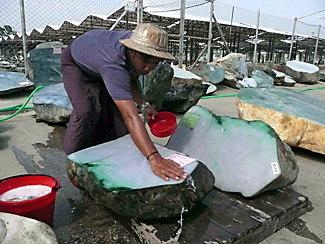
burma_jade.jpgIt’s the last hour of the last day of the gems auction in Rangoon, and tired buyers are fanning themselves with worn auction catalogs, and making their final bids.

Over the past five days, jade, rubies, sapphires, and close to $150 million have passed hands here, according to the Union of Myanmar Economic Holdings Ltd., the consortium that dominates Burma’s gemstone trade and is owned by the defense ministry and a clutch of military officers.

Who’s buying? China, India, Singapore, and Thailand are scooping up Burma’s stones. US first lady Laura Bush’s efforts at a global boycott of Burma’s gems seem to have done little to reduce China’s appetite for Burmese jade to make trinkets and souvenirs to sell at the Summer Olympics.

At this recent auction, 281 foreigners attended, leaving behind much-needed foreign currency and generally turning the auction into a resounding success, according to the state-run New Light of Myanmar newspaper.

Mrs. Bush – and human rights campaigners – would not be pleased.

The first lady has taken on the military regime in Burma (Myanmar), urging jewelers not to buy gems from a country where the undemocratic rulers and their cronies amass fortunes selling off the country’s stones, as well as many of the county’s other natural resources – such as minerals, timber, gold, oil, and gas – but keep Burma’s citizens in abject poverty.

She has urged UN Secretary General Ban Ki Moon to act more forcibly on Burma and stood beside President Bush on several occasions recently as he announced the growing list of US sanctions on the country. And, on International Human Right’s Day this past December, Mrs. Bush added her voice to those seeking a global boycott on gems from Burma.

“Consumers throughout the world should consider the implications of their purchase of Burmese gems,” she said in a statement from the White House. “Every Burmese stone bought, cut, polished, and sold sustains an illegitimate, repressive regime.”

Earlier in the semester, we read an article [which he has made available to the general publilc on his web site] by Richard Snyder on the link between “lootable wealth” and political stability. In fact, the final section of his paper deals explicitly with the Burmese tropical timber trade and its role in funding rebel groups. What are the implications of Snyder’s argument for how we–as potential consumers of junta jade–should respond to Laura Bush’s plea? Of course the two phenomena are not exactly the same (Snyder is seeking to understand the link between “lootable wealth” political stability, while Laura Bush is arguing that “lootable wealth” supports dictatorial rule.) Here is the abstract to Snyder’s article:

This article proposes a political economy of extraction framework that explains political order and state collapse as alternative outcomes in the face of lootable wealth. Different types of institutions of extraction can be built around lootable resources – with divergent effects on political stability. If rulers are able to forge institutions of extraction that give them control over revenues generated by lootable resources, then these resources can contribute to political order by providing the income with which to govern. In contrast, the breakdown or absence of such institutions increases the risk of civil war by making it easier for rebels to organize. The framework is used to explain two puzzling cases that experienced sharply contrasting political trajectories in the face of lootable resources: Sierra Leone and Burma. A focus on institutions of extraction provides a stronger understanding of the wide range of political possibilities – from chaos, to dictatorship, to democracy – in resource-rich countries.

The United Nations and Peacekeeping in Congo

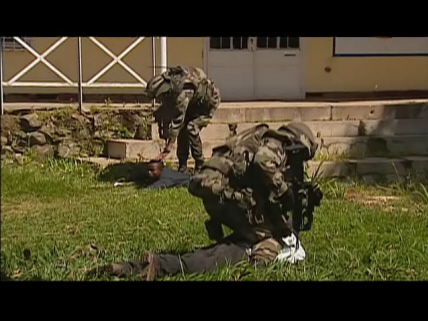
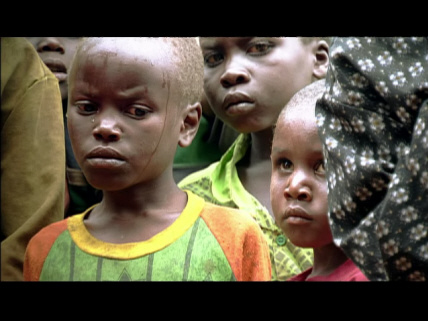
In PLSC250–intro to IR–this week we viewed a documentary made by the National Film Board of Canada, which addresses the UN’s peacekeeping role in Congo. After reading Chapter 7 of Mingst, you should now be aware that the UN in the world’s most important and powerful IGO, and the UN Security Council plays the most prominent global role in the area of international security. Here are a couple of screen shots from the film and the film’s description:

peacekeepers_1.jpg

peacekeepers_2.jpg

With unprecedented access to the United Nations Department of Peacekeeping, The Peacekeepers provides an intimate and dramatic portrait of the struggle to save “a failed state.” The film follows the determined and often desperate manoeuvres to avert another Rwandan disaster, this time in the Democratic Republic of Congo (the DRC).
Focusing on the UN mission, the film cuts back and forth between the United Nations headquarters in New York and events on the ground in the DRC. We are with the peacekeepers in the ‘Crisis Room’ as they balance the risk of loss of life on the ground with the enormous sums of money required from uncertain donor countries. We are with UN troops as the northeast Congo erupts and the future of the DRC, if not all of central Africa, hangs in the balance.
In the background, but often impinging on peacekeeping decisions, are the painful memory of Rwanda, the worsening crisis in Iraq, global terrorism and American hegemony in world affairs. As Secretary General Kofi Annan tells the General Assembly at the conclusion of The Peacekeepers: “History is a harsh judge. The world will not forgive us if we do nothing.” Whether the world’s peacekeeper did enough remains to be seen.

United Nations Security Council Imposes more Sanctions on Iran

In intro to IR, we’ll analyze the role of IGOs, NGOs, and international law in international politics.  Arguably the most important IGO is the United Nations Security Council (UNSC)  Today, the UNSC voted (14-0) to impose tougher sanctions against Iran as a result of that country’s continued pursuit of nuclear weapons.  From the New York Times:

unsc_iran_vote_03mar2008.jpg

UNITED NATIONS — The Security Council on Monday adopted its third resolution imposing sanctions on Iran for its refusal to cease enriching uranium, an activity that the West suspects Iran may be using to create fuel for a nuclear weapon.

 The previous two measures gained the unanimous support of the 15-member panel, but in balloting on Monday Indonesia abstained, saying it “remained to be convinced of the efficacy of adopting additional sanctions at this juncture.” Fourteen countries voted in favor.

The resolution authorizes inspections of cargo to and from Iran that is suspected of carrying prohibited equipment, tightens the monitoring of Iranian financial institutions and extends travel bans and asset freezes against persons and companies involved in the nuclear program.

It adds 13 names to the existing list of 5 individuals and 12 companies subject to travel and asset restrictions. The new names include people with direct responsibility for building fast-spinning centrifuges that enrich uranium ore and a brigadier general engaged in “efforts to get around the sanctions” in the two earlier resolutions.

Notice two things: first, the use of “targeted sanctions.”  Second, the story byline reads “United Nations”, not New York.  I wonder if this is standard practice for stories originating from the United Nations headquarters in New York.  Does anyone know?

Failed States and the Threat of Terrorism

In both intro to IR and intro to comparative, we’ve read about failed states and their impact not only on those living in them but those living even thousands of miles away. Rotberg, Krasner, and Sadowski, have all written about the potential dangers of states that do not have complete sovereignty over their territory. In another example of the potential threat posed by failing states, the Associated Press reports on a US attack on extremists in Somalia:

WASHINGTON – The U.S. launched a military airstrike in Somalia to go after a group of terrorist suspects, defense officials said Monday.

“It was a deliberate, precise strike against a known terrorist and his associates,” one U.S. military official said, speaking on condition of anonymity because he was not authorized to comment on the record.

He gave few other details, except to say the targets were believed staying in building known to be used regularly by terrorist suspects.

In the strike early Monday, Somali police said three missiles hit a Somali town held by Islamic extremists, destroying a home and seriously injuring eight people.

The strike follows one last year in which the U.S. shelled suspected al-QaidaU.S. Navy ship off the shore of the lawless East African nation. targets in Somalia, using gunfire from a

Most Recent Issue of the CrisisWatch Newsletter Released

Crisis Group–an NGO that analyzes and tracks extant and potential conflicts around the world–allows individuals to sign up for the monthly CrisisWatch newsletter. This month’s newsletter informs its readers that “twelve actual or potential conflict situations around the world deteriorated in February 2008, and four improved.”

The situation deteriorated in Armenia, where – as CrisisWatch went to press – a violent crackdown sought to suppress eleven days of protests after presidential elections that the opposition claimed were rigged. A state of emergency has been declared, and armed forces are reportedly mobilising for broader repression.

Attacks on Timor-Leste’s president and prime minister underlined the need for security sector reform in the fragile country. Yet their aftermath – including the killing of former head of military police Alfredo Reinado, who led the attack on the president – presents an opportunity for the government to address key issues.

Rebels in Chad launched a major assault on the capital N’Djamena in which hundreds were killed and thousands displaced. A state of emergency is still in place amid reports of a heavy government crackdown. In Darfur, the Sudanese government attacked three towns and an IDP camp from both ground and air, marking the worst violence in the region in months.

The situation also deteriorated in Cameroon, Comoros Islands, DR Congo, Ethiopia/Eritrea, Israel/Occupied Territories, Philippines, Serbia and Somalia.

Peace and Punishment–An Insider’s Account of the ICTY

Marko Attila Hoare, whose blog (Greater Surbiton) is a great place to read about South East European politics, has a post on the recently published book by former spokeswoman of the International Criminal Tribunal for the former Yugoslavia (ICTY), Florence Hartmann.  The book is written in French and the title is Paix et chatiment: Les guerres secretes de la politique et de la justice internationales [Peace and Punishment: Secret Politial Wars and International Justice].

Hoare has a long post about the book. Here are some snippets:

[Hartmann] has used her eyewitness’s insight into the inner workings of the ICTY to support her blistering critique of the failure of the Western alliance to support the cause of justice for the former Yugoslavia. Her book paints a portrait of Western powers, above all the US, Britain and France, stifling the ICTY and preventing the arrest of war-criminals through a combination of obstruction, manipulation, mutual rivalry and sheer inertia.

One of the best parts of the book concerns what Hartmann terms the ‘fictitious pursuit’ of the two most prominent Bosnian Serb war-criminals, Radovan Karadzic and Ratko Mladic, involving repeated failures to arrest them. Hartmann gives various reasons why the Western powers might have behaved in this manner, among them the alleged agreement in 1995 between Milosevic, Mladic and French President Jacques Chirac, that in return for the release of two French pilots shot down by the Serbs over Bosnia, Mladic would never be prosecuted by the ICTY; the similar alleged agreement between Karadzic, Mladic and the US’s Richard Holbrooke in 1996, for Karadzic to withdraw from political life in return for a guarantee that he would never be prosecuted; and the readiness in 2002 of Bosnia’s High Representative, Britain’s Paddy Ashdown, to sabotage the attempts of Bosnian intelligence chief Munir Alibabic to track down Karadzic, out of rivalry with the French intelligence services with which Alibabic was working…

Peace and Punishment, nevertheless, remains essential reading for several reasons. It reminds us that, however critical one may be of del Ponte’s performance as Chief Prosecutor, she was very far from being the only senior individual responsible for the ICTY’s failures. It gives an insight into the sort of debates and conflicts over strategy that preoccupied war-crimes investigators at the OTP. And it highlights the fact that, far from being an agent of Western imperialism, the Chief Prosecutor was acting in a frequently hostile international arena, in which she had to struggle for international cooperation, and in which the ICTY was frequently squeezed rather than supported by the Great Powers. Although, as I have indicated, I am highly critical of several aspects of this book, I would nevertheless recommend it to anyone interested in the subject of why international justice has failed the peoples of the former Yugoslavia.

NGOs and Their Changing Roles–How Have They Changed

Here is a two-part interview, available on YouTube with Norman Cook, and long-time practitioner and student of NGOs and the role they play in international politics.  We’ll be looking at NGOs next week, so you may want to take a look at this interview to learn a little bit more about how the role of NGOs has changed over time.

Here is a description of the interview:

Interview with Norman Cook, Canadian development expert (and jazz lover). How have the roles of NGOs changed? Are they becoming near-governmental – “embedded” with power politics? How our development models and criteria often don’t fit the reality in developing countries.
Interview by Jan Oberg, November 27, 2007

While watching consider the arguments of Krasner and Slaughter that we discussed last week.  How would they respond to Cook’s assertions?

Mapping the Future from CSIS

The Center for Strategic and International Studies has a fascinating new subway-style map, which interactively maps the global future on the basis of various themes–construction, sporting and culture, science, politics, etc. Each node of information on the interactive map is a hyperlink that takes the reader to a web page with detailed information about the topic.

Below is a much reduced version of the map.  If you click on the word map above, you’ll be taken to the large interactive version of the map. Click on the link (which I’ve indicated using the red circle) and you’ll be taken to a page where you’ll be told the following:

As a result of the internal reorganization of the U.S. military command structure, a new headquarters dedicated exclusively to Africa is expected to become fully operational in 2008. The United States Africa Command, or AFRICOM, will report to the Secretary of Defense on U.S. military relations with 53 African countries, with a focus on war prevention and capacity-building programs. The ultimate stated goal of the program is to enable “a more stable environment in which political and economic growth can take place.” For the fiscal year 2008, AFRICOM is expected to have a $75 billion budget. 

mapping_future2.jpg

h/t to V. Wang.

Who Speaks for Islam–a New Book by the Gallup Poll

The Gallup Polling outfit has a new book out based on a massive (over 50,000 respondents) recent poll on attitudes amongst the world’s approximately 1.3 billion Muslims. Let us allow the publishers to describe the content themselves:

islamwld.jpgGallup’s largest study of Muslim populations worldwide challenges conventional wisdom and the inevitability of a global conflict as the wars in Iraq and Afghanistan continue. Despite widespread media coverage of global terrorism from America and Europe to the Middle East and Asia, little is known about what majorities of the world’s Muslims really think and feel. What do Muslims say about violence and terrorist attacks? What do they say about democracy, women, and relations with the West? What are their values, goals, and religious beliefs?

Who Speaks for Islam? What a Billion Muslims Really Think by John L. Esposito and Dalia Mogahed (Gallup Press; March 2008; hardcover) sheds new light into the “increasing hostility” that Archbishop Tutu characterizes.

In the wake of the terrorist attacks on 9/11, U.S. public officials seemed to have no idea whether or not many Muslims supported the bombings. This troubled Gallup Chairman and CEO Jim Clifton, who felt that “no one in Washington had any idea what 1.3 billion Muslims were thinking, and yet we were working on intricate strategies that were going to change the world for all time.” Clifton commissioned his company to undertake the enormous job.

The result is Who Speaks for Islam? What a Billion Muslims Really Think, based on six years of research and more than 50,000 interviews representing 1.3 billion Muslims who reside in more than 35 nations that are predominantly Muslim or have sizable Muslim populations.

Some of the more intriguing findins?

  • Muslims and Americans are equally likely to reject attacks on civilians as morally unjustifiable.
  • Large majorities of Muslims would guarantee free speech if it were up to them to write a new constitution AND they say religious leaders should have no direct role in drafting that constitution.
  • Muslims around the world say that what they LEAST admire about the West is its perceived moral decay and breakdown of traditional values — the same answers that Americans themselves give when asked this question.
  • When asked about their dreams for the future, Muslims say they want better jobs and security, not conflict and violence.
  • Muslims say the most important thing Westerners can do to improve relations with their societies is to change their negative views toward Muslims and respect Islam.

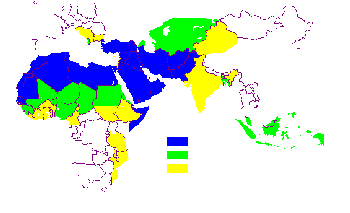
Note: the map above is from Professor Juan Cole.  The colors refer to the percentage of inhabitants of each state who are Muslims.

Design a site like this with WordPress.com
Get started