Rwandan Journalists Jailed for Stirring up Ethnic Tensions

Last week in IS 302, we addressed the issue of how governments should approach the existence of ethnic division in a post-conflict setting. We saw that Rwanda and Burundi have chosen different approaches. Burundi’s leaders have decided to address ethnic grievances via assuring ethnic balance in important institutions such as the military. Rwanda’s government has chosen a different approach, endeavouring to make the society as ethnicity-blind as possible. As such, there has been a zero-tolerance policy with respect to any demonstration or acknowledgement of ethnic particularism. As a recent Amnesty International report states unequivocally:

Rwanda’s laws banning “genocide ideology” and “sectarianism” are vague and sweeping, and have been used to silence legitimate dissent. The laws were designed to encourage unity and restrict speech that could lead to hatred. However, they have had dangerous and chilling effect on Rwandan society.”

The most recent example of this “dangerous and chilling effect on Rwandan society” is news of the conviction of two Rwandan journalists of having “stirred up ethnic divisions.” As this BBC article makes clear, it seems highly likely that President Paul Kagame has been using the role of “hate media” during the Rwandan genocide to silence legitimate opposition:

Editor Agnes Nkusi was sentenced to 17 years, while reporter Saidath Mukakibibi was imprisoned for seven. Among several articles, the judge referred to one saying some Rwandans were unhappy with the country’s rulers. Prosecutors said this was “meant to stir [up] hatred and fury against the government”.

President Paul Kagame came to power in 1994, ending the genocide in which some 800,000 ethnic Tutsis and moderate Hutus were slaughtered. He has recently been accused of intolerance and harassing anyone who criticises him. His government defends its tough media laws, pointing to the role of “hate media” ahead of the genocide.

The newspaper was suspended for six months last year, just ahead of elections which saw Mr Kagame re-elected by a landslide. Nkusi was found guilty of disrupting state freedom, propagating ethnic division, genocide revisionism and libel.
Egypt’s Mubarak Seeks Dissolution of Government Amidst Mass Protests

In today’s session of IS 210 we analysed the concept of the state and also talked about the related political concepts of regime and government. We noted that they were conceptually distinct political phenomena with differing levels of institutionalisation–with the state being the most institutionalised, and the government being the least.

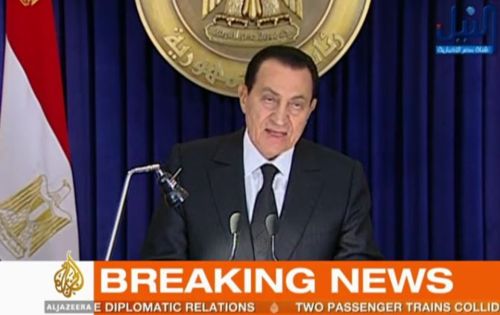
In the midst of continuing mass demonstrations against his rule in Egypt, president Hosni Mubarak has asked the government to resign. Mubarak seemingly hopes that the government’s resignation will appease the demonstrators. What’s interesting from our perspective–as students of comparative government–is that Mubarak hopes to maintain his regime at the expense of the government. It is accurate to call the current leadership of Mubarak a regime, since the norms/rules associated with political authority at the national level have been institutioinalised over the course of the almost three-decade reign by Mubarak as Egypt’s president. The question then becomes will the protesters be satisfied with a change in government alone, or will they insist on a change in the nature of this authoritarian regime, which will obviously not be effected without the removal from office of Mubarak himself. As in the case of many authoritarian regimes, in Egypt it is also true that the autocrat is the regime himself.

Here’s more from the CBC on Mubarak’s latest moves:

Egyptian President Hosni Mubarak says he has asked the government to resign and promised reforms as protests engulf his country.

In a televised speech broadcast early Saturday local time, Mubarak used his first public comments since the unrest began to defend the security crackdown on demonstrations.

“I assure you … I’m working for the people…. as long as you’re respecting the law,” Mubarak said.

“We have to be careful of anything that would allow chaos,” he said.

At the same, Mubarak tried to speak to the demonstrators who have filled Egypt’s streets for days.

“I’ll always be on the side of the poor,” he said. “I am with bettering the economy.”

Mubarak, who has ruled Egypt for three decades, has been facing the biggest pressure of his tenure.

Before the president spoke, tens of thousands of anti-government protesters defied a night curfew and some reportedly set fire to Mubarak’s party headquarters in Cairo. Flames were seen licking at the National Democratic Party headquarters shortly after 6 p.m. local time, though it was not immediately confirmed how the fire began.

The best real-time coverage of the political events in Egypt is, in my opinion, Al-Jazeera. You can watch live streaming coverage of Al-Jazeera here.

A Wave of Protests across North Africa and the Middle East

Following closely in the aftermath of the dramatic changes that have taken place in Tunisia recently, the political unrest seems to have swept its way across northern Africa, with the situation in Egypt now drawing most of the attention. Alan Cowell of the New York Times writes:

After days of protests that have toppled one president and shaken many others, governments across the Middle East braced on Friday for http://www.guardian.co.uk/global/blog/http://www.guardian.co.uk/global/blog/2011/jan/25/middleeast-tunisia://www.guardian.co.uk/global/blog/2011/jan/25/middleeast-tunisia/jan/25/middleeast-tunisia outbursts of rage and discontent directed at entrenched regimes confronting an exceptional clamor for democracy.

The immediate epicenter of the protests was Egypt, where Internet and cellphone connections were closed or restricted in Cairo, Alexandria and other places. Riot police took to the streets of Cairo before the Friday noon prayers that in http://www.guardian.co.uk/global/blog/2011/jan/25/middleeast-tunisia parts of the Islamic world have been a prelude to unrest as worshippers pour onto the streets.

The protests have underscored the blistering pace of events that have transformed the visage of the Arab world, particularly among regimes that have traditionally enjoyed the support of successive administrations in Washington.

Note the words that I have changed to red in the quote above. Is this author using these words as synonyms? If so, is he using them as precisely as he could be? Is he using them incorrectly?

For more information, here’s a useful set of reports, with myriad links to video and audio, from the UK Guardian’s Jack Shenker reporting in Cairo. In addition, the CBC website has an interesting flash-type graphic showing how the geographical extent of the spread of the protests.

“Ghosts of Rwanda” Documentary

As a video supplement to the Rwanda chapter from Samantha Power’s book on genocide, and the Gourevitch book, we viewed the first part of the PBS Frontline documentary “Ghosts of Rwanda” in class today. Please view the remaining hour or so sometime before next Friday’s class as we will use the first portion of that session to continue our discussion on the international community’s failure to halt the slaughter of more than 800,000 Tutsis by the Hutu-led Rwandan government.Here’s the first part of the documentary. Click on the video to take yourself to Youtube, where you will easily find the remaining parts.


The face of Statelessness–Canadian Style

Last week I asked if all the world’s residents have citizenship. We discovered that the answer is `no’ and that there are approximately 15 million  stateless persons worldwide.  On the way to work this morning, I was listening to the CBC program The Current, which reported on the peculiar story of a young girl living in Belgium, whose father is a Canadian citizen, but who is currently not a citizen of any country. She does not fulfill the requirements of Belgian citizenship (which does not have universal jus soli citizenship rules), and as of last year falls through a loophole in Canadian citizenship law as of changes in the law that were enacted last year.

From the program:

Citizens of Nowhere – Ian Goldring

Chloe Goldring is 15 months old. She lives in Brussels, Belgium. And she has no citizenship. She is officially stateless. She has ended up in this situation because of a change made to the Canadian Citizenship Act in April of 2009.

Since then Canadians who were born abroad, in this case her father, are no longer able to pass on Canadian citizenship to their children, unless those children are born in Canada. The change was brought in to target parents born outside Canada who come here, obtain citizenship, and then return to their country of origin and pass along Canadian citizenship to children who may never have any intention of coming to Canada.

You may remember this became an issue in the summer of 2006 when there was a public outcry over Canada’s move to rescue Lebanese Canadians during the Israeli bombardment of Lebanon that summer. Well that is the change that Chloe Goldring has been swept up in.

Chloe’s father Ian Goldring is a Canadian who lives in Brussels.

Canada’s Official Recognition of the Armenian Genocide

There was some uncertainty in seminar a few days ago regarding the Canadian government’s official stance on the Armenian genocide, which began in 1915. In short, Canada as of 2004 officially recognises the Armenian genocide. From a 2004 CBC story–“Canadian Parliament Recognizes Armenian Genocide”:

The House of Commons has reversed a long-standing policy and passed a resolution denouncing the Turks for committing genocide against Armenians in 1915.The vote passed easily, 153-68.

The motion said: “That this House acknowledges the Armenian genocide of 1915 and condemns this act as a crime against humanity.”

For decades consecutive Canadian governments have dodged the sensitive issue by calling what happened in eastern Turkey a “tragedy,” stopping well short of referring to the events as “genocide.”

The U.S. dropped a similar resolution a year earlier after the White House warned it could hurt U.S. security interests.

Before Wednesday’s vote in Parliament, Foreign Affairs Minister Bill Graham issued a statement saying “Canada has had friendly and co-operative relations with Turkey and Armenia for many years. The Canadian government is committed to make these relationships even stronger in the future.

For a transcript of the debate in the House of Commons, go here.

Yale’s Elizabeth Wood to give lecture on sexual violence in war

I wanted to make all of you aware of a lecture by one of the world’s leading experts on the topic of sexual violence during war, Elizabeth Wood from the Department of Political Science at Yale University. The lecture is open to the public. Here are the details:

Simons Lectures in the Social Dynamics

of Peace and Conflict

Guest Speaker:  Professor Elisabeth Jean Wood

Elisabeth Wood is Professor of Political Science at Yale University and
Professor at the Santa Fe Institute.

Monday, 18 October 2010

Public Lecture: ‘Sexual Violence During War: Rape Is Not Inevitable’
1600 – 1730
Room 7000 (Earl & Jennie Lohn Policy Room)
Simon Fraser University, Harbour Centre, (7th floor),
515 West Hastings Street, Vancouver

Worse Than War

In IS 302 today, we viewed the first 2/3 of the PBS documentary, Worse than War, based on the work of genocide (note: not genocidal) scholar Daniel Goldhagen , who is probably known best for his book Hitler’s Willing Executioners. Many of the issues raised by Goldhagen in the documentary were relevant to the readings of this week by Kaldor, et al.

Citizenship and Statelessness

Do all persons have citizenship?

No. It has been estimated that there are currently about 15 million stateless persons worldwide. From the Nubian people of Kenya to residents of the Dominican Republic of Haitian descent, statelessness is a global phenomenon affecting the health, economic well-being, and human security of the individuals, families, and groups involved.

The Open Society Justice Initiative has produced a series of documentaries on the issue, the introduction to which can be viewed below. From the description:

Although some stateless people are refugees, many have never crossed a border or left their country of birth. Although the problems related to statelessness may manifest themselves differently, at the root is a group of people who have been denied a legal identity.

A stateless person is not recognized as a citizen by any state. Citizenship enables you not only to vote, hold public office, and exit and enter a country freely, but also to obtain housing, health care, employment, and education. Citizenship is necessary in order to live a decent human life. Stateless people are denied that right.

For more information, visit http://www.soros.org/stateless

William Buckely and Noam Chomsky Debate Military Intervention

Here’s a fascinating debate from the 1960s between two American intellectual giants–William Buckely and Noam Chomsky–on the morality of military intervention. Chomsky makes a very strong claim: in the history of humankind never has a state intervened military on the basis of disinterested (i.e., altruistic) motives. Military intervention is always about the furthering of self-interest, but is often dressed up in garb of humanitarianism. Chomsky notes, of course, the few exceptions; exceptions, that is, in the sense that some states didn’t even bother trying to put a veneer of humanitarianism on their naked power grabs–think Belgian in the Congo.

Design a site like this with WordPress.com
Get started