Why do Young Canadians Vote Less than Others?

In POLI 1100 today, we looked at a table (from Dyck–Studying Politics) that demonstrated low (relative to other age groups) levels of political interest and politics are amongst young Canadians. We explored (that is, I asked students to conjecture about) some of the potential reasons for this in class.

A recent report by Marion Menard of the Social Affairs Division of the Canadian Library of Parliament explores a few potential causes of low voter turnout amongst Canadian youth. She lists four:

1 No Issues of Interest to Young People?

The explanation most often provided is that the issues that are important to young people are not part of the political parties’ election platforms. However, this hypothesis is challenged by political scientists who conducted a study for Elections Canada following the federal election in 2004. According to Elizabeth Gidengil and her fellow researchers, for instance, health was cited as a key issue for all survey respondents, regardless of age:

Issues that concern many young people are on the political agenda, and the political parties are taking positions on these issues. The problem seems to be that too often these messages are just not registering with a significant proportion of younger Canadians

2 Lack of Political Knowledge?

The authors of the Gidengil study asserted that there were “striking” gaps in young Canadians’ knowledge of politics.6 There is also consensus in the academic community that a significant number of young voters go to the polls without the necessary tools to make an informed decision.7 According to researchers, young people know little or nothing about the politicians and have no idea how the political institutions that run the country function. In a study conducted for the Institute for Research on Public Policy (IPRP), Henry Milner established a cause and effect relationship between the level of political knowledge and youth electoral participation.

3 Lack of Trust in the System?

According to Brenda O’Neill of the University of Manitoba, beyond limited knowledge about the political system, voters both young and old show a lack of interest in public affairs. She says that many voters doubt that voting every four years can truly influencethe decision-making process, and as a result, people stay away from the polls, which can lead to distrust and even cynicism over time

4 Media Influence?

When the issue of cynicism is raised, the media are often singled out as the culprits. Television is mentioned in particular since it tends to focus on the conflicts in politics.10

Yet media use reportedly has a positive impact overall on the acquisition of political knowledge, although its efficacy depends on the medium used. Reading newspapers and news websites has a strong positive impact on the electoral participation of young Canadians, while watching television and listening to the radio do not have as marked an effect.

Which of these do you think is the most important? If so, what is a potential remedy (assuming you share the view that youth political participation should be increased)?

The History of the Recall in BC Provincial Politics

As we noted in POLI 1100 earlier today, the recall mechanism is one of the tools of direct democracy that citizens can use to influence the political process. A student asked whether any provincial politician (in BC) had ever been recalled. The answer is that since the passage of The Recall and Initiative Act (1996), of 24 attempts at recall, not a single one of them proved successful. (Of course, we witnessed the successful recall effort last year of the HST legislation brought in by the Campbell government.) In 23 of these efforts not enough valid signatures were collected, while in one effort the MLA–Paul Reitsma (Lib–Parskville-Qualicum)–resigned prior to the process reaching its conclusion.

Here is an overview of the recall process, from Elections BC:

Recall is a process that allows registered voters to petition for the removal of a Member of the Legislative Assembly between elections.

Any registered voter can apply to have a petition issued for the recall of their MLA (the elected Member representing their electoral district in the Legislative Assembly). A registered voter who wants to start a recall petition must obtain an application form from the Chief Electoral Officer. The completed application form must be submitted to the Chief Electoral Officer with a non-refundable processing fee of $50 and include a statement of 200 words or less of why, in the opinion of the applicant, the Member should be recalled. A Member cannot be recalled during the first 18 months after their election.

If the application is complete and meets the requirements of the Recall and Initiative Act, a petition is issued to the applicant (called a “proponent”) within seven days. The proponent then has 60 days to collect signatures from more than 40% of the voters who were registered to vote in the Member’s electoral district in the last election, and who are currently registered as voters in B.C. The proponent may be helped by volunteers when canvassing for signatures.

When all the signed petition sheets are submitted, the Chief Electoral Officer has 42 days to verify that enough eligible individuals have signed the petition. If enough valid signatures are on the petition, and the financing rules have been met by the proponent, the Member ceases to hold office and a by-election must be called within 90 days. A recalled Member can run as a candidate in the by-election.


Proportional Representation versus First-Past-the-Post

As we learned in POLI 1100 today, Canada is one of small number of countries that continues to have a first-past-the-post system for national elections. What this means is that we divide the country up into 308 single-member districts (divided principally on the basis of the “representation by population” principle), from each of which exactly one individual is elected to represent that district in the House of Commons in Ottawa. In our case, a winner only has to have a plurality of the vote in that district to be elected the winner. What this does is it tends to give larger parties overrepresentation in parliament based on their actual electoral strength. It also gives regionally-concentrated parties (like the Bloc Quebecois) overrepresentation in parliament vis-a-vis parties whose electoral support is more diffuse geographically.

As we can see from the 2008 federal election results, the Green Party received almost 7% of the total national vote, yet because the vote was dispersed across the whole of the country, did not receive a single mandate in the House of Commons. The Bloc Quebecois, meanwhile, gained 50 seats in parliament with a slightly larger percentage of the vote than the Greens! Why? Because the BQ’s votes were geographically concentrated within a minority of ridings in the province of Quebec.

Turning now to the 2011 federal election, in which Stephen Harper’s Conservative Party won a majority in the House of Commons with 166 seats (and 39.6% of the vote). See the results below.

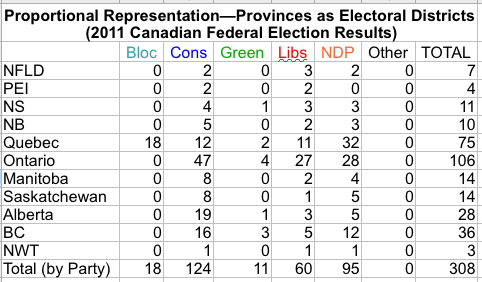
What if, on the other hand, Canada had a proportional representation system in which each province was its own electoral district and seats for the House of Commons were apportioned on the basis of the relative proportion of votes won by each party in each province? What would the results look like? With the help of my students, we were able to calculate the hypothesized makeup of the House of Commons were Canada to have such an electoral system.

Notice that the total number of MPs for the Conservative Party has dropped considerably such that the party no longer has a majority in the House of Commons. In fact, no single party has a majority! In order to form a relatively stable government, the Conservatives would have to find willing coalition partners. Unfortunately for them, however, other than the BQ, there is no immediately suitable coalition partner, given the respective ideological stances of the parties in parliament. Even with the BQ, the Conservatives could not get a governing majority, coming up 15 seats short. An NDP/Liberal?Green coalition, on the other hand, would work both ideologically and in terms of numbers (166 seats, exactly the same number as the Conservatives have today).

Note also how much a proportional representation system would help the Green Party–from only 1 seat in the House to 11 seats!

Which system would you prefer? Do you think that we should maintain the status quo? Should we change to PR? What are some of the advantages and disadvantages of each?

2012–The year for Democracy?

Here’s an example of a good post for the POLI 1100 blog assignment for this week. This took about 20-25 minutes to complete.

As noted in Chapter 2 of the Dyck textbook, the number of democracies worldwide has risen dramatically over the last couple of decades, to the point that currently a majority of the world’s population lives in more-or-less democratic states. More-or-less since democracies vary in character from one to the next. Some democracies fully respect human rights, whereas others are less stringent in this regard.

In a recent article in Foreign Policy magazine, Christian Caryl claims that “2012 could be a great year for democracy.” In all, almost 1/3 of the world’s countries will be heading to the polls this year to elect leaders at the national, regional, and local levels.* As for whether this is a sign of deepening democratization, Caryl is more equivocal:

That may be true. But it hardly means that the triumph of democracy is ensured. If history has taught us anything, it is that nothing in human affairs is inevitable. Most people undoubtedly yearn for freedom. In our imperfect world, however, the political choices actually facing most citizens are messy, risky, or morally fraught. There is no straight line to an open society.

Egypt is illustrative. What happens there, in the largest Arab country, is likely to have broad repercussions for the other countries of the Middle East. Yet Egyptians face many obstacles as they strive to assert their political rights. The military stubbornly refuses to yield power. The weakness of the economy, if allowed to continue, could easily sow doubt about the desirability of representative government. Then there is the possibility of sectarian or factional conflict. Already the two Islamist parties that have emerged victorious from the country’s first post-Mubarak parliamentary elections have begun feuding among themselves. And that’s not even to mention the lingering disquiet among Egypt’s large Christian population after last year’s pogroms.

Elections are a vital prerequisite of democracy. Yet, as many examples this year will remind us, elections alone do not a democracy make.

I think that the bolded part  above (my emphasis) is the key part of the story here. We can think about this in terms of necessary and sufficient conditions. While having elections is necessary for a political system to be considered a democracy, elections are not sufficient for democracy. Other institutions, such as a free press, respect for human and civil rights, the freedom of assembly, etc., are needed as well.

For a list of countries that will be holding elections this year, this page is maintained by the Consortium for Elections and Political Process Strengthening. We see that Finland will be the first to have elections this year–Sunday, January 22–with the first round of Presidential elections. (is Sami Salo running?)

Here is an interview with Croatia’s new Foreign Affairs Minister, Vesna Pusic, with EUObserver.com about the upcoming referendum in Croatia on whether to join the European Union. (In the interview, which was held in early December 2011, Minister Pusic speculates that the referendum would take place in February 2012. In fact, the elections will be held this Sunday, 22 January 2012.

*N.B.: Just as an aside. Is it really striking (statistically, that is) that in any given year 1/3 of the world’s countries will have citizens go to election polls to elect representatives?

ICG claims Ivory Coast on verge of another civil war

In a new report, the International Crisis Group (ICG) claims that the Ivory Coast is on the verge of another civil war. The ICG places the blame for the precarious political situation in that west African country squarely on the shoulders of Laurent Gbagbo, who refuses to acknowledge defeat in the most recent president election. For the executive summary, click here, where you can also find a link to the full report, which is only available in French currently.

Côte d’Ivoire is on the verge of a new civil war between the army loyal to the defiant Laurent Gbagbo, who refuses to acknowledge he lost the November 2010 presidential election, and the “Forces nouvelles” (FN), the ex-insurgency now supporting the winner, Alassane Ouattara. The vote should have ended eight years of crisis, but Gbagbo, staged a constitutional coup and resorted to violence to keep power. The result is a serious threat to peace, security and stability in all West Africa. The African community should not be influenced by the support that Gbagbo enjoys from a part of the population that has been frightened by the ultra-nationalist propaganda and threats of chaos of a militant minority. It must act decisively, not least to defend the principle of democratic elections, but key countries show signs of dangerous disunity. Any proposal to endorse Gbagbo’s presidency, even temporarily, would be a mistake. His departure is needed to halt a return to war.

The November election was intended as the culmination of a painstaking peace process that began after the September 2002 rebellion and was endorsed by many agreements, the latest being the Ouagadougou Political Agreement (OPA) of March 2007. Gbagbo, like all other candidates, took part in the election on the basis of a series of compromises reached on all aspects of organisation and security.

There is no doubt Ouattara won the run-off.


Kurdish Nationalism

What are the prospects for an independent Kurdish state to form out of the wreckage of Iraq? How likely is it that Kurds who live in 5 separate states will set aside their differences long enough to coalesce around the common goal of creating a state for the Kurdish people? As we now know, the Kurdish territory in northern Iraq has enjoyed a high degree of autonomy since the establishment by Great Britain, France, and the United States of the “no-fly zones” in the aftermath of the 1991 Gulf War. (Interestingly, the no-fly zones were established by these three states for putatively humanitarian purposes and had not received official sanction by the United Nations Security Council. For more, click here.)

Following the war-induced collapse of Saddam Hussein’s Ba’athist regime in 2003, the Kurds of Iraq have enjoyed de facto independence in northern Iraq, with a temporary “capital” at Irbil (though the Kurds wish to reclaim the city of Kirkuk, located in the middle of an oil-rich region, as the capital of any independent state in northern Iraq). In IS 309, we read Michael Ignatieff’s chapter on Kurdistan, from his 1993 book, Blood and Belonging, which provides a snap-shot of the situation of the Iraqi Kurds some two years following the establishment of the no-fly zones. Ignatieff addresses the potential for greater autonomy of the Iraqi Kurdish region from the Iraqi state/regime of Hussein and finds skepticism on the part of most Kurds. Fast-forward almost twenty years (has it been that long!!) and we find the situation on the ground has changed substantially. The difficulties, though, seem to remain and the prospects for Kurdish independence are no less clear today than they were some twenty years ago, particularly given the Turkish state’s response to Kurdish separatist sentiment on the territory of eastern Turkey. Here are a couple of interesting short documentaries on the current state of the Kurdish independence movement in Iraq and Turkey.

http://www.youtube.com/watch?v=fdThYj-2G7M

Here’s a video on the Kurdish situation in Turkey.

The Political Economy of Revolution–Egypt

In our last session of IS 210 we looked at the topic, political economy. O’Neil defines political economy as “the study of the role of economic processes in shaping society and history.” The recent overthrow of the Mubarak regime in Egypt is a good case study with which to highlight some of the links between political revolution and political economy. Anybody who has taken a political economy course in political science at the graduate level in the last 15 years or so has almost certainly read Stephen Haggard and Robert R. Kaufman’s influential work, The Political Economy of Democratic Transitions. The authors attempt to answer a series of inter-related questions related to the politics/economics nexus as it appeared to them in the early 1990s:

“What role have economic crises played in the near-global wave of political liberalization and democratization? Can new democracies manage the daunting political challenges posed by economic crises and reform efforts? Under what economic and institutional conditions is democracy most likely to be consolidated?”

Haggard and Kaufman ultimately eschew both liberal theories of modernization and (neo)-Marxist theories of dependency and turn to a rational choice framework that focuses on the strategic actions of political elites–especially presidents and military leaders–under conditions of economic and institutional constraint. In addition, the authors make a few key assumptions, one of which I will highlight here: “…the 0pportunities for political elites to mobilize political support or opposition will depend on how economic policy and performance affect the income of different social groups.” (6) The empirical evidence draws from countries such as Uruguay, Brazil, Argentina, Philippines, Peru, and Bolivia. There argument certainly has relevance for the situation in Egypt today and for the potential for the Egyptian polity to make a successful transition toward consolidated democracy.

Jake Caldwell, Director of Policy for Agriculture, Trade, and Energy at American Progress, and coauthor of The Coming Food Crisis, has written recently about the daunting economic challenges facing any new government with respect to food security. In the midst of rapidly increasing global commodity prices–especially foodstuffs–the government must find a way to continue to feed its people, many of whom live on less than $2/day in income. Caldwell writes:

“Egypt has spent $4 billion a year, or 1.8% of GDP, on its bread subsidization program in an attempt to insulate the 40% of Egyptians living on less than $2 a day from inflation. But prices continue to rise…

…Egypt faces daunting challenges as it prepares for broad presidential and parliamentary elections within a year. Ongoing volatility in global food prices will strain resources during this critical transitional period.

As the world’s largest importer of wheat, Egypt is acutely vulnerable to any surge in food prices. Wheat prices have risen 47 percent over the last year and other staples are rapidly approaching dangerously high levels.

Food price inflation and volatility strike hard at the household budgets of average Egyptian families. Many of them spend 40 percent of their monthly income on food. As prices rise, purchasing power is eroded, and the recovery of Egypt’s fragile economy during the transition is slowed.”

How much time will the new Egyptian government have to provide food security for the Egyptian people before the polity’s patience with democracy is compromised? Or is the public yearning for democracy and liberty so strong that economic crisis will have little effect on democratization in Egypt going forward?

Ethnic Violence in Guyana–Economic Hardship and Ranking of Groups

Here is the video we watched yesterday in IS 309. The video reported on inter-ethnic violence (between those of east Indian heritage and Creoles/Africans/Blacks) that was occurring in the northern South American country of Guyana in 2004. I used the video to highlight some of the themes Horowitz explores in chapters 3 and 4 of Ethnic Groups in Conflict. What are some of the issues that you noticed when watching the video? For a good analytical study on inter-ethnic violence in Guyana from 1948-1999, see this article in the Journal of Peace Research. I provide the abstract for you below:

Coercive and elitist approaches to political control in post-colonial states like Guyana have often proved counterproductive with respect to resolving ethno-political conflicts in these parts. In Guyana, this contradiction is usually manifested in terms of the escalation of legitimate political competition into overtly violent ethno-political violence and polarization, and reinforced by the consequent devaluation of the more democratic or pacific alternatives to conflict resolution such as mass or grass-roots participation, intergroup negotiations, and third-party mediation. Recurring debates between Cultural Pluralists and Marxists on this issue have so far failed to shed light on the prospects for the more pacific approaches to conflict resolution. Closer analytic scrutiny of actual ethno-political conflict events in Guyana between 1948 and 1999 leads to the understanding that such conflicts derive largely from what is termed a continual crisis of political legitimacy reflected in the inequities of political representation and economic resource distribution across groups. The more democratic or pacific approaches are here suggested as most appropriate for the resolution of the political legitimation crisis and the ultimate realization of a sustainable peace among the diverse groups in the Guyana political system.

Rwandan Journalists Jailed for Stirring up Ethnic Tensions

Last week in IS 302, we addressed the issue of how governments should approach the existence of ethnic division in a post-conflict setting. We saw that Rwanda and Burundi have chosen different approaches. Burundi’s leaders have decided to address ethnic grievances via assuring ethnic balance in important institutions such as the military. Rwanda’s government has chosen a different approach, endeavouring to make the society as ethnicity-blind as possible. As such, there has been a zero-tolerance policy with respect to any demonstration or acknowledgement of ethnic particularism. As a recent Amnesty International report states unequivocally:

Rwanda’s laws banning “genocide ideology” and “sectarianism” are vague and sweeping, and have been used to silence legitimate dissent. The laws were designed to encourage unity and restrict speech that could lead to hatred. However, they have had dangerous and chilling effect on Rwandan society.”

The most recent example of this “dangerous and chilling effect on Rwandan society” is news of the conviction of two Rwandan journalists of having “stirred up ethnic divisions.” As this BBC article makes clear, it seems highly likely that President Paul Kagame has been using the role of “hate media” during the Rwandan genocide to silence legitimate opposition:

Editor Agnes Nkusi was sentenced to 17 years, while reporter Saidath Mukakibibi was imprisoned for seven. Among several articles, the judge referred to one saying some Rwandans were unhappy with the country’s rulers. Prosecutors said this was “meant to stir [up] hatred and fury against the government”.

President Paul Kagame came to power in 1994, ending the genocide in which some 800,000 ethnic Tutsis and moderate Hutus were slaughtered. He has recently been accused of intolerance and harassing anyone who criticises him. His government defends its tough media laws, pointing to the role of “hate media” ahead of the genocide.

The newspaper was suspended for six months last year, just ahead of elections which saw Mr Kagame re-elected by a landslide. Nkusi was found guilty of disrupting state freedom, propagating ethnic division, genocide revisionism and libel.

Theories of Ethnic Identity Formation and Ethnic Violence & Ivory Coast

In IS 309 this evening, we assessed the strengths and weaknesses of three competing theories of ethnic identity (and ethnic violence)–constructivism, primordialism, and instrumentalism. We read the following:

  • Fearon, James D. and David D. Laitin. 2000. Review: Violence and the Social Construction of
    Ethnic Identity,” International Organization, 54:4, pp. 845-877
  • Harvey, Frank P. 2000. Primordialism, Evolutionary Theory and Ethnic Violence in the Balkans:
    Opportunities and Constraints for Theory and Policy,” Canadian Journal of Political Science, 33:1,
    pp. 37-65
  • Collett, Moya. 2006. Ivoirian identity constructions: ethnicity and nationalism in the prelude to
    civil war,” Nations and Nationalism, 12(4), 613-629
  • Kaplan, Robert. D. 1993. Balkan Ghosts: A Journey through history Part I and One Chapter from each of Parts II, III, and IV.
  • Hechter, Michael. 1995. Explaining Nationalist Violence,” Nations and Nationalism, Vol 1(1), 53-68.
  • We then viewed a video on the breakdown of political life in the Ivory Coast and the descent of that once relatively prosperous west African state into civil war. The civil war was characterised as a battle between the “Muslim-populated north and the Christian-dominated south.” How accurate is this characterisation of the ethnic character of Cote D’Ivoire’s civil war?

    http://www.youtube.com/watch?v=UOjgiPMs7nc

    For information about the current political situation, in the wake of the refusal of former(?) President Laurent Gbagbo to acknowledge having lost power in elections held several weeks ago, watch these.

    Design a site like this with WordPress.com
    Get started