Political Psychology–How the gut, head, and heart decide our political views

David Moscrop of Maclean’s magazine, has been writing a series of articles on the psychology of politics. Why do we have the political opinions that we do? The answer, as you now know, is a combination of environmental, demographic, and personal characteristics. More and more, political scientists and psychologists have been researching the importance of psychology as a factor that influences political beliefs and behaviours.

moscrop-graphic

At the beginning of his article, Moscrop reveals the inspiration behind the series:

But the truth is that your gut is as much a source of your political decisions as your rational brain, and much of the time your gut—emotions, feelings, intuition—does its work outside of your awareness.

Yep. The faces of the candidates, the pitch of their voices, their gender and ethnicity and height; whether or not you believe in God, whether or not you’re hungry, whether you’re a lawyer or dock worker or school teacher; the effects of political advertising, the effects of issue framing or priming, the effects of your peer group; your partisanship, your family, your fears.

Here we see an image taken from the article, that demonstrates the various parts of our bodies that are involved in the making of political decisions.

Political Ideology and Political Parties

The Conservative Party of Canada website in the weeks leading up to the 2015 federal election.

Today, we continue to look at Canada’s glorious Prime Minister, Stephen Harper. Besides being the current PM of Canada, Stephen Harper is also an honourable MP (member of parliament–we Canadians are forever grateful to the glorious denizens of Calgary Southwest*) and the leader of the federal Conservative Party.

On the short quiz that I gave on Tuesday, you were asked to write three words or phrases that are usually associated with conservatism, as a political ideology. Did any of you use the word “protect?”

Below you’ll find some screenshots of the scrolling images on the home page of the Conservative Party website. You’ll notice that the political campaign operatives have decided to portray PM Harper is our daddy, whose job it is to protect us in a dangerous world. Protect our jobs (presumably from being snatched away by foreigners); protect our children; protecting our economy, and protecting us from terrorists and others who would do us harm. Will it work?

“Fear makes man unwise in the three great departments of human conduct: his dealings with nature, his dealings with other men, and his dealings with himself. Until you have admitted your own fears to yourself, and have guarded yourself by a difficult effort of will against their myth-making power, you cannot hope to think truly about many matters of great importance … .”

—Bertrand Russell (“Outline of Intellectual Rubbish” in Unpopular Essays 1950)

*Calgary Southwest is no longer a federal constituency. It has been dissolved into Calgary Heritage and Calgary Midnapore.

Should Canada have Mandatory Voting?

When political scientists engage in studies of political phenomena there are many approaches that they may take. One oft-used approach is the so-called most similar systems design. This approach tries to “control for concomitant variation.” What does that mean? In social research it is difficult to clear cause-and-effect relationships because phenomena are complex and multi-faceted. Thus, if we wanted to determine why, for example, Canada is a relatively enduring and stable democracy, and Azerbaijan is not, one potential reason could be the relatively different histories of the two countries–Canada is a former British colony, while Azerbaijan was a former republic in the Soviet Union (which was a communist state).

Figure_3_3

Could this be the reason? Possibly. But, there are so many other differences between Canada and Azerbaijan that could also be the cause of the divergent outcomes regarding present political regime. Which one of these myriad differences, then, is the true cause of the difference between Canada and Azerbaijan regarding the level of democracy in each? (Indeed, the answer may not be mono-causal, but more complex and multi-causal.)

https://www.youtube.com/watch?v=m0UCc-fvRgQ

This is why many comparativists use the most similar systems design. By selecting units (countries) that are as similar as possible, they can control for many other potential causes for the alleged divergence in outcomes across the political phenomenon of interest.

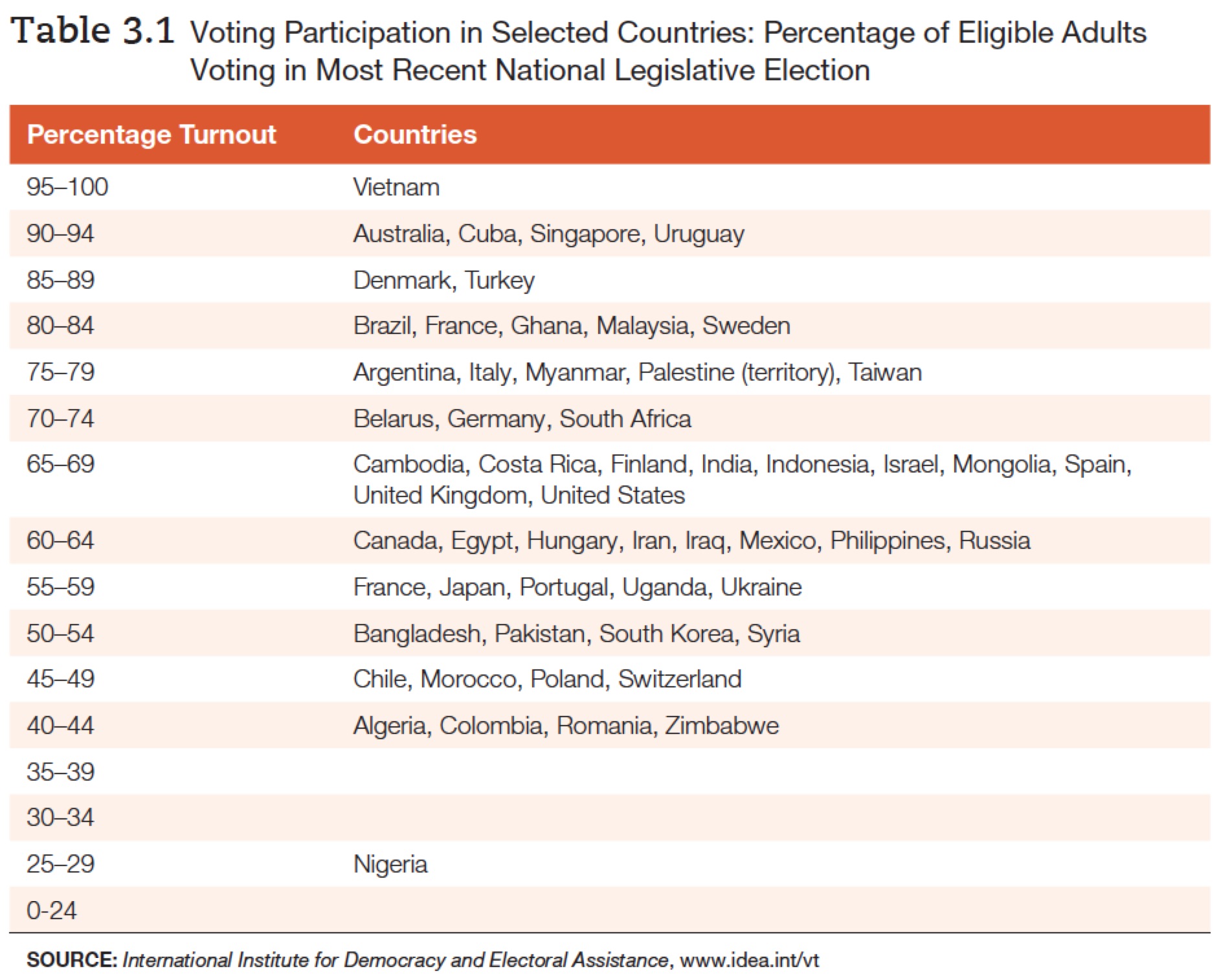
So, let’s look at Canada and Australia–two countries that are quite similar in many respects: former British colonies, large land masses with relatively small populations, multi-cultural, constitutional monarchies, parliamentary democracies, economies reliant on natural resources, neither of which has won FIFA’s World Cup (men or women), etc. The two countries, differ, however, in levels of voting participation. Whereas barely 60% of eligible Canadians vote in federal elections, the corresponding figure for Australia is well over 90%. Do Aussies simply value political participation more than Canadians? Hardly! Australia has a mandatory voting law, which penalizes (monetarily) those who do not vote.

Should Canada enact a mandatory voting law? What do you think? Is it anti-democratic to force citizens to participate in the democratic process?

US Midterm Election Results and Climate Change

Election results in the United States are mostly final and the Republican Party has had a big night, capturing control of the US Senate, which combined with a Republican-controlled House of Representative means that President Barack Obama will face a united (in party name, at least) Republican Congress upon the opening of the new Congressional session–the 114th–which meets for the first time in early January of next year.

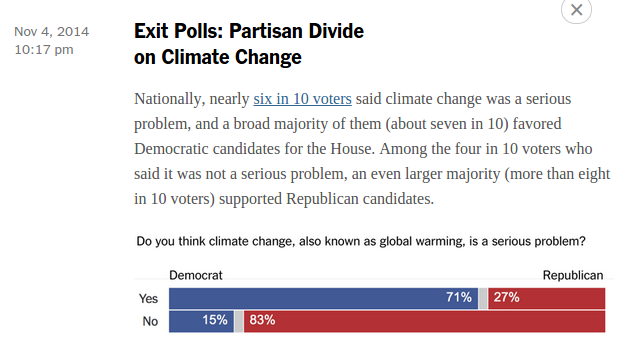
The New York Times has a handy graphic, summarizing the disconcerting results (from the perspective of climate change politics) of exit polls earlier today. This seems to be disheartening news to those who wish to see the United States government become more proactive in the are of climate politics and climate change. As you can see, while six in 10 voters said that climate change is a problem, fully 83\% of the partisans of the majority party in Congress believe the same.

us_midterm_elections_exit_polls_climatechange

Domestic Politics and Climate Change

Last week we discussed the role of domestic politics–institutions, electoral systems, partisanship, etc.,–on national political leaders’ attitudes towards and policies on climate change. We noted that the Canadian federal governments stance toward mitigation and adaptation changed dramatically upon the ascension of the Conservatives to power in 2006 (a minority government). The majority government that Harper was able to win in 2011 signalled the death knell for Canada’s involvement in the Kyoto process as Harper’s government reneged on Canada’s obligations quickly thereafter.

The United States, meanwhile, enters the final week of the biennial “midterm elections”, with most candidates (and the public) focused on issues other than climate change. When climate change is mentioned, however, the candidates responses are not reassuring. Have a look at this video for an impressive compilation of candidates’ responses to whether they believe in the existence of anthropogenic climate change. Incidentally, for a comprehensive debunking of Representative Steve Pearce’s claim that 31,000 scientists signed a petition claiming that there was no global warming, click here.

New Report Claims that British Columbia Has Geo-hermal Energy

The useful DesmogCanada blog has an informative new post up, describing the results of a new report issued by the Canadian Geothermal Energy Association, which claims that there is enough untapped geothermal energy in British Columbia to power the whole province. Although there are some drawbacks to using geothermal power as a dominant energy source, there are many advantages, the most important of which (from an environmental perspective) is that geothermal energy is virtually carbon-free! (For a short demonstration of how geothermal energy is produced and transported, see the video clip below.} From DesmogCanada:

Geothermal power plants provide a firm source of base load power, similar to a hydro dam. Dr. Stephen Grasby, a geochemist with Natural Resources Canada, says the environmental footprint of geothermal energy is smaller than other renewable energy sources, such as wind and hydro.
“For instance, the surface area required to have developments like a wind farm, that takes a large surface area and has other associated issues with things like bird kill,” he said. Geothermal energy requires only a well and a heat exchange system.
“Drilling is relatively low impact,” he said, adding with a laugh, “worst case scenario is you accidentally discover oil or something.”
According to the CanGEA report, BC has “enormous potential to produce geothermal power,” which makes it shameful that Canada is “currently the only major country located along the Pacific Rim’s Ring of Fire not producing geothermal energy”. Why is this? There are many factors, but the political power of oil and gas interests is certainly an important impediment to constructing a carbon-free, environmentally-sustainable source of energy for our province.

Proportional Represenation versus Plurality

In IS210 we will discuss the relative merits of the two most frequently instituted electoral systems–proportional representation and plurality (also called majority or “first-past-the-post” electoral systems.

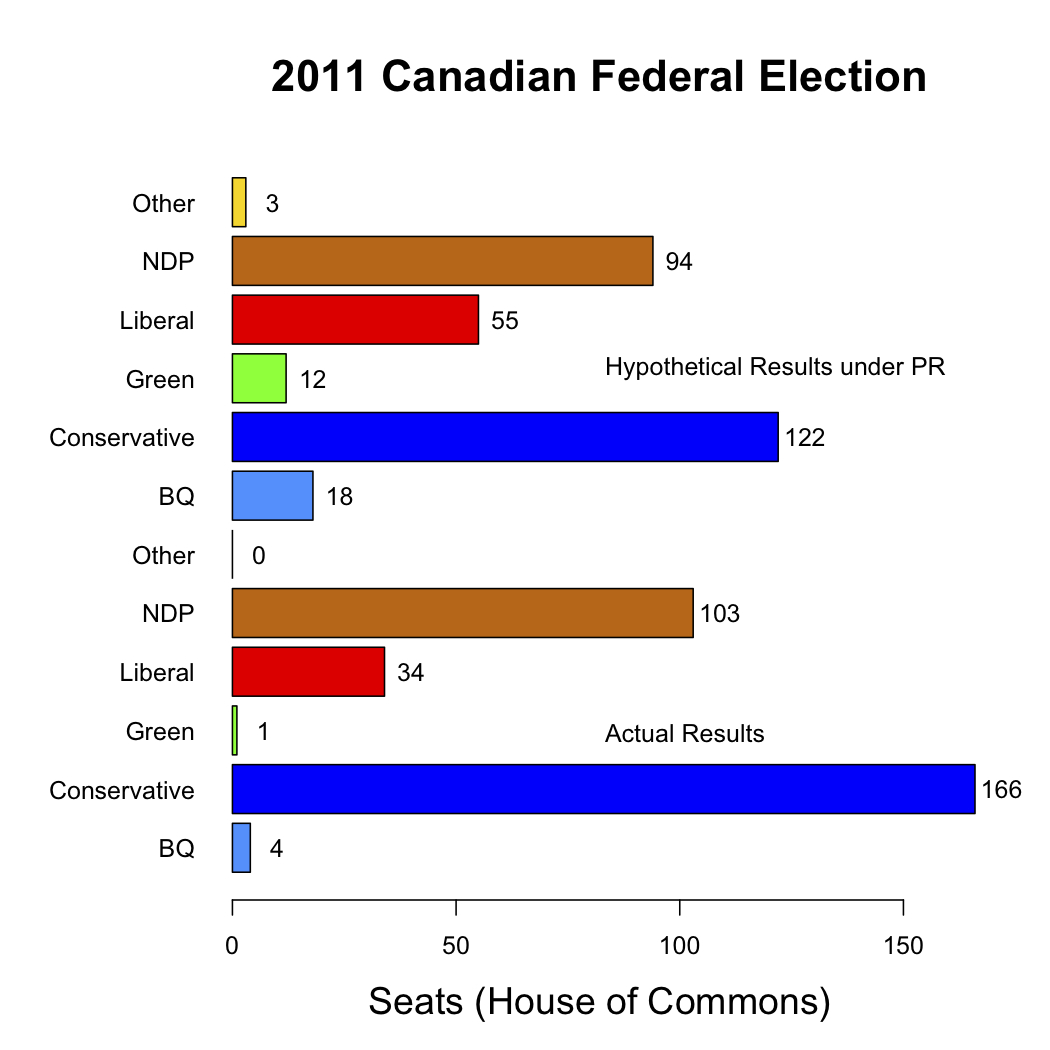
In advance, here is a chart that I’ve created, which shows the electoral results (in terms of number of seats won in the House of Commons) of the 2011 Canadian Federal election. The bottom of the chart contains the actual number of seats won, while the top lists the hypothetical number of seats each party would have won if Canada’s electoral system were one of proportional representation. So, Canada’s electoral system is working as it should, correct?

canada_2011_election_PR

Political Regimes

Those of you in my IS210 class may find the Polity IV data to be of use when writing your paper. Click on the image below to take you to the website, where (if you scroll down to the bottom) you can see the regime scores (between -10 and +10) for each country over many years. See the example at the bottom of this post.

Political Regime Types–Polity IV Dataset

Here’s an exampe of the history of movements in regime for El Salvador from 1946 until 2010. How many changes in regime does El Salvador seem to have experienced in the post-WWII period? What happened in the early 1980s?


Polity IV Score in El Salvador

Electoral Systems

Here’s an interesting post by a student on the effect of different electoral systems on the strategic calculations of voters. Would Canadian voters vote differently if our electoral system were PR? The evidence suggests that for a substantial minority, the answer is yes.

Here’s an example: in many (most) ridings, there is no chance that a member of the Green Party would be elected to parliament. Thus, rather than voting for the Green Party, many voters in these ridings who would prefer to vote Green, vote their 2nd preference, meaning that the Liberal Party and the NDP receive more votes during our elections than they otherwise would under a PR system. (Very few voters whose favoured party is the Green Party have the Conservative Party as their 2nd preference). Check out the post…

Electoral Systems.

More on Representation and Electoral Systems

Prompted by a comment on a previous post regarding how voter representation would be different if Canada had a proportional representation system, I decided to do some reading on the Fair Vote website and stumbled upon some interesting facts. The first is an illuminating quote regarding the difference between decision-making (rule) and representation by somebody named Ernest Haville:

 “In a democratic government, the right of decision belongs to the majority, but the right of representation belongs to all.”

As we noted in class earlier today, many of the votes cast in our elections are wasted as a result of our first-past-the-post system. Below is a screenshot from the website wastedvotes.ca, which shows that in the 2008 federal election in Gatineau, QC, fully 70% of the voters were not represented. This is because the Bloc Quebecois candidate, Richard Nadeau, won a tight four-way battle, garnering a plurality of the vote at 29.2%.

This is just the most egregious example of wasted votes (and, thereby, of non-representation), but every Canadian election and electoral district sees wasted votes. Indeed, the folks at wastedvote.ca have calculated that of the more than 14 million votes cast during Canada’s last federal election (2011) only slightly more than half (50.4%) were effective, while 49.6% were wasted.

Why is this bad for democracy? Well, here is another excerpt from fairvote.ca:

Does Canada actually have representative democracy? In the 2008 federal election:

  • 940,000 voters supporting the Green Party elected no one, while fewer Conservative voters in Alberta alone elected 27 Conservative MPs.
  • In the prairie provinces, Conservatives received roughly twice the votes of the Liberals and NDP combined, but took seven times as many seats.
  • Similar to the last election, a quarter-million Conservative voters in Toronto elected no one and neither did Conservative voters in Montreal.
  • New Democrats: The NDP attracted 1.1 million more votes than the Bloc, but the voting system gave the Bloc 49 seats, the NDP 37.

What about majority rule? Canadians are usually ruled by majority governments that the majority voted against. In some provincial elections, parties coming in second in the popular vote have won majority control of the legislature.

In class, we noted the irony of the part above that is in bold font! The 1988 federal election was fought primarily on the basis of a pending free trade agreement amongst Canada, the United States, and Mexico. In Canada, the Progressive Conservatives (led by Prime Minister Brian Mulroney) were in favour of (what would become) NAFTA, while the NDP and the Liberal Party were against. In the end, a majority of Canadians voted for parties that were against NAFTA, yet the PCs won a majority of seats in parliament, enabling them to push through the necessary legislation.

Design a site like this with WordPress.com
Get started