Digital Media and Political Unrest

Via the Oxford University Press blog (what a great idea!), Philip Howard assesses the link between digital (specifically, social) media and political unrest in the Middle East and north Africa. Although he cautions against running afoul of the common “correlation is not causation” fallacy, Howard does make an illuminating point about the impact of social media and civil society on the potential for a country to experience political unrest:

Digitally enabled protesters in Tunisia and Egypt tossed out their dictator. The protests in Libya have posed the first serious challenge to Gaddafi’s rule in decades and the crisis in that country is not over. Several regimes have had to dismiss their cabinets and offer major concessions to their citizens. Discontent has cascaded over transnational networks of family and friends to Algeria, Bahrain, Jordan, Lebanon, Saudi Arabia, and Yemen. Ben Ali ruled Tunisia for 20 years, Mubarak reigned in Egypt for 30 years, and Gaddafi has held Libya in a tight grip for 40 years. Yet their bravest challengers are 20- and 30-year-olds without ideological baggage, violent intentions or clear leaders.

The answer, for the most part, is online. And it is not just that digital media provided new tools for organizing protest and inspiring stories of success from Tunisia and Egypt. The important structural change in Mideast political life is not so much about digital ties between the West and the Arab street, but about connections between Arab streets.

But a reasonable foreign policy question remains. If digital media changes the political game in countries run by tough dictators, who will fall next?

Here’s a handy chart that gives us an indication of the answer to that question:

Regime Change, Freedom, Democracy, and Islam

In our IS210 class, we’ve been assessing nondemocratic regimes. I had my students read an article by M. Steven Fish, published in World Politics in 2002, titled “Islam and Authoritarianism.” In it, the author notes the striking empirical finding that a majority of Arab Muslim countries had nondemocratic regimes, even after controlling for potentially confounding factors such as oil wealth, level of political violence, poverty, etc. Fish asks what it is about Islam that is linked to authoritarianism. Or, to put it another way, he searches for the causal mechanism lining Islam and regime type. He tentatively finds it in the status of women in contemporary Muslim societies.


Nothing could be less heartening to democratic idealists than the notion that a particular religion is inimical to democracy. Religious traditions are usually constants within societies; they are variables only
across societies. Societies usually are “stuck” with their religious traditions and the social and psychological orientations they encode and reproduce. Yet religious practices and the salience of particular beliefs can change. Even if Muslim countries are more male dominated in some respects than non-Muslim countries, there is no logical reason why such a state of affairs must be immutable. Rigid segregation according to sex and male domination does not have a firm scriptural basis. The Koran provides no justification whatsoever for practices such as female genital mutilation and it condemns all infanticide as a heinous sin, even if it is motivated by a fear of want (17:31; 81:1–14). Much of the Koran’s instruction on marriage, divorce, and other aspects of relations between the sexes (for example, 2:222–41; 4:3; 4:128; 33:1–5; 58:1–4) is more liberal than the sharia (religious law) as practiced in some modern-day Muslim societies. It is therefore as dubious to try to locate the sources of social practice and order in scripture in Islamic settings as it is to try to locate them there in Christian and Jewish settings, because as with all holy injunction based on sacred text, interpretive traditions are powerful and ultimately determine practice. The status of women in Muslim societies is thus both paradoxical and mutable.

At the present time, however, the evidence shows that Muslim countries are markedly more authoritarian than non-Muslim societies, even when one controls for other potentially influential factors; and the station of women, more than other factors that predominate in Western thinking about religious systems and politics, links Islam and the democratic deficit.

What do the recent upheavals in the Muslim-majority states of north Africa and the Middle East portend not only for democracy but for the status of women in these societies. CBC Radio’s “the Current” program set out to try to answer that question in a show dedicated to “women and political upheaval.” Here’s a description of the women interviewed on that evening’s show:

We started this segment with a clip from Mona Seif. She was heavily involved in the protests that brought down former Egyptian President Hosni Mubarak. And in the days leading up to his resignation, she told us she really believed the revolt would lead to a significant improvement in the lives of Egyptian women.

But since then, there have been reports that the situation for Egyptian women has regressed to the way it used to be. So we checked in again with Mona Seif. She’s still in Tahrir Square. But she’s feeling a little less optimistic.

Women have often played leading roles in pushing for change in the Arab and Muslim worlds. But when the dust settles, the gains they think they have made are often elusive. For their thoughts on why that is and whether things may be different this time … we were joined by three women who have spent decades trying to improve the position of women in their societies.

Before the Iranian revolution, Mahnaz Afkhami was Iran’s Minister for Women’s Affairs. She’s now the Founder and President of the Women’s Learning Partnership. She was in Washington, D.C.

Asma Khader is a former Jordanian minister of culture. She’s now the Secretary General of the Jordanian National Commission for Women. She was in Amman, Jordan.

And Leila Ahmed is an Egyptian-born professor at Harvard University’s Divinity School. Her research focuses on women in Islam. And her book, The Quiet Revolution: The Veil’s Resurgence From the Middle East to America will be published next month. She was in Cambridge, Massachusetts.

Gender and violence during and after India/Pakistan Partition 1947

In a recent post, I made reference to a fascinating and very informative BBC documentary that deals with the final days of British rule on the Indian subcontinent and the eventual partition of that territory in 1947 into a Muslim-dominated Pakistan (east and west) and a Hindu-dominated India.  In part four of the documentary an elderly Sikh gentleman from the Punjab region tells the harrowing tale of how his female relatives were the victims of brutal violence. Many scholars have argued that the ethnicization of the violence that accompanied the Partition obscure the fact that women bore the brunt of the violence.  In a recent paper, Richard Lee writes about the gendered nature of the violence:

Women were arguably the worst victims of the Partition of India in 1947 and endured displacement, violence, abduction, prostitution, mutilation, and rape. However, on reading histories of the division of India, one finds that the life-stories of women are often elided, and that there is an unwillingness to address the atrocities of 1947. This reticence results partly from the desires of the Indian and Pakistani governments to portray the events as freak occurrences with no place in their modern nations. Literature can play an important role in interrupting state-managed histories, and ‘The Rebirth of Inherited Memories’ focuses upon the manner in which Shauna Singh Baldwin’s What the Body Remembers (2001) unsettles official versions of Partition. It examines how the novel acts as a counterpoint to ‘national’ accounts of 1947 through its depiction of the gendered nature of much of the violence, and it explores Baldwin’s representation of the elusive concept of ‘body memory’. The possibility of remembrances being passed on physically, or born within people, has found support in the eschatologies of Eastern religions, in Western psychological theories, and in recent scientific investigations into the ‘mind-body’ problem. The transmission of ‘body memories’ between generations serves to disrupt accounts that downplay the brutalities at the splitting of India. This paper draws upon a chapter of my doctoral thesis that investigates issues of memory and the enduring influence of Partition in South Asia.

http://www.youtube.com/watch?v=ilq9_SLPU5s&feature=related

Kurdish Nationalism

What are the prospects for an independent Kurdish state to form out of the wreckage of Iraq? How likely is it that Kurds who live in 5 separate states will set aside their differences long enough to coalesce around the common goal of creating a state for the Kurdish people? As we now know, the Kurdish territory in northern Iraq has enjoyed a high degree of autonomy since the establishment by Great Britain, France, and the United States of the “no-fly zones” in the aftermath of the 1991 Gulf War. (Interestingly, the no-fly zones were established by these three states for putatively humanitarian purposes and had not received official sanction by the United Nations Security Council. For more, click here.)

Following the war-induced collapse of Saddam Hussein’s Ba’athist regime in 2003, the Kurds of Iraq have enjoyed de facto independence in northern Iraq, with a temporary “capital” at Irbil (though the Kurds wish to reclaim the city of Kirkuk, located in the middle of an oil-rich region, as the capital of any independent state in northern Iraq). In IS 309, we read Michael Ignatieff’s chapter on Kurdistan, from his 1993 book, Blood and Belonging, which provides a snap-shot of the situation of the Iraqi Kurds some two years following the establishment of the no-fly zones. Ignatieff addresses the potential for greater autonomy of the Iraqi Kurdish region from the Iraqi state/regime of Hussein and finds skepticism on the part of most Kurds. Fast-forward almost twenty years (has it been that long!!) and we find the situation on the ground has changed substantially. The difficulties, though, seem to remain and the prospects for Kurdish independence are no less clear today than they were some twenty years ago, particularly given the Turkish state’s response to Kurdish separatist sentiment on the territory of eastern Turkey. Here are a couple of interesting short documentaries on the current state of the Kurdish independence movement in Iraq and Turkey.

http://www.youtube.com/watch?v=fdThYj-2G7M

Here’s a video on the Kurdish situation in Turkey.

The Political Economy of Revolution–Egypt

In our last session of IS 210 we looked at the topic, political economy. O’Neil defines political economy as “the study of the role of economic processes in shaping society and history.” The recent overthrow of the Mubarak regime in Egypt is a good case study with which to highlight some of the links between political revolution and political economy. Anybody who has taken a political economy course in political science at the graduate level in the last 15 years or so has almost certainly read Stephen Haggard and Robert R. Kaufman’s influential work, The Political Economy of Democratic Transitions. The authors attempt to answer a series of inter-related questions related to the politics/economics nexus as it appeared to them in the early 1990s:

“What role have economic crises played in the near-global wave of political liberalization and democratization? Can new democracies manage the daunting political challenges posed by economic crises and reform efforts? Under what economic and institutional conditions is democracy most likely to be consolidated?”

Haggard and Kaufman ultimately eschew both liberal theories of modernization and (neo)-Marxist theories of dependency and turn to a rational choice framework that focuses on the strategic actions of political elites–especially presidents and military leaders–under conditions of economic and institutional constraint. In addition, the authors make a few key assumptions, one of which I will highlight here: “…the 0pportunities for political elites to mobilize political support or opposition will depend on how economic policy and performance affect the income of different social groups.” (6) The empirical evidence draws from countries such as Uruguay, Brazil, Argentina, Philippines, Peru, and Bolivia. There argument certainly has relevance for the situation in Egypt today and for the potential for the Egyptian polity to make a successful transition toward consolidated democracy.
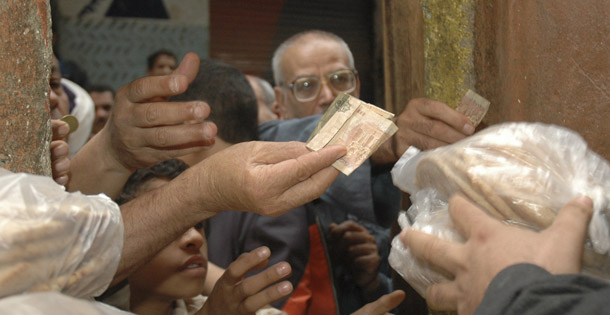
Jake Caldwell, Director of Policy for Agriculture, Trade, and Energy at American Progress, and coauthor of The Coming Food Crisis, has written recently about the daunting economic challenges facing any new government with respect to food security. In the midst of rapidly increasing global commodity prices–especially foodstuffs–the government must find a way to continue to feed its people, many of whom live on less than $2/day in income. Caldwell writes:

“Egypt has spent $4 billion a year, or 1.8% of GDP, on its bread subsidization program in an attempt to insulate the 40% of Egyptians living on less than $2 a day from inflation. But prices continue to rise…

…Egypt faces daunting challenges as it prepares for broad presidential and parliamentary elections within a year. Ongoing volatility in global food prices will strain resources during this critical transitional period.

As the world’s largest importer of wheat, Egypt is acutely vulnerable to any surge in food prices. Wheat prices have risen 47 percent over the last year and other staples are rapidly approaching dangerously high levels.

Food price inflation and volatility strike hard at the household budgets of average Egyptian families. Many of them spend 40 percent of their monthly income on food. As prices rise, purchasing power is eroded, and the recovery of Egypt’s fragile economy during the transition is slowed.”

How much time will the new Egyptian government have to provide food security for the Egyptian people before the polity’s patience with democracy is compromised? Or is the public yearning for democracy and liberty so strong that economic crisis will have little effect on democratization in Egypt going forward?

Social Network Media and Revolution

In the wake of the revolutionary changes that have (hopefully) taken place in Tunisia and Egypt, much has been made about the role of social media–particularly Facebook–in facilitating the participatory aspect of the revolutionary end-game. (A Google search of `Facebook AND Egypt revolution’ turns up over 22 million hits.) The Globe and Mail’s  Chrystia Freeland is the latest journalist to address the phenomenon, quoting economists Daron Acemoglu and Matthew Jackson.

Freeland notes that social network media have helped resolve what social scientists refer to as the collective action problem.

“It is a question of co-ordinating people’s beliefs,” said Daron Acemoglu, a professor of economics at the Massachusetts Institute of Technology, who, with Matthew Jackson of Stanford University in California, is working on a paper about the effect of social networks on collective action problems.

Protesting against an authoritarian regime is a prime example of this issue, Mr. Acemoglu said, because opponents of a dictator need to know that their views are widely shared and that a sufficient number of their fellow citizens are willing to join them to make opposition worthwhile.

“I need to know if other people agree with me and are willing to act,” he said. “What really stops people who are oppressed by a regime from protesting is the fear that they will be part of an unsuccessful protest. When you are living in these regimes, you have to be extremely afraid of what happens if you participate and the regime doesn’t change.”

That makes publicly protesting an oppressive regime a classic collective action problem: If everyone who wants regime change takes to the streets, the group will achieve its shared goal. But if too few protest, they will fail and be punished. Even if an overwhelming majority wants change, it is smart for individuals to speak out only if enough compatriots do, too.

To Freeland’s characterisation of the collective action problem I would add that the reason it is “smart for individuals to speak out only if enough compatriots do, too” is because each individual reasons in the following manner:

  • I am only one person; my individual marginal contribution to the probability of having a successful revolution is infinitesimally small.
  • Thus, my taking part or not will not be determinative. That is, the revolution will succeed or fail regardless with or without my participation.
  • Given the above, and given potential costs of participating, it is rational for me to not participate.

Social media, however, can help to change the calculus of participation by assuring the would-be participant that millions of others will also participate, thereby decreasing the potential costs of participation to any one individual. I do have an issue, however, with Freeland’s use of the Groupon analogy, which is based on the difference between the types of private goods Groupon specialises in and the truly public good that is a revolution.

The Sectarian Division in the Middle East

The revolutions in Tunisia and Egypt have prompted similar uprisings in many other countries of the Middle East and North Africa. Though the vast majority of the populations in each of these countries are Muslim, the societies are far from homogeneous. In addition, to social class and ethnic cleavages, Brian Ulrich–Assistant Professor of Middle East History–notes the Sunni/Shi’a sectarian split within Islam:

The sectarian split between a Shi’ite majority and Sunni monarchy and minority matters, but not in a straightforward way. The country’s rulers have played a game of divide and rule, one which seems to have accelerated over the past few years which have seen an increase in anti-Shi’ite discrimination. Presumably hoping to keep smaller the popular base to which they must dispense patronage while tying that base to them ideologically, the Al Khalifa dynasty has portrayed Shi’ites as potential Iranian catspaws and pointed to Iraq as an example of the negative consequences of Shi’ite democratic empowerment. What you see in the government’s rhetoric is an attempt to cast the Shi’ites themselves as the sectarian ones primarily on the grounds of their Shi’ism, much like the Mubarak and Ben Ali regime claimed to suppress Islamic extremism.

Bahrain has also seen major protests before, with a 1990’s “intifada” almost exclusively Shi’ite demographically. During that period, the key to the uprisings’ longevity was a social base in the winding narrow streets of the Shi’ite neighborhoods in and around Manama that the mostly South Asian police had trouble penetrating.

Here’s the video of an interesting debate on the Shi’a/Sunni division in Islam, with some very interesting guests, including U. of Michigan Professor of Middle Eastern History, Juan Cole, who has a very informative blog on Islam and Middle East politics.

Rwandan Journalists Jailed for Stirring up Ethnic Tensions

Last week in IS 302, we addressed the issue of how governments should approach the existence of ethnic division in a post-conflict setting. We saw that Rwanda and Burundi have chosen different approaches. Burundi’s leaders have decided to address ethnic grievances via assuring ethnic balance in important institutions such as the military. Rwanda’s government has chosen a different approach, endeavouring to make the society as ethnicity-blind as possible. As such, there has been a zero-tolerance policy with respect to any demonstration or acknowledgement of ethnic particularism. As a recent Amnesty International report states unequivocally:

Rwanda’s laws banning “genocide ideology” and “sectarianism” are vague and sweeping, and have been used to silence legitimate dissent. The laws were designed to encourage unity and restrict speech that could lead to hatred. However, they have had dangerous and chilling effect on Rwandan society.”

The most recent example of this “dangerous and chilling effect on Rwandan society” is news of the conviction of two Rwandan journalists of having “stirred up ethnic divisions.” As this BBC article makes clear, it seems highly likely that President Paul Kagame has been using the role of “hate media” during the Rwandan genocide to silence legitimate opposition:

Editor Agnes Nkusi was sentenced to 17 years, while reporter Saidath Mukakibibi was imprisoned for seven. Among several articles, the judge referred to one saying some Rwandans were unhappy with the country’s rulers. Prosecutors said this was “meant to stir [up] hatred and fury against the government”.

President Paul Kagame came to power in 1994, ending the genocide in which some 800,000 ethnic Tutsis and moderate Hutus were slaughtered. He has recently been accused of intolerance and harassing anyone who criticises him. His government defends its tough media laws, pointing to the role of “hate media” ahead of the genocide.

The newspaper was suspended for six months last year, just ahead of elections which saw Mr Kagame re-elected by a landslide. Nkusi was found guilty of disrupting state freedom, propagating ethnic division, genocide revisionism and libel.

Two Opportunities for Summer Study Abroad

Via the polcan listserv (Canadian Political Science Association) comes word about two opportunities for study abroad in the area of (ethnic) conflict. The first is a course offered in Kenya by the University of Toronto. The course, PCS361Y–Special Topics in Peace and Conflict Studies: Conflict in Africa: Causes, Consequences, and Responses–is described as “an intensive inquiry into the causes, consequences, and especially possible to conflict in Africa.” The course will be taught in Nairobi, Masai Mara, and Mombasa from May 13 through June 6. For more information, go here.

The second course will be taught as part of the American University in Kosovo summer program. Here is a description of the program:

American University in Kosovo is now accepting applications for the Summer of 2011 to study Peacebuilding, Post-conflict Transformation, and Development in the fun and safe ‘living laboratory’ of the Balkans. This four-week program offers a wide selection of courses in related areas from an impressive array of global scholars, diplomats, retired military officers, ex-combatants, practitioners, and representatives of international organizations. The goal of the program is to bridge the gap between theory and practice. Last year’s program included about 60 students from over 30 countries — including 6 Canadians. About 2/3 of the students were undergraduates — the remaining graduate students. Undergraduate course credits are transferrable. Several participants from 2010 referred to their experiences in the program as ‘life transforming.’

For more about this program, go here.

Egypt’s Mubarak Seeks Dissolution of Government Amidst Mass Protests

In today’s session of IS 210 we analysed the concept of the state and also talked about the related political concepts of regime and government. We noted that they were conceptually distinct political phenomena with differing levels of institutionalisation–with the state being the most institutionalised, and the government being the least.

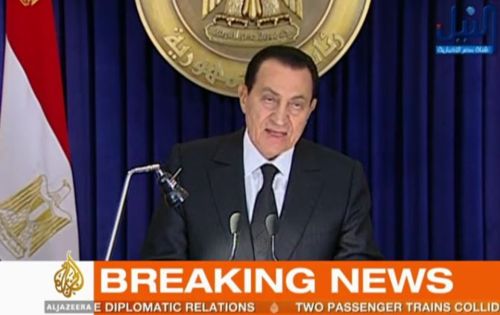
In the midst of continuing mass demonstrations against his rule in Egypt, president Hosni Mubarak has asked the government to resign. Mubarak seemingly hopes that the government’s resignation will appease the demonstrators. What’s interesting from our perspective–as students of comparative government–is that Mubarak hopes to maintain his regime at the expense of the government. It is accurate to call the current leadership of Mubarak a regime, since the norms/rules associated with political authority at the national level have been institutioinalised over the course of the almost three-decade reign by Mubarak as Egypt’s president. The question then becomes will the protesters be satisfied with a change in government alone, or will they insist on a change in the nature of this authoritarian regime, which will obviously not be effected without the removal from office of Mubarak himself. As in the case of many authoritarian regimes, in Egypt it is also true that the autocrat is the regime himself.

Here’s more from the CBC on Mubarak’s latest moves:

Egyptian President Hosni Mubarak says he has asked the government to resign and promised reforms as protests engulf his country.

In a televised speech broadcast early Saturday local time, Mubarak used his first public comments since the unrest began to defend the security crackdown on demonstrations.

“I assure you … I’m working for the people…. as long as you’re respecting the law,” Mubarak said.

“We have to be careful of anything that would allow chaos,” he said.

At the same, Mubarak tried to speak to the demonstrators who have filled Egypt’s streets for days.

“I’ll always be on the side of the poor,” he said. “I am with bettering the economy.”

Mubarak, who has ruled Egypt for three decades, has been facing the biggest pressure of his tenure.

Before the president spoke, tens of thousands of anti-government protesters defied a night curfew and some reportedly set fire to Mubarak’s party headquarters in Cairo. Flames were seen licking at the National Democratic Party headquarters shortly after 6 p.m. local time, though it was not immediately confirmed how the fire began.

The best real-time coverage of the political events in Egypt is, in my opinion, Al-Jazeera. You can watch live streaming coverage of Al-Jazeera here.

Design a site like this with WordPress.com
Get started