Empty Olympic Promises? China as Global Citizen

The New York Times editorial board has chosen to use its valuable op-ed space to evaluate the nature of China’s behavior on the world stage.   The granting of the 2008 Summer Olympic Games to China years ago was meant to serve as a “carrot” in the carrot-and-stick approach being used by sovereign states, like the US, Canada, etc., and IGOs, like the United Nations to nudge China along the road to democratic reform and the protection of personal liberties in that communist state.  Has it worked?  Here’s a data point that rebuts the theory:

Six months out from the 2008 Olympics, China has jailed another inconvenient dissident. Hu Jia was dragged from his home by state police agents, and last week he was formally charged with inciting subversion. To earn the right to host the Games, China promised to improve its human rights record. Instead, it appears determined to silence anyone who dares to tell the truth about its abuses.

Mr. Hu and his wife, Zeng Jinyan, are human rights activists who spent much of 2006 restricted to their apartment. She used the power of the Internet to blog about life under detention while he wrote online about peasant protests and human rights cases.

Mr. Hu’s recent testimony, by telephone, to the European Parliament about Olympics-related rights violations may have been the last straw. Ms. Zeng and the couple’s two-month-old baby remain in their apartment under house arrest, with telephone and Internet connections now severed.

Improving its human rights record isn’t China’s only unmet commitment to the International Olympic Committee. It also promised to improve air quality. Now athletes and their coaches are figuring out how to spend as little time as possible in China’s smog-swamped capital, where they may need masks to breathe.

I’ve written about China before and mentioned the work of an NGO whose goal is to make the Chinese Olympics, the “Genocide Olympics”, highlighting China’s complicity in the genocide in Darfur.  See this post also by one of my students in Intro to IR.

It Just Keeps on Getting Worse: Violence Escalates in Chad

From the BBC, we learn that the situation in the African state of Chad is going downhill quickly. According to the Failed States Index compiled by the Fund For Peace, Chad was the 5th most failed state in 2007. Chad has been affected negatively by the ongoing conflict and genocide in the neighboring state of Sudan.

Thousands of people are fleeing the Chad capital, N’Djamena, after two days of fierce fighting between government and rebel forces in the city.

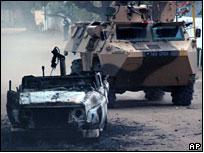
chad.jpgThe government says it has pushed the rebels out of the city but they say they withdrew to give civilians the chance to evacuate. Aid workers report that fighting is continuing outside the city, while dead bodies litter the streets.

The UN Security Council has urged member states to help the government. The BBC’s Laura Trevelyan at the UN in New York says this non-binding statement gives the go-ahead to France and other countries to help President Idriss Deby’s forces against the rebels.

Chad’s former colonial power France has a military base in Chad and has previously helped the government with logistics and intelligence. Thousands of people have been streaming across the Ngueli bridge, which separates Chad from Cameroon.

Local officials have told the UN refugee agency that thousands were also crossing at the border town of Kousseri. “We’re expecting a lot more people coming,” said UNHCR spokesman Ron Redmond. He also said he was extremely concerned for the 240,000 Darfur refugees in Chad.

The International Crisis Group released a report back in 2006 detailing the situation in Chad and fearing a return to war in that country. You can view the executive summary here, where there is a link to the full report (the full report is only in French, however). Here is a snippet from that summary:

The April 2006 rebel offensive brought Chad to the brink of all-out civil war. The victory that President Idriss Déby ultimately achieved in pushing the United Front for Democracy and Change (FUCD) back from the gates of the capital, N’Djamena, to its Darfur sanctuary settled nothing on the military front and underscored the political fragility of the regime. The army’s success was primarily due to French logistical and intelligence support, while the setback paradoxically may encourage the armed opposition groups to forge closer links in order to pursue a war of attrition in the north, the east and along the border with the Central African Republic. The crisis is far from resolved, and is likely to be an enduring one.

Only weeks before the 3 May presidential elections, Déby had to fight off spectacular defections of senior figures from the army and the political elite as well as assassination attempts, all likewise aimed at preventing him from gaining a third term but he won the controversial elections with 64.67 per cent of the vote.[1] Though opposition groups challenged the result, France and the wider international community hastily accepted it to avoid further destabilisation, while declaring that they now expected the president to democratise his regime.

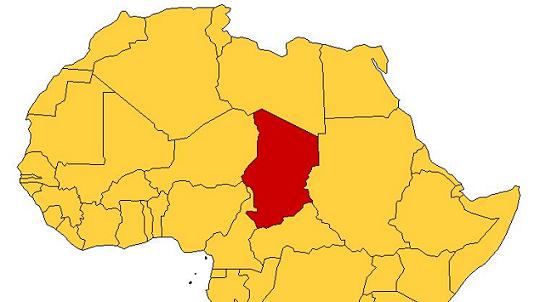
Chad (red on the map) is in north-central Africa and is on the eastern border of Sudan.

chad_map.jpg

Another Foreign Policy List: How to Steal an Election Without Breaking a Sweat

Foreign Policy magazine frequently publishes “lists” that are meant to illuminate, in a sometimes ironic manner, political phenomena that are receiving much discussion.  In a recent issue, the focus turns to elections.   From their introduction:

From Abuja to Islamabad, autocratic regimes have become adept at manipulating “free and fair elections” to stay in power. Here’s how they do it—and how to stop them.

Here is their list, with some real-world examples of each:

  1. Control the processKenya’s constitution invests an enormous amount of power in the executive branch. This allowed President Mwai Kibaki to create a vast system of patronage throughout the government based largely on tribal ties. The head of the Electoral Commission of Kenya, Samuel Kivuitu, has recently admitted that he was pressured by the president’s office to announce results before he could verify their authenticity.
  2. Manipulate the mediaIn the months leading up to the recent presidential election in Georgia, President Mikheil Saakashvili’s government shut down Imedi TV, an opposition-friendly television station founded by one of the president’s rivals and managed by Rupert Murdoch’s News Corporation.
  3. Keep out the observersDuring the 2005 Egyptian parliamentary elections, judges at individual polling stations made seemingly arbitrary decisions about whether to allow outside monitoring. The result? Some stations were monitored and some were not. Monitors were beaten by police in one southern city, and eight were arrested and released elsewhere.
  4. Misreport resultsNadia Diuk, senior director for Europe and Eurasia at the National Endowment for Democracy (NED), relays a tale from Azerbaijan’s 2000 elections: “The light went out in the room where the counting was to take place, and the flashlights of the observers just caught sight of a bundle of ballots sailing through the air to land on the counting table.” [This is my favorite! :)]
  5. Foster incompetence and chaosNigeria’s 2007 national and state elections take the chaos prize. Ballots arrived late to polling stations, if at all, or were printed with missing or incorrect information. Polling places and procedures were changed at the last minute. With security lax, reports were rampant of militants harassing voters and youth gangs breaking into polling places and making off with ballot boxes.
  6. Resort to the crude stuff A favorite tactic in Egypt is to deploy riot police in strategic polling locations to keep out voters for the opposition Muslim Brotherhood—while state employees arrive in buses and are ushered in en masse. In 2005, a bloody showdown in the streets of Alexandria between government-backed thugs wielding machetes and Brotherhood supporters seeking to cast their votes became international news, embarrassing the regime.

Voter Turnout Across the World

O’Neil (in Chapter 6) argues that democracies are institutionalized through the institutions of participation, competition, and liberty.  The most common form of participation in democracies is voting in elections.  Yet, the general sense seems to be that voters are turning out to vote in ever smaller numbers over the years.  Do the data bear that out?

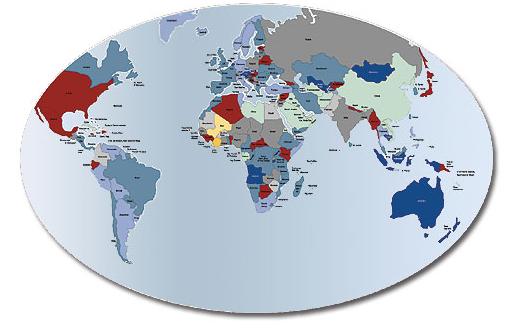
The IGO IDEA–The International Institute for Democracy and Electoral Assistance–has a fantastic website dedicated to, amongst other things, tracking voter turnout levels in elections around the world. Referring to the map below, we see that voter turnout levels differ from country to country. Why might this be the case? This observation could be used as the first step in demonstrating Lave and March’s four-step process of modeling social and political phenomena. Thus, step one (“observe a social fact”) is voter turnout levels are higher in some countries and lower in others. Step two, then, requires us to consider a social process that could have accounted for this variation in outcomes. Can you think of a social process that can account for the findings on the map below?

world_voter_turnout1.jpg

Here are some important findings from IDEA’s report on world voter turnout trends.  For a complete list of data for each respective country, go here.

  • High turnout is not solely the property of established democracies in the West. Of the top 10 countries in the 1990s only three were Western European democracies.
  • Turnout across the globe rose steadily between 1945 and 1990 – increasing from 61% in the 1940s to 68% in the 1980s. But post-1990 the average has dipped back to 64%.
  • Since 1945 Western Europe has maintained the highest average turnout (77%), and Latin America the lowest (53%), but turnout need not necessarily reflect regional wealth. North America and the Caribbean have the third lowest turnout rate, while Oceania and the former Soviet states of the Commonwealth of Independent States (CIS) and Central Eastern Europe are respectively second and third highest in the regional league table over this period.
  • The overall average turnout in the post-war period for established democracies is 73%, which contrasts with an average of 58% for all other countries. However, turnout rates in both established and non-established democracies have been converging over time.
  • Out of the 81 countries which had first and subsequent elections between 1945 and 1997, the average turnout in first elections (61%) is actually lower than the average for subsequent elections (62%). This represents a mixed pattern backed up by the fact that turnout in 41 countries dropped between the first and second elections but turnout actually rose in another 40 countries.

Is Freedom on the March Worldwide? Freedom House says “no”.

In a previous post I introduced the NGO, Freedom House, and included a world map of freedom based on the results of that organization’s analysis of the level of democracy worldwide in the last year. The map, of course, is static, and tells us nothing about the dynamics of democratization worldwide. In other words, compared to the year before, is the world more or less free? Well, the news is not good. Here are some highlights (or better yet, lowlights) from the press release:

The year 2007 was marked by a notable setback for global freedom, Freedom House reported in a worldwide survey of freedom released today.

The decline in freedom, as reported in Freedom in the World 2008, an annual survey of political rights and civil liberties worldwide, was reflected in reversals in one-fifth of the world’s countries. Most pronounced in South Asia, it also reached significant levels in the former Soviet Union, the Middle East and North Africa, and sub-Saharan Africa. A substantial number of politically important countries whose declines have broad regional and global implications—including Russia, Pakistan, Kenya, Egypt, Nigeria, and Venezuela—were affected.

Complete survey results reflect global events during 2007. A package of charts and graphs and an explanatory essay are available online.

As for specifics:

    The number of countries judged by Freedom in the World as Free in 2007 stood at 90, representing 46 percent of the global population. The number of Free countries did not change from the previous year’s survey.

      • The number of countries qualifying as Partly Free stood at 60, or 18 percent of the world population. The number of Partly Free countries increased by two from the previous year, as Thailand and Togo both moved from Not Free to Partly Free.
      • Forty-three countries were judged Not Free, representing 36 percent of the global population. The number of Not Free countries declined by two from 2006. One territory, the Palestinian Authority, declined from Partly Free to Not Free.
      • The number of electoral democracies dropped by two and totals 121. One country, Mauritania, qualified to join the world’s electoral democracies in 2007. Developments in three countries—Philippines, Bangladesh and Kenya—disqualified them from the electoral democracy list.

      We’ll address electoral democracies, and other “hybrid regimes” just before the mid-term break.

      Barack Obama Writes Editorial in Kenyan Newspaper

      Democratic candidate for US President, Barack Obama, has written an editorial in one of Kenya’s most prominent newspapers addressing the dire situation there, the catalyst for which were disputed elections that took place in late December. Obama, who has family ties to that African country, wrote that Kenya had reached a “defining moment” on its road to democratic consolidation. Here is a snippet and a link to the full text of the opinion piece.

      Clearly, Kenya has reached a defining moment. It is up to Kenyan leaders and the Kenyan population to turn away from the path of bloodshed, division, and repression, and to turn towards reconciliation, negotiation, and renewed commitment to democratic governance. There is no doubt that there were serious flaws in the process by which presidential votes were tabulated. There is also no doubt that actions taken by both sides in the aftermath of the election have deepened the stalemate.

      But Kenya’s hard-won democracy and precious national unity can be salvaged. Now is the time for all parties to renounce violence. And now is the time for President Kibaki, Raila Odinga, and all of Kenya’s leaders, to calm tensions, to come together unconditionally, and to implement a political process that peacefully addresses the controversies that divide them and restores the Kenyan people’s confidence in their political system.

      Image from stuff.co.nz

      Freedom House

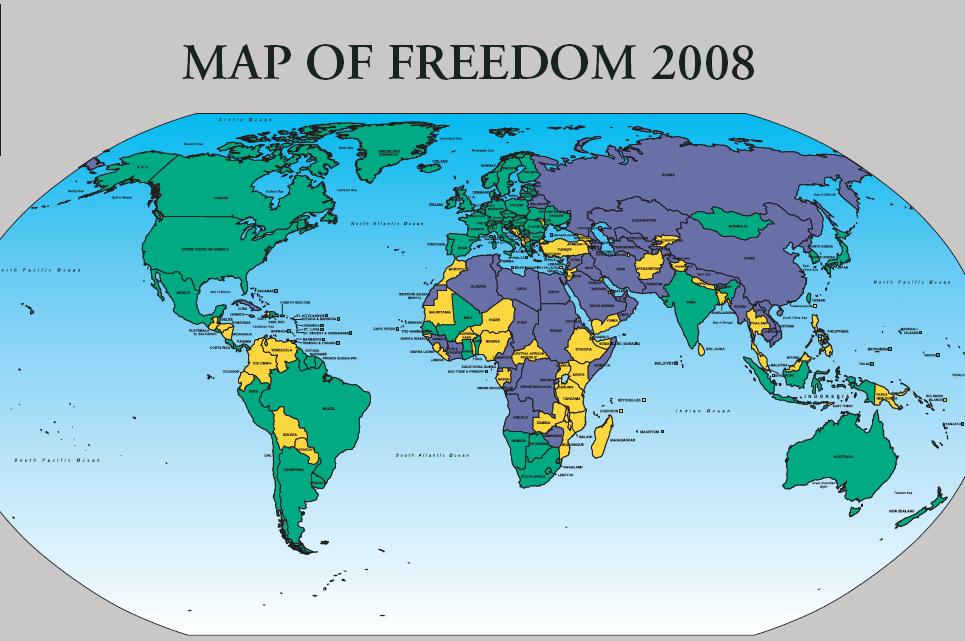
      Freedom House is an NGO that is prominent in the global movement to expand democracy and economic freedom worldwide. The organization also publishes the well-known (and well-regarded) Freedom in The World rankings annually. These rankings evaluate the countries of the world along various dimensions related to democracy, freedom, and the rule of law. A composite score for each country is then tabulated and each country is placed into one of three categories–free, partly free, not free–as a result. Which color corresponds to which category, do you suppose? Their website provides a vast array of data and resources–and strong analytical country descriptions–on phenomena broadly related to democracy.
      (Click on link for large image)

      freedom_house_rankings_2008.jpg

      Transparency International Corruption Perceptions Index for 2007

      Economists, political scientists and practitioners have long been aware of the deleterious effects of corruption. Transparency International, an international NGO, has been playing a lead role since its inception in 1993 in the fight to highlight the problem of corruption and in creating a forceful international anti-corruption movement. What is corruption?

      Corruption is the abuse of entrusted power for private gain. It hurts everyone whose life, livelihood or happiness depends on the integrity of people in a position of authority.

      What are some of the effects of corruption, but obvious and hidden?

      Corruption hurts everyone, and it harms the poor the most. Sometimes its devastating impact is obvious:

      * A father who must do without shoes because his meagre wages are used to pay a bribe to get his child into a supposedly free school.

      * The unsuspecting sick person who buys useless counterfeit drugs, putting their health in grave danger.

      * A small shop owner whose weekly bribe to the local inspector cuts severely into his modest earnings.

      * The family trapped for generations in poverty because a corrupt and autocratic leadership has systematically siphoned off a nation’s riches.

      Other times corruption’s impact is less visible:

      * The prosperous multinational corporation that secured a contract by buying an unfair advantage in a competitive market through illegal kickbacks to corrupt government officials, at the expense of the honest companies who didn’t.

      * Post-disaster donations provided by compassionate people, directly or through their governments, that never reach the victims, callously diverted instead into the bank accounts of criminals.

      * The faulty buildings, built to lower safety standards because a bribe passed under the table in the construction process that collapse in an earthquake or hurricane.

      Corruption has dire global consequences, trapping millions in poverty and misery and breeding social, economic and political unrest.

      Corruption is both a cause of poverty, and a barrier to overcoming it. It is one of the most serious obstacles to reducing poverty.

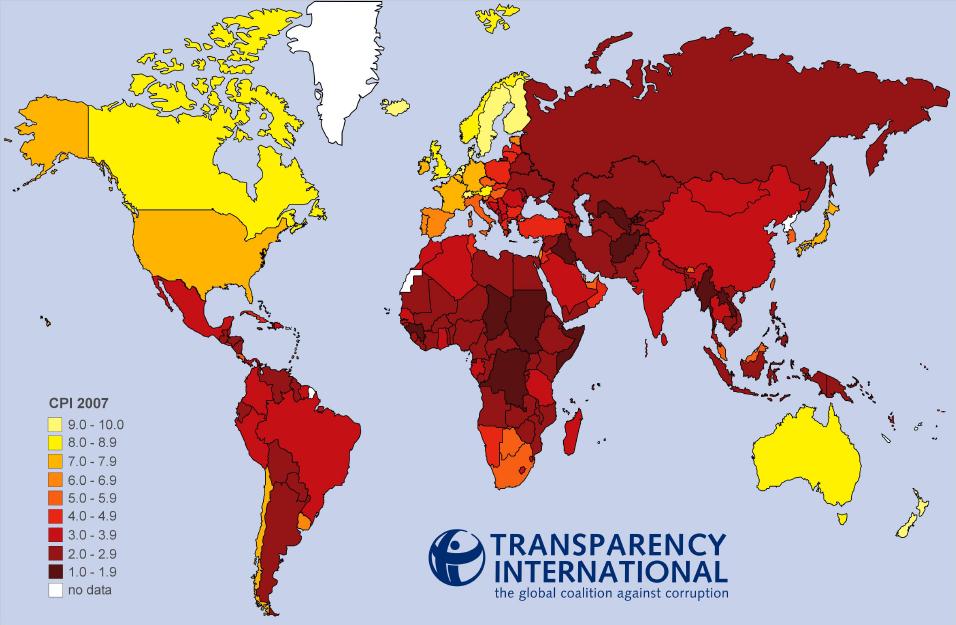
      Here is a chart comparing corruption levels around the world in 2007. The higher the cpi score, the higher the level of perceived corruption.

      transparency_corruption_world_map_2007.jpg

      Debaathification redux

      In an earlier post, I noted that the Iraqi parliament had passed a law allowing the re-hiring of rank-and-file members of the Baathist party, who had lost their jobs in one fell swoop as a result of a decision by Paul Bremer in the immediate aftermath of the US-led invasion. As has been the case on numerous prior occasions in Iraq, the news may not be as good as originally hoped. From the NY Times we find:

      A day after the Iraqi Parliament passed legislation billed as the first significant political step forward in Iraq after months of deadlock, there were troubling questions — and troubling silences — about the measure’s actual effects.

      The measure, known as the Justice and Accountability Law, is meant to open government jobs to former members of the Baath Party of Saddam Hussein — the bureaucrats, engineers, city workers, teachers, soldiers and police officers who made the government work until they were barred from office after the American invasion in 2003.

      But the legislation is at once confusing and controversial, a document riddled with loopholes and caveats to the point that some Sunni and Shiite officials say it could actually exclude more former Baathists than it lets back in, particularly in the crucial security ministries.

      Once again, the crux of the issue in Iraq is the sectional and interethnic struggle amongst Sunni Arabs, Shia Arabs, and non-Arab Kurds, and who get what, when, and where. There are no easy answers.

      Worldwide Governance Indicators from the World Bank

      Probably the best compilation of data related to governance can be found here .  The data can be viewed interactively (this is how I created the world map above that is being used as the page header for my website) here. The data include measures for most of the world’s countries on the following:

      The Worldwide Governance Indicators (WGI) project
      reports aggregate and individual governance indicators for 212 countries and territories over the period 1996–2006, for six dimensions of governance:

      Voice and Accountability

      Political Stability and Absence of Violence

      Government Effectiveness

      Regulatory Quality

      Rule of Law

      Control of Corruption

      The aggregate indicators combine the views of a large number of enterprise, citizen and expert survey respondents in industrial and developing countries. The individual data sources underlying the aggregate indicators are drawn from a diverse variety of survey institutes, think tanks, non-governmental organizations, and international organizations.

      The six aggregate indicators and the underlying data sources can be viewed interactively on the Governance Indicators webpage of this site. Documentation of the latest update of the WGI can be found in “Governance Matters VI: Governance Indicators for 1996–2006.” Further documentation and research using the WGI is available on the Resources page of this website or at www.worldbank.org/wbi/governance.

      What is governance? From the website we find this definition of governance:

      Governance consists of the traditions and institutions by which authority in a country is exercised. This includes the process by which governments are selected, monitored and replaced; the capacity of the government to effectively formulate and implement sound policies; and the respect of citizens and the state for the institutions that govern economic and social interactions among them.

      Design a site like this with WordPress.com
      Get started