Centrist wins run-off Election for Serbian Presidency

The BBC reports that centrist candidate Boris Tadić has won more than 50% of the vote in the second round of the Serbian presidential elections held on Sunday. Turnout was high and the Serbian electorate has, with a slight majority, signaled its intention of looking towards the future and the West, rather than returning to the nationalist rhetoric and policies of Serbia’s recent past.

Serbian President Boris Tadic, 3 February 2008

Mr Tadic wants to push forward his European integration agenda

Serbia’s pro-Western president, Boris Tadic, has won a second round election run-off against nationalist challenger Tomislav Nikolic, who conceded defeat. Mr Tadic was re-elected by more than 50% of voters in a contest that saw a high voter turnout.

Car horns could be heard around Belgrade as Tadic supporters took to the streets of the Serbian capital to celebrate the victory.

The election was seen as a referendum on Serbia’s relations with Europe.

“Serbia has shown its great democratic potential,” said Mr Tadic said in his victory speech, in which he lauded Mr Nikolic for his performance in the knife-edge contest, and said the country still had hard work ahead.

Using Powerpoint-type Presentations in Class

latex.jpg

The rise in the ubiquity of use of Powerpoint-type (and I use the phrase Powerpoint-type since Powerpoint is but one–although the most popular–type of software used for electronic lecture presentations; I use the Beamer package add-on for the type-setting software LaTeX) presentations has led to a spirited debate in the field of academia. Some argue that the presentations are self-defeating and do not advance any sane pedagogical objective, while others swear by the benefits.

I see both advantages and disadvantages to their use but believe that ultimately, like with most tools, there is no inherent value in the tool itself, but that the value of the tool (for better or worse) comes in its application. Thus, I think that Powerpoint-type lectures can be used to enhance the educational experience and one’s pedagogical objectives. The issue, then, revolves around determining just what the best use of Powerpoint is.

Thankfully, there has been some research on the subject. From the blog “Thinking about College Teaching“, here is a snippet from a post explaining the best use of Powerpoint in classs:

I found a research study that compared student learning for four ways of combining PowerPoint presentations with distribution to students. (I no longer have a citation for that study.) One group of students did not receive any handouts, a second group received complete handouts prior to discussion, a third group received complete handouts after discussion, and a fourth group received skeletal handouts prior to the discussion and complete handouts after the discussion. Learning was greatest in the last group, and that was the model I followed…

…I went through that file and deleted most content except for slide headings. I made that file available to students on the Blackboard site for my course prior to class, and those who wanted it could download it and bring a printed copy to class. After I completed the class discussion, I made the [complete] file available. The most enterprising students brought the outline version to class, took notes on it, and later compared their notes to my complete version. In any case, I did not spend the school’s money to duplicate materials that only some students wanted. Students were satsified with that arrangement when I explained that they would learn the most that way.

This is what I will do for the remainder of the semester. When I am using Powerpoints, which will be about every second or third session, I’ll post the Powerpoint lecture outlines on Blackboard, the post the complete version there after I have completed the lecture. If it takes more than one session to finish a lecture, the completed version will be posted after the lecture has been completed in full.

War and the Process of State-making

As we discussed in class on Thursday, there is a close relationship between the war, the state, and state-making.  Thus, violence is at the root of the idea of the modern state, as Weber’s famous definition of the state aptly demonstrates.  Norbert Elias suggested that the state-formation process in Europe was “an elimination contest.”  In addition, Charles Tilly famously wrote* “war made the state and the state made war.”  In a much-read paper** on the topic, Tilly wrote:

What distinguished the violence produced by states from the violence delivered by anyone else? In the long run, enough to make the division between “legitimate” and “illegitimate” force credible. Eventually, the personnel of states purveyed violence on a larger scale, more effectively, more efficiently, with wider assent from their subject populations, and with readier collaboration from neighboring authorities than did the personnel of other organizations.  But it took a long time for that series of distinctions to become established. Early in the state-making process, many parties shared the right to use violence, the practice of using it routinely to accomplish their ends, or both at once. The continuum ran from bandits and pirates to kings via tax collectors, regional power holders, and professional soldiers.

The uncertain, elastic line between “legitimate” and “illegitimate” violence appeared in the upper reaches of power. Early in the state-making process, many parties shared the right to use violence, its actual employment, or both at once. The long love-hate affair between aspiring state makers and pirates or bandits illustrates the division. “Behind piracy on the seas acted cities and city-states,” writes Fernand Braudel of the sixteenth century. “Behind banditry, that terrestrial piracy, appeared the continual aid of lords.”‘ In times of war, indeed, the managers of full-fledged states often commissioned privateers, hired sometime bandits to raid their enemies, and encouraged their regular troops to take booty. In royal service, soldiers and sailors were often expected to provide for themselves by preying on the civilian population: commandeering, raping, looting, taking prizes. When demobilized, they commonly continued the same practices, but without the same royal protection; demobilized ships became pirate vessels, demobilized troops bandits.

It also worked the other way: A king’s best source of armed supporters was sometimes the world of outlaws. Robin Hood’s conversion to royal archer may be a myth, but the myth records a practice. The distinctions between “legitimate” and “illegitimate” users of violence came clear only very slowly, in the process during which the state’s armed forces became relatively unified and permanent.

The process of legitimation of state violence came, as Tilly argues above, slowly.  What, according to Weber, are the different types of legitimacy that attended to this process?

*Charles Tilly, “Reflections on the History of European State-Making,” in Charles Tilly, ed.,  The Formation of National States in Western Europe (Princeton, N.J.: Princeton Univ. Press, 1975), p. 42.

**Tilly, Charles. “War Making and State Making as Organized Crime, ” in Evans, Rueschemeyer and Skocpol, ed., Brining the State Back in (Cambridge: Cambridge University Press, 1985), p.172-173.

***Elias, Norbert. The Civilizing Process  (Oxford: Blackwell), 1993.

Human Security Resources

A general trend has developed, amongst governments, academics, and (especially) activists working in IGOs and NGOs worldwide that has moved the focus of security away from traditional concepts–such as protecting borders from external threat–to a new approach that focuses specifically on human security. What is “human security?” Well, the Human Security Report Project, at Vancouver, Canada’s Simon Fraser University, defines human security in this way:

Unlike traditional concepts of security, which focus on defending borders from external military threats, human security is concerned with the security of individuals…

For some proponents of human security, the key threat is violence; for others the threat agenda is much broader, embracing hunger, disease and natural disasters. Largely for pragmatic reasons, the Human Security Report Project has adopted the narrower concept of human security that focuses on protecting individuals and communities from violence.

Traditional security policy emphasizes military means for reducing the risks of war and for prevailing if deterrence fails. Human security’s proponents, while not eschewing the use of force, have focused to a much greater degree on non-coercive approaches. These range from preventive diplomacy, conflict management and post–conflict peacebuilding, to addressing the root causes of conflict by building state capacity and promoting equitable economic development.

The website has an informative and very useful set of links to various organizations, governmental institutions, research institutes, etc., that focus on issues of human security.

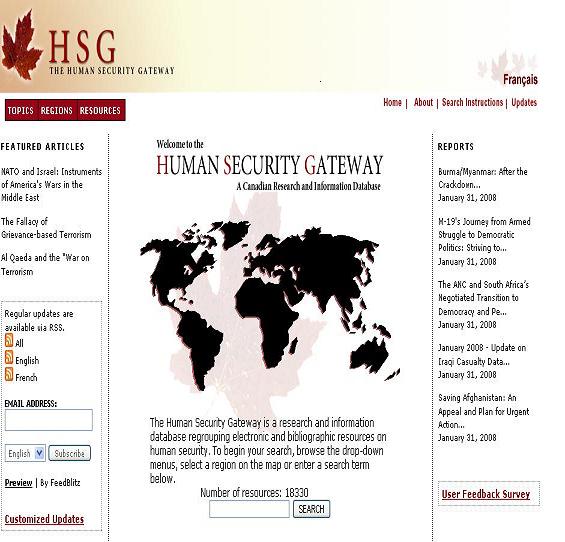
Another excellent source for information related to human security is the Human Security Gateway. Below is a thumbnails which will take you to a screen shot of their home page. (Notice the RSS feed icons in the left sidebar.)

human_security_gateway_homepage1.jpg

Another Foreign Policy List: How to Steal an Election Without Breaking a Sweat

Foreign Policy magazine frequently publishes “lists” that are meant to illuminate, in a sometimes ironic manner, political phenomena that are receiving much discussion.  In a recent issue, the focus turns to elections.   From their introduction:

From Abuja to Islamabad, autocratic regimes have become adept at manipulating “free and fair elections” to stay in power. Here’s how they do it—and how to stop them.

Here is their list, with some real-world examples of each:

  1. Control the processKenya’s constitution invests an enormous amount of power in the executive branch. This allowed President Mwai Kibaki to create a vast system of patronage throughout the government based largely on tribal ties. The head of the Electoral Commission of Kenya, Samuel Kivuitu, has recently admitted that he was pressured by the president’s office to announce results before he could verify their authenticity.
  2. Manipulate the mediaIn the months leading up to the recent presidential election in Georgia, President Mikheil Saakashvili’s government shut down Imedi TV, an opposition-friendly television station founded by one of the president’s rivals and managed by Rupert Murdoch’s News Corporation.
  3. Keep out the observersDuring the 2005 Egyptian parliamentary elections, judges at individual polling stations made seemingly arbitrary decisions about whether to allow outside monitoring. The result? Some stations were monitored and some were not. Monitors were beaten by police in one southern city, and eight were arrested and released elsewhere.
  4. Misreport resultsNadia Diuk, senior director for Europe and Eurasia at the National Endowment for Democracy (NED), relays a tale from Azerbaijan’s 2000 elections: “The light went out in the room where the counting was to take place, and the flashlights of the observers just caught sight of a bundle of ballots sailing through the air to land on the counting table.” [This is my favorite! :)]
  5. Foster incompetence and chaosNigeria’s 2007 national and state elections take the chaos prize. Ballots arrived late to polling stations, if at all, or were printed with missing or incorrect information. Polling places and procedures were changed at the last minute. With security lax, reports were rampant of militants harassing voters and youth gangs breaking into polling places and making off with ballot boxes.
  6. Resort to the crude stuff A favorite tactic in Egypt is to deploy riot police in strategic polling locations to keep out voters for the opposition Muslim Brotherhood—while state employees arrive in buses and are ushered in en masse. In 2005, a bloody showdown in the streets of Alexandria between government-backed thugs wielding machetes and Brotherhood supporters seeking to cast their votes became international news, embarrassing the regime.

Lies, Damned Lies, and Excel Charts!

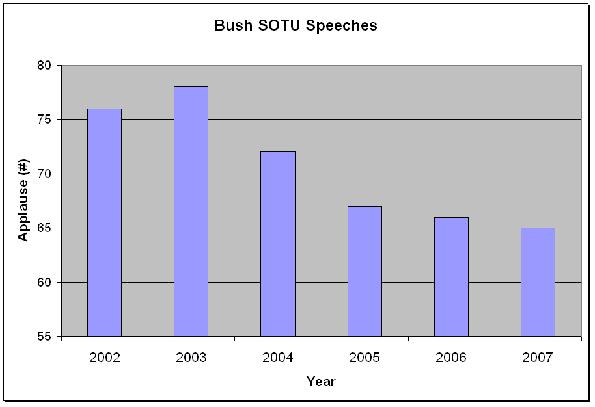
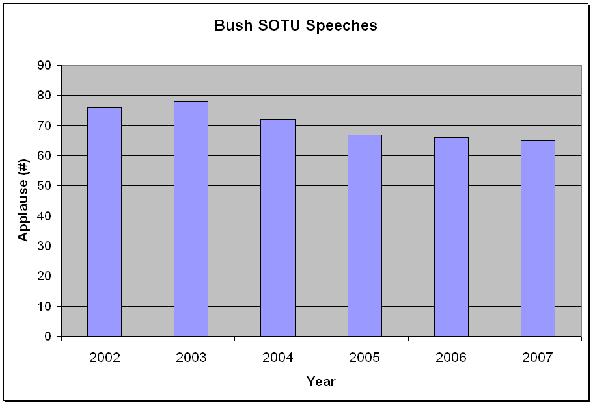
I provide links to many sources that collect data on various political phenomena because I think that describing and measuring are extremely useful tools in helping us understand politics. As Mark Twain was well aware, and as I mentioned in PLSC240 today, often-times researchers (and especially!) politicians use data and statistics to obfuscate reality rather than to illuminate. No sooner had I returned to my office than I saw the following chart on the web (courtesy of democrats.org). Here is a typical example of “massaging” the data to promote a preferred interpretation of political reality. Here’s the original chart:

sotu_speeches_11.jpg

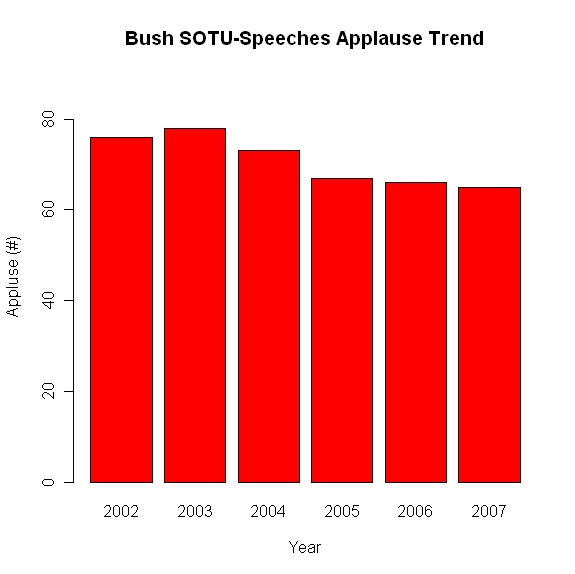
The inference that the creators of the chart want the observer to make is that the number of instances of applause from Bush’s State-of-the-Union (SOTU) speeches has, except for a spike in the immediate pre-Iraq invasion period of January 2003, been dropping, and significantly. Notice the range of the y-axis. Why did the chart creators decide to make 55 the minimum value? I have to give them the benefit of the doubt, however, as this seems to be a built-in feature of Excel (that’s why I encourage students to start using R for graphing capabilities). When I created the chart above myself in Excel, the program chose 55 as the minimum value of the y-axis. What would the chart look like if one were to make the y-axis minimum value zero? Here’s the result:

bush_sotu_zero_axis.jpeg

Now, the impression made upon the observer is that the drop in applause is not that great at all, and most likely within the range of what is called “random error”. Which chart is the correct one? Well, one way of determining the right answer to this would be to compare the SOTU applause trends of other presidents. Is every president guaranteed 40 or 50 bursts of applause no matter how lame the speech is or how unpopular the president is amongst those present? If so, then a minimum value on the y-axis of 40 or 50 would be more appropriate than zero, but I don’t know the answer off-hand.

UCDP/PRIO Armed Conflict Dataset


konfliktkart_8908.jpg

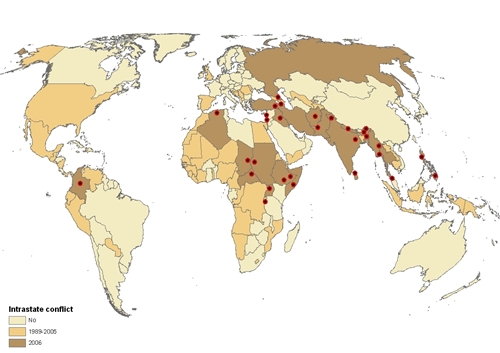
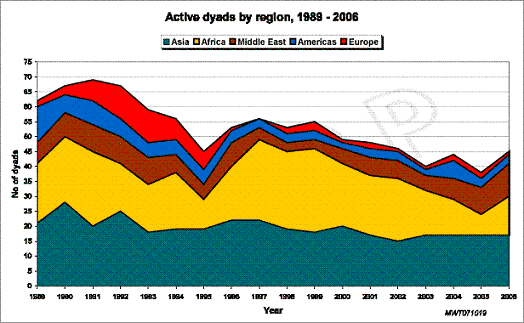
The Centre for the Study of Civil War at the International Peace Research Institute, Oslo (PRIO) and Uppsala Conflict Data Program (UCDP) at the Department of Peace and Conflict Research, Uppsala University, are the home for the Armed Conflict Dataset.  The dataset allows users access to information on such variables as name of conflict, antagonists, whether/not there was third-party intervention, etc., for all global conflicts between 1946 and 2002.  The website also has other data sources and illuminating charts and graphs, an example of which is reproduced below.

dyads_year_reg1.gif

This chart shows the number of conflicts in various regions of the world over time.

Roundtable–Globalizing Sport: National Rivalry and International Community in the 1930s

As we discussed in PLSC250, Woodrow Wilson set out an idealistic vision of the post-WWI world in his famous “Fourteen Points” address to Congress in 1918. As we all know, the vision was almost immediately undermined and finally turn asunder when Nazi Germany showed the rest of Europe–and the world–that military and economic power would triumph over cooperation and peace. Barbara J. Keys has written a compelling monograph on a little-researched aspect of that era–the role of sport in international politics. Of course, many are familiar with Hitler’s use of the Berlin Olympics in 1936 as a propaganda tool, but that is but one event. In Globalizing Sport: National Rivalry and International Community in the 1930s, Keys demonstrates “how sports revealed international contact zones as well as distinctive qualities of nationhood.”*   Here is a lengthy excerpt from Thomas Zeiler’s introduction to a roundtable at H-Diplo on the Keys’ book:

  “I see great things in baseball.”  Although we cannot confirm that poet Walt Whitman actually authored this famous quote back in the 1840s, we do know that he later believed the sport to be a shaper of American character that reflected the country’s democratic institutions, striving disposition, and rising geo-political and economic greatness.  In the
middle of the next century, intellectual historian Jacques Barzun also viewed the sport as a mirror of national traits.  In God’s Country and Mine:  A Declaration of Love Spiced with a Few Harsh Words (1954), he offered the oft-quoted words, “Whoever wants to know the heart and mind of America had better learn baseball.”  A half century after this publication, we come to Barbara Keys’ masterful work on how sports revealed international contact zones as well as distinctive qualities of nationhood.  Arriving in the age of globalization, her study properlysituates sports as a transnational movement amidst and between the national of Whitman and Barzun and the vast global arena.

Of course, as readers will discover, Keys’ focus is not on baseball, but she does examine the primary influence of nationalism on sporting events, particularly the Olympics movement and also other aspects such as athleticism and soccer.  Among many others, the main contribution of this book to the literature on diplomacy, sports, and culture regards Keys’ analysis of the tension between the manipulation of sports as an expression of national identity and sports’ position as a transnational carrier of culture abroad. 

*From Zeiler’s introduction to the roundtable in H-Diplo.

South Carolina Democratic Primary, Institutional Legacies, and Generational Change

In class on Thursday, I defined institutions and described some of their major characteristics, the most important of which is that an institution endures, sometimes despite the significant impetus for change driven by changing political, social, economic, and technological sources. Last night’s Democratic primary exit polls in South Carolina provide a glimpse into the institution known as the Democratic primary and how that institution has endured over time. Here is a portion of the exit polls from CNN:

sc_primary_exit_polls1.jpg

Notice the three red boxes, which confirm that Obama was able to win a landslide victory in South Carolina despite receiving only 15% of the 60-and-older non-black vote. So what, you may respond, a pattern has emerged showing Obama captures much more support from the under-30 crowd than the over-60 cohort. But if you look at the over-60 black vote, you’ll see that they voted overwhelmingly in favor of Obama. The complete story here is the institutional legacy of the Democratic party in the South and the impact of generational change on the nature of the party. When we cover political attitudes and ideologies in about two weeks time, we’ll read Ronald Inglehart’s work, in which he highlights the importance of inter-generational changes in attitudes brought about by exposure to epoch-changing events. Lyndon Johnson’s signature on the Civil Rights Act in 1964 was just such an event.

Kenyan Violence Menacing for Intertribal Marriages

Kenya’s political troubles have had a immediate impact on marriages composed of partners of different tribes. Individuals in inter-tribal or inter-ethnic marriages are often twice cursed in the event of inter-ethnic violence. On the one hand, each marriage partner is increasingly distrusted by members of the other ethnic/tribal group. But what makes matter even worse is that they are also ostracized and often the victims of violence on the part of members of their own group. Their sin is that, having married someone from the rival ethnic group/tribe, they are no longer seen as trustworthy. In noticed in Croatia that this led to counter-intuitive outcomes where individuals who had married spouses of the other ethnic group often become publicly intolerant toward members of the spouse’s group. This was not the result of true ethnic hostility but in order to prove the individual’s ethnic/nationalist bona fides to his (and it was mostly males in this case) own ethnic brethren.

Here is a report from the Associated Press about a woman in Kenya whose husband had to leave home, fearing for his life.

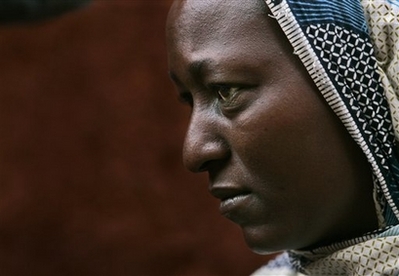
He doesn’t call. He doesn’t write. His cell phone has been switched off for weeks. After 17 years, Naomi Kering’s husband is gone — one more intertribal marriage fallen victim to the violence that has followed Kenya‘s disastrous presidential election.

“The kids always ask me, ‘Where is he?’ And I always say he is going to come back,” Kering, a 34-year-old of the Kalenjin tribe, told The Associated Press as she stood in the rubble of her home, torched by a mob last month because her kenya_divided_love_abc5031.jpghusband is a Kikuyu. “But I hope he stays away, because I love him and I want him to be safe.”

Since the Dec. 27 vote, marriages that united different ethnic groups have felt the strain as communities shun the Kikuyu tribe of President Mwai Kibaki, whose disputed re-election unleashed a wave of bloodshed that has killed at least 685 people.

Until now, marriages like Kering’s were common enough to go largely unnoticed, representing hope for what Kenya could be as a nation. But now the fabric of Kenyan society is fraying, forcing families to confront tribal identities many had cast aside long ago.

“This election has changed the very essence of these marriages,” said the Rev. Charles Kirui, a Catholic priest whose church in the nearby town of Burnt Forest shelters hundreds of Kikuyus. “Marriages are breaking up because of a tribal conflict, which means we really have a problem in Kenya.”

There are no figures on how many families are affected, but the impact is particularly felt in the heart of opposition territory in western Kenya, where tribal tensions have been most inflamed by the election.

This country of 38 million was once seen as a stable democracy on a violent continent. But it depended on a delicate balance of intertribal power.

Design a site like this with WordPress.com
Get started