Is Freedom on the March Worldwide? Freedom House says “no”.

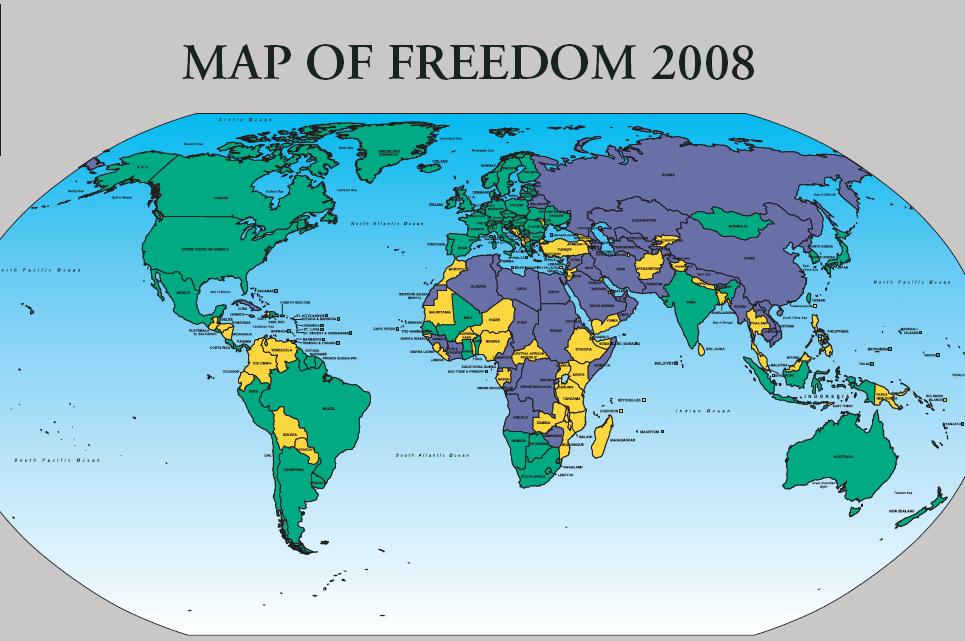
In a previous post I introduced the NGO, Freedom House, and included a world map of freedom based on the results of that organization’s analysis of the level of democracy worldwide in the last year. The map, of course, is static, and tells us nothing about the dynamics of democratization worldwide. In other words, compared to the year before, is the world more or less free? Well, the news is not good. Here are some highlights (or better yet, lowlights) from the press release:

The year 2007 was marked by a notable setback for global freedom, Freedom House reported in a worldwide survey of freedom released today.

The decline in freedom, as reported in Freedom in the World 2008, an annual survey of political rights and civil liberties worldwide, was reflected in reversals in one-fifth of the world’s countries. Most pronounced in South Asia, it also reached significant levels in the former Soviet Union, the Middle East and North Africa, and sub-Saharan Africa. A substantial number of politically important countries whose declines have broad regional and global implications—including Russia, Pakistan, Kenya, Egypt, Nigeria, and Venezuela—were affected.

Complete survey results reflect global events during 2007. A package of charts and graphs and an explanatory essay are available online.

As for specifics:

    The number of countries judged by Freedom in the World as Free in 2007 stood at 90, representing 46 percent of the global population. The number of Free countries did not change from the previous year’s survey.

      • The number of countries qualifying as Partly Free stood at 60, or 18 percent of the world population. The number of Partly Free countries increased by two from the previous year, as Thailand and Togo both moved from Not Free to Partly Free.
      • Forty-three countries were judged Not Free, representing 36 percent of the global population. The number of Not Free countries declined by two from 2006. One territory, the Palestinian Authority, declined from Partly Free to Not Free.
      • The number of electoral democracies dropped by two and totals 121. One country, Mauritania, qualified to join the world’s electoral democracies in 2007. Developments in three countries—Philippines, Bangladesh and Kenya—disqualified them from the electoral democracy list.

      We’ll address electoral democracies, and other “hybrid regimes” just before the mid-term break.

      How You can Directly Promote Entrepreneurship in the Developing World

      Periodically, I will use student posts as the inspiration for posts of my own here. This post is inspired by an informative post by Matt and Russ on the NGO KIVA.org. KIVA allows you, from the comfort of your keyboard, to monetarily support entrepreneurship in the developing world through facilitating the supply of micro-credit loans to budding entrepreneurs. This allows these individuals to overcome the handicap of poorly developed credit markets in these countries. [You may want to ask yourself why credit markets in most parts of the developing world are poorly developed.] For as little as $25 US, you can help a budding entrepreneur get the funding s/he needs to attempt to build a sustainable living for themselves and their families. The principal is returned to the donors (or lenders, more appropriately) within a specified time period. We’ll look at micro-credit in both PLSC240 and PLSC250 later in the course. Here is former President Bill Clinton explaining the concept of KIVA to Fox News’ Greta van Susteren.

      Barack Obama Writes Editorial in Kenyan Newspaper

      Democratic candidate for US President, Barack Obama, has written an editorial in one of Kenya’s most prominent newspapers addressing the dire situation there, the catalyst for which were disputed elections that took place in late December. Obama, who has family ties to that African country, wrote that Kenya had reached a “defining moment” on its road to democratic consolidation. Here is a snippet and a link to the full text of the opinion piece.

      Clearly, Kenya has reached a defining moment. It is up to Kenyan leaders and the Kenyan population to turn away from the path of bloodshed, division, and repression, and to turn towards reconciliation, negotiation, and renewed commitment to democratic governance. There is no doubt that there were serious flaws in the process by which presidential votes were tabulated. There is also no doubt that actions taken by both sides in the aftermath of the election have deepened the stalemate.

      But Kenya’s hard-won democracy and precious national unity can be salvaged. Now is the time for all parties to renounce violence. And now is the time for President Kibaki, Raila Odinga, and all of Kenya’s leaders, to calm tensions, to come together unconditionally, and to implement a political process that peacefully addresses the controversies that divide them and restores the Kenyan people’s confidence in their political system.

      Image from stuff.co.nz

      Freedom House

      Freedom House is an NGO that is prominent in the global movement to expand democracy and economic freedom worldwide. The organization also publishes the well-known (and well-regarded) Freedom in The World rankings annually. These rankings evaluate the countries of the world along various dimensions related to democracy, freedom, and the rule of law. A composite score for each country is then tabulated and each country is placed into one of three categories–free, partly free, not free–as a result. Which color corresponds to which category, do you suppose? Their website provides a vast array of data and resources–and strong analytical country descriptions–on phenomena broadly related to democracy.
      (Click on link for large image)

      freedom_house_rankings_2008.jpg

      Congo Civil War Kills 45,000 Persons Monthly

      We’ll be covering war and strife later in the semester and we’ll note that the nature of warfare has changed over the years. Whereas most wars in the past were of the inter-state variety, contemporary wars are mostly intra-state (i.e, wars resulting from civil and ethnic conflict). A worrisome characteristic of these contemporary wars is that the vast majority of victims are civilians and they generally succumb to factors, such as disease and hunger, not related to direct conflict. In a new report by the International Red Cross, we learn that 45,000 persons have died (and continue to die) monthly from civil war in Congo.

      25congo600.jpg

      The effects of one of the bloodiest wars in modern history continue to unfold in relative obscurity in the Democratic Republic of Congo, where 5.4 million lives have been lost as a result of conflict since 1998, according to a nationwide mortality survey that will be released today.

      While the conflict in the Darfur region of neighbouring Sudan has begun to draw substantial international attention, the humanitarian crisis resulting from conflict in the Congo has received almost none. About 200,000 people have been killed in Darfur, and two million displaced.

      “People aren’t dying dramatically in Congo,” said Richard Brennan, a lead researcher with the U.S.-based International Rescue Committee, which conducted the survey. “It’s not like a Rwandan genocide where people die in a very dramatic and acute manner. They are dying quietly and anonymously.”

      In fact, very few of the recorded deaths were caused directly by violence, roughly 0.4 per cent nationwide, the report says. Instead, the principal causes of death across Congo, a largely undeveloped country the size of Western Europe, were malnutrition, preventable diseases and pregnancy-related conditions.
      “Our experience in poorly developed countries over the last 20 years is that in most conflicts, the majority of deaths, frequently over 90 per cent, are due to the indirect consequences of that conflict,” Dr. Brennan said. “They are no less devastating, but they are very much below our radar screen in the West.”

      Corruption and Transparency International (Redux)

      Apropos of an earlier post and discussion in class today about correlation and causality, here is an excerpt from an interview with Transparency International’s Huguette Labelle, where she answers questions about the apparent correlation between corruption levels and GDP, and corruption levels and levels of violent conflict:

      Question:
      The countries with the best scores in the CPI seem to be some of the world’s richest countries – is higher GDP the key to less corruption?
      Answer:
      I think the difference between the countries at the top and the bottom is not so much due to their relative wealth or poverty, but to the development of their institutions. The top scorers have effective public sectors, with open contracting procedures, strong disclosure rules and access to information.

      Labelle is implying here that the correlation between corruption and GDP is not causal; it is spurious (we’ll talk about spurious causation next class).

      Question:
      Many of the countries with the worst scores in the CPI are victims of violent conflict (Somalia, Myanmar, Iraq, Sudan and Afghanistan). What is the relationship between failed states and corruption?
      Answer:
      In a crisis situation, the institutions of government are weakened, so corruption can more easily take hold and spread. It is not just individuals, but also institutions, that are responsible for maintaining integrity in a country. Many countries at the bottom of the CPI are failed states that are at the intersection of poverty, conflict and corruption.

      New York Times special Report on Pollution and Economic Growth in China

      You can find a fascinating 10-part report on the dramatic environmental impact of China’s miraculous economic growth in the New York Times. The report, Choking on Growth, provides readers and viewers a multimedia perspective on growth and pollution. From the perspective of comparative politics, it is important to note that some scientists and other scholars in China are trying to estimate the impact of environmental destruction on the general welfare of China’s citizens. They have begun to use a new measure of well-being, “green GDP”, arguing in effect that GDP itself is not an accurate measurement of a society’s well-being. In PLSC240, we will analyze other indicators of well-being, including HDI, the Gini Index, etc, when we study Political Economy (Chapter 4). From an IR perspective, we can ask ourselves what right or responsibility those outside China (whether IGOs like the UN, or other states like Japan and the US) have to intervene and attempt to reverse the damage China is causing to its own and the planet’s fragile ecosystem. Here is a link to a compelling video and some images below from the New York Times:

      [rockyou id=99737780&w=500&h=350]

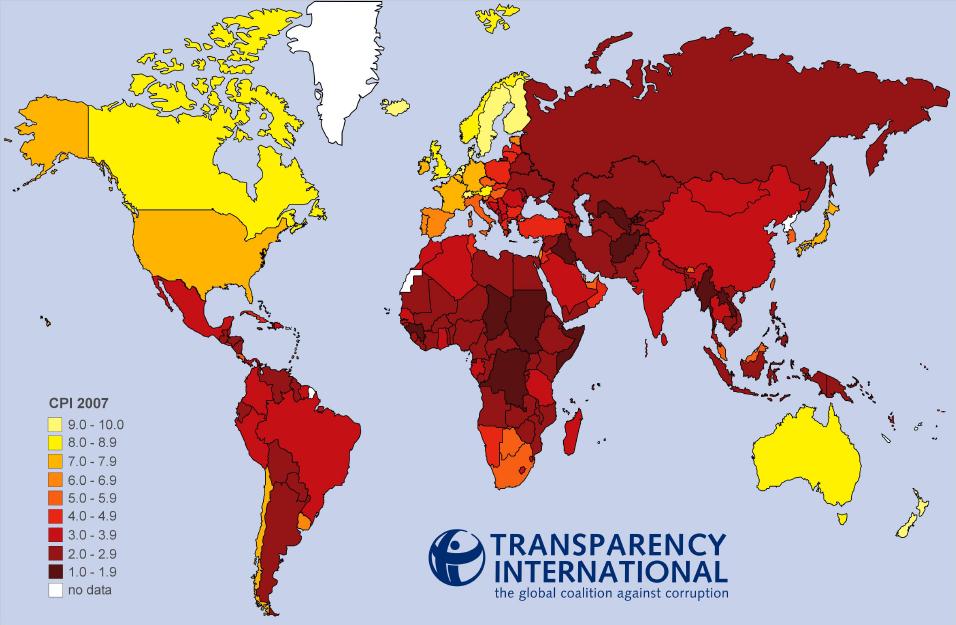
      Transparency International Corruption Perceptions Index for 2007

      Economists, political scientists and practitioners have long been aware of the deleterious effects of corruption. Transparency International, an international NGO, has been playing a lead role since its inception in 1993 in the fight to highlight the problem of corruption and in creating a forceful international anti-corruption movement. What is corruption?

      Corruption is the abuse of entrusted power for private gain. It hurts everyone whose life, livelihood or happiness depends on the integrity of people in a position of authority.

      What are some of the effects of corruption, but obvious and hidden?

      Corruption hurts everyone, and it harms the poor the most. Sometimes its devastating impact is obvious:

      * A father who must do without shoes because his meagre wages are used to pay a bribe to get his child into a supposedly free school.

      * The unsuspecting sick person who buys useless counterfeit drugs, putting their health in grave danger.

      * A small shop owner whose weekly bribe to the local inspector cuts severely into his modest earnings.

      * The family trapped for generations in poverty because a corrupt and autocratic leadership has systematically siphoned off a nation’s riches.

      Other times corruption’s impact is less visible:

      * The prosperous multinational corporation that secured a contract by buying an unfair advantage in a competitive market through illegal kickbacks to corrupt government officials, at the expense of the honest companies who didn’t.

      * Post-disaster donations provided by compassionate people, directly or through their governments, that never reach the victims, callously diverted instead into the bank accounts of criminals.

      * The faulty buildings, built to lower safety standards because a bribe passed under the table in the construction process that collapse in an earthquake or hurricane.

      Corruption has dire global consequences, trapping millions in poverty and misery and breeding social, economic and political unrest.

      Corruption is both a cause of poverty, and a barrier to overcoming it. It is one of the most serious obstacles to reducing poverty.

      Here is a chart comparing corruption levels around the world in 2007. The higher the cpi score, the higher the level of perceived corruption.

      transparency_corruption_world_map_2007.jpg

      Nationalist wins First Round of Serbian Presidential Elections

      According to results released by the Election Commission of the Republic of Serbia, a second round of voting will be needed to elect Serbia’s next president. Current president, the moderate Boris Tadić, finished second (with 34.5% of votes cast) to challenger, Tomislav Nikolić, (40.0%) whose campaign was based on stark appeals to nationalist sentiments in the Serbian body politic. Given that neither candidate received the required 50% to be formally declared the first-round winner, Tadić and Nikolić will compete head-to-head in a run-off election on February 3rd. (Many European countries’ election laws also require winning candidates to have won 50% of the vote to avoid second-round run-off elections.)

      The election outcome is seen as a battle between those who would aspire to a new era of Serbian politics, stressing future political and economic integration with the rest of Europe, and their opponents, who it is argued desire a return to the Milošević-era inspired nationalist ethos. The election could prove to be (yet another) important watershed in contemporary Serbian political affairs, evidence of which is the turnout, which was the largest in almost ten years. Here is a nice, short article from Time magazine explaining the future implications of the elections and below is a video report from Russia Today can be found here.

      Below is a report prepared for the Sunday Telegraph in advance of the elections:

      Blog Assignment–PLSC 250-Introduction to International Relations

      The function of your blog will be to select, research, analyze, and contribute knowledge and information on a topic of interest to you (the group will select one topic only) in international relations. As we address the theories and principles of international relations over the course of the semester, you will post to your blog analyzing how these theories, principles, and ideas apply to your chosen topic. The goal is for your group to learn more about that topic than we could ever hope to cover in class over the course of a single semester. You will have to post your topic of choice, and a brief description of the topic, by midnight, Sunday, January 27th.

      There is a myriad of topics in international relations that may be of interest to you. To help you begin to narrow down your choice of topic, go to the index of Mingst’s Essentials, and browse the list of entries.

      Continue reading “Blog Assignment–PLSC 250-Introduction to International Relations”

      Design a site like this with WordPress.com
      Get started