
Are Homebuyers Rational Decision-Makers?

According to rational choice theorists, how do individuals make decisions?  Put simply, they act so as to maximize their expected utility, given their a priori preferences and some general idea of the nature of the world (by this, they mean that individuals have some idea of the probability of certain actions leading to specific outcomes).  While rational choice theory was first developed in academic disciplines such as economics, political scientists have adopted the technique and it’s use has proliferated in that discipline.  One of the criticisms of using rational choice theory to explain political phenomena is that often individuals have difficulty ordering preferences adequately.  This is because there is no single “currency” of utility in political science.  The same, however, can not be said for economics as it is much easier to order preferences when there are dollar values attached.  But what happens when time, leisure, etc., have to be taken into account.  Well, it turns out that individuals make many “mistakes” that diverge from that expected of instrumentally rational decision-makers.

Jonah Lehrer informs his readers of a fascinating series of studies done by Ap Dijksterhuis, a psychologist at Radboud University in the Netherlands.  One of these studies looks at decisions related to real estate purchases.  The studies:

look at how people shop for “complex products,” like cars, apartments, homes, etc. and how they often fall victim to what he calls a “weighting mistake”. Consider two housing options: a three bedroom apartment that is located in the middle of a city, with a ten minute commute time, or a five bedroom McMansion in the suburbs, with a forty-five minute commute. “People will think about this trade-off for a long time,” Dijksterhuis writes. “And most them will eventually choose the large house. After all, a third bathroom or extra bedroom is very important for when grandma and grandpa come over for Christmas, whereas driving two hours each day is really not that bad.” What’s interesting is that the more time people spend deliberating, the more important that extra space becomes. They’ll imagine all sorts of scenarios (a big birthday party, Thanksgiving dinner, another child) that will turn the suburban house into an absolute necessity. The lengthy commute, meanwhile, will seem less and less significant, at least when compared to the allure of an extra bathroom.

But, as Dijksterhuis points out, that reasoning process is exactly backwards: “The additional bathroom is a completely superfluous asset for at least 362 or 363 days each year, whereas a long commute does become a burden after a while.” For instance, a recent study found that, when a person travels more than one hour in each direction, they have to make forty per cent more money in order to be as “satisfied with life” as someone with a short commute. Another study, led by Daniel Kahneman and the economist Alan Krueger, surveyed nine hundred working women in Texas and found that commuting was, by far, the least pleasurable part of their day. And yet, despite these gloomy statistics, nearly 20 percent of American workers commute more than forty-five minutes each way. (More than 3.5 million Americans spend more than three hours each day traveling to and from work: they’re currently the fastest growing category of commuter. For more on commuter culture, check out this awesome New Yorker article.) According to Dijksterhuis, these people are making themselves miserable because they failed to properly “weigh” the relevant variables when they were choosing where to live. Because these deliberative homeowners tended to fixate on details like square footage or the number of bathrooms, they assumed that a bigger house in the suburbs would make them happy, even if it meant spending an extra hour in the car everyday. But they were wrong.:

Dependency Theory and Import Substitution Industrialization (ISI)

PBS broadcast a tremendously informative series called Commanding Heights, which took a look at the the battle over the world’s political economy during the 20th century.  Below you’ll find a portion of the episode on Latin America, which has been uploaded to You Tube.  The clip below explains the concept of dependency theory–the theoretical impetus behind the establishment of the political economic institution of import-substitution-industrialization (ISI).  Unfortunately, ISI did not work very well in practice, and Moises Naim–the editor of Foreign Policy Magazine, explains why in the clip below.

P.S. “The Chicago Boys” were not Michael, Scotty, and Phil. 🙂

What are the Fundamental Tenets of Confucianism…Culture as Destiny?

Over the past few weeks, we have addressed the debate regarding the relative explanatory power of cultural versus institutional and rational choice approaches to the analysis of political phenomena.  In the book excerpt, “A Brief History of Human Liberty,” Newsweek editor Fareed Zakaria analyzes the cultural argument regarding economic growth and democracy. He quotes the former Singaporean Prime Minister Lee Kuan Yew:

“…if you want to see how culture works, compare the performance of German workers and Zambian workers anywhere in the world.  You will quickly come to the conclusion that there is something very different in the two cultures that explains the results.”

Zakaria has some sympathy for this argument, but then argues that it is strange that Lee Kuan Yew is such a strong proponent of cultural arguments* given that while Singapore is culturally very similar to its neighbor, Malaysia, Singapore has been much more effective in its economic policies than has its neighbor.  In fact, I would add that a strong argument against cultural explanations of democracy and economic development are the differences between East Germany and West Germany (in the post-WWII-era until unification) and the present difference between North and South Korea.

The 38th parallel may be just a line on a map, and the division of the nation of Korea into two separate states may be a historically contingent act, but it demonstrates the tremendously powerful impact of institutions on a society.  South Korea was able to develop good political and economic institutions, while North Korea has not.  The cultural foundation of each state was similar (although I’m not an expert on Korea, so maybe there was a cultural difference between the “north” and the “south” that can account for the vast differences in the two states today–although I’m highly skeptical) before the division and we know, in a methodological sense, that a constant can not explain an outcome that varies.

Getting back to Zakaria and Lee Yuan Kew, Zakaria writes that

“the key to Singapore’s success…is Lee Kuan Yew, not Confucius.  The point is not that culture is unimportant; on the contrary it matters greatly…But culture can change…A hundred years ago, when East Asia seemed immutably poor, many scholars–most famously Max Weber [we’ve read his Protestant Ethic argument]–argued that Confucian-based cultures discouraged all the attributes necessary for success in capitalism…A decade ago, when East Asia was booming, scholars had turned this explanation on its head, arguing that Confucianism actually emphasized the traits essential for economic dynamism. Today the wheel has turned again and many see in ‘Asian values’ all the ingredients of crony capitalism.”‘

What are these Confucian and ‘Asian values’ about which there has been so much discussion.  Well, needless to say Asia is a vast land mass, with exceedingly high levels of diversity–culturally, linguistically, religiously, racially, etc.  So the concept of ‘Asian values’ may be so amorphous as to http://onpoint.wbur.org/2006/08/15/china-and-confucian-democracy http://onpoint.wbur.org/2006/08/http://onpoint.wbur.org/2006/08/15/china-and-confucian-democracy/china-and-confucian-democracy.  Confucianism, however, is a distinct and compact body of ideas that has a comprehensive philosophical foundation.  What are Confucian values, then and do they help or hinder China’s precarious journey towards democracy and economic development?  Well, here’s an answer from political philosopher Daniel Bell, who insists that ultimately, Confucianism is about three core values.  What are these?  Listen to the first ten minutes of the audio podcast from this episode of “On Point.”  Here’s a link to the URL on which you can find an archived version of the show.

**Here, it should be noted that a reason Lee Kuan Yew is strongly predisposed to arguing on the basis of culture is his contempt for the licentiousness of Western values and his desire to prevent demands for those kinds of freedoms (as long as political liberty) to take root in the strongly authoritarian state of Singapore.  Just read his statements during the infamous Michael Fay incident.

It wasn’t long before Singapore patriarch Lee Kuan Yew weighed in. He reckoned the whole affair revealed America’s moral decay. “The U.S. government, the U.S. Senate and the U.S. media took the opportunity to ridicule us, saying the sentence was too severe,” he said in a television interview. “[The U.S.] does not restrain or punish individuals, forgiving them for whatever they have done. That’s why the whole country is in chaos: drugs, violence, unemployment and homelessness. The American society is the richest and most prosperous in the world but it is hardly safe and peaceful.”

Here’s another story on the incident.

John Cleese on Proportional Representation

There are generally two types of electoral system in use around the world–first-past-the-post (single-member district) and proporational representation (multi-member district).

As John Cleese explains in this public service announcement, the choice of which electoral system to implement in a democracy can have a dramatic impact on party politics and on the political system in general.  The idea behind proportional representation is that the composition of the legislative body is directly representative of the political opinions in the electorate.  So if, for example, 3% of the electorate votes for the Polish Beer-Lovers’ Party (PPPP–Polska Partia Przyjaciół Piwa), as happened in the Polish parliamentary elections of 1991, then that party will have 3% of the representatives in the legislative body (which it did).

In first-past-the-post systems, such as the USA, Canada, and the UK, the electorate is divided up into single-member-districts, from which a single representative is elected to represent that seat in the parliament.  The winner does not have to win a majority of the vote, only a plurality.  Thus, if there are 4 contenders for a particular seat, and three of them each garners 20% of the vote, the fourth candidate, with 40% of the vote, wins the seat, representing that district in parliament.  The rest of the votes (the 60% going to non-winning parties) is “wasted” as it is not used to determine representation in parliament.  These are the basics, but upon these foundations one can build a myriad of different types of systems, such as the “double-vote” system in Germany.

Monty Python’s take on Constitutional Government

I am a huge fan of the British sketch comedy group Monty Python.  For a political science professor, this clip is like politico-comedic gold.  Here is Dennis the peasant’s views on democratic legitimacy, the proper role of popular mandates in the wielding of supreme executive power, and a sarcastic critique of socialist critiques of liberal capitalism (“oh, there you go bringing class into it again!”).  And remember, “you don’t vote for kings.”

Totalitarianism and 1984

This week we are addressing authoritarianism and totalitarianism.  As mentioned in the textbook, totalitarian regimes are extremely odious, but fortunately are also relatively rare.  There are a couple of regimes today than can safely be characterized as totalitarian–North Korea and Burma.

Totalitarian regimes are characterized by the desire on the part of rulers for complete control of all of the state, civil society and economy.  There is much overt violence and other forms of both cooptation and coercive control.  Take a look at these two video clips of the film adaptation of George Orwell’s famous novel, 1984, and see if you can think of how many characteristics of a totalitarian regime you notice.

How much of Your Income is Spent of Food?

Here is an interesting table from the United States Department of Agriculture (USDA) website, which compares food expenditures across different countries of the world.  Notice the wide disparity between the developed world and many developing countries.  I found it particularly noteworthy that Croatians spend fully 1/3 of their income on food.  I can say that I have first-hand evidence that this is true.  The reasons for this are complex (Croatia is not a poor country, at least compared to those countries with which it shares food expenditure characteristics) but have to do with small population size and small farm size, along with an overvalued (for political reasons) currency vis-a-vis countries from which Croatia imports a lot of foodstuffs.

Look at Pakistan!!  Wow!

Table 97
Percent of household final consumption expenditures spent on food, alcoholic beverages, and tobacco that were consumed at home, by selected countries, 20061
Country/Territory Share of household final consumption expenditures
Food2 Alcoholic beverages and tobacco Total household final consumption expenditures3 Expenditure per capita on food2
Percent U.S. dollars per person
United States
ERS estimate 5.8 NA NA 1,848
Euromonitor estimate 7.2 2.0 30,624 2,204
Singapore 8.1 2.3 12,000 975
Ireland 8.2 5.0 22,022 1,812
United Kingdom 8.7 3.6 24,205 2,097
Canada 9.3 3.8 21,526 1,994
United Arab Emirates 10.1 0.6 8,099 816
Netherlands 10.4 3.0 18,593 1,937
Switzerland 10.4 3.6 29,124 3,040
Denmark 10.9 3.6 24,175 2,629
Austria 11.1 2.6 20,666 2,289
Germany 11.2 3.5 19,811 2,226
Australia 11.2 4.1 19,991 2,247
Sweden 11.9 3.5 19,367 2,302
Kuwait 12.0 1.3 11,083 1,324
Finland 12.4 4.8 19,268 2,392
New Zealand 12.5 4.4 15,107 1,882
Norway 12.8 4.3 28,026 3,591
Hong Kong, China 13.0 0.8 15,199 1,979
Belgium 13.2 3.7 19,313 2,546
France 13.9 3.1 19,931 2,776
Japan 14.3 3.1 19,320 2,768
Spain 14.6 3.3 15,724 2,304
Italy 14.9 2.8 18,396 2,745
Malaysia 15.0 1.2 2,412 361
South Korea 15.1 2.6 9,668 1,464
Greece 15.6 5.0 14,469 2,259
Slovenia 15.9 4.4 9,836 1,568
Czech Republic 17.0 8.0 6,723 1,146
Hungary 17.8 8.2 7,239 1,291
Portugal 18.0 4.0 11,533 2,072
Israel 18.1 1.7 10,624 1,926
Estonia 18.4 8.6 6,206 1,141
Latvia 19.0 6.3 5,606 1,063
Slovakia 19.2 4.9 5,777 1,112
Argentina 20.1 3.3 3,325 667
Saudi Arabia 21.4 1.1 3,519 752
South Africa 21.4 4.6 3,146 674
Poland 22.1 7.4 4,968 1,099
Chile 23.7 0.8 4,332 1,025
Taiwan 23.9 2.1 9,961 2,377
Mexico 24.5 2.5 5,293 1,296
Brazil 24.7 1.9 2,915 721
Lithuania 24.9 6.4 5,752 1,432
Colombia 25.5 4.4 1,741 444
Thailand 25.8 5.6 1,809 467
Indonesia 26.7 2.0 979 262
Philippines 27.4 2.1 943 258
China 27.8 2.2 746 207
Ecuador 28.5 5.8 1,144 326
Turkey 28.7 5.1 3,626 1,040
Bolivia 29.1 2.2 715 208
Venezuela 29.4 3.1 2,413 709
Bulgaria 29.5 4.2 2,796 824
Peru 29.6 2.0 2,002 593
Russia 31.4 2.5 3,278 1,029
Turkmenistan 32.7 2.7 798 261
India 33.4 2.3 421 141
Croatia 33.9 4.1 5,281 1,791
Romania 34.6 5.0 4,285 1,481
Kazakhstan 36.6 3.5 2,267 829
Tunisia 36.7 1.0 1,875 688
Vietnam 39.7 2.9 426 169
Nigeria 40.7 2.5 412 168
Pakistan 41.5 2.5 44 18
Egypt 41.5 2.5 1,032 428
Ukraine 43.1 6.4 1,408 606
Jordan 43.6 5.1 1,648 718
Algeria 43.7 2.0 1,204 526
Morocco 44.8 1.5 1,156 517
Belarus 47.3 6.3 1,835 868
Azerbaijan 51.6 2.4 912 471
NA=Not available.
1The data are computed by Birgit Meade (202-694-5159, bmeade@ers.usda.gov), ERS/USDA, EUROMONITOR data, March 2006.
2Includes nonalcoholic beverages.
3Household expenditures for goods and services.

Would you pass the U.S. Citizenship Test?

Were you not born in this country and had to take the citizenship test, would you pass?  Remember that citizenship is a concept that defines one’s relationship to the state.  There are essentially three types of citizenship–jus sanguinis, jus soli, and naturalization.  Craig Ferguson is now a naturalized US citizen.  On what basis did you receive your US citizenship?  Were you born on U.S. soil?  Were you born outside of the United States, but (at least) one of your parents was a US citizen at the time?

Cross-National Comparisons in Alcohol Consumption amongst Adults

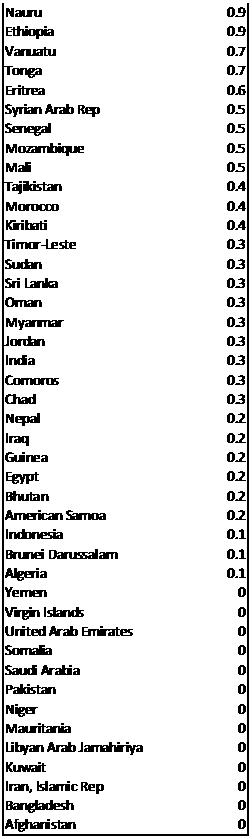
In response to a short assignment on the process of modeling social phenomena, one of my students (thanks, EE!) has chosen to try to understand why the residents of some countries consume (on average) more alcohol per capita than the residents of other countries. She argued that it may have something to do with the cultural acceptance of drinking alcohol as children. That’s seems to be a plausible hypothesis. You can find data on annual drinking rates from the EarthTrends website (which I’ve used on many previous occasions; it’s a fantastic resource!). Here is a link to 2003 data (the most recent year for which they have data) and here is a table, which I have created from the data. What do you think accounts for the difference in consumption across these countries?

Design a site like this with WordPress.com
Get started