The Important Role of the State

A country’s roads and road system can give outsiders a quick and readily available idea of how well that country is governed. Here are some examples:

A video of part of the drive from the Kenyan city of Mombasa (pop. 700,000) to the town of Kilifi (pop. 75,000). (Try to ignore the cackling of the passengers and driver.)

Here are some photographs of the main highway between Moscow and the Siberian city of Yakutsk. The road is a vital federal highway, believe it or not! See many more photographs here.

russian-road-33.jpg

russian-road-24a.jpgrussian-road-25a.jpgsiberia-06-302.jpg

Also take a look at these incredible and frightening photographs from the world’s most dangerous highway. Find many more of these photographs here.

death-road-16.jpg

Mingst and Snyder–Chapter 3 Reading Questions

Morgenthau, Hans–“A Realist Theory of International Politics”
  • Does Morgenthau’s explanation of realist theory focus on any of the levels of analysis in particular? Explain.
  • Morgenthau writes “political realism is aware of the moral significance of political action. It is also aware of the ineluctable tension between the moral command and the requirements of successful political action.” What does he mean by this and why is this important for international relations?
  • How does Morgenthau define political power, and how is it used in internaitonal politics?

Continue reading “Mingst and Snyder–Chapter 3 Reading Questions”

Lies, Damned Lies, and Excel Charts!

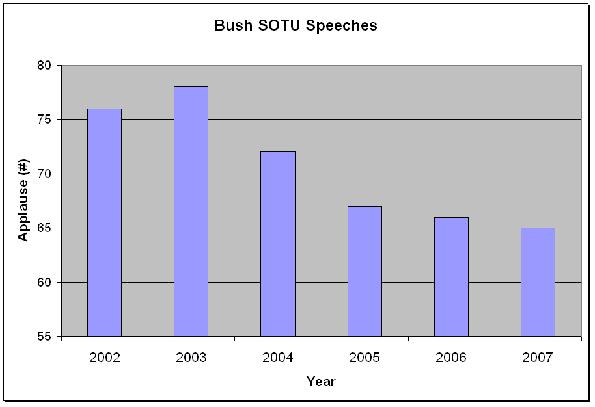
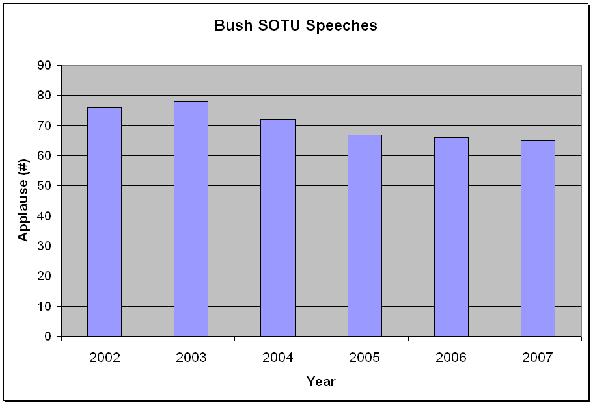
I provide links to many sources that collect data on various political phenomena because I think that describing and measuring are extremely useful tools in helping us understand politics. As Mark Twain was well aware, and as I mentioned in PLSC240 today, often-times researchers (and especially!) politicians use data and statistics to obfuscate reality rather than to illuminate. No sooner had I returned to my office than I saw the following chart on the web (courtesy of democrats.org). Here is a typical example of “massaging” the data to promote a preferred interpretation of political reality. Here’s the original chart:

sotu_speeches_11.jpg

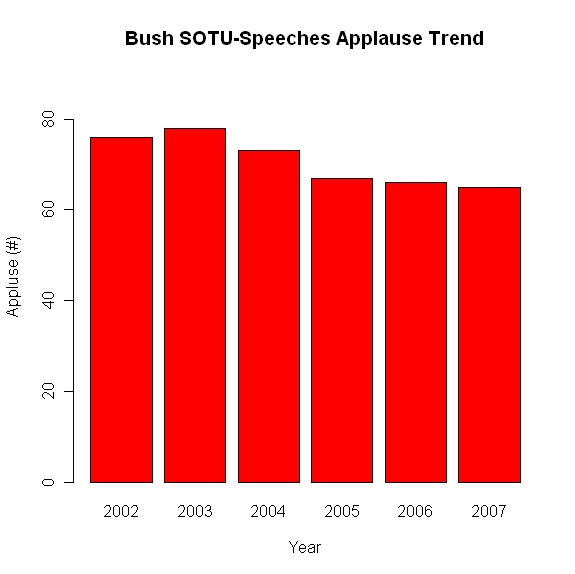
The inference that the creators of the chart want the observer to make is that the number of instances of applause from Bush’s State-of-the-Union (SOTU) speeches has, except for a spike in the immediate pre-Iraq invasion period of January 2003, been dropping, and significantly. Notice the range of the y-axis. Why did the chart creators decide to make 55 the minimum value? I have to give them the benefit of the doubt, however, as this seems to be a built-in feature of Excel (that’s why I encourage students to start using R for graphing capabilities). When I created the chart above myself in Excel, the program chose 55 as the minimum value of the y-axis. What would the chart look like if one were to make the y-axis minimum value zero? Here’s the result:

bush_sotu_zero_axis.jpeg

Now, the impression made upon the observer is that the drop in applause is not that great at all, and most likely within the range of what is called “random error”. Which chart is the correct one? Well, one way of determining the right answer to this would be to compare the SOTU applause trends of other presidents. Is every president guaranteed 40 or 50 bursts of applause no matter how lame the speech is or how unpopular the president is amongst those present? If so, then a minimum value on the y-axis of 40 or 50 would be more appropriate than zero, but I don’t know the answer off-hand.

UCDP/PRIO Armed Conflict Dataset


konfliktkart_8908.jpg

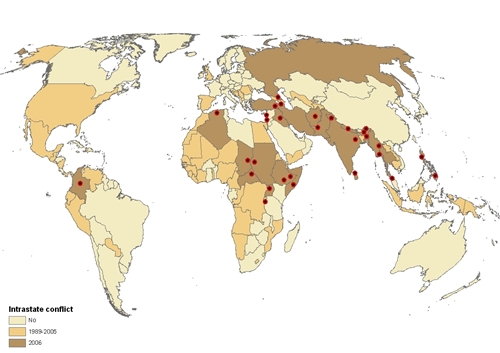
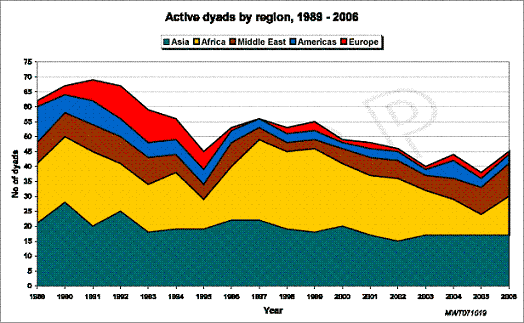
The Centre for the Study of Civil War at the International Peace Research Institute, Oslo (PRIO) and Uppsala Conflict Data Program (UCDP) at the Department of Peace and Conflict Research, Uppsala University, are the home for the Armed Conflict Dataset.  The dataset allows users access to information on such variables as name of conflict, antagonists, whether/not there was third-party intervention, etc., for all global conflicts between 1946 and 2002.  The website also has other data sources and illuminating charts and graphs, an example of which is reproduced below.

dyads_year_reg1.gif

This chart shows the number of conflicts in various regions of the world over time.

Thanks in part to Hillary and “Obama-san”, fresh image of U.S. Abroad

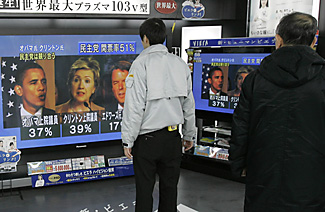
In Chapter 5, Mingst discusses two main categories of the power of states–tangible and intangible. Amongst the intangible sources of power are national image, public (whether domestic or international) support, and leadership. Based on this article in the Christian Science Monitor, the Democratic primary seems to have increased the level of tangible U.S. power.

Regardless of which Democrat pulls ahead as the candidates race toward Nevada and South Carolina, the rapid political rise of a Harvard-educated Illinois senator with a Kenyan father is bringing ripples and some tides of excitement in the near and far corners of a weary world.

Who’s The One? Japanese watched the results of the New Hampshire Democratic primary in Tokyo Wednesday. Shizuo Kambayashi/APIt’s clear that the buzz around America’s first realistic black candidate has fed the imagination of many non-US observers, who see the controversial superpower as offering something different…

…”[Barack Obama is] what the rest of the world dreams America can be,” says JacquesMistral, a transatlantic specialist and director of economic studies at the French Institute for International Relations in Paris. “He looks like a Kennedy type, and that he’s black is very new. In Europe, the idea that a woman can win is accepted. But for a black person to win would represent a radical change – for the US, and the world.”

It is too early to say that “Obama-mania” is sweeping the planet, particularly after the junior senator’s second place showing in New Hampshire. The public in Europe and Asia have only recently focused on Mr. Obama, though in Africa he’s been news for some time.

But in a world where nearly every poll shows America’s image seriously dragging after the Iraq war onset, and scant interest in Republicans, Obama has made a significant splash, especially among the young…

…In Japan, where US elections are sometimes taken more seriously than the election of the Japanese prime minister, the rise of Obama is as intriguing a subject as the romance between French President Nicolas Sarkozy and the Italian singer Carla Bruni.

“Obama-san is great,” says Azusa Shiraishi, a sophomore at Seinan Gakuin University in Fukuoka. She compares Obama with the Rev. Martin Luther King Jr. and thinks “he could bring different perspectives of the US to us as well as American people. That would be great.”

Roundtable–Globalizing Sport: National Rivalry and International Community in the 1930s

As we discussed in PLSC250, Woodrow Wilson set out an idealistic vision of the post-WWI world in his famous “Fourteen Points” address to Congress in 1918. As we all know, the vision was almost immediately undermined and finally turn asunder when Nazi Germany showed the rest of Europe–and the world–that military and economic power would triumph over cooperation and peace. Barbara J. Keys has written a compelling monograph on a little-researched aspect of that era–the role of sport in international politics. Of course, many are familiar with Hitler’s use of the Berlin Olympics in 1936 as a propaganda tool, but that is but one event. In Globalizing Sport: National Rivalry and International Community in the 1930s, Keys demonstrates “how sports revealed international contact zones as well as distinctive qualities of nationhood.”*   Here is a lengthy excerpt from Thomas Zeiler’s introduction to a roundtable at H-Diplo on the Keys’ book:

  “I see great things in baseball.”  Although we cannot confirm that poet Walt Whitman actually authored this famous quote back in the 1840s, we do know that he later believed the sport to be a shaper of American character that reflected the country’s democratic institutions, striving disposition, and rising geo-political and economic greatness.  In the
middle of the next century, intellectual historian Jacques Barzun also viewed the sport as a mirror of national traits.  In God’s Country and Mine:  A Declaration of Love Spiced with a Few Harsh Words (1954), he offered the oft-quoted words, “Whoever wants to know the heart and mind of America had better learn baseball.”  A half century after this publication, we come to Barbara Keys’ masterful work on how sports revealed international contact zones as well as distinctive qualities of nationhood.  Arriving in the age of globalization, her study properlysituates sports as a transnational movement amidst and between the national of Whitman and Barzun and the vast global arena.

Of course, as readers will discover, Keys’ focus is not on baseball, but she does examine the primary influence of nationalism on sporting events, particularly the Olympics movement and also other aspects such as athleticism and soccer.  Among many others, the main contribution of this book to the literature on diplomacy, sports, and culture regards Keys’ analysis of the tension between the manipulation of sports as an expression of national identity and sports’ position as a transnational carrier of culture abroad. 

*From Zeiler’s introduction to the roundtable in H-Diplo.

Call for Papers for Human Rights, Individualism, and Globalization

Bethany College in West Virginia is hosting a conference this April on the general theme of human rights, individualism, and globalization.  There will also be a panel dedicated to  an undergraduate research paper competition, and an award will be given to the best undergraduate research paper.  There are two conflicting deadlines, but the earlier one is February 21st, by which date you must send a 150-word abstract of your proposed paper topic, which would then have to be completed (assuming your proposal is accepted) by April 10th.

According to the conference website, some suggested topics are:

Cultural Narcissism; The Lonely Planet—Literature; Film and Art; Alienable Vs Inalienable Human Rights; Documenting Human Rights Abuse; Film; Art; Literature; Imagining a Human(e) Community; Common sense and Common Selves; Self Reflection and the Reflected Self; Global Orders Private Lives; The Law and Practice of Human Rights; Abolition of Slave Trade; Refugees and Forced Migration; Nationalism and Ethnicity; Diplomacy and Human Rights; Human Rights and Religious Expression ;Trafficking in Persons and Drugs; Human Rights and Globalization; Democracy; Political Rights and Human Rights; Democracy and Political Activism; NGOS and Human Rights; Rights of Women; Rights of Children; Human Rights and Diversity in the Workplace; Preventing Harassment and Discrimination in the Workplace; Human Rights and Labor Exploitation; Human Rights and the Environment; War Crimes and Terror; Transnational Politics and Globalization; Gandhi’s view on Globalization; Poverty and Globalization; Globalization as a Sophisticated Form of Colonization; Outsourcing; Capitalism and Worker’s Union; Anti-terrorist Measures and International Human Rights; Gangs; Violent Crime and Security; Racism and the Multicultural Self; Social Responsibility and Labor Rights; Objectivist Framework of Individualism; Privacy Rights and Communications Technology; Genetic Engineering and Human Rights.

I encourage you to send a proposal and you could use your blogs as the basis for a research paper to present at this conference.  There is more information at the conference website.

The USA’s Place in the World in 2016?

I posted earlier some excerpts from Daniel Drezner’s article envisioning what a post-Bush administration American foreign policy may look like, In a similar vein, here are some snippets from a piece in the New York Times Magazine written by Parag Khanna* that try to predict the nature of US power and authority at the end of 2016. The article is entitled “Waving Goodbye to Hegemony.” Do you think that the United States will lose its hegemonic status by 2016? What about the challenges from an integrated Europe and a rising China? I encourage you to read the whole article. If we have time, we will read this at the end of the semester.

But the distribution of power in the world has fundamentally altered over the two presidential terms of George W. Bush, both because of his policies and, more significant, despite them. Maybe the best way to understand how quickly history happens is to look just a bit ahead.

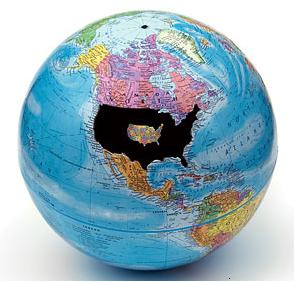
It is 2016, and the Hillary Clinton or John McCain or Barack Obama administration is nearing the end of its second term. America has pulled out of Iraq but has about 20,000 troops in the independent state of Kurdistan, as well as warships anchored at Bahrain and an Air Force presence in Qatar. Afghanistan is stable; Iran is nuclear. China has absorbed Taiwan and is steadily increasing its naval presence around the Pacific Rim and, from the Pakistani port of Gwadar, on the Arabian Sea. The European Union has expanded to well over 30 members and has secure oil and gas flows from 27world3-450.jpgNorth Africa, Russia and the Caspian Sea, as well as substantial nuclear energy. America’s standing in the world remains in steady decline.

Why? Weren’t we supposed to reconnect with the United Nations and reaffirm to the world that America can, and should, lead it to collective security and prosperity? Indeed, improvements to America’s image may or may not occur, but either way, they mean little. Condoleezza Rice has said America has no “permanent enemies,” but it has no permanent friends either. Many saw the invasions of Afghanistan and Iraq as the symbols of a global American imperialism; in fact, they were signs of imperial overstretch. Every expenditure has weakened America’s armed forces, and each assertion of power has awakened resistance in the form of terrorist networks, insurgent groups and “asymmetric” weapons like suicide bombers. America’s unipolar moment has inspired diplomatic and financial countermovements to block American bullying and construct an alternate world order. That new global order has arrived, and there is precious little Clinton or McCain or Obama could do to resist its growth.

Remember that when I post snippets from articles, that in no way suggests that I agree with what the author is saying. I alert you to them mostly because they introduce or mention concepts, theories and ideas that we discuss in class and also to show you get you to think critically about claims and assertions made by the author(s). To which theory of international relations do you think the author is an adherent? Why? What evidence in this article can you find to support your assertion?

*Parag Khanna is a senior research fellow in the American Strategy Program of the New America Foundation. This essay is adapted from his book, “The Second World: Empires and Influence in the New Global Order,” to be published by Random House in March.


South Carolina Democratic Primary, Institutional Legacies, and Generational Change

In class on Thursday, I defined institutions and described some of their major characteristics, the most important of which is that an institution endures, sometimes despite the significant impetus for change driven by changing political, social, economic, and technological sources. Last night’s Democratic primary exit polls in South Carolina provide a glimpse into the institution known as the Democratic primary and how that institution has endured over time. Here is a portion of the exit polls from CNN:

sc_primary_exit_polls1.jpg

Notice the three red boxes, which confirm that Obama was able to win a landslide victory in South Carolina despite receiving only 15% of the 60-and-older non-black vote. So what, you may respond, a pattern has emerged showing Obama captures much more support from the under-30 crowd than the over-60 cohort. But if you look at the over-60 black vote, you’ll see that they voted overwhelmingly in favor of Obama. The complete story here is the institutional legacy of the Democratic party in the South and the impact of generational change on the nature of the party. When we cover political attitudes and ideologies in about two weeks time, we’ll read Ronald Inglehart’s work, in which he highlights the importance of inter-generational changes in attitudes brought about by exposure to epoch-changing events. Lyndon Johnson’s signature on the Civil Rights Act in 1964 was just such an event.

Design a site like this with WordPress.com
Get started