Poor Countries, Agriculture, and IMF Policies

There has been a rapid increase in food prices over the last couple of years, seen most dramatically in the recent 30% one-day rise in the price of rice worldwide.  This is putting tremendous pressure on the poor and is leading to instability in countries around the world.  There have been violent demonstrations–and equally violent government responses–to food rioting in Egypt and Haiti in the last couple of weeks.  They may be but a harbinger of the economic and political instability to come.  Here is a report from the BBC, in which an expert argues that IMF policies have contributed to the rise in food prices:

“Poor countries need to invest heavily in agriculture to feed their people.  There’s been a dearth of investment in agriculture in poor countries, mainly because of IMF and World Bank policies…”

The IMF and the World Bank–The New “Global Masters”

Here is an excerpt from a documentary on the World Bank and the IMF, entitled “The New Rulers of the World,” by John Pilger.

…And at no extra cost, US Congressman Ron Paul (R-TX) unloads on the World Bank with both barrels:

“The World Bank is an organization that is not devoted to capitalism, or to the free market, but to state-run corporate capitalism…the World Bank promotes managed trade by which politically connected individuals and corporations enrich themselves at the expense of the poor and the middle class.”

The Bretton Woods System and the International Financial System

Anticipating the end of World War II, world leaders gathered in the New Hampshire town of Bretton Woods to create the financial architecture of the post-war global financial system.  The three main pillars were the World Bank, the IMF (both of which were created) and the International Trade Organization (this was never built but the governing philosophy behind it eventually gave rise to the General Agreement and Trade and Tariffs (GATT), which morphed into the World Trade Organization (WTO).  We’ll discuss these institutions in much more detail beginning Monday.

Here is an excerpt from a newsreel describing the meetings at Bretton Woods in 1944:

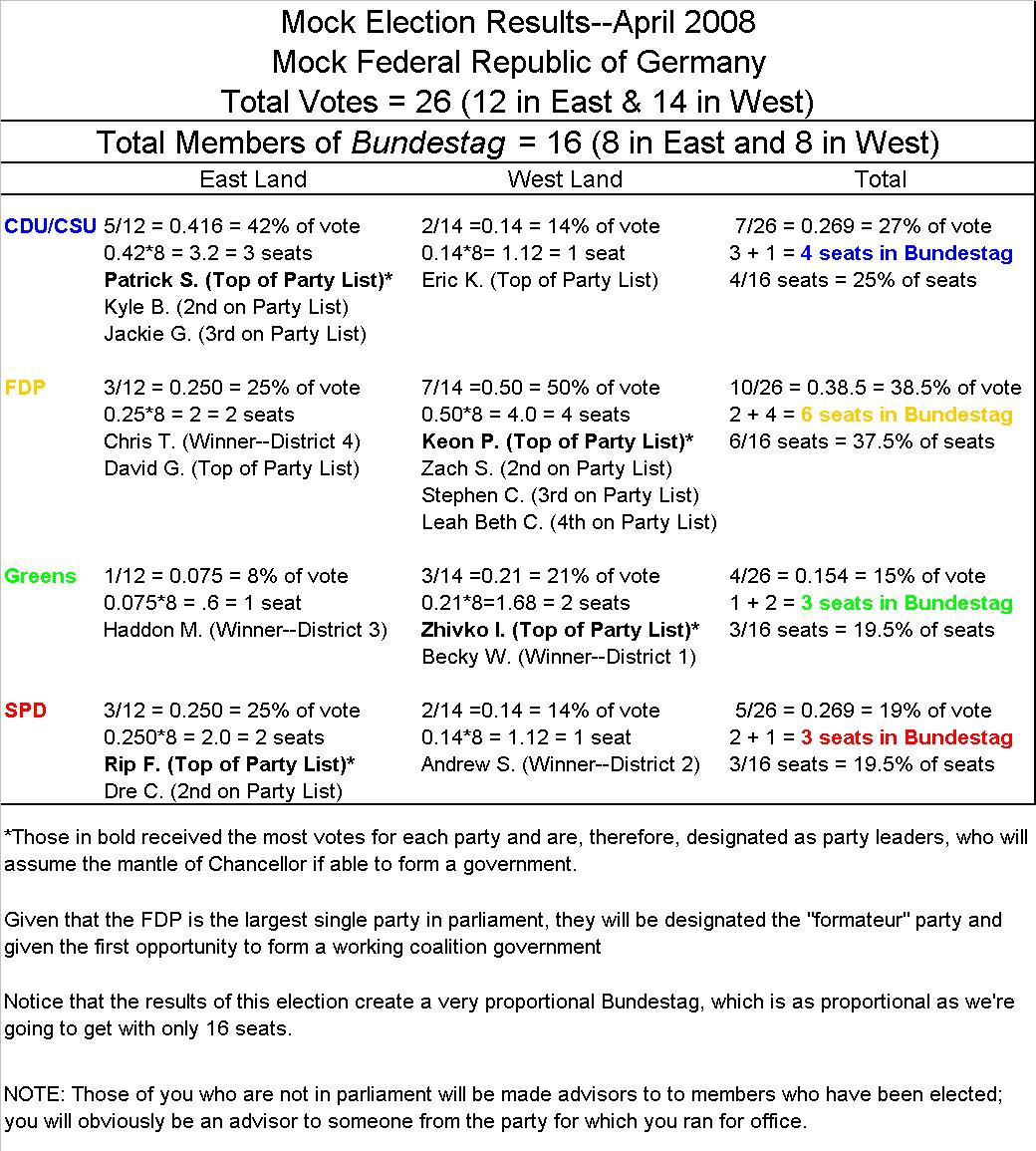
FDP Wins Plularity of Bundestag Seats in Mock German Election–Spring 2008

[UPDATE: I made a mistake when I was initially tabulating results, necessitating a slight change in the composition of the Bundestag. As it now stands, the problem occurred in West Land, where is seems some poll workers had imbibed a little bit too much of that noted Bavarian beverage, bier. A recount (which is easy given that paper ballots were used) results in the following change: one more mandate for the FDP in West Land–I’ve slotted in the 4th candidate from the FDP party list from that Land–and one fewer mandate for the SPD in the same Land. Therefore, the final results are FDP-6; CDU-4; Greens-3; SPD-3. The party leader of FDP will still be given the role of party formateur.]

[UPDATE 2: The aforementioned poll workers have been fired and are now in AA.]

[UPDATE 3: Please see below how the adviser roles have been distributed.]

Here are the results from the mock election to the lower house of the German Reichstag held this afternoon. Those of you who were not elected to represent your district or Land in the Bundestag will nonetheless also be actively involved (as advisers to your fellow party members) in the second part of the simulation–negotiations to form a government. I will send more instructions regarding that portion of the simulation later this weekend. As you can see below, the FDP has won a plurality in the Bundestag and will be given first crack at putting together a workable coalition, trying to reach a formal agreement with one of the other parties. Signing coalition agreements with either the CDU/CSU or the SPD are most likely (given that there is a total of 16 seats in our parliament) but don’t count out a coalition with the Greens either.

As I mentioned earlier, I’ll have more information regarding the specifics of the coalition negotiations and also post a sample coalition agreement form on Blackboard later, but in the meantime think about the most important elements of the negotiation process:

  1. Which party/parties will form the government? Remember you need a majority in parliament to vote the new government into power.
  2. Who will become the Chancellor (i.e., the Prime Minister)?
  3. What will be the general orientation of the government’s policy-making agenda? Given the campaign pledges you made (either to your district and/or your Land) can you plausibly vote for a government that is dedicated to carrying out this policy agenda?
  4. What about some of the policy specifics? Changes to the citizenship law? Higher taxes on carbon emitting industries? Higher (lower) income/consumption taxes? Anything else of importance to you or your district/Land?
  5. Who will get which Ministerial Portfolios? Who will become Foreign Minister? Minister of the Environment? Minister of Health? Minister of Finance? Minister of Justice? Minister of Labor?
  6. Which individuals will be given these portfolios?

I will set up a new folder in the Discussion Board section of Blackboard so that you can all begin the “feeling out” process prior to the official negotiations on Tuesday afternoon.

Click here to see the current members of the German Federal Cabinet (which is the Chief Executive), which is made up of the Chancellor (currently Angela Merkel) and 15 Cabinet ministers.

NOTE: You will notice that some of you who ran for election in districts have nonetheless been elected to parliament on the basis of party lists. I had to do this, given the relatively small number of students in the class. In general, the party lists are much larger than the ones you saw on your ballots as there were simply not enough students and I wanted to have four SMDs. Therefore, where it was warranted, I moved non-SMD-winners over to party lists (i.e., when the proportion of votes generated a number of seats for that party in excess of the number of individuals on the party list. Of course, this would never happen in a real German election as the party lists always have many more candidates than the party will end up earning on the basis of PR. I’ll go over this on Tuesday.

Here are the advisers and the party member whom you will be advising over the course of the government formation negotiations on Tuesday.

Reagan to Gorbachev–“Tear Down This Wall”

Getting ready for our mock German election tomorrow has me thinking about the German political system, the respective political parties, and German reunification.  It reminded me of this famous speech by President Ronald Reagan at Brandenburg Gate in (West) Berlin.

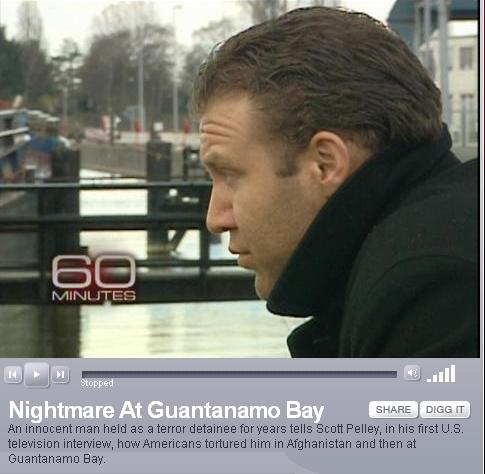
60 Minutes Report on Torture in Guantanamo Bay

Via the CBS news program 60 Minutes, we learn about a German resident of Turkish origin who was tortured by his captors in Afghanistan and Guantanamo Bay.  From the description:

An innocent man held as a terror detainee for years tells Scott Pelley, in his first U.S. television interview, how Americans tortured him in Afghanistan and then at Guantanamo Bay.

You can find the video report here.

Lecture on German Political Parties April 17th

Talk about serendipity!  We will finish our mock German election and government formation simulation on Tuesday, April 15th and two days later there will be a guest lecture on campus by Dieter Dettke, Visiting Scholar at the American Institute for Contemporary German Studies and Adjunct Professor at Georgetown University, Security Studies Program.  on “Is Germany Moving to the Left?  The Changing German Party System.

You can find below a copy of the flyer announcing the lecture, which will begin at 5:30 at the Gottwald Science Center Auditorium.  I’ll see you there.

The Richmond Eric M. Warburg Chapter

of the American Council on Germany

cordially invites you to a

Discussion and Reception

with

Dr. Dieter Dettke

Visiting Scholar at the American Institute for Contemporary German Studies and

Adjunct Professor at Georgetown University, Security Studies Program

on

“Is Germany Moving to the Left?

The Changing German Party System"

Thursday, April 17, 2008

5:30 – 6:45 pm

at

The University of Richmond, Gottwald Science Center Auditorium

Directions: If coming from Three Chopt Road, turn onto Boatwright Drive and continue straight ahead at the welcoming wall at the bottom of the winding hill (do not turn left for the main campus gate). After passing the Robins Center on your left and a large parking lot on your right, proceed for another 300 yards on College Road to the Westhampton entrance on your left. (If coming from River Road, turn onto College Road and turn right into the Westhampton entrance.) Continue on Keller Road to the Modlin Center and pass through the archway. Opposite the stop sign are parking spaces in front of the Westhampton Deanery and even more spaces between it and the cafeteria and science center. The science center auditorium is in the Gottwald Science Center across from the cafeteria. (In case the above parking spaces are full,  there is a parking lot behind the Modlin Center which you can access by turning right at the stop sign or left if exiting the parking lot across from the stop sign.)

If you have any questions, please contact Dr. Arthur B. Gunlicks,

Dr. Dieter Dettke is currently a visiting scholar at the American Institute for Contemporary German Studies and Adjunct Professor at Georgetown University, Security Studies Program. He is working on a book on German foreign policy and transatlantic relations – with the working title “In Search of Normalcy: German Foreign and Security Policy Between Realpolitik and the Civilian Power Paradigm.” He has also been a fellow at both the Woodrow Wilson Center and the German Marshall Fund of the United States.

From 1985 to 2006 he served as US Representative and Executive Director of the Washington Office of the Friedrich Ebert Foundation – which is affiliated with Germany’s Social Democratic Party (SPD). Prior to his work with the Ebert Foundation, Dr. Dettke was Political Counsellor of the SPD Parliamentary Group of the German Bundestag (1974 – 1984) and Staff Director of the Working Group on US-German relations. In this capacity, he coordinated all foreign, security and defence policy related issues on the agenda of the German Bundestag and the Committees for Foreign Affairs, Defence, German-German relations, Development Policy and European Affairs.

He has lectured frequently in Europe and the United States on transatlantic relations, German-American security issues and European-American economic relations. He has also presented papers, acted as a discussant and/or chair at U.S. and international conferences of the American Political Science Association, the International Studies Association, the German Studies Association and the American Association of Slavic Studies. In addition, Dr. Dettke testified in Congress on the implications of German unification for the United States and US-European relations.

Dr. Dettke has appeared on the News Hour with Jim Lehrer, C-SPAN, Voice of America as well as other American, German, Swiss, and British television and radio programs to discuss issues and developments related to domestic and foreign policy developments in Europe and the United States. Dr. Dettke studied political science and law at the universities of Bonn and Berlin (Germany) and Strasbourg (France). He was a Fulbright Scholar at the University of Washington in Seattle (1967/68).

Mock German Election and Government Formation Simulation

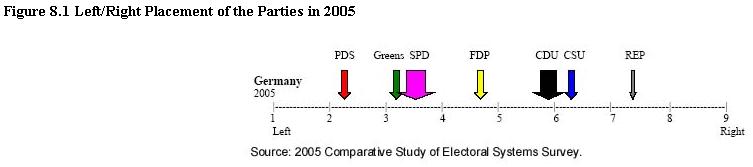
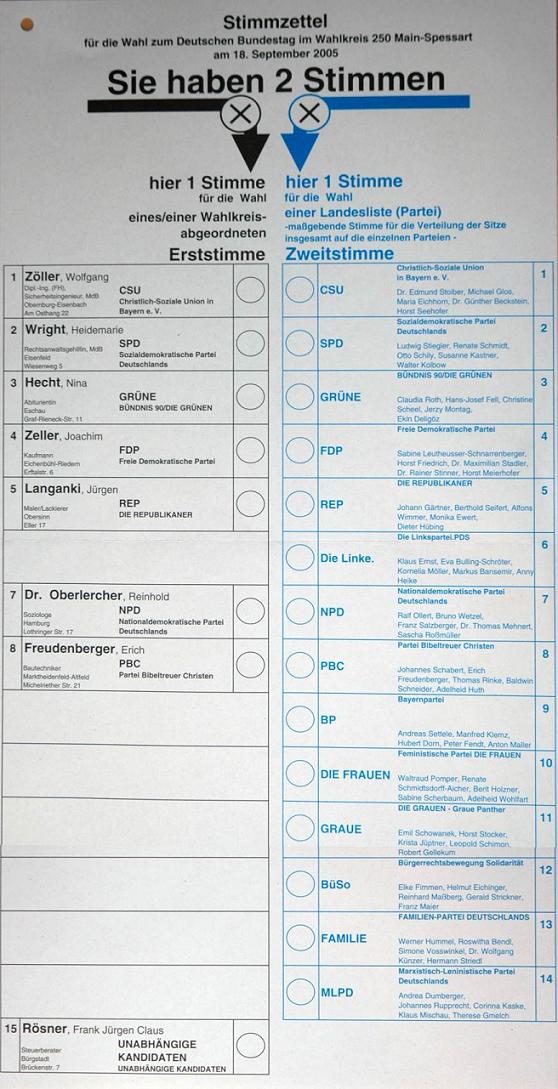
Here is a great link to information about the German electoral and political party system. You can find all sorts of information and links (to youtube videos even!) related to German political parties and the electoral system. Here are a couple of images from the link above:

The first is a one-dimensional left-right placement of political parties. Remember that given our relatively small class size, you will be a representative of only one of four parties–CDU/CSU, FDP, SPD, Green Party. [Update: I notice that they have the CDU and CSU listed as separate parties, which they technically are.  As I noted in the assignment instructions, the CSU is essentially the CDU, but in Bavaria.  They always forms coalitions in the Bundestag when deciding on government formation.]

The second image is the unique two-vote electoral ballot; remember that Germans get to vote twice–once for a candidate to fill one of the 299 single-member districts, and once for a party list in a multi-member district. You’ll notice the left side of the ballot has the individual candidate’s name prominently displayed, whereas the party-list side (the right-side of the ballot) has the party name prominently displayed.

Here’s a nice breakdown of the characteristics of demographic support for each of the parties during the 2005 Bundestag elections, the result of which was a “grand coalition” between Angela Merkel’s CDU/CSU (Merkel was voted in by parliament as the Chancellor) and Gerhard Schroeder’s SPD.

Catholic Church’s View of Torture–Another Post in Support of My Anti-Torture Jeremiad

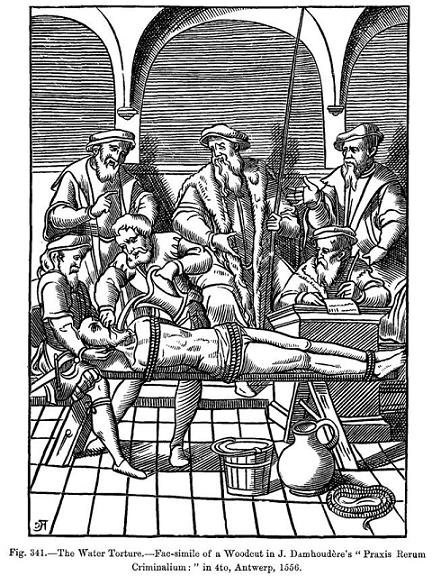
Tomorrow, we will address the morality of torture from both deontological and consequentialists viewpoints. Here I’d like to refer you to what a prominent relatively orthodox Catholic believes about the Catholic Church’s teachings regarding the morality of torture. The Catholic Church knows what of it speaks as it attempted to water-board” Jews into accepting the tenets of the Catholic faith in Spain centuries ago. Mark Shea writes this about the Catholic Church’s views on torture (I encourage you to read his whole post):

The Church’s basic teaching on torture is laid out in Veritatis Splendor 80 (followed by a discussion of what the Holy Father means by “intrinsically immoral” acts). VS cites, I believe, Lumen Gentium and Gaudium et Spes (though I could be wrong and my memory is groggy this early). The Church does not define what torture is (leaving that matter to common sense and to the specialized knowledge of those whose job it has historically been to know such as police, judges, interrogators, philosphers, and other people of good will who operate in the field where interrogation and police work must be done).

The basic guidelines the Church proposes are pretty simple

1. Don’t do evil that good may come of it. [This is about as strong an injunction against consequentialism as is possible.]
2. Some things are intrinsically evil, meaning you *can’t* do them under any circumstance.
3. Torture is one of these things.
4. If you are confused about what “torture” is, then bear in mind the Church’s *other* command, which is that we must treat prisoners humanely, not merely “not torture them”. Aim for that, and you won’t accidently torture them.
5. Seek the intelligence you need while bearing in mind the above.

Some of the basic attempts to justify the use of torture are:

Watch Video Animations of U.S. Carbon Dioxide Pollution

Here is a video of a graphic representation of C02 emissions over the continental United States.  Here is a description of the video’s contents:

A new, high resolution, interactive map of United States carbon dioxide emissions from fossil fuels has found that the emissions aren’t all where we thought. The maps and system, called Vulcan, show CO2 emissions at more than 100 times more detail than was available before. Until now, data on carbon dioxide emissions were reported, in the best cases, monthly at the level of an entire state grid. The Vulcan model examines CO2 emissions at local levels on an hourly basis. Purdue researchers say the maps are also more accurate than previous data because they are based on greenhouse gas emissions instead of estimates based on population in areas of the United States.

From thedailygreen.com, we find more information about the details of carbon emissions here in the United States:

Just where is all that global warming pollution coming from?

The Northeast pumps out an awful lot of carbon dioxide, but the Southeast, Midwest and Southern California are also responsible for voluminous pollution that billows out each day.

The precise sources of carbon dioxide have now been mapped, with 100-times more detail than was previously available, by Vulcan project researchers at Purdue University.

The high-resolution, interactive maps combines emissions data from power plants, factories and vehicles, and produces maps and movies that compare the relative contribution of pollution from various parts of the country on an hourly basis. One of the most striking things one sees when watching the animations is the day-night “breathing” cycle of our pollution, with a long exhale of pollution all day, followed by a sharp decline each night. Seasonal spikes – such as those when hot days prompt millions of Americans to turn up their air conditioners – are also evident.

Design a site like this with WordPress.com
Get started