Pope Benedict XVI a Foreign Policy Radical

The Pope delivered a speech last week to the United Nations in which he argued–as have many radicals over the last few decades–that the will of the international community to act in order to solve important global problems is being undermined because a few states have accrued too much power.  The Associated Press has more:

NEW YORK – Pope Benedict XVI warned diplomats at the United Nations on Friday that international cooperation needed to solve urgent problems is “in crisis” because decisions rest in the hands of a few powerful nations.

In a major speech on his U.S. trip, Benedict also said that respect for human rights, not violence, was the key to solving many of the world’s problems.

While he didn’t identify the countries that have a stranglehold on global power, the German pope — just the third pontiff to address the U.N. General Assembly — addressed long-standing Vatican concerns about the struggle to achieve world peace and the development of the poorest regions.

On the one hand, he said, collective action by the international community is needed to solve the planet’s greatest challenges.

On the other, “we experience the obvious paradox of a multilateral consensus that continues to be in crisis because it is still subordinated to the decisions of a few.”

The pope made no mention of the United States in his speech, though the Vatican did not support the U.S.-led invasion of Iraq in 2003, which occurred despite the Bush administration’s failure to gain Security Council approval for it. At other moments on his trip, Benedict has been overtly critical of the U.S., noting how opportunity and hope have not always been available to minorities.

The pope said questions of security, development and protection of the environment require international leaders to work together in good faith, particularly when dealing with Africa and other underdeveloped areas vulnerable to “the negative effects of globalization.”
Flu Viruses’ Global Pathways Largely Predictable

We’ll be addressing globalizing issues in intro to IR on Monday and this interesting story in the Washington Post from a couple of days ago illustrates some of the important concepts raised in Chapter 10 of Mingst.

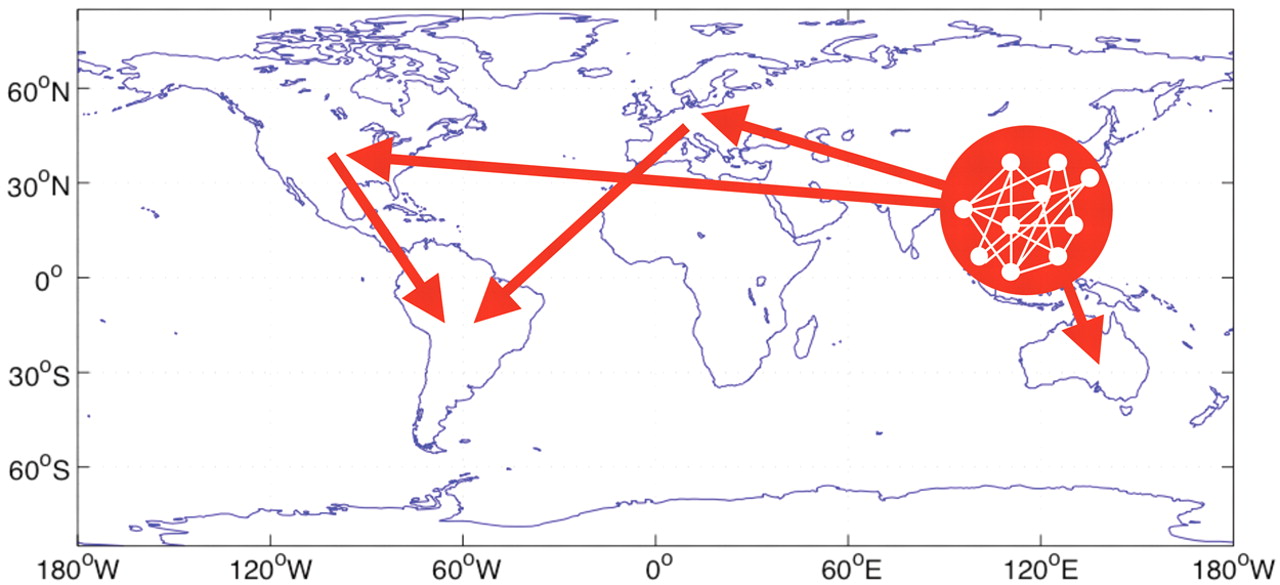
New strains of seasonal influenza virus all arise in East or Southeast Asia and take a largely predictable route around the world before dying out for good in South America, the global glue-trap for the pathogen.

That is the conclusion reported yesterday by a large team of researchers who analyzed the genetic ancestry of about 13,000 virus samples collected from six continents over a five-year period to answer long-standing questions about the flu’s life cycle.

The findings help explain the biological mechanisms that underlie two long-held observations about flu: New strains tend to appear first somewhere near China, and Australia’s flu season is a preview of what will happen in North America six months later. They also help explain why one winter’s flu is always at least a little bit different from the previous winter’s, even though the virus disappears over the summer…

But why is East-Southeast Asia always the starting point? The researchers believe it’s because of the unusual concentration of different climates there. The region has both tropical environments, where flu flourishes during the rainy season, and temperate zones. There are places that are relatively close — Russell cited Bangkok and Kuala Lumpur, Malaysia, 700 miles apart — that have totally different flu seasons.

This effectively allows new strains to be passed around the region like a baton in a relay race, even though in each climate zone the virus completely dies out once a year.

The reason new variants don’t cause epidemics if they are carried back to East Asia from elsewhere is because people already have immunity to them. They’re old news. At least that’s the theory.

Here, from Science magaizine (subscription only) is a chart demonstrating the global spread of flu viruses.

CDU and Greens form Coalition Government in Hamburg

ollowing our mock election and government formation simulation, I thought it might be of interest to you to note that the CDU and the Green Party of have formed an historic alliance in the city-state government of Hamburg (Hamburg is one of the sixteen German states, or Lander). Der Spiegel (the German equivalent of Time magazine) has more on the new coalition government.

Hamburg mayor Ole von Beust, a Christian Democrat, has found \

The conservative Christian Democrats and the environmental Green Party have long been skeptical of one another. But now, the two have joined forces to form a government in the German city-state of Hamburg.

Members of the German Green Party and the conservative Christian Democrats (CDU) have arrived at an agreement “in principle” to govern together in Hamburg, SPIEGEL ONLINE has learned from Green Party sources. It would be the first CDU-Green coalition at the state level in German politics.

We just have to put it in writing,” said the source, who asked not to be named. “It’s just a matter of the preamble (to the coalition agreement), and such things.”

The coalition agreement will reportedly be unveiled late Thursday — which implies that some points of disagreement, like a Hamburg-area schools policy and the fate of two coal-fired power plants, have been settled.

“We have nothing else to discuss in a full meeting,” said a spokeswoman for the Greens, Antje Möller, after the last round of talks on Wednesday. The two sides had reached an understanding, she said, on “the points which still remained.”

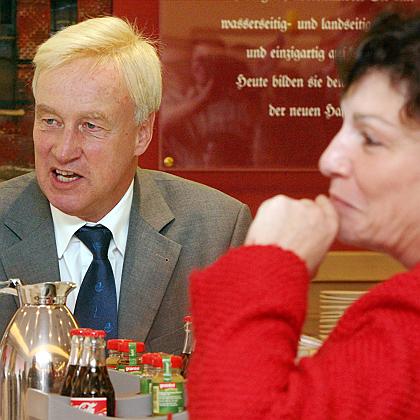
(Picture Caption:Hamburg mayor Ole von Beust, a Christian Democrat has found “common ground” with Green leader Christa Goetsch.)

Iraq is a Minefield

Have any of you ever realized that you just may be in a minefield? It’s a difficult conundrum because you don’t want to just stay there, but you also don’t want to move. It seems as though there is no good choice to make. That, according to an analyst at the National Defense University, is the US fate in Iraq currently.

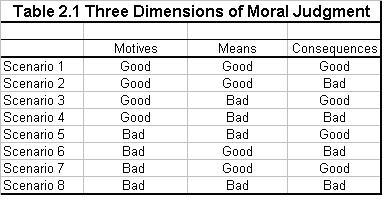
During our relatively short discourse into international ethics, we discussed Table 2.1 from Amstutz’s book, which demonstrates the Three Dimensions of Moral Judgment.

Here it is:

We notice that in order to evaluate the morality of a foreign policy decision, we must judge the motives behind the decision, the means used, and the final result of the decision. A new paper by Joseph J. Collins, of the Institute for National Strategic Studies of the National Defense University analyzes the Bush administration’s decision to invade Iraq in 2003. According to the author,

To date, the war in Iraq is a classic case of failure to adopt and adapt prudent courses of action that balance ends, ways, and means.

The paper is an interesting and nuanced read and I encourage you to take a look. Here is the first page:

Measured in blood and treasure, the war in Iraq has achieved the status of a major war and a major debacle. As of fall 2007, this conflict has cost the United States over 3,800 dead and over 28,000 wounded. Allied casualties accounted for another 300 dead. Iraqi civilian deaths—mostly at the hands of other Iraqis—may number as high as 82,000. Over 7,500 Iraqi soldiers and police officers have also been killed. Fifteen percent of the Iraqi population has become refugees or displaced persons. The Congressional Research Service estimates that the United States now spends over $10 billion per month on the war, and that the total, direct U.S. costs from March 2003 to July 2007 have exceeded $450 billion, all of which has been covered by deficit spending. No one as yet has calculated the costs of long-term veterans’ benefits or the total impact on Service personnel and materiel.


The war’s political impact also has been great. Globally, U.S. standing among friends and allies has fallen. Our status as a moral leader has been damaged by the war, the subsequent occupation of a Muslim nation, and various issues concerning the treatment of detainees. At the same time, operations in Iraq have had a negative impact on all other efforts in the war on terror, which must bow to the priority of Iraq when it comes to manpower, materiel, and the attention of decisionmakers. Our Armed Forces—especially the Army and Marine Corps—have been severely strained by the war in Iraq. Compounding all of these problems, our efforts there were designed to enhance U.S. national security, but they have become, at least temporarily, an incubator for terrorism and have emboldened Iran to expand its influence throughout the Middle East.

As this case study is being written, despite impressive progress in security during the surge, the outcome of the war is in doubt. Strong majorities of both Iraqis and Americans favor some sort of U.S. withdrawal. Intelligence analysts, however, remind us that the only thing worse than an Iraq with an American army may be an Iraq after the rapid withdrawal of that army. The 2007 National Intelligence Estimate (NIE) on Iraq’s future stability said that a rapid withdrawal “almost certainly would lead to a significant increase in the scale and scope of sectarian conflict in Iraq, intensify Sunni resistance to the Iraqi government, and have adverse consequences for national reconciliation.” The NIE goes on to say that neighboring countries might intervene, resulting in massive casualties and refugee flows. No one has calculated the psychopolitical impact of a perceived defeat on the U.S. reputation for power or the future of the overall war on terror. For many analysts (including this one), Iraq remains a “must win,” but for many others, despite the obvious progress under General David Petraeus and the surge, it now looks like a “can’t win.” To date, the war in Iraq is a classic case of failure to adopt and adapt prudent courses of action that balance ends, ways, and means.

So What does the Price of Soybeans have to do with Smog in Buenos Aires?

When I was younger, my friend’s father would often respond to our childhood rantings with the question, “but what’s that got to do with the price of tea in China?”  I still don’t really understand what it means, but in this increasingly globalized world, there is a direct causal link bewtween the price of soybeans and smog in the Argentinian capital city of Buenos Aires.  The causal mechanism is outlined in this Bloomberg news report:
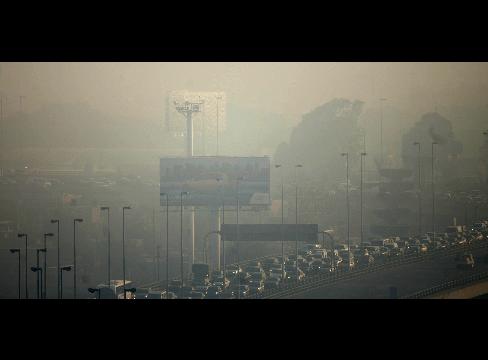
April 17 (Bloomberg) — Smoke from fires set by farmers to clear fields for grazing covered the city of Buenos Aires and shut down some highways leading into the Argentine capital.

Interior Minister Florencio Randazzo called the smoke a “disaster” and said 292 separate fires covering 70,000 hectares (173,000 acres) had been detected in the provinces of Buenos Aires and neighboring Entre Rios.

Farmers are burning more land as they create pastures for cattle that previously grazed fields now dedicated to soybeans, said Randazzo.  An 89 percent increase in soybean futures prices in the past year, part of a global explosion in food costs, has prompted Argentine farmers to increase the area sown to the oilseed by 10 percent, according to the Agriculture Secretariat.

“Those responsible are farmers who are burning their meadows to cut costs and maximize profits without considering the consequences,” said Randazzo in a news conference at the Presidential Palace. “We are conducting investigations to find those responsible.”

Notice this chart of soybean prices below and the fact that many farmers are moving into the soybean growing business and I think we could have the potential for an intermediate-term top in the soybean market.  As in many speculative markets, many would-be speculators rush in just at (or even just after) the top has been set for that particularly stock or commodity.  It’s not a surprise the the record number of sales transactions for US real estate occurred in the month (around Summer 2005) as a top was setting in.  If I had to bet, I’d wager that many of those new soybean farmers will wish they had remained cattle farmers.

Thomas Friedman’s First Law of Petropolitics

New York Times columnist wrote a fairly interesting article in Foreign Policy magazine a couple of years entitled “The First Law of Politics.” Here are some excerpts:

When I heard the president of Iran, Mahmoud Ahmadinejad, declare that the Holocaust was a “myth,” I couldn’t help asking myself: “I wonder if the president of Iran would be talking this way if the price of oil were $20 a barrel today rather than $60 a barrel.” When I heard Venezuela’s President Hugo Chávez telling British Prime Minister Tony Blair to “go right to hell” and telling his supporters that the U.S.-sponsored Free Trade Area of the Americas “can go to hell,” too, I couldn’t help saying to myself, “I wonder if the president of Venezuela would be saying all these things if the price of oil today were $20 a barrel rather than $60 a barrel, and his country had to make a living by empowering its own entrepreneurs, not just drilling wells.”

As I followed events in the Persian Gulf during the past few years, I noticed that the first Arab Gulf state to hold a free and fair election, in which women could run and vote, and the first Arab Gulf state to undertake a total overhaul of its labor laws to make its own people more employable and less dependent on imported labor, was Bahrain. Bahrain happened to be the first Arab Gulf state expected to run out of oil. It was also the first in the region to sign a free trade agreement with the United States. I couldn’t help asking myself: “Could that all just be a coincidence? Finally, when I looked across the Arab world, and watched the popular democracy activists in Lebanon pushing Syrian troops out of their country, I couldn’t help saying to myself: “Is it an accident that the Arab world’s first and only real democracy happens not to have a drop of oil?”

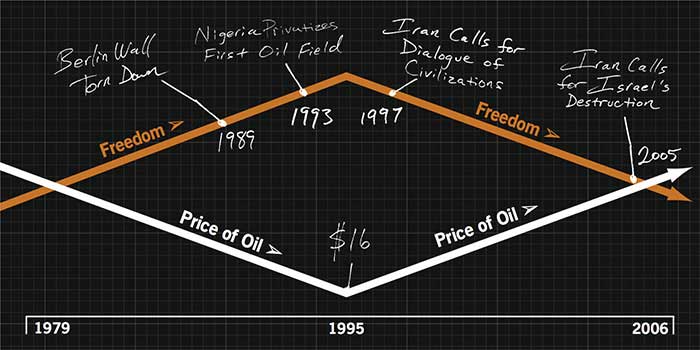
The more I pondered these questions, the more it seemed obvious to me that there must be a correlation—a literal correlation that could be measured and graphed—between the price of oil and the pace, scope, and sustainability of political freedoms and economic reforms in certain countries.

Mock German Election Simulation–Government Formation Results

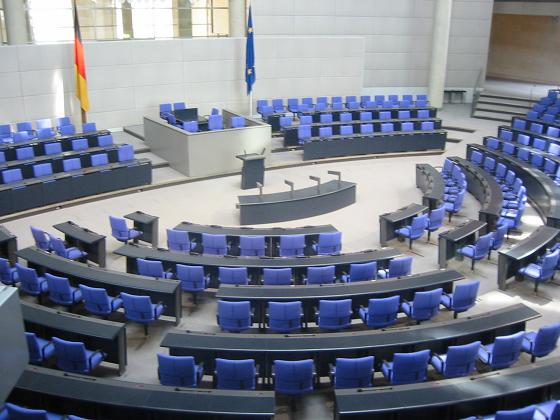
In the second part of our mock German election simulation–the government formation negotiations–we were able to get a new government voted into power by the recently elected Bundestag.  (I refer you to this post for more information about the electoral results.)

To remind you, following the election, we had the composition of the Bundestag was:

FDP–6 mandate (formateur party)

CDU/CSU–4 mandates

SPD–3 mandates

Greens–3 mandates

In order to have a secure governing coalition, a governing coalition of at least 9 mandates would be needed in this sixteen-member parliament.

The FDP were unable to convince any of the other parties to form a governing coalition with them, and the government that was voted into office, by a majority vote of 10-6 was a three-party coalition of the Greens, CDU/CSU, and the SPD.

In the end, it was the personal ambition of the CDU/CSU leader–Patrick S.–that ruled the day.  He wanted to become Chancellor and this steely determination served him well as he, with his fellow party members and advisory committee, was able to effectively forge a rather wieldy three-party governing coalition.

Why did Patrick S. want to become Chancellor so desperately?  There have been reports in some of the leading journals that it has been his dream since childhood.  But in a sit-down interview with Deutsche Welle following his ascension to the Chancellorship, Chancellor S. claimed that it was because this election was crucial to the future of the German state.  According to the Chancellor, he and his party believe that a moral crisis of epic proportions has descended upon Germany and only his party had the necessary moral acuity to set Germany back on the correct path.

The Chancellor and the six-member Cabinet is composed of the following:

Chancellor–Patrick S. (CDU/CSU)

Minister of Education–Becky W. (Greens)

Minister of the Interior–Erick K. (CDU/CSU)

Minister of the Environment–Zhivko I. (Greens)

Minister of Foreign Affairs–Kyle B. (CDU/CSU)

Minister of Health–Rip F. (SPD)

Minister of Labor–Andrew S. (SPD)

One of the advisers to the SPD commented that the SPD actually had refused to sign a coalition agreement offered to them by the FDP, which in retrospect, was better for the SPD than the one they signed ultimately.  There seemed to be a consensus within the SPD that the arrogance of the FDP had created friction between the two potential coalition partners.

I look forward to reading your impressions of the simulation exercise on your blogs.

India’s Finance Minister Calls Biofeuls a “Crime Against Humanity”

In the WSJ article reference below, it is noted that one of the reasons for the dramatic rise in food prices over the last few years has been the decision by rich countries–particularly the United States–to use agricultural products not for food, but for fuel for motor vehicles. In fact, according to this NPR report:

“The grain required to fill a 25-gallon SUV tank with ethanol will feed one person for a year,” [Lester] Brown [author of the book Plan B 3.0: Mobilizing to Save Civilization] says. “And what we are seeing now is the emergence of direct competition between the 860 million people in the world who own automobiles and who want to maintain their mobility while the 2 billion poorest people in the world simply want to survive.”

For audio of the NPR report, click the link above.

Indeed, the issue of biofeuls is more than simply a matter of geopolitics. It has come to be viewed as a moral dilemma. Once again, from the WSJ article:

“When millions of people are going hungry, it’s a crime against humanity that food should be diverted to biofuels,” said India’s finance minister, Palaniappan Chidambaram, in an interview. Turkey’s finance minister, Mehmet Simsek, said the use of food for biofuels is “appalling.”

James Connaughton, chairman of the White House’s council on environmental quality, said biofuels are only one contributor to rising food prices. Rising prices for energy and electricity also contribute, as does strong demand for food from big developing countries like China.

But beyond taking shots at the U.S., there was little agreement this weekend on what should be done.

Wall Street Journal Reports on Rise in Food Prices, Riots

The WSJ has published a report on the outcome of last week’s annual meetings of the World Bank and the IMF and how leaders there proposed to deal with the very real problem of rapidly rising food prices worldwide. For a variety of reasons, there has been a dramatic surge in the prices of all commodities, including primary agricultural products, like rice and wheat. This has already led to rioting in Haiti and Egypt (see a previous blog post here) and could lead to even more social and political unrest in developing countries around the world, where large majorities rely on rice and wheat as staple foods. Here are some excerpts from the WSJ article:

WASHINGTON — Finance ministers gathered this weekend to grapple with the global financial crisis also struggled with a problem that has plagued the world periodically since before the time of the Pharaohs: food shortages.

Surging commodity prices have pushed up global food prices 83% in the past three years, according to the World Bank — putting huge stress on some of the world’s poorest nations. Even as the ministers met, Haiti’s Prime Minister Jacques Edouard Alexis was resigning after a week in which that tiny country’s capital was racked by rioting over higher prices for staples like rice and beans.

Rioting in response to soaring food prices recently has broken out in Egypt, Cameroon, Ivory Coast, Senegal and Ethiopia. In Pakistan and Thailand, army troops have been deployed to deter food theft from fields and warehouses. World Bank President Robert Zoellick warned in a recent speech that 33 countries are at risk of social upheaval because of rising food prices. Those could include Indonesia, Yemen, Ghana, Uzbekistan and the Philippines. In countries where buying food requires half to three-quarters of a poor person’s income, “there is no margin for survival,” he said.

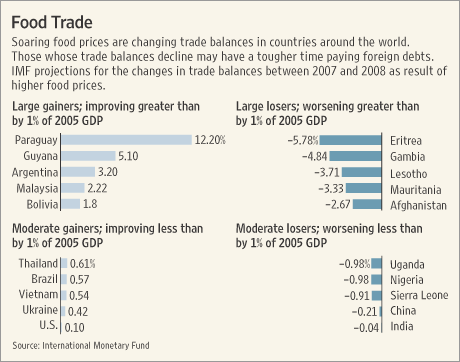
I encourage you to read the whole article, which is free on the WSJ web site. Here is a chart demonstrating how rising food prices have affected balance of payments accounts in select countries around the world. As the graphic states, worsening balance of payments figures will make it much more difficult for some countries to pay off foreign debt and provide the infrastructure necessary for further economic and social development.

Newsweek Editor Fareed Zakaria Says “No” to Olympic Boycott

In a recent column, Newsweek’s Fareed Zakaria argues that the US should not boycott the Olympic Games in Beijing this summer.  He argues that it would have the opposite of the intended effect.  Here are some snippets:

Public humiliation does not work nearly as well on the regime in Beijing as private pressure. At first glance, China’s recent crackdown in Tibet looks like a familiar storyline: a dictatorship represses its people. And of course that’s part of the reality — as it often is in China. But on this issue, the communist regime is not in opposition to its people. The vast majority of Chinese have little sympathy for the Tibetan cause. To the extent that we can gauge public opinion in China and among its diaspora, ordinary Chinese are, if anything, critical of the Beijing government for being too easy on the Tibetans. The real struggle here is between a nationalist majority and an ethnic and religious minority looking to secure its rights.

In these circumstances, a boycott of the Olympics would have precisely the opposite effect that is intended. The regime in Beijing would become only more defensive and stubborn. The Chinese people would rally around the flag and see the West as trying to humiliate China in its first international moment of glory. (There are many suspicions that the United States cannot abide the prospect of a rising China.) For most Chinese, the Games are about the world’s giving China respect, rather than bolstering the Communist Party’s legitimacy…

…Some want to punish China for its association with the Sudanese government, which is perpetrating atrocities in Darfur. But to boycott Beijing’s Games because it buys oil from Sudan carries the notion of responsibility too far. After all, the United States has much closer ties to Saudi Arabia, a medieval monarchy that has funded Islamic terror. Should the world boycott America for this relationship?

Design a site like this with WordPress.com
Get started