
Are your Political Attitudes and Ideologies Biologically Determined?

Next week (January 31) in POLI 1100, we’ll be discussing political attitudes and political ideologies. The conclusion of Chapter 5 in Dyck summarizes political ideologies nicely:

Conflicting ideologies offer us a means of understanding our society, situating ourselves in the political world, and participating in actions intended to advance our interests and those of our communities.

What is the source of any individual’s political ideological leanings? A common answer is that we are politically socialized into our ideologies. Agents of political socialization such as families, churches, educational institutions, and the media play prominent roles in the process of an individual’s ideological development. But what if we were biologically pre-disposed to our ideological views. Is there a chance that some of us are more conservative, and others more liberal, from birth, and the role that agents of political socialization is negligible? According to recent research, the answer to that question may be ‘yes’. How much of the developmental process of political ideology is nature and how much is nurture?

As much as we stake our identity on such core beliefs, it’s unlikely we emerged from the womb as little liberals or libertarians. This raises a fundamental question: At what point in our development did such predispositions begin to form, to coalesce and to harden? What is it about our biology and/or psychology that propels us toward a liberal or conservative mindset?

The question has long intrigued social psychologists such as John Jost of New York University. In a 2003 meta-analysis of 50 years of research, he summarizes the overwhelming evidence that political ideologies, “like virtually all other belief systems, are adopted in part because they satisfy various psychological needs.” Jost quickly adds that this “is not to say they are unprincipled, unwarranted, or unresponsive to reason or evidence” — only that the underlying motivation to believe in them emerges from somewhere other than the rational, conscious mind.

According to Jost, political ideologies derive from our effort to “satisfy…psychological needs.” What, though, gives rise to these psychological needs? It could very well be our biology/physiology:

Researchers at the University of Nebraska at Lincoln showed people a series of photos — some endearing, some disgusting — and then measured their physiological and cognitive reactions. Conservatives, in keeping with past literature, reacted more strongly to the negative images, and liberals strongly to the positive ones…

…“I figured because conservatives reacted more strongly to negative things, they’d be more likely to avoid them,” said Mike Dodd, an assistant professor of psychology and the study’s lead author. “That ended up not being the case. They ended up locking onto them quicker and taking more time on them, which makes sense from a policy perspective. Oftentimes they end up confronting things that they think of as threats.” [emphasis added]

Are these findings consistent with your personal experience? Are they plausible explanations for the political ideological leanings of your friends and family?

Do you even know your political ideology? Here’s a relatively painless online test you can take that summarizes political ideologies in a two-dimensional (left-right; authoritarian-libertarian) scale.

My Intro to IR Class is full of Realists

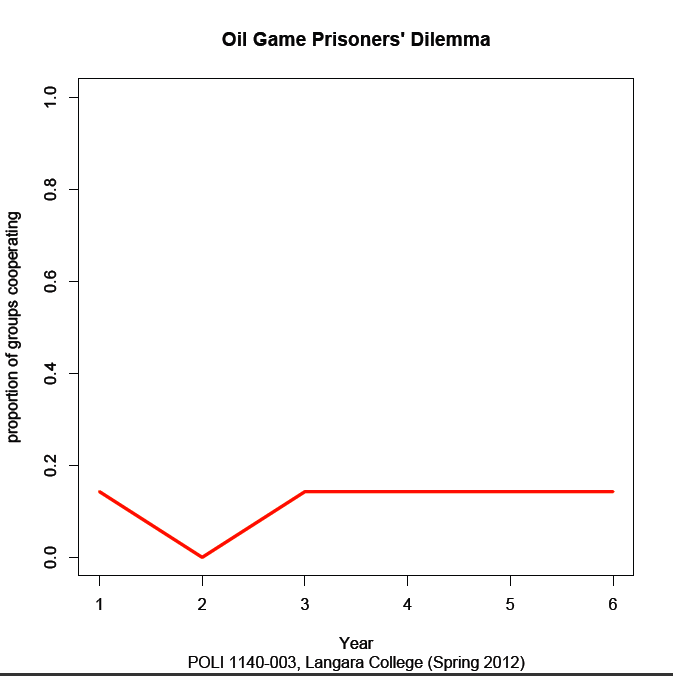
Last Tuesday in POLI 1140, the students completed an class oil-market exercise in which pairs of students engaged in a strategic situation that required them to sell oil at specific prices. Many students were able to understand relatively quickly that the “Oil Game” was an example of the classic prisoner’s dilemma (PD). As Mingst and Arreguin-Toft note on page 78, the crucial point about the prisoner’s dilemma:

Neither prisoner knows how the other will respond; the cost of not confessing if the other confesses is extraordinarily high. So both will confess, leading to a less-than-optimal outcome for both.

From a theoretical perspective (and empirical tests have generally confirmed this) there will likely be very little cooperation in one-shot prisoner’s dilemma-type situations. Over repeated interaction, however, learning can contribute to higher levels of cooperation. With respect to IR theories, specifically, it is argued that realists are more likely to defect in PD situations as they are concerned with relative gains. Liberals, on the other hand, who value absolute gains more highly, are more likely to cooperate and create socially more optimal outcomes. What were the results in our class?

The graph above plots the level of cooperation across all six years (stages) of the exercise. There were seven groups and what the probabilities demonstrate is that in each year there was only one group for which the interaction was cooperative. In year 2, there was not a single instance of cooperation. Moreover, it was the same group that cooperated. Therefore, one of the groups cooperated 5 out of 6 years, while none of the other six groups cooperated a single time over the course of the sex years!! What a bunch of realists!!

If you were involved in this exercise, please let me know your reactions to what happened.

Here’s an excellent post, which would get a grade of 4/4.

jsake's avatarsomeoriginalname

One of the most frightening events happening today is a piece of legislature that is currently being debated in U.S. Congress. The Stop Online Piracy Act or “SOPA” combined with the Protect IP Act (“PIPA”) have the ability to drastically change the face of the internet as we know it. To put it simply, it would give the Attorney General of the United States and other “Qualifying plaintiffs” (copyright holders) the ability to immediately censor any website that it deems to have committed copyright infringement whether it is a domestic or foreign domain.  This in turn would cripple many widely used social networking sites (Youtube, Reddit, Blogs, even Facebook could be severely affected) but would also severely hinder many smaller scale developers, artists and designers.

Of course, it may not be apparent to all how SOPA/PIPA relates to IR, or more specifically the IR theory referred to as “Realism” (as…

View original post 378 more words

Here’s a pretty good example of what I am looking for in your blog posts, with respect to what I want you to write. The post would be better with some links to contemporary stories/news clips illustrating the point.

sensnation's avatarsensnation

For this post i have chosen to comment on an article found in Foreign Affairs entitled, “Democratization and War” written by Edward D. Mansfield and Jack Snyder. I have chosen to write on this topic because of our discussion regarding the argument that democracies do not make war upon each other. After reading the article this thesis has its limits. The authors start their argument by mentioning that this idea is the “law” in international relations, only because the United States used it to further their aggressive foreign policy of promoting democracies across the globe. They also bring into the argument of history playing an important factor, in saying that after the Napoleonic wars, the elite halted the rise of  democracy and nationalism and there was a time of relative peace until the Crimean War. What does this mean to us today? While we see the creations of democracies outside of…

View original post 157 more words

My Tribe is my Pain

Here is a very interesting and personal account of a Ugandan’s views about identity–tribal, ethnic, national. I encourage you to read it, but here are some snippets:

If you live in Uganda you must come across these sentiments. My last name begins with Kag-Kagumire. My blog is not under that name for many reasons but this is one of them. When I say my last name to people sometimes they will say: Kaguta, so you’re from the west, Museveni’s relative etc. Even if it’s a slight joke it evokes a feeling that I can’t describe. To associate me with someone that is increasingly becoming negative makes me mad and in my tribe most times it’s okay to be mad and show it. I take time to explain to friends, sometimes gently other times with some emotion that I am from Bushenyi and I have never been to Rwakitura and that my father doesn’t own a single head of cattle. I am a private person but for the sake of clarity I am forced to talk about all these things and now i am writing about them.

Here’s another piece that implies the shifting nature of identities:

But this kind of view is not limited to the ‘uneducated’ Ugandans. A friend once told me that his Ugandan female friend hates ‘westerners’ so much that at her work place when job applications are brought in, she sorts out the west first.  This personal level of disdain for a group of people  is unfathomable. Others point out how rich you’re and how many opportunities you get. Many times I tell the people about my life which is not the most difficult one but is not any better than that of an educated person from the east, north or central.

Ethnic (cultural) diversity and public spending

We talked a little bit in class today about the link between ethnic (cultural) diversity and public spending. The empirical record seems to find that the more ethnic diversity in a polity, the less public spending–health, education, etc.–there is. A recent article in the American Political Science Review (Habyarimana et al. 2007) addresses the theoretical mechanisms that may underlie this empirical association:

A large and growing literature links high levels of ethnic diversity to low levels of public goods provision. Yet although the empirical connection between ethnic heterogeneity and the underprovision of public goods is widely accepted, there is little consensus on the specific mechanisms through which this relationship operates. We identify three families of mechanisms that link diversity to public goods provision—what we term “preferences,” “technology,” and “strategy selection” mechanisms—and run a series of experimental games that permit us to compare the explanatory power of distinct mechanisms within each of these three families. Results from games conducted with a random sample of 300 subjects from a slum neighborhood of Kampala, Uganda, suggest that successful public goods provision in homogenous ethnic communities can be attributed to a strategy selection mechanism: in similar settings, co-ethnics play cooperative equilibria, whereas non-co-ethnics do not. In addition, we find evidence for a technology mechanism: co-ethnics are more closely linked on social networks and thus plausibly better able to support cooperation through the threat of social sanction. We find no evidence for prominent preference mechanisms that emphasize the commonality of tastes within ethnic groups or a greater degree of altruism toward co-ethnics, and only weak evidence for technology mechanisms that focus on the impact of shared ethnicity on the productivity of teams. (my emphasis)

Thus, what the experimenters found was that (at least in their experiment) co-ethnics were more likely to co-operate in a strategic setting than non-co-ethnics. An additional important factor is the ability of the threat of social sanction to be stronger within a homogenous social group, presumably due to more closely linked social networks. (“I’ll tell your mother on you!” as a threat has more of a potential enforcement effect if you think the person making the threat may actually know your mother. And the likelihood of that person knowing your mother increases, other things being equal, if s/he shares the same ethnicity as your mother.

Bosnia–education and multiculturalism

An interesting article on the education system in Bosnia, which looks at the effect of a particular view of multiculturalism in that war-scarred country. How does it compare to our system in Canada? What are the advantages/disadvantage of each system?

There was no Santa Claus in the Sarajevo and Bosnia and Herzegovina of my childhood. The white-bearded fat man who assessed the worth of children’s obedience and brought them presents was called Deda Mraz—Grandpa Frost. Having dispatched his proxies to schools and kindergartens in the preceding weeks, he showed up at your home in person (though always unseen) on New Year’s Eve, at midnight or so, just for you. He was non-denominational and non-ideological and delivered presents to all obedient children regardless of their ethnicity or political convictions. The old man was a civic, communal character, someone everyone waited for and was happy to see. He was welcome before the war, even during the war, but, it turns out, not so much after the war.

As for contemporary schooling in Bosnia,

In some parts of Bosnia, children of different ethnicities attend school in the same building, but are meticulously segregated: they go to different classrooms, share no classes, they often have different programs and textbooks, the faculty neither mix nor cooperate. In some schools, classes begin at different times, lest children have any contact or communication before or after school. … The nationalists who represent the constitutive peoples want and expect national subjects, not citizens. They want children to come out of the rickety educational machine equipped to think of themselves exclusively within the framework of their ethnicity.

Interesting post on the collapse of the state in Somalia.

iluvbluetube's avatariluvbluetube

Being my first blog post, I would like to talk about failed states and how corrupt the government has truly become in this world. Failed states are defined as states that have failed to provide the basic elements that are necessary in any sovereign government. Somalia is just one of the many places in the world that have been labeled a “failed state”, however in this post, I will narrow my focus solely on Somalia. “There is no law here, no justice system” says the reporter. I found this quite shocking when I first heard this because I always thought in order to keep any sort of peace between people in a country, a established government should be in order. This country has a population of 9 million and in many parts of the country, “there is no education, as well as no health care”. Most of the aid anyone gets in this…

View original post 65 more words

Here is an excellent post from the first blog assignment.

ddarling77's avatarddarling77

It’s 2012, and the world in which we live is going through major political changes.  Dictatorship after dictatorship fall as the people in  authoritarian regimes, such as Egypt and Libya, rise in a drive towards pursuing  the “good life,” a phrase associated with Aristotle in his analysis of different forms of government (Dyck, Studying Politics).  Aristotle’s classification of governments (The Politics) could just as easily have been done 100 years ago, yet he did so more than 2,000 years before.

Aristotle’s Typology of Governments
True forms Ruled for the common good of allPerversions Ruled for the good of private interests
Rule by oneMonarchyTyranny Governed for the interest of the monarch only
Rule by fewAristocracyOligarchy Governed for the interest of the wealthy only
Rule by manyPolityDemocracy Governed for the interests of the needy only

Today’s observer should have no problem identifying the form of government in most states, with regimes generally falling into…

View original post 570 more words

Support for Capital Punishment

On Thursday in POLI 1100, a general discussion about the distinctions between democratic and non-democratic regimes focused on the use(s) of violence by governments as a means of control. This led to a discussion of the use of, and support for, the death penalty. As many of my students knew, the death penalty is not used in Canada or Europe (with the exception of Belarus) but is used in the United States. Most of the class, however, was surprised to learn that, despite the differences in policy, until quite recently a majority of both Canadians and Americans supported the death penalty. The graphic below shows the supports of a Gallup-Ipsos survey carried out in 2004, in which Canadians just barely oppose the death penalty (although, as you can see, it is not a majority), while Great Britons (55%) and US Americans (64%) both have majorities supporting the death penalty.

Although support for capital punishment is decreasing in many countries, in many European countries a majority of the population still is in favour of the death penalty for those convicted of murder. What about Japan? In a poll released in February 2010, a record 85% of Japanese supported the death penalty!

What do you think about these results? Are they as you expected? What does this say about the political culture of the countries in question?

Design a site like this with WordPress.com
Get started