
PM Harper’s Foreign Policy Shift Towards China

In the National Post, Peter Godspeed argues that Prime Minister Stephen Harper’s pending visit to China represents somewhat of a foreign policy pivot for the Conservative government.

Like the United States, Canada is in the midst of a foreign policy pivot in Asia…

…Tuesday, Stephen Harper, the Prime Minister, arrives in the Chinese capital for what almost amounts to a traditional “Team Canada” trade mission, seeking to strengthen economic ties with Canada’s second-largest trading partner.

With four cabinet ministers — John Baird, the Foreign Affairs Minister, Ed Fast, the International Trade Minister, Gerry Ritz, the Agriculture Minister, and Joe Oliver, the Natural Resources Minister — and seven MPs and 40 business executives and academics, he hopes to build on rapidly expanding ties that have pushed bilateral trade to US$57.7-billion a year in 2010.

“China’s growth as an emerging market is very significant for Canada’s business community, and it is an economic relationship that requires the attention of the highest political level,” said Peter Harder, president of the Canada-China Business Council.

From the perspective of foreign-policy decision-making in IR theory, the makeup of the Team Canada mission to China would indicate the importance of the pluralist and organizational/bureaucratic models. The pluralist model notes the impact of powerful interest groups, such as the Canada-China Business Council, and business executives and academics. Radicals, especially Marxists, would note the absence of any environmental or union groups amongst the mission’s members.

About the tone of the trip, NDTV reports that

The visit can be seen as a change in attitude for Canada, which has a record of taking a hard stance on the Chinese regime’s human rights abuses, as it looks as if economic ties between the two nations are warming.

Countries no longer look to US Constitution as Template

Via the New York Times, we learn of the waning popularity of the US constitution as a guide for constitution-makers worldwide. A study in the New York University Law Review, which will be published in June, shows that whereas in 1987 a vast majority of the world’s countries had “written charters modeled directly or indirectly on the U.S. version”, today the ” U.S. Constitution appears to be losing its appeal as a model for constitutional drafters elsewhere,” According to recently retired US Supreme Court justice, Ruth Bader Ginsburg [it was Sandra Day O’ Connor, of course, who recently retired from the SCOTUS], who was interviewed on Egyptian television last week (see video below), had this to say:

“I would not look to the United States Constitution if I were drafting a constitution in the year 2012,” she said. She recommended, instead, the South African Constitution, the Canadian Charter of Rights and Freedoms or the European Convention on Human Rights.

Two reasons that this many constitutional scholars agree with Bader Ginsburg is that i) the US constitution guarantees relatively few rights, and particularly guarantees none of the “second-” and “third-generation” rights, such as social and economic rights, and group-based cultural rights, and ii) the US constitution is notoriously difficult to amend. It is, in fact, the most difficult to amend of any constitution today. The Times wryly notes that Yugoslavia used to hold that distinction. Yugoslavia, as we know, no longer exists today.

The US constitution, however, was plenty good enough for Captain Kirk!

Joseph Nye on Shifts on Smart Power

One of the leading scholars of IR theory is Joseph Nye, who teaches at Harvard University. He, along with co-author Robert Keohane, wrote one of the seminal works in IR theory–Power and Interdependence. Here is a short, but interesting TED talk in which Nye explains, amongst other things, the distinction between power transition and power diffusion, the “rise of China” and what “smart” power is.

Comparing My Political Ideology to that of an Elderly Couple

I recently blogged about research that does not support the conventional wisdom that individuals get more conservative as they age. What kind of research design would help us determine, with a high degree of certainty, whether individuals do, in fact, become more conservative (politically) as they age? The best would be a panel study, which interviews the same individuals over time. Ideally, it would be great if we had data on an individual’s political ideology at various stages of her lifetime.

What about comparing young people today to old people today? That, unfortunately, is not ideal since  we would have to know the average political ideology of today’s elderly against their young selves. Nonetheless, I found it interesting to compare my political ideology–using the political compass test–to an individual who is a generation older than am I.

What were the results? Well, first here’s an informative chart produced by Political Compass.org.

Which one of these political leaders is the closes to you in political ideology? For me, it is the Dalai Lama. Here is my personal political ideology:

Here is the political ideology of somebody who is one generation older than I am.

Does Political Ideology Change as we Age?

It has long been accepted conventional wisdom that as we age we become more conservative in our political views. Remember the quote that has been (allegedly) wrongly attributed to Winston Churchill:

“If you’re not a liberal when you’re 25, you have no heart.  If you’re not a conservative by the time you’re 35, you have no brain.”

But as with many things, conventional wisdom doesn’t seem to be very wise. According to recent research, individuals do not become more conservative as they age. In fact, just the opposite may be true. From an article on the Discovery magazine website, we learn:

Ongoing research, however, fails to back up the stereotype [about age and conservatism]. While there is some evidence that today’s seniors may be more conservative than today’s youth, that’s not because older folks are more conservative than they use to be. Instead, our modern elders likely came of age at a time when the political situation favored more conservative views.

In fact, studies show that people may actually get more liberal over time when it comes to certain kinds of beliefs. That suggests that we are not pre-determined to get stodgy, set in our ways or otherwise more inflexible in our retirement years. [emphasis added]

The studies do reference data collected in the United States, but there’s no reason to think that the same phenomenon wouldn’t apply in other advanced capitalist democracies.

How do your political beliefs compare to those of your parents? What was the political climate like at the time your parents were becoming politically aware? In which country (if it wasn’t Canada) did your parents come of political age?

Helpful series of videos explaining IR theory

If, like many beginning students of IR theory, you are stumped by some of the nuances of the various IR theories, there is a helpful set of videos in which IR experts try to explain the theories in everyday language. (H/t to a student of mine–sensnation–for alerting me to the existence of these videos.)

I’ve posted the video of Caleb Gallemore of The Ohio State University, who talks about constructivism. Among many other insights in this short video, Gallemore stresses that while realists take the existence of what they find in the world as a given–“all states want to increase their power”, “we must stop at a red light”–constructivists understand that the world is “socially constructed” and would ask questions such as these: “what are states?”, “why was red (and not some other colour) chosen as the `stop’ colour?”

Have a look at this, and other videos in this series:

Here’s a very good post from a POLI 1140 student.

jsake's avatarsomeoriginalname

Personally, I have been appalled from the get-go at Canada’s lack of action regarding Kyoto. In all honesty, I did not follow it as much as a socially conscious individual should, but I did keep an ear to the ground for any large potential developments regarding it.

Unfortunately for myself (and Mother Nature) there wasn’t a whole lot to be heard. All the information I did receive over the last few years seemed to amount to very little. We had fallen behind our emission reduction goals by 2009 and that trend continued into 2011. Needless to say I was not entirely surprised to hear that the Harper Government was planning to withdraw while it was still legally viable (Countries had the option to back out, provided they gave at least one year’s notice before the end of the first compliance period, which is the end of 2012).

Looking at the…

View original post 360 more words

Does the Acquisition of Nuclear Weapons Change States’ Behaviour?

Political scientist James Fearon has an interesting blog post on the political science blog, The Monkey Cage. In it, he asks, and then gives an answer to, the question “How do states act after they get nuclear weapons?” The issue, Fearon notes, is gaining increasing attention in the United States, given the alleged quest by Iran to develop nuclear weapons. The issue also resonates in Canada, with Stephen Harper recently affirming his fear of the Iranian regime acquiring nukes. From this CBC interview with Peter Mansbridge, Harper responds in the affirmative to Mansbridge’s characterization of an interview Harper had given a couple of weeks earlier on the issue of Iran’s quest for nuclear weapons:

…in your view, they [Iran’s regime] want nuclear weapons, and they would not be shy about using them.[see the exchange below]

In opposition to views like Harper’s are the views of what Fearon calls “proliferation optimists” such as the well-known realist Kenneth Waltz, who claims that contrary to our repeated expectations about the behaviour of post-nuclear states, the opposite has turned out to be true much more often than not. What does Fearon find empirically? First, he sets up what it is, specifically, that he is measuring:

The following graph shows, for each of the nine states that acquired nuclear capability at some time between 1945 and 2001, their yearly rate of militarized disputes in years when they didn’t have nukes, and the rate for years when they did.

Here is a graph of Fearon’s finding with his summary below:

China, France, India, Israel, Pakistan, and the UK all saw declines in their total militarized dispute involvement in the years after they got nuclear weapons.  A number of these are big declines.  USSR/Russia and South Africa have higher rates in their nuclear versus non-nuclear periods, though it should be kept in mind that for the USSR we only have four years in the sample with no nukes, just as the Cold War is starting.
 

Are your Political Attitudes and Ideologies Biologically Determined?

Next week (January 31) in POLI 1100, we’ll be discussing political attitudes and political ideologies. The conclusion of Chapter 5 in Dyck summarizes political ideologies nicely:

Conflicting ideologies offer us a means of understanding our society, situating ourselves in the political world, and participating in actions intended to advance our interests and those of our communities.

What is the source of any individual’s political ideological leanings? A common answer is that we are politically socialized into our ideologies. Agents of political socialization such as families, churches, educational institutions, and the media play prominent roles in the process of an individual’s ideological development. But what if we were biologically pre-disposed to our ideological views. Is there a chance that some of us are more conservative, and others more liberal, from birth, and the role that agents of political socialization is negligible? According to recent research, the answer to that question may be ‘yes’. How much of the developmental process of political ideology is nature and how much is nurture?

As much as we stake our identity on such core beliefs, it’s unlikely we emerged from the womb as little liberals or libertarians. This raises a fundamental question: At what point in our development did such predispositions begin to form, to coalesce and to harden? What is it about our biology and/or psychology that propels us toward a liberal or conservative mindset?

The question has long intrigued social psychologists such as John Jost of New York University. In a 2003 meta-analysis of 50 years of research, he summarizes the overwhelming evidence that political ideologies, “like virtually all other belief systems, are adopted in part because they satisfy various psychological needs.” Jost quickly adds that this “is not to say they are unprincipled, unwarranted, or unresponsive to reason or evidence” — only that the underlying motivation to believe in them emerges from somewhere other than the rational, conscious mind.

According to Jost, political ideologies derive from our effort to “satisfy…psychological needs.” What, though, gives rise to these psychological needs? It could very well be our biology/physiology:

Researchers at the University of Nebraska at Lincoln showed people a series of photos — some endearing, some disgusting — and then measured their physiological and cognitive reactions. Conservatives, in keeping with past literature, reacted more strongly to the negative images, and liberals strongly to the positive ones…

…“I figured because conservatives reacted more strongly to negative things, they’d be more likely to avoid them,” said Mike Dodd, an assistant professor of psychology and the study’s lead author. “That ended up not being the case. They ended up locking onto them quicker and taking more time on them, which makes sense from a policy perspective. Oftentimes they end up confronting things that they think of as threats.” [emphasis added]

Are these findings consistent with your personal experience? Are they plausible explanations for the political ideological leanings of your friends and family?

Do you even know your political ideology? Here’s a relatively painless online test you can take that summarizes political ideologies in a two-dimensional (left-right; authoritarian-libertarian) scale.

My Intro to IR Class is full of Realists

Last Tuesday in POLI 1140, the students completed an class oil-market exercise in which pairs of students engaged in a strategic situation that required them to sell oil at specific prices. Many students were able to understand relatively quickly that the “Oil Game” was an example of the classic prisoner’s dilemma (PD). As Mingst and Arreguin-Toft note on page 78, the crucial point about the prisoner’s dilemma:

Neither prisoner knows how the other will respond; the cost of not confessing if the other confesses is extraordinarily high. So both will confess, leading to a less-than-optimal outcome for both.

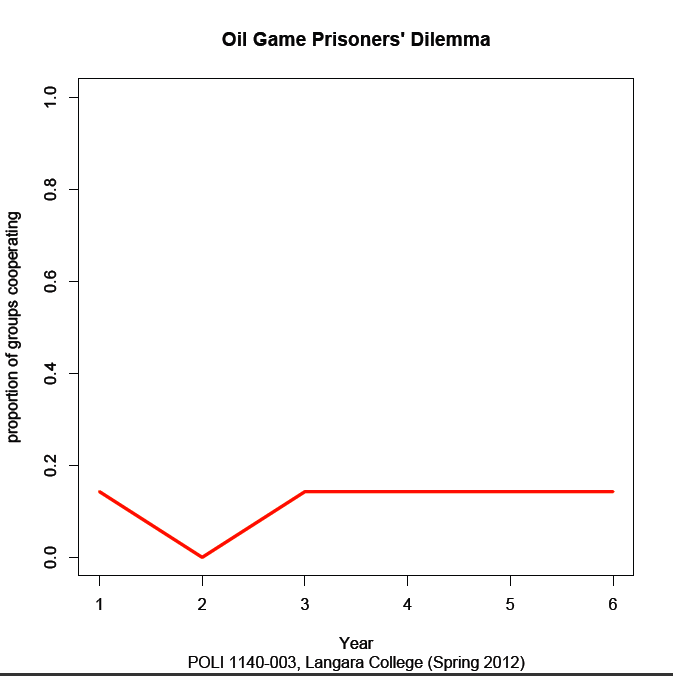
From a theoretical perspective (and empirical tests have generally confirmed this) there will likely be very little cooperation in one-shot prisoner’s dilemma-type situations. Over repeated interaction, however, learning can contribute to higher levels of cooperation. With respect to IR theories, specifically, it is argued that realists are more likely to defect in PD situations as they are concerned with relative gains. Liberals, on the other hand, who value absolute gains more highly, are more likely to cooperate and create socially more optimal outcomes. What were the results in our class?

The graph above plots the level of cooperation across all six years (stages) of the exercise. There were seven groups and what the probabilities demonstrate is that in each year there was only one group for which the interaction was cooperative. In year 2, there was not a single instance of cooperation. Moreover, it was the same group that cooperated. Therefore, one of the groups cooperated 5 out of 6 years, while none of the other six groups cooperated a single time over the course of the sex years!! What a bunch of realists!!

If you were involved in this exercise, please let me know your reactions to what happened.

Design a site like this with WordPress.com
Get started