
Today in IS 302 we viewed the video “Can the UN Keep the Peace”, which looked at the challenges that face the UN Mission in the Democratic Republic of the Congo. Like the pairing of the perfect wine with the right meal, this video was (at least in my opinion) a perfect complement to today’s readings.
Category: United Nations
Worse Than War
In IS 302 today, we viewed the first 2/3 of the PBS documentary, Worse than War, based on the work of genocide (note: not genocidal) scholar Daniel Goldhagen , who is probably known best for his book Hitler’s Willing Executioners. Many of the issues raised by Goldhagen in the documentary were relevant to the readings of this week by Kaldor, et al.
List of All UN Peacekeeping Operations
Here’s an exhaustive list of the peacekeeping operations established by the UN since its inception.Notice how long some of the operations have lasted (and continue to last). The longest continuing peacekeeping operation is UNMOGIP, which continues to the present and was established in 1949! For the complete list, click here.
| Acronym | Mission name | Start date | Closing date |
|---|---|---|---|
| UNTSO | United Nations Truce Supervision Organization | May 1948 | Present |
| UNMOGIP | United Nations Military Observer Group in India and Pakistan | January 1949 | Present |
| UNEF I | First United Nations Emergency Force | November 1956 | June 1967 |
| UNOGIL | United Nations Observation Group in Lebanon | June 1958 | December 1958 |
| ONUC | United Nations Operation in the Congo | July 1960 | June 1964 |
| UNSF | United Nations Security Force in West New Guinea | October 1962 | April 1963 |
| UNYOM | United Nations Yemen Observation Mission | July 1963 | September 1964 |
| UNFICYP | United Nations Peacekeeping Force in Cyprus | March 1964 | Present |
| DOMREP | Mission of the Representative of the Secretary-General in the Dominican Republic | May 1965 | October 1966 |
Current United Nations Peacekeeping Operations
We discussed Tom Weiss’ book–Humanitarian Intervention–in IS 302 today. We spent some time on the changing nature, and number, of peacekeeping operations since the end of the Cold War. Below is a map listing the 16 current UN peacekeeping operations. You can find the source image, which is clickable, here. How many of these operations are proceeding under the auspices of Chapter VII of the UN Charter?

Here is part of the textof the UNSC resolution, authorizing the establishment of MONUSCO in the Democratic Republic of the Congo:
Resolution 1925 (2010)
Adopted by the Security Council at its 6324th meeting, on 28 May 2010The Security Council,
Continue reading “Current United Nations Peacekeeping Operations”
Michael Ignatieff and Humanitarian Intervention
Current leader of the Canadian Federal Liberal Party, Michael Ignatieff has long been involved in the issue of human rights–as a historian, journalist, public intellectual, and as the former Carr Professor and Director of the Carr Center for Human Rights Policy at the Kennedy School of Government.
In the aftermath of the contentious NATO military intervention in Kosovo (1999), Ignatieff sat down with WBUR’s Chris Lydon to assess what had gone right (and wrong) during the intervention. A self-identified member of the “something must be done [to stop alleged Serbian war crimes against the Kosovar Albanians]”, Ignatieff stands by his support for the intervention, claiming that, on the whole, the benefits outweighed the costs.
Pope Benedict XVI a Foreign Policy Radical
The Pope delivered a speech last week to the United Nations in which he argued–as have many radicals over the last few decades–that the will of the international community to act in order to solve important global problems is being undermined because a few states have accrued too much power. The Associated Press has more:
NEW YORK – Pope Benedict XVI warned diplomats at the United Nations on Friday that international cooperation needed to solve urgent problems is “in crisis” because decisions rest in the hands of a few powerful nations.
In a major speech on his U.S. trip, Benedict also said that respect for human rights, not violence, was the key to solving many of the world’s problems.
While he didn’t identify the countries that have a stranglehold on global power, the German pope — just the third pontiff to address the U.N. General Assembly — addressed long-standing Vatican concerns about the struggle to achieve world peace and the development of the poorest regions.
On the one hand, he said, collective action by the international community is needed to solve the planet’s greatest challenges.
On the other, “we experience the obvious paradox of a multilateral consensus that continues to be in crisis because it is still subordinated to the decisions of a few.”
The pope made no mention of the United States in his speech, though the Vatican did not support the U.S.-led invasion of Iraq in 2003, which occurred despite the Bush administration’s failure to gain Security Council approval for it. At other moments on his trip, Benedict has been overtly critical of the U.S., noting how opportunity and hope have not always been available to minorities.
The pope said questions of security, development and protection of the environment require international leaders to work together in good faith, particularly when dealing with Africa and other underdeveloped areas vulnerable to “the negative effects of globalization.”
UN Peacekeeping Mission in Darfur Failing?
A couple of weeks ago we watched the National Film Board of Canada documentary film, The Peacekeepers, in introduction to IR. It was a fascinating behind-the-scenes look at the enterprise of UN peacekeeping operations, demonstrating the successes and failures of the UN in attempting to create and keep the pace amongst Congo’s warring factions. We saw the clash between realist views of international sovereignty, security, and power and the liberal ideal of multinational cooperation. The New York Times reports today on the potential failure of a relatively new UN peacekeeping operation before it has even started. Those who have been following the atrocities in the Darfur region of Sudan know that it has taken four years to get a UN peacekeeping force on the ground. It may already be doomed to failure. It is uncanny how much of this report sounds like it was taken directly from the documentary about Sudan.
ABU SUROUJ, Sudan — As Darfur smolders in the aftermath of a new government offensive, a long-sought peacekeeping force, expected to be the world’s largest, is in danger of failing even as it begins its mission because of bureaucratic delays, stonewalling by Sudan’s government and reluctance from troop-contributing countries to send peacekeeping forces into an active conflict.

The force, a joint mission of the African Union and the United Nations, officially took over from an overstretched and exhausted African Union force in Darfur on Jan. 1. It now has just over 9,000 of an expected 26,000 soldiers and police officers and will not fully deploy until the end of the year, United Nations officials said.
Even the troops that are in place, the old African Union force and two new battalions, lack essential equipment, like sufficient armored personnel carriers and helicopters, to carry out even the most rudimentary of peacekeeping tasks. Some even had to buy their own paint to turn their green helmets United Nations blue, peacekeepers here said.
The peacekeepers’ work is more essential than ever. At least 30,000 people were displaced last month as the government and its allied militias fought to retake territory held by rebel groups fighting in the region, according to United Nations human rights officials.
U.N. Security Council Silent on Tibet Protests
How do changing ideas about sovereignty–from sovereignty viewed as a “right” to sovereignty viewed as a “responsibilty”–affect the nature of how states act and the functioning of organizations such as the United Nations? Just before spring break we viewed the documentary The Peacekeepers, where you were able to witness the deliberations that take place behind the scenes at the United Nations and the Security Council specifically. For Wednesday, we’ll read Erik Voeten’s article on “The Political Origins of the UN Security Council’s Ability to Legitimize the Use of Force”, the main point of which is obvious given the title. Today, the Guardian reports that the Security Council remains silent on the current situation in Tibet.
UNITED NATIONS, March 17 (Reuters) – The U.N. Security Council will likely keep silent about China’s crackdown on demonstrations in Tibet, mostly due to belief that provoking Beijing would accomplish nothing, diplomats said on Monday.China, which has sent in troops to enforce control in the regional capital Lhasa, said earlier that the violent protests by Tibetans were organized by followers of the Dalai Lama seeking to derail the Beijing Olympics in August. Tibet’s exiled spiritual leader has denied this charge.“The issue did not come up in the council,” China’s Deputy permanent U.N. representative Liu Zhenmin told Reuters after a meeting of the council on unrelated issues. “This has nothing to do with peace and security,” he said. “It is local violence, … a domestic issue.”China, like the United States, Britain, France and Russia, is a permanent veto-wielding member of the council and would be able to block any attempts by the council to act on Tibet.Russia’s U.N. Ambassador Vitaly Churkin, currently president of the council, told reporters without elaborating that he did not expect the 15-nation Security Council to discuss Tibet. Several other ambassadors confirmed this view.
The United Nations and Peacekeeping in Congo
In PLSC250–intro to IR–this week we viewed a documentary made by the National Film Board of Canada, which addresses the UN’s peacekeeping role in Congo. After reading Chapter 7 of Mingst, you should now be aware that the UN in the world’s most important and powerful IGO, and the UN Security Council plays the most prominent global role in the area of international security. Here are a couple of screen shots from the film and the film’s description:
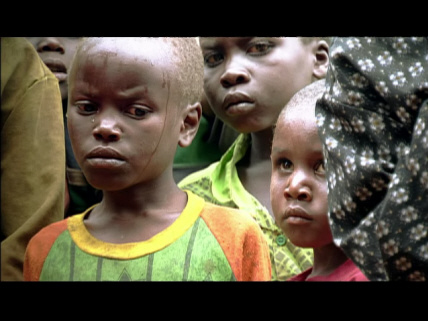
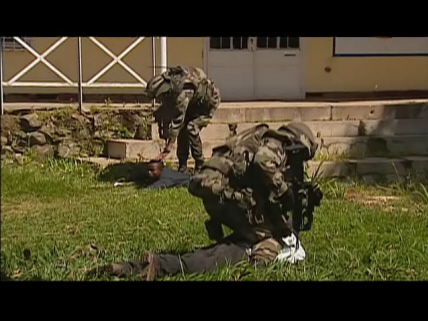
With unprecedented access to the United Nations Department of Peacekeeping, The Peacekeepers provides an intimate and dramatic portrait of the struggle to save “a failed state.” The film follows the determined and often desperate manoeuvres to avert another Rwandan disaster, this time in the Democratic Republic of Congo (the DRC).
Focusing on the UN mission, the film cuts back and forth between the United Nations headquarters in New York and events on the ground in the DRC. We are with the peacekeepers in the ‘Crisis Room’ as they balance the risk of loss of life on the ground with the enormous sums of money required from uncertain donor countries. We are with UN troops as the northeast Congo erupts and the future of the DRC, if not all of central Africa, hangs in the balance.
In the background, but often impinging on peacekeeping decisions, are the painful memory of Rwanda, the worsening crisis in Iraq, global terrorism and American hegemony in world affairs. As Secretary General Kofi Annan tells the General Assembly at the conclusion of The Peacekeepers: “History is a harsh judge. The world will not forgive us if we do nothing.” Whether the world’s peacekeeper did enough remains to be seen.
United Nations Security Council Imposes more Sanctions on Iran
In intro to IR, we’ll analyze the role of IGOs, NGOs, and international law in international politics. Arguably the most important IGO is the United Nations Security Council (UNSC) Today, the UNSC voted (14-0) to impose tougher sanctions against Iran as a result of that country’s continued pursuit of nuclear weapons. From the New York Times:

UNITED NATIONS — The Security Council on Monday adopted its third resolution imposing sanctions on Iran for its refusal to cease enriching uranium, an activity that the West suspects Iran may be using to create fuel for a nuclear weapon.
The previous two measures gained the unanimous support of the 15-member panel, but in balloting on Monday Indonesia abstained, saying it “remained to be convinced of the efficacy of adopting additional sanctions at this juncture.” Fourteen countries voted in favor.
The resolution authorizes inspections of cargo to and from Iran that is suspected of carrying prohibited equipment, tightens the monitoring of Iranian financial institutions and extends travel bans and asset freezes against persons and companies involved in the nuclear program.
It adds 13 names to the existing list of 5 individuals and 12 companies subject to travel and asset restrictions. The new names include people with direct responsibility for building fast-spinning centrifuges that enrich uranium ore and a brigadier general engaged in “efforts to get around the sanctions” in the two earlier resolutions.
Notice two things: first, the use of “targeted sanctions.” Second, the story byline reads “United Nations”, not New York. I wonder if this is standard practice for stories originating from the United Nations headquarters in New York. Does anyone know?
 Clouds, Clocks, and Sitting at Tables
You must be logged in to post a comment.