Another interesting student post on political ideology

alicesweeney's avataralicesweeney

After taking the Political Compass Test, I found the outcome interesting when I compared it to an individual who is a generation older than I am.

Dalai Lama is one of the political leaders that is closest to me in political ideology.

In contrast, this is the political ideology of somebody who is one generation older than I am.

My result as compared to the person who was one generation older than me shows that the differences may be due to age. Conservatism is about preservation and liberalism is about changing things. It would make sense that someone who is younger is still surrounded by diversity. On the other hand, as you age, you become adapted to a certain way of life so it is easy to become conservative. From this test it would seem likely that every young generation would  find the next generation to be more conservative. In Dasovic’s post, however, research has shown…

View original post 358 more words

Here’s a very good post from a POLI 1140 student.

jsake's avatarsomeoriginalname

Personally, I have been appalled from the get-go at Canada’s lack of action regarding Kyoto. In all honesty, I did not follow it as much as a socially conscious individual should, but I did keep an ear to the ground for any large potential developments regarding it.

Unfortunately for myself (and Mother Nature) there wasn’t a whole lot to be heard. All the information I did receive over the last few years seemed to amount to very little. We had fallen behind our emission reduction goals by 2009 and that trend continued into 2011. Needless to say I was not entirely surprised to hear that the Harper Government was planning to withdraw while it was still legally viable (Countries had the option to back out, provided they gave at least one year’s notice before the end of the first compliance period, which is the end of 2012).

Looking at the…

View original post 360 more words

My Intro to IR Class is full of Realists

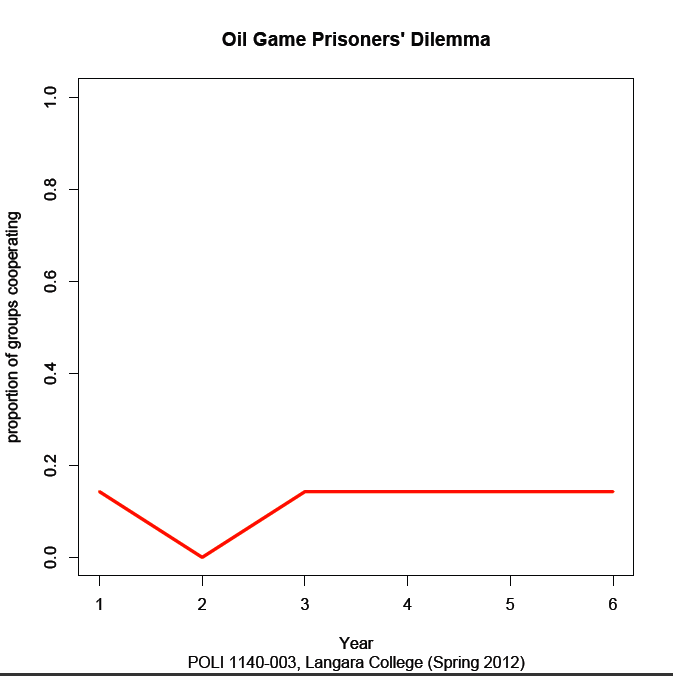
Last Tuesday in POLI 1140, the students completed an class oil-market exercise in which pairs of students engaged in a strategic situation that required them to sell oil at specific prices. Many students were able to understand relatively quickly that the “Oil Game” was an example of the classic prisoner’s dilemma (PD). As Mingst and Arreguin-Toft note on page 78, the crucial point about the prisoner’s dilemma:

Neither prisoner knows how the other will respond; the cost of not confessing if the other confesses is extraordinarily high. So both will confess, leading to a less-than-optimal outcome for both.

From a theoretical perspective (and empirical tests have generally confirmed this) there will likely be very little cooperation in one-shot prisoner’s dilemma-type situations. Over repeated interaction, however, learning can contribute to higher levels of cooperation. With respect to IR theories, specifically, it is argued that realists are more likely to defect in PD situations as they are concerned with relative gains. Liberals, on the other hand, who value absolute gains more highly, are more likely to cooperate and create socially more optimal outcomes. What were the results in our class?

The graph above plots the level of cooperation across all six years (stages) of the exercise. There were seven groups and what the probabilities demonstrate is that in each year there was only one group for which the interaction was cooperative. In year 2, there was not a single instance of cooperation. Moreover, it was the same group that cooperated. Therefore, one of the groups cooperated 5 out of 6 years, while none of the other six groups cooperated a single time over the course of the sex years!! What a bunch of realists!!

If you were involved in this exercise, please let me know your reactions to what happened.

Here’s an excellent post, which would get a grade of 4/4.

jsake's avatarsomeoriginalname

One of the most frightening events happening today is a piece of legislature that is currently being debated in U.S. Congress. The Stop Online Piracy Act or “SOPA” combined with the Protect IP Act (“PIPA”) have the ability to drastically change the face of the internet as we know it. To put it simply, it would give the Attorney General of the United States and other “Qualifying plaintiffs” (copyright holders) the ability to immediately censor any website that it deems to have committed copyright infringement whether it is a domestic or foreign domain.  This in turn would cripple many widely used social networking sites (Youtube, Reddit, Blogs, even Facebook could be severely affected) but would also severely hinder many smaller scale developers, artists and designers.

Of course, it may not be apparent to all how SOPA/PIPA relates to IR, or more specifically the IR theory referred to as “Realism” (as…

View original post 378 more words

Here’s a pretty good example of what I am looking for in your blog posts, with respect to what I want you to write. The post would be better with some links to contemporary stories/news clips illustrating the point.

sensnation's avatarsensnation

For this post i have chosen to comment on an article found in Foreign Affairs entitled, “Democratization and War” written by Edward D. Mansfield and Jack Snyder. I have chosen to write on this topic because of our discussion regarding the argument that democracies do not make war upon each other. After reading the article this thesis has its limits. The authors start their argument by mentioning that this idea is the “law” in international relations, only because the United States used it to further their aggressive foreign policy of promoting democracies across the globe. They also bring into the argument of history playing an important factor, in saying that after the Napoleonic wars, the elite halted the rise of  democracy and nationalism and there was a time of relative peace until the Crimean War. What does this mean to us today? While we see the creations of democracies outside of…

View original post 157 more words

Interesting post on the collapse of the state in Somalia.

iluvbluetube's avatariluvbluetube

Being my first blog post, I would like to talk about failed states and how corrupt the government has truly become in this world. Failed states are defined as states that have failed to provide the basic elements that are necessary in any sovereign government. Somalia is just one of the many places in the world that have been labeled a “failed state”, however in this post, I will narrow my focus solely on Somalia. “There is no law here, no justice system” says the reporter. I found this quite shocking when I first heard this because I always thought in order to keep any sort of peace between people in a country, a established government should be in order. This country has a population of 9 million and in many parts of the country, “there is no education, as well as no health care”. Most of the aid anyone gets in this…

View original post 65 more words

Here is an excellent post from the first blog assignment.

ddarling77's avatarddarling77

It’s 2012, and the world in which we live is going through major political changes.  Dictatorship after dictatorship fall as the people in  authoritarian regimes, such as Egypt and Libya, rise in a drive towards pursuing  the “good life,” a phrase associated with Aristotle in his analysis of different forms of government (Dyck, Studying Politics).  Aristotle’s classification of governments (The Politics) could just as easily have been done 100 years ago, yet he did so more than 2,000 years before.

Aristotle’s Typology of Governments
True forms Ruled for the common good of allPerversions Ruled for the good of private interests
Rule by oneMonarchyTyranny Governed for the interest of the monarch only
Rule by fewAristocracyOligarchy Governed for the interest of the wealthy only
Rule by manyPolityDemocracy Governed for the interests of the needy only

Today’s observer should have no problem identifying the form of government in most states, with regimes generally falling into…

View original post 570 more words

Does Globalization Cause Ethnic Conflict?

Today’s session in IS 309 addressed the link between globalization and ethnic conflict. Our main reading material came from Amy Chu’s book, World On Fire, the thesis of which is that the twin phenomena of economic globalization and the spread of liberal democracy cause ethnic conflict in countries that have “market-dominant minorities.” Cynthia Olzak’s recently published article in the Journal of Conflict Resolution answers the same question in this way:

This article examines how different components of globalization affect the death toll from internal armed conflict. Conventional wisdom once held that the severity of internal conflict would gradually decline with the spread of globalization, but fatalities still remain high. Moreover, leading theories of civil war sharply disagree about how different aspects of globalization might affect the severity of ethnic and nonethnic armed conflicts. Using arguments from a variety of social science perspectives on globalization, civil war, and ethnic conflict to guide the analysis, this article finds that (1) economic globalization and cultural globalization significantly increase fatalities from ethnic conflicts, supporting arguments from ethnic competition and world polity perspectives, (2) sociotechnical aspects of globalization increase deaths from
ethnic conflict but decrease deaths from nonethnic conflict, and (3) regime corruption increases fatalities from nonethnic conflict, which supports explanations suggesting that the severity of civil war is greater in weak and corrupt states.

Chua’s book was received with some praise but also with a fair amount of criticism. Here are some links to videos that may be of interest to you:

Ethnic Violence in Guyana–Economic Hardship and Ranking of Groups

Here is the video we watched yesterday in IS 309. The video reported on inter-ethnic violence (between those of east Indian heritage and Creoles/Africans/Blacks) that was occurring in the northern South American country of Guyana in 2004. I used the video to highlight some of the themes Horowitz explores in chapters 3 and 4 of Ethnic Groups in Conflict. What are some of the issues that you noticed when watching the video? For a good analytical study on inter-ethnic violence in Guyana from 1948-1999, see this article in the Journal of Peace Research. I provide the abstract for you below:

Coercive and elitist approaches to political control in post-colonial states like Guyana have often proved counterproductive with respect to resolving ethno-political conflicts in these parts. In Guyana, this contradiction is usually manifested in terms of the escalation of legitimate political competition into overtly violent ethno-political violence and polarization, and reinforced by the consequent devaluation of the more democratic or pacific alternatives to conflict resolution such as mass or grass-roots participation, intergroup negotiations, and third-party mediation. Recurring debates between Cultural Pluralists and Marxists on this issue have so far failed to shed light on the prospects for the more pacific approaches to conflict resolution. Closer analytic scrutiny of actual ethno-political conflict events in Guyana between 1948 and 1999 leads to the understanding that such conflicts derive largely from what is termed a continual crisis of political legitimacy reflected in the inequities of political representation and economic resource distribution across groups. The more democratic or pacific approaches are here suggested as most appropriate for the resolution of the political legitimation crisis and the ultimate realization of a sustainable peace among the diverse groups in the Guyana political system.

Design a site like this with WordPress.com
Get started