Leaderless Jihad–the Transformation of Al Qaeda

In PLSC250, we have discussed both Samuel Huntington’s prediction of the nature of the new world order (as outlined in his “Clash of Civlizations” thesis) and Yahya Sadowski’s response (“Political Islam: Asking the Wrong Questions”). David Ignatius has written an op-ed piece in the Washington Post today, which amounts to a book review of former CIA officer Marc Sagerman’s new book, “Leaderless Jihad.” Find some excerpts posted below. How does Sagerman’s view fit with the views expressed by Sadowski in his article?

Sageman has a résumé that would suit a postmodern John le Carré. He was a case officer running spies in Pakistan and then became a forensic psychiatrist. What distinguishes his new book, “Leaderless Jihad,” is that it peels away the emotional, reflexive responses to terrorism that have grown up since Sept. 11, 2001, and looks instead at scientific data Sageman has collected on more than 500 Islamic terrorists — to understand who they are, why they attack and how to stop them.

The heart of Sageman’s message is that we have been scaring ourselves into exaggerating the terrorism threat — and then by our unwise actions in Iraq John McCain, that, as McCain’s Web site puts it, the United States is facing “a dangerous, relentless enemy in the War against Islamic Extremists” spawned by al-Qaeda. making the problem worse. He attacks head-on the central thesis of the Bush administration, echoed increasingly by Republican presidential candidate

The numbers say otherwise, Sageman insists. The first wave of al-Qaeda leaders, who joined Osama bin Laden in the 1980s, is down to a few dozen people on the run in the tribal areas of northwest Pakistan. The second wave of terrorists, who trained in al-Qaeda’s camps in Afghanistan during the 1990s, has also been devastated, with about 100 hiding out on the Pakistani frontier. These people are genuinely dangerous, says Sageman, and they must be captured or killed. But they do not pose an existential threat to America, much less a “clash of civilizations.”

It’s the third wave of terrorism that is growing, but what is it? By Sageman’s account, it’s a leaderless hodgepodge of thousands of what he calls “terrorist wannabes.” Unlike the first two waves, whose members were well educated and intensely religious, the new jihadists are a weird species of the Internet culture. Outraged by video images of Americans killing Muslims in Iraq, they gather in password-protected chat rooms and dare each other to take action. Like young people across time and religious boundaries, they are bored and looking for thrills.

“It’s more about hero worship than about religion,” Sageman said in a presentation of his research last week at the New America Foundation, a liberal think tank here. Many of this third wave don’t speak Arabic or read the Koran. Very few (13 percent of Sageman’s sample) have attended radical madrassas.

Luminous Flux and IR Theory

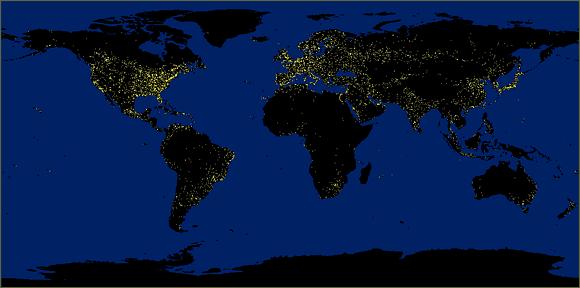
Which theory of IR comes to mind when you view this image? Why? These are night-time lights [the lights wouldn’t show up as well in the daytime 🙂 ] as recorded by NASA. Click here for a full explanation.

city_lights_world.jpg

The answer is below the fold…

Continue reading “Luminous Flux and IR Theory”

Calvin and Hobbes and IR Theory

Which theory of IR immediately comes to mind upon reading this Calvin and Hobbes cartoon? Why? One of the more clever students in Intro to IR noticed that one of the character’s names gives us an obvious clue.

calvin_hobbes_modern_threats.jpg

The answer is below the fold…

Continue reading “Calvin and Hobbes and IR Theory”

Samuel Huntington of “Clash of Civilizations” fame, Interviewed

Charlie Rose interviews Huntington on the ideas in his oft-cited and even more criticized “Clash of Civilizations” thesis. Rose calls the clash thesis “provocative.”  What do you think about the logic of the clash thesis.  Given that you’ve read Amartya Sen’s response to Huntington, what kinds of questions would you have asked Huntington that Rose failed to?  (The Huntington interview runs from 1:55 until about 21:00.  No, Professor Huntington is not a dead-ringer for John Cleese.  That is, in fact, John Cleese, who is interviewed in the middle segment; hence, the screen shot of Cleese.)

Playing the Dominant Strategy in a Prisoner’s Dilemma Situation

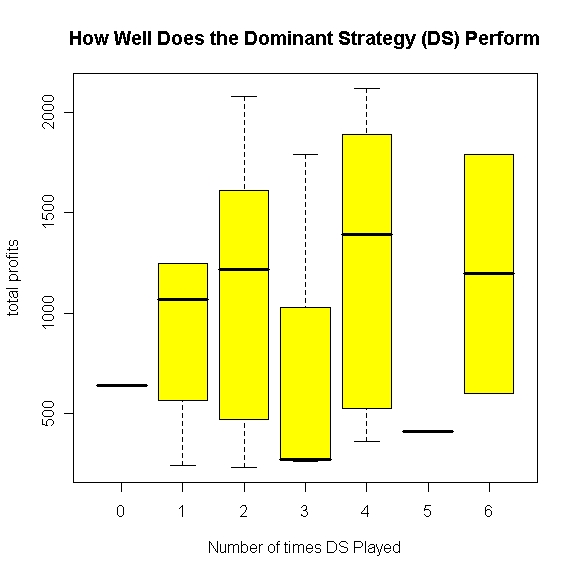
As you’ll see in lecture tomorrow, instrumentally rational players will also choose to “defect” in a priosoner’s dilemma type situation even though they could be much better off absolutely if they and their opponents could learn to cooperate.  The chart below has been created using data from the simulation of yesterday.  What is take-home message from the chart?  Why is the relationship between the phenomena displayed not completely linear?  Think about the nature (i.e., the specific rules) of the oil game we played yesterday. (The plot below is a box plot, which is a way of summarizing the means, range, and certain percentiles of the values of a single variable based on another variable.)

oil_game_dominant_strategy.jpeg

Results from a Prisoner’s Dilemma Simulation–The Oil Game

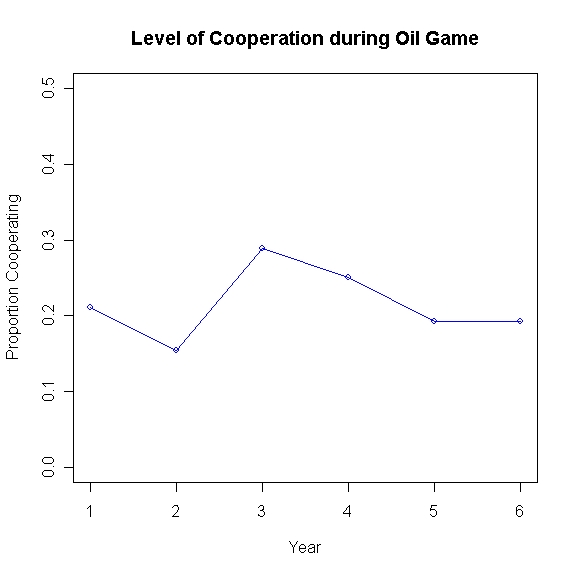
Today in class, you competed in groups to maximize total profits in a simulation called “the Oil Game.” You represented one of two competing oil producers–Iraz and Sabia–trying to maximize profits selling oil to a net importer of oil–ESYUVI (the names were created using a random letter-generator–I swear!). Most of you recognized very quickly, if not immediately, that the simulation was a modified Prisoner’s Dilemma situation. As I’ll discuss on Friday, in a Prisoner’s Dilemma situation, players acting in an instrumentally rational manner will always choose not to cooperate (i.e., “defect”), because it is a dominant strategy. What makes the situation a dilemma is that the players could do much better were they able to cooperate and trust one another.

oil_game_results.jpeg

The compelling logic of the prisoner’s dilemma, along with some strong empirical evidence, is used by realists to support their arguments regarding the nature of interaction in the international world. Liberals, on the other hand, argue that there is much more cooperation in the world than realists would predict. Thus, despite the structure of the prisoner’s dilemma, players are able to cooperate in international politics. What factors do you think make cooperation more likely? Less likely? Why?

The results from our simulation today are in graphical form above. You’ll note that communication was not allowed for Years 1, 2, and 4; communication was allowed for Year 3, and communication (to decide what to do for Years 5 and 6) was allowed prior to Year 5. The results from this class are consistent with the expectations. I would note the relatively low level of cooperation throughout, rising only initially after the first episode of communication.

Presenting Data Graphically to Increase Understanding and Impact

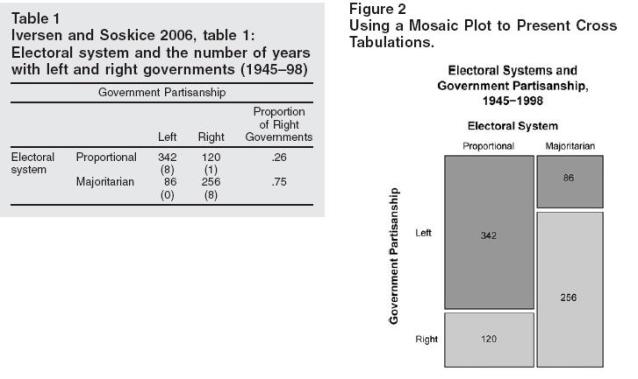
Jonathan P. Kastellec and Eduardo L. Leoni have written an article, published in a recent issue of Perspectives on Politics, in which they encourage academics to make much more frequent use of graphs to present data that is more commonly presented in tabular form. From the abstract:

When political scientists present empirical results, they are much more likely to use tables than graphs, despite the fact that graphs greatly increases the clarity of presentation and makes it easier for a reader to understand the data being used and to draw clear and correct inferences.

Here is one of their examples, and they are absolutely right; graphical data facilitates the making of almost instantaneous inferences regarding the results (or maybe I’m just a visual learner?).

When presenting data in your papers, think about what you want to say with the data and use the best format available to facilitate that end.

graphs_tables.jpg

Kastellec and Leoni have crated a website that provides the code necessary to replicate these graphs in the R statistical program (which is a fantastic program that is free to download and use). Here is a link to the code for replicating the graph above.

You’ve got to Fight…for Your Right…to…Gain Citizenship

During our discussion in class today on different forms of group identity, many of you seemed surprised when I mentioned that there were many non-US citizens currently fighting for the US military in Iraq; many (a majority at least) are doing so in exchange for the promise of US citizenship. Which begs the questions, just how many non-citizens are currently serving in the US military? According to this paper (pdf),

“As of February 2003, there were 37,000 non-citizens serving in active duty in the U.S. armed forces, almost 12,000 foreign nationals serving in the selected reserves, and another 8,000 serving in the inactive national guard and ready reserves.”*

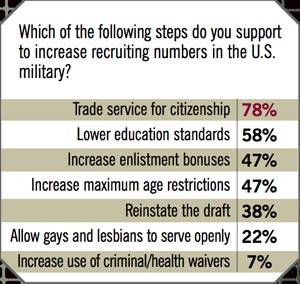
As we learned in class, prior to the establishment and consolidation of nation-states in Europe, post-Westphalia, most political leaders recruited mercenary armies. Thus, the link between military protection and citizenship is a modern phenomenon. This makes the results of a recent survey done by Foreign Policy Magazine very interesting.

recruit_armed_forces.jpg

Many proposals have been suggested to help the military meet its recruiting and retention needs. But an incredible percentage of the index’s officers favor the same solution: Nearly 80 percent support expanding options for legal, foreign permanent residents of the United States to serve in exchange for U.S. citizenship. A high percentage of officers, about 6 in 10, also support the idea of allowing more recruits who have a high school equivalency degree—but no diploma—to serve. Almost 40 percent favor reinstating the draft.

*Not all of these, of course, are serving in Iraq. Moreover, while it is a seemingly large number it is still a very small percentage of the total military.

The Relationship Between Wealth and Health

The BBC reports on fascinating new research, which concludes that “economic growth does not necessarily translate into improvements in child mortality.” There are two points I wish to make about this: First, it illustrates an important trend in the development literature regarding the correct metric to use to determine, and compare, levels of well-being worldwide. Historically, well-being has been captured by the crude instrument of Gross National Product (GDP) per capita, but the realization that, for many reasons, the measure was too crude to be a satisfactory indicator of well-being development led to the introduction of other measures, the most useful of which is the Human Development Index (HDI) put out by the United Nations Development Program (UNDP). (Why might GDP per capita be a misleading indicator of well-being?)

The second point follows from the first; one’s policy prescriptions vis-a-vis issues of development are to a large extent determined by just which indicator of well-being one believes best captures the essential nature of that elusive concept. As such, IGOs such as the World Bank, have focused attention on overall economic growth, while scholars such as Amartya Sen (who champions the “capabilities approach”) do not view growth tout court as a magical anti-poverty elixir.

From the BBC article:

Ten million children still die every year before their fifth birthday, 99% of them in the developing world, according to Save the Children.

A study comparing economic performance with child mortality reveals that some countries have not translated wealth into improvements across society.

Survival is too often just a “lottery”, said Save the Children’s David Mepham.

He said that even the poorest countries can cut child mortality by following simple policies, but at the moment “a child’s chance of making it to its fifth birthday depends on the country or community it is born into”.

Lagging behind

Angola comes at the bottom of a new “Wealth and Survival” league table drawn up by the UN Development Programme (UNDP).

The figures for child mortality in India are shocking
Shireen Miller
Save the children India

There are few countries in the world where there are such stark wealth contrasts as there are between the wealth of oil-rich coastal strip around the Angolan capital Luanda, and the war-ravaged interior.

UNDP statisticians calculate that more than half of the babies who die in Angola could be saved were the country to spread its wealth more fairly.

child_mortality_map.jpg

Click on the map to be taken to the Johns Hopkins Bloomberg School of Public Health’s Magazine for an article on child mortality.

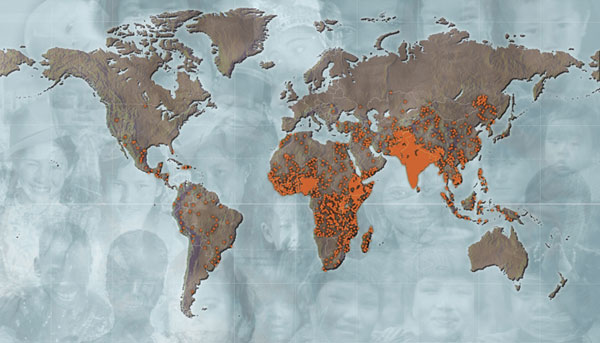
[Each orange dot is equivalent to 5,000 child deaths.]


Pearl Jam and R.E.M

If I had to guess as to which theory of international relations the lead singers of two of my favorite bands, Eddie Vedder (Pearl Jam) and Michael Stipe (R.E.M.) would subscribe, I’d say radicalism, and radicalism, respectively. Here’s a version of what can only be characterized correctly as a protest song, Begin the Begin, from one of R.E.M.’s earliest albums. The lyrics are below. There’s certainly no compromise in this song; they argue, like all radicals, for radical systemic change; if you don’t like the system, “begin the begin.”

(chorus)
Birdie in the hand for life’s rich demand
The insurgency began and you missed it
I looked for it and I found it
Myles Standish proud, congratulate me

A philanderer’s tie, a murderer’s shoe

Life’s rich demand creates supply in the hand
Of the powers, the only vote that matters
Silence means security silence means approval

On Zenith, on the TV, tiger run around the tree
Follow the leader, run and turn into butter

Let’s begin again, begin the begin
Let’s begin again like Martin Luther zen
The mythology begins the begin
Answer me a question I can’t itemize
I can’t think clear, you look to me for reason
It’s not there, I can’t even rhyme here in the begin

A philanderer’s tie, a murderer’s shoe
Example: the finest example is you

(repeat chorus)

A philanderer’s tie, a murderer’s shoe
Let’s begin again, begin the begin
Let’s begin again

Design a site like this with WordPress.com
Get started