Cuba’s Human Welfare Indicators

Recent news regarding Fidel Castro’s plans to step aside in favor of his brother have returned Cuba to the news headlines here in the United States.  It has prompted some to take stock of Castro’s tenure as Cuba’s leader of nearly five decades.  Unfortunately, much of what we are likely to read will be ideologically-driven and devoid of much empirical substance.  For a comparative look at Castro’s and Batista’s regimes, we turn to Cal-Berkeley economist Brad DeLong:

ist2_64313_vintage_1950s_cars_in_havana_cuba.jpgThe hideously depressing thing is that Cuba under Battista [sic]–Cuba in 1957–was a developed country. Cuba in 1957 had lower infant mortality than France, Belgium, West Germany, Israel, Japan, Austria, Italy, Spain, and Portugal. Cuba in 1957 had doctors and nurses: as many doctors and nurses per capita as the Netherlands, and more than Britain or Finland. Cuba in 1957 had as many vehicles per capita as Uruguay, Italy, or Portugal. Cuba in 1957 had 45 TVs per 1000 people–fifth highest in the world. Cuba today has fewer telephones per capita than it had TVs in 1957.

You take a look at the standard Human Development Indicator variables–GDP per capita, infant mortality, education–and you try to throw together an HDI for Cuba in the late 1950s, and you come out in the range of Japan, Ireland, Italy, Spain, Israel. Today? Today the UN puts Cuba’s HDI in the range of Lithuania, Trinidad, and Mexico. (And Carmelo Mesa-Lago thinks the UN’s calculations are seriously flawed: that Cuba’s right HDI peers today are places like China, Tunisia, Iran, and South Africa.)

Thus I don’t understand lefties who talk about the achievements of the Cuban Revolution: “…to have better health care, housing, education, and general social relations than virtually all other comparably developed countries.” Yes, Cuba today has a GDP per capita level roughly that of–is “comparably developed”–Bolivia or Honduras or Zimbabwe, but given where Cuba was in 1957 we ought to be talking about how it is as developed as Italy or Spain.

This week in intro to comparative, we’ll discuss various indicators of well-being and welfare, such as GDP per capita and the HDI, comparing the indicators themselves and comparing different countries.
Military Spending and Private Industry

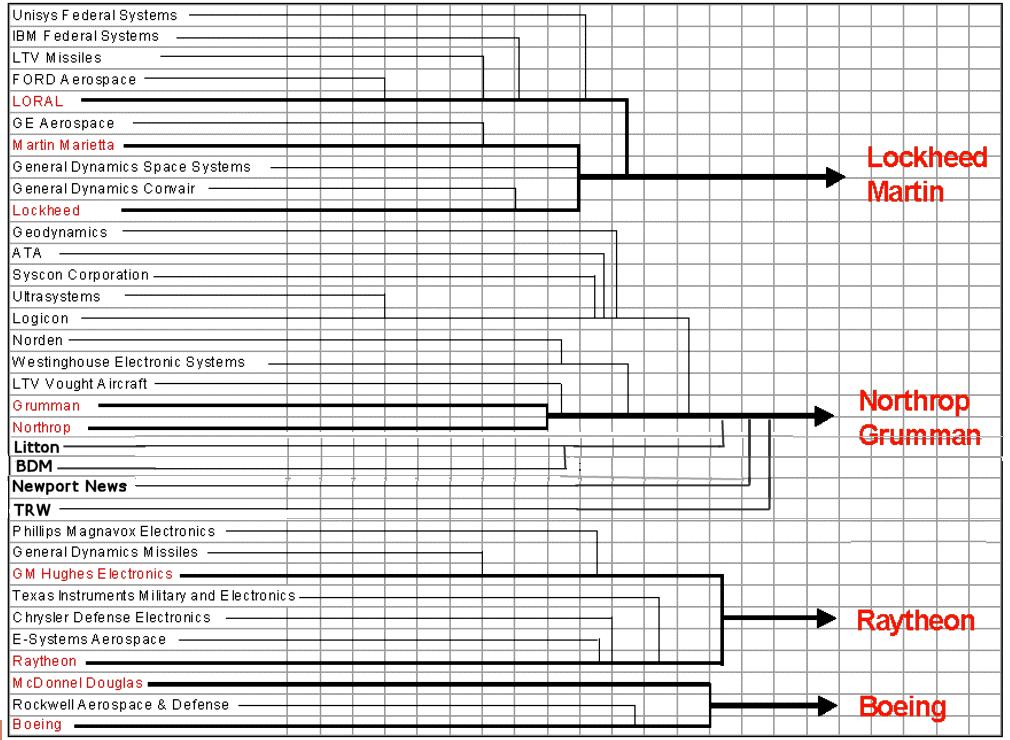
Here is a fascinating chart from globalsecurity.org, which shows the consolidation of firms in the defense contracting industry over the course of a few decades.  Whereas approximately thirty companies were producing weaponry and other weapons systems for the federal government decades ago, now there are only four.  Is this a good or a bad thing, or does it even matter?

military_contractorsmergers.jpg

Comparative Welfare States in Advanced Industrial Economies

In a couple of weeks, we–in PLSC240–will address the topic of political economy.  We’ll compare states around the world with respect to institutions such as tax regimes, openness of borders to goods and services imported from abroad, and also with respect to welfare state spending.  Andrew Gelman has posted on his blog a review–which will be published in Political Science Quarterly–of a new book by Clem Brooks and Jeff Manza, titled Why Welfare States Persist.  Not surprisingly, the answer is that they are publicly popular.  What is more interesting, though, is why the size of the welfare state differs amongst countries with relatively similar income levels.  Can you can think a cultural explanation?  Institutional?  Rational Choice?

Rich capitalist democracies around the world differ widely in their welfare states—their systems of government-provided social support–despite having comparable income levels. Brooks and Manza report that welfare state spending constituted 27% of GDP in “social democratic countries” such as Sweden and 26% of GDP in “Christian democratic countries” such as Germany, but only 17% in “liberal democracies” such as the United States and Japan. These differences are correlated with differences in income inequality and poverty rates between countries.

In their book, Brooks and Manza study how countries with different levels of the welfare state differ in their average policy preferences, as measured by a cross-national survey that asks whether respondents think the government should (a) provide a job to everyone who wants one, and (b) reduce income differences between rich and poor. Brooks and Manza find that countries where government jobs policies and redistribution are more popular are the places where the welfare state is larger, and this pattern remains after controlling for time trends, per-capita GDP of the country, immigration, women’s labor force participation, political institutions, and whether the ruling party is religious or on the left.

Next week, you will have a chance to test this hypothesis when we comparatively analyze public opinion attitudes around the world using the World Values Survey.   Is this relationship real?  Does it apply to states that are not advanced industrial economies?  We’ll find out next week.

How You can Directly Promote Entrepreneurship in the Developing World

Periodically, I will use student posts as the inspiration for posts of my own here. This post is inspired by an informative post by Matt and Russ on the NGO KIVA.org. KIVA allows you, from the comfort of your keyboard, to monetarily support entrepreneurship in the developing world through facilitating the supply of micro-credit loans to budding entrepreneurs. This allows these individuals to overcome the handicap of poorly developed credit markets in these countries. [You may want to ask yourself why credit markets in most parts of the developing world are poorly developed.] For as little as $25 US, you can help a budding entrepreneur get the funding s/he needs to attempt to build a sustainable living for themselves and their families. The principal is returned to the donors (or lenders, more appropriately) within a specified time period. We’ll look at micro-credit in both PLSC240 and PLSC250 later in the course. Here is former President Bill Clinton explaining the concept of KIVA to Fox News’ Greta van Susteren.

World Economic Forum Releases Global Risks Report for 2008

The World Economic Forum, a Swiss-based NGO whose motto is “entrepreneurship in the global public interest”, has recently released its Global Risks Report for 2008.  They view four main issues as presenting the most potential global risk over the next twelve months and beyond.

The present report looks at global risks from a range of different perspectives. The first part of the report focuses on four emerging issues that are shaping the global risk landscape: systemic financial risk, food security, supply chains and the role of energy. On systemic financial risk, we put current market turmoil in the historical context and ask how the transformation of the global financial system over the last two decades may require us to rethink our expectations and understanding of systemic risk in the future. On food security, we discuss how the subject has moved from the periphery of the global risk landscape to its centre, and ask whether the world is ready to cope with the various trade-offs that the new food economy is generating. On supply chains, we investigate a potentially hidden set of vulnerabilities in the global economy to supply chain disruptions. Finally, on energy, we outline the emergence of a range of energy-related risks and ask if the world can move towards secure and sustainable energy.

Foreign Direct Investment(FDI)–an Indicator of Globalization

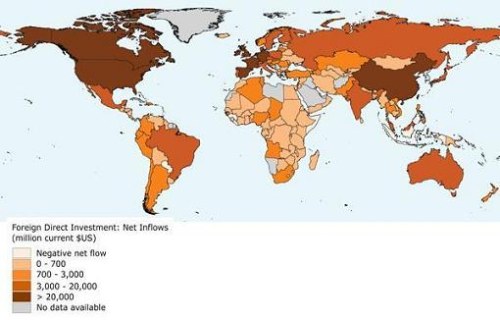
As we will see, globalization is a word (and phenomenon) that is analogous to a Rorschach test in that everyone seems to have his, or her, own slightly unique definition of what it actually means. There is wide agreement, however, that an important characteristic of contemporary globalization is the level of economic integration internationally. One such component of that integration is foreign direct investment (FDI). From the World Resources Institute, here is a map that shows the differing levels of FDI around the globe. The patterns should, by now, be exceedingly familiar.

world_fdi_map_450.jpg

Here is the map description:

Foreign direct investment data do not give a complete picture of international investment in an economy. Balance of payments data on foreign direct investment do not include capital raised locally, which has become an important source of financing for investment projects in some developing countries. In addition, foreign direct investment data capture only cross-border investment flows involving equity participation and thus omit nonequity cross-border transactions such as intrafirm flows of goods and services. For a detailed discussion of the data issues see the World Bank’s World Debt Tables 1993-1994 (volume 1, chapter 3). Also, cross-country comparisons may not be accurate, because of differences in the definition of what constitutes foreign direct investment.

Source: World Bank Group. 2004, World Development Indicators Online. Washington, DC:World Bank.
Available On-line at: Source Link

A Unique Indicator of Economic Development–Luminous Flux

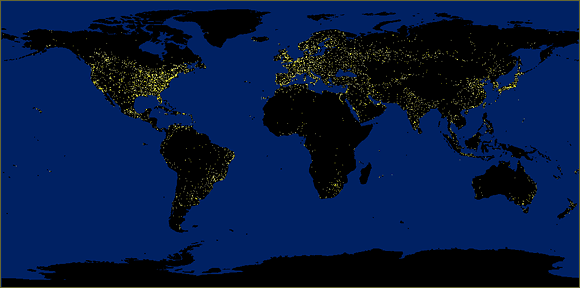
Or light. Below you will find a fascinating map from the World Resources Institute, (which is a great website, featuring information on such matters as renewable fresh water resources, literacy rates, and other phenomena that are found at the “intersection of the environment and human needs.”

world_city_lights.gif

Here is a description of the map:

“The National Geophysical “city lights” database depicts stable lights and radiance calibrated lights of the world (which includes lights from cities, towns, industrial sites, gas flares, fires, and lightning illuminated clouds). A high concentration of city lights is especially found in industrialized densely populated regions such as western Europe, Japan, and the U.S.. Alternatively, few “city lights” are shown in economically poorer and sparsely populated regions (e.g. central and northern Africa and South America). Moderate “city lights” are found in several densely populated “developing countries” (e.g. India, Indonesia, eastern Brazil, and South Africa). The “city lights” data may be used a proxy for population distribution or infrastructure (e.g. in which it may be assumed that the occurrence of few city lights is correlated with the presence of institutional, political, and industrial infrastructure).”

Africa Rising?

One of the recurring themes of global political development is the inability of sub-Saharan countries to “get things right.” From corruption to anemic economic growth, to political instability and civil war, sub-Saharan Africa suffers to a degree unrivaled by other regions of the world. A recent article in the Boston Globe reports on some apparent successes in this part of the world.

Here are some snippets:

“The state of Africa is a scar on the conscience of the world,” Tony Blair, then prime minister of England, famously said in 2001. “But if the world, as a community, focused on it, we could heal it. And if we don’t, that scar will become deeper and angrier still.”

“But it’s not the whole story. By many standards, Africa is doing better than it has in decades. The number of democratically elected governments has risen sharply in the past decade, and the number of violent conflicts has dropped. African economies, and African businesses, are starting to show impressive results, and not just by the diminished standards the rest of the world reserves for its poorest continent. The runaway inflation that crippled African economies for decades is on the ebb, and foreign investment is rising. Last month, the World Bank reported that average GDP growth in Sub-Saharan Africa has averaged 5.4 percent over the last decade, better than the United States, with some countries poised for dramatic expansion.

“For the first time in a long time, you have the potential that a handful of countries could break from the pack and become leopards, cheetahs, or whatever the African equivalent of an Asian Tiger would be,” says John Page, the World Bank’s chief Africa economist, referring to the nickname given East Asian nations like Taiwan and South Korea because of their double-digit growth in the 1960s, ’70s and ’80s.”

It all suggests that much of Africa, after decades of sclerosis and strife, may have turned a corner. Economists believe that several African countries have made the sort of fundamental changes in governance and economic management that could buttress them against swings in commodity prices and the other global economic shocks that in the past have been so devastating.

“The turnaround has been pretty stunning, and there’s something deeper going on than just a surge in oil and commodity prices,” says Edward Miguel, an associate professor of economics at the University of California, Berkeley. “You’re seeing more responsible governments, more democracies, and better economic policies.”

Political Culture and Economic Outcomes

What kind of an impact does political culture have on political and economic outcomes and are there systematic differences across countries? In this new paper, Alberto Alesina and Paola Guiliano use data culled from the World Value Survey to demonstrate an effect between the strength of family ties (which they argue are different across cultures) and economic outcomes.

Here is the abstract and a link to the paper:

We study the importance of culture, as measured by the strenght of family ties, on economic ehavior and attitudes. We define our measure of family ties using individual responses from he World Value Survey regarding the role of the family and the love and respect that children eed to have for their parents for over 70 countries. We show that strong family ties imply more reliance on the family as an economic unit which provides goods and services and less on the market and on the government for social insurance. With strong family ties home production is higher, labor force participation of women and youngsters, and geographical mobility, lower. Families are larger (higher fertility and higher family size) with strong family ties, which is consistent with the idea of the family as an important economic unit. We present evidence in cross country regressions. To assess causality we look at the behavior of second generation immigrants in the US and we employ a variable based on the grammatical rule of pronoun drop as an instrument for family ties. Our results overall indicate a significant influence of the strength of family ties on economic outcomes.

You hopefully remember the graphic of the tripartite division of society that was shown in class last week. The family, as we mentioned, is one of the fundamental institutions of civil society and the level of involvement of the family in economic decisions and economic output varies greatly across countries. As Alesian and Guiliano observe:

Stronger family ties are associated with lower labour force participation, especially that of youngsters who stay at home longer, and that of women who have traditional roles in these societies as “guardians” of the household, fostering and protecting family ties. Thus stronger family ties mean more is produced at home and less in the market. Since official statistics only take market-production into account, countries with larger home production may have a downward bias in their measure of per capita GDP. This may also suggest that it is NOT the lack of child and care facilities that make women stay at home (an argument that one always hear as a self-evident truth, for instance in Italy), but it may be – right or wrong – the result of a family choice.

Design a site like this with WordPress.com
Get started