Who Speaks for Islam–a New Book by the Gallup Poll

The Gallup Polling outfit has a new book out based on a massive (over 50,000 respondents) recent poll on attitudes amongst the world’s approximately 1.3 billion Muslims. Let us allow the publishers to describe the content themselves:

islamwld.jpgGallup’s largest study of Muslim populations worldwide challenges conventional wisdom and the inevitability of a global conflict as the wars in Iraq and Afghanistan continue. Despite widespread media coverage of global terrorism from America and Europe to the Middle East and Asia, little is known about what majorities of the world’s Muslims really think and feel. What do Muslims say about violence and terrorist attacks? What do they say about democracy, women, and relations with the West? What are their values, goals, and religious beliefs?

Who Speaks for Islam? What a Billion Muslims Really Think by John L. Esposito and Dalia Mogahed (Gallup Press; March 2008; hardcover) sheds new light into the “increasing hostility” that Archbishop Tutu characterizes.

In the wake of the terrorist attacks on 9/11, U.S. public officials seemed to have no idea whether or not many Muslims supported the bombings. This troubled Gallup Chairman and CEO Jim Clifton, who felt that “no one in Washington had any idea what 1.3 billion Muslims were thinking, and yet we were working on intricate strategies that were going to change the world for all time.” Clifton commissioned his company to undertake the enormous job.

The result is Who Speaks for Islam? What a Billion Muslims Really Think, based on six years of research and more than 50,000 interviews representing 1.3 billion Muslims who reside in more than 35 nations that are predominantly Muslim or have sizable Muslim populations.
Some of the more intriguing findins?

  • Muslims and Americans are equally likely to reject attacks on civilians as morally unjustifiable.
  • Large majorities of Muslims would guarantee free speech if it were up to them to write a new constitution AND they say religious leaders should have no direct role in drafting that constitution.
  • Muslims around the world say that what they LEAST admire about the West is its perceived moral decay and breakdown of traditional values — the same answers that Americans themselves give when asked this question.
  • When asked about their dreams for the future, Muslims say they want better jobs and security, not conflict and violence.
  • Muslims say the most important thing Westerners can do to improve relations with their societies is to change their negative views toward Muslims and respect Islam.

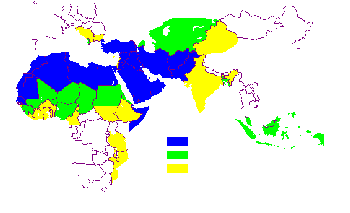
Note: the map above is from Professor Juan Cole.  The colors refer to the percentage of inhabitants of each state who are Muslims.
The Fluid Religious Marketplace in the United States

The New York Times reports on a new poll released by the Pew Forum on Religion and Public Life, which shows a relatively high level of fluidity in the religious identities of residents here in the United States. Analysts and scholars of the role of religion in public life have long understood the US exceptionalism with respect to the important role and place of religion in public life. This has occurred despite (although some would argue because of) the official church-state separation in US society. Most other states with developed economies are much more secular than is the United States, even though some of these states (such as Great Britain and Germany) do not have state/church separation.

The main take-home message of this new Pew Poll, I think, is the fluidity of religious identity here in the United States, where religion is more individualized and personalized and really becomes a type of individual identity. (Remember in Chapter 3 of O’Neil where we differentiated between individual and group identity and discussed whether religious identity could be both.) Conversely, in countries like France, Great Britain, Germany, etc., religion is much more a social–i.e., group–(rather than a religious) identity and is, therefore, much more immutable. Here is an excerpt from the article, with a graphic:

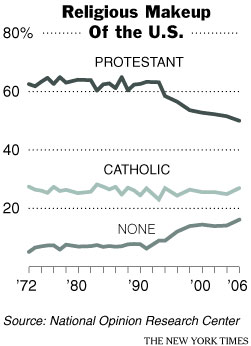
us_religious_makeup.jpgWASHINGTON — More than a quarter of adult Americans have left the faith of their childhood to join another religion or no religion, according to a survey of religious affiliation by the Pew Forum on Religion and Public Life.

The report, titled “U.S. Religious Landscape Survey,” depicts a highly fluid and diverse national religious life. If shifts among Protestant denominations are included, then it appears that 44 percent of Americans have switched religious affiliations.

For at least a generation, scholars have noted that more Americans are moving among faiths, as denominational loyalty erodes. But the survey, based on telephone interviews with more than 35,000 Americans, offers one of the clearest views yet of that trend, scholars said. The United States Census does not track religious affiliation.

It shows, for example, that every religion is losing and gaining members, but that the Roman Catholic Church “has experienced the greatest net losses as a result of affiliation changes.” The survey also indicates that the group that had the greatest net gain was the unaffiliated. Sixteen percent of American adults say they are not part of any organized faith, which makes the unaffiliated the country’s fourth-largest “religious group.”

That 44 percent of Americans have switched religious affiliation is astounding. What are the implcations of this? I can think of two immediately…

You can find the Pew Forum on Religion and Public Life here. Here is a link to a video interview with Pew Forum Director Luis Lugo who talks about the next step in data analysis. Lugo characterizes the United States as having a dynamic “religious marketplace.” Here is a link to an interview with Neela Bannerjee, the New York Times journalist, who wrote the article.

Life, Liberty, and the Pursuit of Happiness

We hold these truths to be self-evident, that all men are created equal, that they are endowed by their Creator with certain unalienable Rights, that among these are Life, Liberty and the pursuit of Happiness.

All of us immediately recognize these powerful sentences as being part of the Declaration of Independence of the United States of America. Happiness is an important concept and has been the object of increased study in political science and comparative politics. Ronald Inglehart (he of World Values Survey fame) argues that there is a strong relationship between happiness and democracy across countries. Inglehart writes:

Correlation is not causation, and this linkage could reflect any of the following things: (1) living under democratic institutions makes people much happier than living under authoritarian institutions; or (2) high levels of subjective well-being are conducive to democratic institutions; or (3) the correlation could be spurious, due to the fact that both subjective well-being and democracy are strongly correlated with some other variable such as high levels of economic development.

Solving this puzzle has far-reaching implications. If the linkage is not spurious and democracy makes people happy, this provides a strong additional argument on behalf of democracy; while if high levels of happiness are conducive to democracy, this can lead to a better understanding of how democracy emerges and flourishes. Using World Values Survey data on happiness levels from 1981 to 2006, and the Freedom House measures of democracy levels from 1972 to 2005, this paper analyzes the relationships between happiness and democracy in order to determine what is causing what.

How happy are Americans? How happy are Germans, Chinese, or Brazilians, for that matter? Who are the happiest people on earth? According to the new World Database of Happiness, it’s the Danes, Swiss and Maltese. Is this a political cultural trait, as Inglehart assumes, or are there structural and institutional factors at work? All three countries are rather small, and European. (Malta and Denmark are, additionally, amongst the most homogeneous states in the world, and this could be having an effect, given new research by Robert Putnam on the potential socially, politically, and economically detrimental effects of ethnic diversity.) Americans, by the way, are ranked #25 in level of happiness.

Roger Clemens, Steroids, and Political Ideologies

In class today, we discussed yesterday’s Congressional hearings dealing with the use of steroids, and other performance-enhancing drugs in baseball, in which our esteemed elected representatives questioned umpteen-time all-star pitcher, Roger Clemens, on his involvement. Those of you who have been following this soap opera understand that one of Clemens’ former trainers, Brian McNamee, and a former teammate, Andy Pettitte, have both accused Clemens of having used steroids and HGH (human growth hormone).

I watched some of the highlights of the testimony, and what was interesting was that here, as in many other contemporary issues in American society, there seemed to be a readily apparent partisan split on the issue, with Republicans believing and supporting Clemens, while Democrats did the opposite. I have no idea why, given the nature of political attitudes and political ideologies, this would be the case. What is it about the issue of steroids in baseball that would “tap into” underlying political attitudes and ideologies in order to make this a clearly ideological issue. Maybe this isn’t an “ideological” issue at all, but a partisan one. By this I mean that for many in this country (especially on Capitol Hill), their partisanship is no longer a means to an underlying ideological end, but an end in and of itself. So if George Bush (with the complicity of both Republican and Democratic-led Congresses during his tenure) spends the people’s money like a drunken soldier, he–a Republican–is immune from criticism by other Republicans, even though his behavior is anathema to conservative economic ideology.

Here is Clemens testifying, and a clip from Mike and the Mad Dog, the most highly rated sports talk show in the New York City area, in which Chris “the Mad Dog” Russo–a Republican–exhorts his listeners in Connecticut to vote long-term Congressman, Christopher Shays (R), out of office for what Russo viewed as Shays’ “grandstanding” during the hearings yesterday.

Mad Dog snarly towards Shays:

Italians and Europeans–The Two Solitudes?

Here is an animated short film by Bruno Bozzetto, which shows the putative differences between Italians and Europeans (notice the not-so-subtle “othering” that is implicit in the title). Have you ever been to Italy? Are these differences real, and if so, can political culture account for them? What underlying differences in political attitudes would help explain the divergence in behaviors demonstrated in the video? It’s interesting that Italy was one of the original six members of the European Union (which was then called the European Coal and Steel Community (ECSC). This was quite monumental as the other five members were on the other side of the Alps. Have a look at Bozzetto’s animated short:

P.S. This could easily be titled “Europe and Croatia!”

Do national cultures exist? Do supra-national cultures exist?

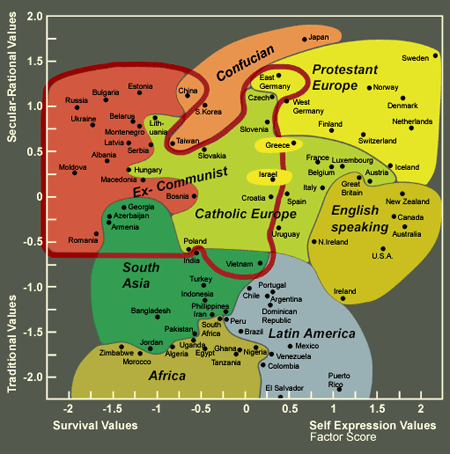
Here is a map from Ronald Inglehart’s World Values Survey organization web site. The site allows users to analyze data collected by the World Values Survey in dozens of countries around the world. We are reading Inglehart’s The Renaissance of Political Culture this week and will analyze the importance of political culture for understanding political outcomes, such as democracy and economic development. Are some cultures more compatible with democracy and economic growth than others? Is culture a more compelling framework for testing political phenomena than is rational choice?

Inglehart-Welzel Cultural Map of the World

This map reflects the fact that a large number of basic values are closely correlated; they can be depicted in just major two dimensions of cross-cultural variation

inglehart_weltzel_value_map.gif

Comparative Welfare States in Advanced Industrial Economies

In a couple of weeks, we–in PLSC240–will address the topic of political economy.  We’ll compare states around the world with respect to institutions such as tax regimes, openness of borders to goods and services imported from abroad, and also with respect to welfare state spending.  Andrew Gelman has posted on his blog a review–which will be published in Political Science Quarterly–of a new book by Clem Brooks and Jeff Manza, titled Why Welfare States Persist.  Not surprisingly, the answer is that they are publicly popular.  What is more interesting, though, is why the size of the welfare state differs amongst countries with relatively similar income levels.  Can you can think a cultural explanation?  Institutional?  Rational Choice?

Rich capitalist democracies around the world differ widely in their welfare states—their systems of government-provided social support–despite having comparable income levels. Brooks and Manza report that welfare state spending constituted 27% of GDP in “social democratic countries” such as Sweden and 26% of GDP in “Christian democratic countries” such as Germany, but only 17% in “liberal democracies” such as the United States and Japan. These differences are correlated with differences in income inequality and poverty rates between countries.

In their book, Brooks and Manza study how countries with different levels of the welfare state differ in their average policy preferences, as measured by a cross-national survey that asks whether respondents think the government should (a) provide a job to everyone who wants one, and (b) reduce income differences between rich and poor. Brooks and Manza find that countries where government jobs policies and redistribution are more popular are the places where the welfare state is larger, and this pattern remains after controlling for time trends, per-capita GDP of the country, immigration, women’s labor force participation, political institutions, and whether the ruling party is religious or on the left.

Next week, you will have a chance to test this hypothesis when we comparatively analyze public opinion attitudes around the world using the World Values Survey.   Is this relationship real?  Does it apply to states that are not advanced industrial economies?  We’ll find out next week.

South Carolina Democratic Primary, Institutional Legacies, and Generational Change

In class on Thursday, I defined institutions and described some of their major characteristics, the most important of which is that an institution endures, sometimes despite the significant impetus for change driven by changing political, social, economic, and technological sources. Last night’s Democratic primary exit polls in South Carolina provide a glimpse into the institution known as the Democratic primary and how that institution has endured over time. Here is a portion of the exit polls from CNN:

sc_primary_exit_polls1.jpg

Notice the three red boxes, which confirm that Obama was able to win a landslide victory in South Carolina despite receiving only 15% of the 60-and-older non-black vote. So what, you may respond, a pattern has emerged showing Obama captures much more support from the under-30 crowd than the over-60 cohort. But if you look at the over-60 black vote, you’ll see that they voted overwhelmingly in favor of Obama. The complete story here is the institutional legacy of the Democratic party in the South and the impact of generational change on the nature of the party. When we cover political attitudes and ideologies in about two weeks time, we’ll read Ronald Inglehart’s work, in which he highlights the importance of inter-generational changes in attitudes brought about by exposure to epoch-changing events. Lyndon Johnson’s signature on the Civil Rights Act in 1964 was just such an event.

Design a site like this with WordPress.com
Get started