Current United Nations Peacekeeping Operations

We discussed Tom Weiss’ book–Humanitarian Intervention–in IS 302 today. We spent some time on the changing nature, and number, of peacekeeping operations since the end of the Cold War. Below is a map listing the 16 current UN peacekeeping operations. You can find the source image, which is clickable, here.  How many of these operations are proceeding under the auspices of Chapter VII of the UN Charter?

Here is part of the textof the UNSC resolution, authorizing the establishment of MONUSCO in the Democratic Republic of the Congo:

Resolution 1925 (2010)
Adopted by the Security Council at its 6324th meeting, on 28 May 2010

The Security Council,

Continue reading “Current United Nations Peacekeeping Operations”

Michael Ignatieff and Humanitarian Intervention

Current leader of the Canadian Federal Liberal Party, Michael Ignatieff has long been involved in the issue of human rights–as a historian, journalist, public intellectual, and as the former Carr Professor and Director of the Carr Center for Human Rights Policy at the Kennedy School of Government.

In the aftermath of the contentious NATO military intervention in Kosovo (1999), Ignatieff sat down with WBUR’s Chris Lydon to assess what had gone right (and wrong) during the intervention. A self-identified member of the “something must be done [to stop alleged Serbian war crimes against the Kosovar Albanians]”, Ignatieff stands by his support for the intervention, claiming that, on the whole, the benefits outweighed the costs.

Sarah Palin should have taken PLSC250

Had one of my Introduction to International Relations students been taking questions from Charlie Gibson tonight, s/he would have been well prepared to answer his question regarding the “Bush Doctrine”.  As my students (still?) know, the “Bush Doctrine” was most clearly and forcefully enunciated in the 2002 National Security Strategy of the United States.  While there are three major components to the “Bush Doctrine”, the most important of which (at least the one that received the most attention and presented the most radical departure from the part-realist, part-liberal, bi-partisan, pre-9/11 US foreign policy framework was the idea of using preemptive military force, without the need for there to be an imminent threat.

Democratic critics have often charged Bush and his administration with claiming that Saddam Hussein posed an “imminent threat”, but I have yet to see any evidence that anyone speaking for the administration did so.  And it’s not a surprise, as the Bush Doctrine allows the use of force without imminent threat.  Maybe Governor Palin should bring some of those critics along with her to my class.  And if the Republican Party would like to hire a IR tutor for Governor Palin, they’ll find my rates more than reasonable.

Japanese American Internment During World War II

Students in my Intro to IR class have turned in papers dealing with ethics in international relations. One of the papers has an interesting quote by a Lieutenant General John L. DeWitt (who [my student claims] ultimately ordered the internment).

According to my student (AA), this is what Lt-Gen. DeWitt said to members of a Congressional panel:

“I don’t want any of them [persons of Japanese ancestry] here. They are a dangerous element. There is no way to determine their loyalty… It makes no difference whether he is an American citizen, he is still Japanese. American citizenship does not necessarily determine loyalty… But we must worry about the Japanese all the time until he is wiped off the map” (Mullen)*.

*Here is the source: Fred Mullen, “DeWitt Attitude on Japs Upsets Plans,” Watsonville Register- Pajaronian, April 16, 1943. Reproduced by Santa Cruz Public Library, accessed April 6, 2008.

Fareed Zakaria calls John McCain’s Foreign Policy Vision Radical

I won’t be posting much over the next week or so as grading and exams are taking up most of my time. I did want, however, to alert my students to this interesting article by Newsweek editor Fareed Zakaria on Republican Presidential candidate John McCain’s foreign policy philosophy. Zakaria agrees with Pat Buchanan and others at the American Conservative magazine that McCain’s foreign policy views are a radical break with past administrations (Democratic and Republican). Zakaria writes:

On March 26, McCain gave a speech on foreign policy in Los Angeles that was billed as his most comprehensive statement on the subject. It contained within it the most radical idea put forward by a major candidate for the presidency in 25 years. Yet almost no one noticed.

I guess that’s because the American media knows what the real issues are–Barack Obama refusing coffee for orange juice at a diner in Pennsylvania, Hillary Clinton doing shots in a Pennsylvania bar (were they body shots?), and lapel flag pins.

In his speech McCain proposed that the United States expel Russia from the G8, the group of advanced industrial countries. Moscow was included in this body in the 1990s to recognize and reward it for peacefully ending the cold war on Western terms, dismantling the Soviet empire and withdrawing from large chunks of the old Russian Empire as well. McCain also proposed that the United States should expand the G8 by taking in India and Brazil—but pointedly excluded China from the councils of power.

We have spent months debating Barack Obama’s suggestion that he might, under some circumstances, meet with Iranians and Venezuelans. It is a sign of what is wrong with the foreign-policy debate that this idea is treated as a revolution in U.S. policy while McCain’s proposal has barely registered. What McCain has announced is momentous—that the United States should adopt a policy of active exclusion and hostility toward two major global powers. It would reverse a decades-old bipartisan American policy of integrating these two countries into the global order, a policy that began under Richard Nixon (with Beijing) and continued under Ronald Reagan (with Moscow). It is a policy that would alienate many countries in Europe and Asia who would see it as an attempt by Washington to begin a new cold war.

This is bang on. Hillary Clinton and others, who have tried to trash Obama on his views about dialogue with putative enemies would do well to remember that it was ultimately dialogue with China and the Soviet Union that lessened tensions between these states and the United States. What McCain wants to do is to return the world to the situation ex-ante, for what strategic reason I’m not sure. This is, in the immortal words of Chazz Michael Michaels, “mind-bottling!”

I write this with sadness because I greatly admire John McCain, a man of intelligence, honor and enormous personal and political courage. I also agree with much of what else he said in that speech in Los Angeles. But in recent years, McCain has turned into a foreign-policy schizophrenic, alternating between neoconservative posturing and realist common sense. His speech reads like it was written by two very different people, each one given an allotment of a few paragraphs on every topic.

The neoconservative vision within the speech is essentially an affirmation of ideology. Not only does it declare war on Russia and China, it places the United States in active opposition to all nondemocracies. It proposes a League of Democracies, which would presumably play the role that the United Nations now does, except that all nondemocracies would be cast outside the pale. The approach lacks any strategic framework. What would be the gain from so alienating two great powers? How would the League of Democracies fight terrorism while excluding countries like Jordan, Morocco, Egypt and Singapore? What would be the gain to the average American to lessen our influence with Saudi Arabia, the central banker of oil, in a world in which we are still crucially dependent on that energy source?

How many of these questions do you think will be asked at the first Presidential Debate? My over/under is one. Zakaria is right that McCain’s foreign policy vision is a triumph of ideology over strategy. Here is where McCain would most clearly take the mantle from George Bush and embark upon a third term for the ideological and policy goals of the current administration. “The King is dead…long live the king!”

Israel and Syria once again Negotiating over Golan Heights

In intro to IR on Wednesday we addressed global environmental issues and we went over this chart outlining Thomas Homer-Dixon’s overview regarding the link between environmental scarcity and security. According to Homer-Dixon, environmental degradation is not only an important economic, social, and health issue, it is crucially an issue of importance for global security.

We see the important link between increased environmental scarcity and social effects (like ethnic conflicts, deprivation conflicts and coups d’etat), facilitated indirectly at times by the conditions of weakened states.

Homer-Dixon argues that these environmentally-driven conflicts will increase the more the environment degrades. Moreover, it is just those places in the world that have the least capacity to deal with the potentially negative effects of environmental degradation whose environments will be most likely to suffer.

In the far left column is “unequal resource access”. One of the most important resources to humankind is water. The conflict between Syria and Israel over the Golan Heights is crucially linked to water. As we learn from the New York Times:

JERUSALEM — Peace overtures between Israel and Syria moved up a gear on Wednesday when a Syrian cabinet minister said that Prime Minister Ehud Olmert of Israel had sent a message to President Bashar al-Assad to the effect that Israel would be willing to withdraw from all the Golan Heights in return for peace with Syria.

The Syrian expatriate affairs minister, Buthaina Shaaban, told Al Jazeera television, “Olmert is ready for peace with Syria on the grounds of international conditions; on the grounds of the return of the Golan Heights in full to Syria.” She said that Turkey had conveyed the message.

Israeli officials did not deny the statement from Damascus but would not confirm it either, offering a more general, positive reaction. “Israel wants peace with Syria; we are interested in a negotiated process,” said Mark Regev, a spokesman for Mr. Olmert. “The Syrians know well our expectations, and we know well their expectations…”

“…Withdrawal from the Golan Heights is a contentious issue in Israel. The territory is a strategic plateau that overlooks a large swath of northern Israel. Israel has objected to past Syrian demands for access to the shore of the Sea of Galilee, a main water source for Israel.

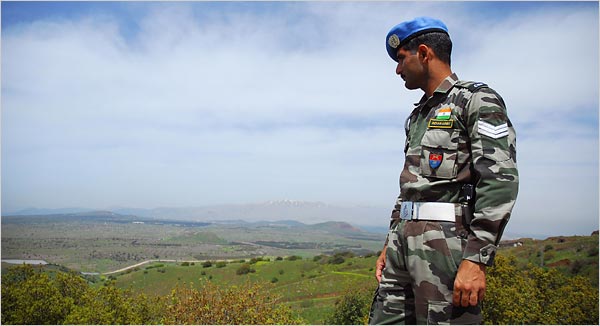
Yehuda Raizner/Agence France-Presse — Getty Images

An Indian member of the United Nations force in the Golan Heights, a strategic

plateau that overlooks a swath of northern Israel.

Rising Food Prices Have Global Political Implications

The issue of rising food prices globally has come under increasing scrutiny lately and has political leaders concerned. The annual meetings of the World Bank and IMF gave prominence to the problem and newspapers and magazines are weighing in with their opinion on the potential short- and long-term implications of the dramatic spike in world food prices. Will this last? Are we finally facing a neo-Malthusian future or will we be able to find a feasible and politically palatable solution to this crisis?

The Economist has a new article on the potentially devastating impact that the rise in food prices. In an article called “The silent tsunami” the editors (who generally espouse a free-market oriented, classically liberal view of the relation between markets and the state) argue that what is needed to avert disaster are “radical solutions.”

PICTURES of hunger usually show passive eyes and swollen bellies. The harvest fails because of war or strife; the onset of crisis is sudden and localised. Its burden falls on those already at the margin.

Today’s pictures are different. “This is a silent tsunami,” says Josette Sheeran of the World Food Programme, a United Nations agency. A wave of food-price inflation is moving through the world, leaving riots and shaken governments in its wake. For the first time in 30 years, food protests are erupting in many places at once. Bangladesh is in turmoil (see article); even China is worried (see article). Elsewhere, the food crisis of 2008 will test the assertion of Amartya Sen, an Indian economist, that famines do not happen in democracies.

Famine traditionally means mass starvation. The measures of today’s crisis are misery and malnutrition. The middle classes in poor countries are giving up health care and cutting out meat so they can eat three meals a day. The middling poor, those on $2 a day, are pulling children from school and cutting back on vegetables so they can still afford rice. Those on $1 a day are cutting back on meat, vegetables and one or two meals, so they can afford one bowl. The desperate—those on 50 cents a day—face disaster.

Roughly a billion people live on $1 a day. If, on a conservative estimate, the cost of their food rises 20% (and in some places, it has risen a lot more), 100m people could be forced back to this level, the common measure of absolute poverty. In some countries, that would undo all the gains in poverty reduction they have made during the past decade of growth. Because food markets are in turmoil, civil strife is growing; and because trade and openness itself could be undermined, the food crisis of 2008 may become a challenge to globalisation.
After arguing that the first step in any proposed solution is for states to adequately fund the World Food Program, the editorial argues for a free-market solution to the underlying problems:

In general, governments ought to liberalise markets, not intervene in them further. Food is riddled with state intervention at every turn, from subsidies to millers for cheap bread to bribes for farmers to leave land fallow. The upshot of such quotas, subsidies and controls is to dump all the imbalances that in another business might be smoothed out through small adjustments onto the one unregulated part of the food chain: the international market.

For decades, this produced low world prices and disincentives to poor farmers. Now, the opposite is happening. As a result of yet another government distortion—this time subsidies to biofuels in the rich world—prices have gone through the roof. Governments have further exaggerated the problem by imposing export quotas and trade restrictions, raising prices again. In the past, the main argument for liberalising farming was that it would raise food prices and boost returns to farmers. Now that prices have massively overshot, the argument stands for the opposite reason: liberalisation would reduce prices, while leaving farmers with a decent living.

Here is a world hunger map from the UN Food Program. What do you think the various colors represent?

Pope Benedict XVI a Foreign Policy Radical

The Pope delivered a speech last week to the United Nations in which he argued–as have many radicals over the last few decades–that the will of the international community to act in order to solve important global problems is being undermined because a few states have accrued too much power.  The Associated Press has more:

NEW YORK – Pope Benedict XVI warned diplomats at the United Nations on Friday that international cooperation needed to solve urgent problems is “in crisis” because decisions rest in the hands of a few powerful nations.

In a major speech on his U.S. trip, Benedict also said that respect for human rights, not violence, was the key to solving many of the world’s problems.

While he didn’t identify the countries that have a stranglehold on global power, the German pope — just the third pontiff to address the U.N. General Assembly — addressed long-standing Vatican concerns about the struggle to achieve world peace and the development of the poorest regions.

On the one hand, he said, collective action by the international community is needed to solve the planet’s greatest challenges.

On the other, “we experience the obvious paradox of a multilateral consensus that continues to be in crisis because it is still subordinated to the decisions of a few.”

The pope made no mention of the United States in his speech, though the Vatican did not support the U.S.-led invasion of Iraq in 2003, which occurred despite the Bush administration’s failure to gain Security Council approval for it. At other moments on his trip, Benedict has been overtly critical of the U.S., noting how opportunity and hope have not always been available to minorities.

The pope said questions of security, development and protection of the environment require international leaders to work together in good faith, particularly when dealing with Africa and other underdeveloped areas vulnerable to “the negative effects of globalization.”

Iraq is a Minefield

Have any of you ever realized that you just may be in a minefield? It’s a difficult conundrum because you don’t want to just stay there, but you also don’t want to move. It seems as though there is no good choice to make. That, according to an analyst at the National Defense University, is the US fate in Iraq currently.

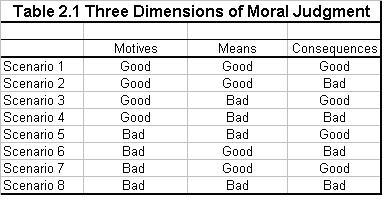
During our relatively short discourse into international ethics, we discussed Table 2.1 from Amstutz’s book, which demonstrates the Three Dimensions of Moral Judgment.

Here it is:

We notice that in order to evaluate the morality of a foreign policy decision, we must judge the motives behind the decision, the means used, and the final result of the decision. A new paper by Joseph J. Collins, of the Institute for National Strategic Studies of the National Defense University analyzes the Bush administration’s decision to invade Iraq in 2003. According to the author,

To date, the war in Iraq is a classic case of failure to adopt and adapt prudent courses of action that balance ends, ways, and means.

The paper is an interesting and nuanced read and I encourage you to take a look. Here is the first page:

Measured in blood and treasure, the war in Iraq has achieved the status of a major war and a major debacle. As of fall 2007, this conflict has cost the United States over 3,800 dead and over 28,000 wounded. Allied casualties accounted for another 300 dead. Iraqi civilian deaths—mostly at the hands of other Iraqis—may number as high as 82,000. Over 7,500 Iraqi soldiers and police officers have also been killed. Fifteen percent of the Iraqi population has become refugees or displaced persons. The Congressional Research Service estimates that the United States now spends over $10 billion per month on the war, and that the total, direct U.S. costs from March 2003 to July 2007 have exceeded $450 billion, all of which has been covered by deficit spending. No one as yet has calculated the costs of long-term veterans’ benefits or the total impact on Service personnel and materiel.


The war’s political impact also has been great. Globally, U.S. standing among friends and allies has fallen. Our status as a moral leader has been damaged by the war, the subsequent occupation of a Muslim nation, and various issues concerning the treatment of detainees. At the same time, operations in Iraq have had a negative impact on all other efforts in the war on terror, which must bow to the priority of Iraq when it comes to manpower, materiel, and the attention of decisionmakers. Our Armed Forces—especially the Army and Marine Corps—have been severely strained by the war in Iraq. Compounding all of these problems, our efforts there were designed to enhance U.S. national security, but they have become, at least temporarily, an incubator for terrorism and have emboldened Iran to expand its influence throughout the Middle East.

As this case study is being written, despite impressive progress in security during the surge, the outcome of the war is in doubt. Strong majorities of both Iraqis and Americans favor some sort of U.S. withdrawal. Intelligence analysts, however, remind us that the only thing worse than an Iraq with an American army may be an Iraq after the rapid withdrawal of that army. The 2007 National Intelligence Estimate (NIE) on Iraq’s future stability said that a rapid withdrawal “almost certainly would lead to a significant increase in the scale and scope of sectarian conflict in Iraq, intensify Sunni resistance to the Iraqi government, and have adverse consequences for national reconciliation.” The NIE goes on to say that neighboring countries might intervene, resulting in massive casualties and refugee flows. No one has calculated the psychopolitical impact of a perceived defeat on the U.S. reputation for power or the future of the overall war on terror. For many analysts (including this one), Iraq remains a “must win,” but for many others, despite the obvious progress under General David Petraeus and the surge, it now looks like a “can’t win.” To date, the war in Iraq is a classic case of failure to adopt and adapt prudent courses of action that balance ends, ways, and means.

60 Minutes Report on Torture in Guantanamo Bay

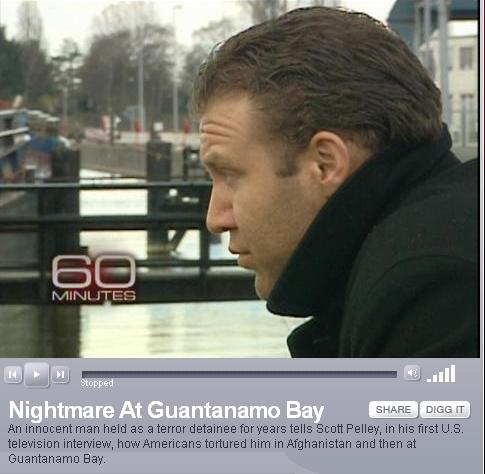
Via the CBS news program 60 Minutes, we learn about a German resident of Turkish origin who was tortured by his captors in Afghanistan and Guantanamo Bay.  From the description:

An innocent man held as a terror detainee for years tells Scott Pelley, in his first U.S. television interview, how Americans tortured him in Afghanistan and then at Guantanamo Bay.

You can find the video report here.

Design a site like this with WordPress.com
Get started