Afghan Aid Money Spent on High Salaries

After class today I spoke with a student who is interested in working in the humanitarian field after graduation.  Given that I had acquired some experience working for humanitarian organizations before heading to graduate school, I was able to impart some words of wisdom.  While I enjoyed my time working for humanitarian NGOs, I did find that it was very easy to get frustrated and become cynical.  Here’s a story from the Associated Press that reminded me of some of the reasons that I stopped working for humanitarian organizations (I encourage you to read the whole report):

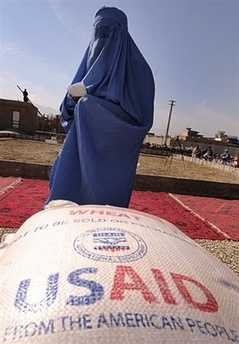
afghan_woman_usaid.jpg KABUL, Afghanistan – Too much money meant for Afghanistan aid is wasted, with a vast amount spent on foreign workers’ high salaries, security and living arrangements, according to a report from humanitarian groups published Tuesday.

The prospects for peace in Afghanistan are being undermined because Western countries are failing to deliver on aid promises — and because much of the aid money they do send is going to expatriate workers, according to the Agency Coordinating Body for Afghan Relief, an alliance of 94 international aid agencies.

Since 2001, the international community has pledged $25 billion in help but has delivered only $15 billion, the alliance said. Of that $15 billion, some 40 percent of it — or $6 billion — goes back to donor countries in corporate profits and consultant salaries, the report found.

“A vast amount of aid is absorbed by high salaries, living, security, transport and accommodation costs for expatriates working for consulting firms or contractors,” the report said. The costs are increasing with a recent deterioration in security, it said.

The cost of a full-time expatriate consultant working in Afghanistan is around $250,000, according to the group.

This is some 200 times the average annual salary of an Afghan civil servant, who is paid less than $1,000″ per year, the report said.

Amy Frumin, an international affairs fellow with the Council on Foreign Relations who spent a year in Afghanistan as an officer on a U.S. Agency for International Development reconstruction team, said blaming high expat salaries is unfair.

“You have to pay them good money to do that. They’re still having trouble finding people to fill these positions. It’s a dangerous place. Not many people are willing to risk their limbs,” she said.
40th Anniversary of the Prague Spring and Soviet Invasion of Czechoslovakia

 This Spring marks the 40th anniversary of the Prague Spring–a domestic, Czech-led liberalization and democratization movement in the former Czechoslovakia–and the subsequent Soviet military invasion of that former communist state.  As Czechs sang and wrote their way towards a regime Czechs would describe as “Communism with a human face”, Leonid Brezhnev–the leader of the Soviet Union–rolled Soviet tanks onto the streets of Prague to put an end to Alexander Dubcek’s reforms.  This was the first concrete foreign policy manifestation of the “combating of anti-socialist forces,” which came to be known as the Brezhnev Doctrine.

Euronews has an interesting report on the commemoration of the Prague Spring, which has been uploaded to youtube.  I encourage you to take a look.

International Relations–Paper One Assignment

Academic use theories as a lens/filter through which to analyze and discuss important events in international relations. In that way, we can understand more about the event and compare it to other events, which we believe may have similar characteristics and causes.  We’ll be using IR theories profusely in this course so it is important that the student has a strong understand of the main theories used in IR.

Introduction to International Relations Paper 1–Using Theory to
Understand Stuff

As Mingst notes in the conclusion of Chapter 3, the theoretical lens/filter through which one views the world determines to a large extent what one sees. Realists look at the Iraq war and see and understand it in a particular way, whereas radicals/Marxists see the same event and interpret it very differently. For this first paper assignment, I would like you to select an important event in international politics (it could be as grand as the Second World War, or less grand–the US decision to boycott the Olympic Games in Moscow in 1980) and critically analyze from the perspective of two competing
IR theories. Some of the elements of the paper should be:

  • A description of the basic tenets/principles of the competing IR theories.
  • Reference to any levels-of-analysis that are important in understanding the event.
  • A short description of the event itself (i.e., the who, what, where, when).
  • An assessment of the event from a theoretical perspective, including an evaluation of which of the theories provides more support for understanding why the event occurred, or why it developed in the manner in which it did.

You will obviously use Chapter 3 of the Mingst book (Essentials of International Relations) as a source for the paper. For information related to your specific states, you will have to consult at least 3 other academically reputable sources. Note that this means Google is not your friend here!! This will entail a trip down to the library by foot, or a virtual trip to the library’s electronic resources. Finally, use the course page at the Library’s web-site for further sources to use.
Your paper should be 4 − 5 pages long (maximum!!), double-spaced on 8.5X11 − inch paper, with 1-inch margins on the top, bottom, and the sides. The paper must be written in Times Roman 12pt. font, with a separate title page and works cited page.3 The paper is due electronically via Digital Dropbox in Blackboard by the beginning of class on Wednesday, February 20th4. Finally, I
will also require that you electronically append a “paper evaluation sheet to the end of your paper, which I’ll use as a rubric to evaluate the paper. (Once again, I’ll show you exactly how to do this next week.)

No Torture. No Exceptions.

no_torture_no_exceptions.jpg

The above sketch by Thomas V. Curtis, a former Reserve M.P. sergeant, is of an Afghan detainee, Dilawar, who was taken into U.S. custody on December 5, 2002, and died five days later. Dilawar was deprived of sleep and chained to the ceiling of his cell—techniques that the Bush administration has refused
to outlaw for use by the CIA. Further, his legs were, according to a coroner, “pulpified” by repeated blows. Later evidence showed that Dilawar had no connection to the rocket attack for which he’d been apprehended.

One of the most important tenets of my teaching philosophy is to make the classroom a safe forum for diverse and competing points of view. In order to facilitate this, I believe that it is necessary, as much as is humanly possible, to refrain from promoting my own views and importing my personal biases into what I teach. I will temporarily put that tenet aside in order to address the topic of torture.

The United States government tortures. That’s a difficult sentence for me to write. The human rights organization for which I worked in Croatia during the 1990s–the Croatian Helsinki Committee–was at the forefront of the effort in that country to stop human rights abuses, such as torture, that the Tudjman-led regime was committing during those years. I would often find myself in debate with individuals–soldiers, police officers, government officials, religious leaders, and average citizens–about the human rights abuses the government was committing. My argument was basically, “we (in Croatia) are being hypocritical if, on the one hand, we claim that we are superior–in some civilizational sense (this is argument that was made, though I don’t adhere to it)–to the Serbs because we are more “Western” and more democratic, yet we allow our government (with our support) to commit absolutely horrific human rights abuses. We should try to mimic the behavior, then, of Western democracies such as Canada and the United States rather than the abhorrent policies of the Milosevic regime.”

My interlocutors would usually reply, “but, Canada’s, and America’s government would be doing the same thing if 1/3 of their territory was under foreign occupation.” I replied that they would not. I have to apologize to every single one of those people, because they were right and I was wrong. And it didn’t even take foreign occupation for the US government to begin to undermine the fundamental tenets upon which democracy and the respect for human dignity are based. My attitude towards torture is nicely captured by the title of a recent series on torture put out by the magazine Washington Monthly–“No Torture. No Exceptions.”

We’ll take a look at the debate on torture near the end of the semester (in intro to IR) and we’ll see that the strongest moral claim for torture comes from a consequentialist (or utilitarian) perspective; this is why the “ticking bomb scenario” is customarily trotted out to refute deontological arguments. I will argue (and I encourage you to try to prove me wrong) that there are consequentialist reasons for not torturing. I encourage you to read the essays in “No Torture. No Exceptions.” (In fact, if you’re in intro to IR, you’ll have to.)

U.N. Security Council Silent on Tibet Protests

How do changing ideas about sovereignty–from sovereignty viewed as a “right” to sovereignty viewed as a “responsibilty”–affect the nature of how states act and the functioning of organizations such as the United Nations?  Just before spring break we viewed the documentary The Peacekeepers, where you were able to witness the deliberations that take place behind the scenes at the United Nations and the Security Council specifically. For Wednesday, we’ll read Erik Voeten’s article on “The Political Origins of the UN Security Council’s Ability to Legitimize the Use of Force”, the main point of which is obvious given the title. Today, the Guardian reports that the Security Council remains silent on the current situation in Tibet.

UNITED NATIONS, March 17 (Reuters) – The U.N. Security Council will likely keep silent about China’s crackdown on demonstrations in Tibet, mostly due to belief that provoking Beijing would accomplish nothing, diplomats said on Monday.
China, which has sent in troops to enforce control in the regional capital Lhasa, said earlier that the violent protests by Tibetans were organized by followers of the Dalai Lama seeking to derail the Beijing Olympics in August. Tibet’s exiled spiritual leader has denied this charge.
“The issue did not come up in the council,” China’s Deputy permanent U.N. representative Liu Zhenmin told Reuters after a meeting of the council on unrelated issues. “This has nothing to do with peace and security,” he said. “It is local violence, … a domestic issue.”
China, like the United States, Britain, France and Russia, is a permanent veto-wielding member of the council and would be able to block any attempts by the council to act on Tibet.
Russia’s U.N. Ambassador Vitaly Churkin, currently president of the council, told reporters without elaborating that he did not expect the 15-nation Security Council to discuss Tibet. Several other ambassadors confirmed this view.

Woodrow Wilson at the White House

Here is some fascinating (silent) footage of Woodrow Wilson at the White House, no doubt thinking about his Fourteen Points.  I think he’s on the phone to Clemenceau debating the merits of Point Nine.  It’s interesting how many of the points refer to the establishment of new nation-states (getting nations congruent with borders) and/or adjusting borders to more adequately cohere with notions of justice.

Book Review: “Justice in Conflict? The ICC and Peace Processes”,

icc.jpgWe will be analyzing international law next week upon our return from spring break. The recently established International Criminal Court (ICC), an independent (i.e., it has no linkn to the United Nations, unlike the International Court of Justice–ICJ) international court located in the Hague, has in its short existence (it came into force in 2002) been the subject of heated debate between those who view it as a bold and necessary step in the fight for international justice, and those who view its powers as undermining to a dangerous degree state sovereignty.

This week’s weekly letter from the International Crisis Group (ICG) contains a book review of Nicholas Waddell and Phil Clark’s “Justice in Conflict: The ICC and Peace Processes. The author of the review, Nicholas Gronko, writes:

The International Criminal Court (ICC) is now investigating or prosecuting individuals involved in three of the most devastating conflicts in Africa – Darfur, northern Uganda and the Democratic Republic of Congo (DRC). In each case, the ICC has been forced to confront the challenges inherent in pursuing peace and justice simultaneously. What happens – and what should happen – when efforts to prosecute perpetrators of mass atrocities coincide with a peace process? What is the best approach when the price of a peace deal may be a degree of impunity for those most responsible for such abuses? One common and convenient response is to hide behind truisms and make general statements of principle to the effect that no trade-off is required because peace and justice are inextricably linked. Clearly peace and justice are complementary in that justice can deter abuses and can help make peace sustainable by addressing grievances non-violently. But good things don’t always go together, and to present peace and justice as invariably mutually reinforcing is misleading and unhelpful when the difficult reality of peacemaking often proves otherwise. We review below arguments surrounding the ICC’s impact on prospects for peace in Uganda and go on to offer some general considerations that international policymakers should heed when seeking to balance peace and justice demands.

Here is a look at the 106 (most recent count) signatories to the Statute of Rome (which established the ICC).  States in green are signatories to the statute.

iccmemberstates.png

Ethnic Conflict and Strife

A couple of days ago all blog posts seemed to be related to the theme “the social logic of politics”. Today, there seems to be a surge in episodes of inter-ethnic conflict worldwide. First, we learn from the Washington Post, that there is unrest and violence in the Tibetan capital of Lhasa, where a week of increasing confrontations between native Tibetans and the Chinese government have turned violent, with native Tibetans battling with Chinese police and troops and also attacking ethnic Han Chinese, which is either unprecedented or extremely rare.

BEIJING, March 14 — A week of tense confrontations over Chinese rule in Tibet erupted in violence Friday, as hundreds of protesters clashed with police and set fire to shops in the center of Lhasa. Doctors reported dozens of wounded streaming into area hospitals, and one witness said the downtown area was “in a state of siege.”

The rare breakout of violence, the worst in 20 years in the capital city of a remote mountainous region that is the heart of Tibetan Buddhism, posed a challenge to the Chinese government as it prepares to host the 2008 Olympic Games in August. Seeking to make the Games a worldwide celebration of its swift economic progress during the past three decades, the Chinese government has steadfastly attempted to project an image of harmony and stability, even while tightening its grip over the restive region.

“This spiraling unrest has triggered the scenario the Chinese prayed would not happen,” said Robbie Barnett, director of modern Tibetan studies at Columbia University. “Now we’re just watching the clock tick until people get off the street or the Chinese open fire.”

In a different part of the world, Malaysia, in which once again ethnic Chinese are involved, the New York Times reports on post-electoral tension on the island of Penang:

PENANG, Malaysia — Chanting “Long Live the Malays!” several hundred members of Malaysia’s largest ethnic group gathered Friday on this largely Chinese island, defying a police ban on protests and raising communal tensions after sharp electoral losses by the country’s governing party.

Newly elected state governments have moved rapidly to abolish some of the long-held privileges of ethnic Malays. Those efforts have challenged the core of Malaysia’s ethnic-based political system and inflamed the sensibilities of Malays. Until the March 8 elections, Malays thoroughly dominated politics through the country’s largest party, the United Malays National Organization, known by its initials, U.M.N.O.

The opposition parties that beat U.M.N.O. and its partners in five states say affirmative action should be based on need rather than ethnicity. But the opposition, too, is struggling to contain fissures along ethnic lines as a Chinese opposition party competes with its Malay counterpart.

“We’re living in very sensitive times,” said Tricia Yeoh, director of the Center for Public Policy Studies, an independent research center in Kuala Lumpur, the capital.

The affirmative action program favoring the Malays has been in place for more than three and a half decades and gives Malays everything from discounts on new houses to 30 percent quotas in initial public offerings of companies. It is known as the New Economic Policy.

Finally, in Iraq, where in the last four years the minority Christian community has been decimated, either through targeted killings or ethnic cleansing, we hear news of the killing of a prominent Catholic Bishop:

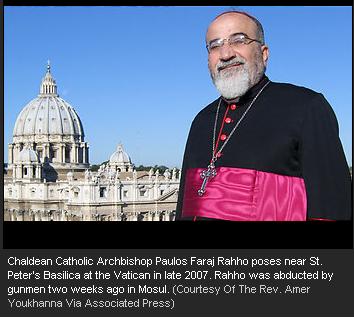
bishop_rahro.jpg BAGHDAD, March 13 — The body of a senior Christian cleric was found Thursday in the northern city of Mosul, two weeks after gunmen abducted him there and killed three of his associates.

The death of Paulos Faraj Rahho, 65, archbishop of Mosul’s Chaldean community, prompted expressions of remorse and condemnation from the Iraqi government and Christian leaders.

Pope Benedict XVI, in a message to the Chaldean patriarch in Iraq, called the killing an “act of inhuman violence that offends the dignity of the human person and seriously harms the cause of fraternal coexistence among the beloved Iraqi people.”

Iraqi Prime Minister Nouri al-Maliki said it was a crime of “aggression aimed at inciting sedition among” Iraqis.

CO2 Emissions in China Increasing Faster than Previously Believed

In intro to comparative, we have generally compared spatially across countries (or states). There is a lot of explanatory power, however, that can be achieved by modeling and comparing political phenomena at the sub-national level. Maximilian Auffhammer and Richard Carson–two economists–have done this by modeling the rise in Chinese CO2 emissions, using a panel data set at the provincial level in China. Their data set includes 30 provincial-level entities (or provinces) analyzed between 1985 and 2004. See a post I made on China’s pollution problems and economic growth here. I’ve reproduced a slide show from the post below. Here’s a snippet from their paper, which can be accessed here:

[rockyou id=99737780&w=500&h=350]

The People’s Republic of China (PRC) has long been seen as the key future participant to an effective agreement limiting the adverse impacts of climate change. It is currently the number two emitter of carbon dioxide (CO2) and is about to overtake the United States, who has held this position since 1890, as the leading emitter. Further, the United States has long preconditioned its adherence to any international agreement such as the Kyoto Protocol on China’s formal concurrence that it would also undertake substantial CO2 reductions. Efforts to reach such an agreement failed in the late 1990’s during the Clinton administration and the Bush administration decided not to pursue policies that would allow it to sign the treaty and have it rati¯ed by the U.S. Senate.

This paper presents econometric forecasts that strongly suggest that the short to medium term path of Chinese CO2 emissions has increased by a factor of two or more since that time. Our best forecast has China’s CO2 emissions surpassing the United States before the year 2010 rather than 2020 as previously anticipated (Intergovernmental Panel on Climate Change, 2000; Siddiqi, Streets, Wu and He, 1994; Panayotou, Sachs and Zwane, 2002). Our focus in this paper is on exploring alternative econometric specifications for forecasting China’s CO2 emissions using a rich new panel dataset from 1985 to 2004 at the provincial level. The prediction of a dramatic recent increase in the predicted path of China’s CO2 emissions over the short to medium term horizon is shown to be robust to a wide range of alternative specifications. We show, however, that it is possible to strongly reject both the standard engineering specifications that appear in the Intergovernmental Panel on Climate Change (2000), and the recent Stern Report (2006) as well as the popular environmental Kuznets curve specification. All of the “best” models are dynamic in nature employing some type of lag structure, which is consistent with the nature of an installed durable capital stock.

Catholicism and the Social Dimension of Sin

Father James Martin takes the London Times to task for their framing of the story of the Catholic Church’s developing views on the nature of sin. (Click here for my blog post on the Times story.)

Father Martin writes in the America Magazine–the national Catholic weekly–that the Times’ story has confused the issue “unnecessarily.” He writes:

pd_hell_070706_ms.jpgMy guess is that some in the media bobbled this story for two reasons, neither of them malicious. First, a general unfamiliarity with the contemporary Catholic tradition of social sin, even though under Pope John Paul II something like “anti-Semitism” was often referred to in those terms. And, second, the fact that a headline that reads “Seven New Deadly Sins” is undeniably sexier than a headline saying, “Vatican Official Deepens Church’s Reflection on Longstanding Tradition of Social Sin.”

The Vatican’s intent seemed to be less about adding to the traditional “deadly” sins (lust, anger, sloth, pride, avarice, gluttony, envy) than reminding the world that sin has a social dimension, and that participation in institutions that themselves sin is an important point upon which believers needed to reflect.

In other words, if you work for a company that pollutes the environment, you have something more important to consider for Lent than whether or not to give up chocolate.

Design a site like this with WordPress.com
Get started