Using Powerpoint-type Presentations in Class

latex.jpg

The rise in the ubiquity of use of Powerpoint-type (and I use the phrase Powerpoint-type since Powerpoint is but one–although the most popular–type of software used for electronic lecture presentations; I use the Beamer package add-on for the type-setting software LaTeX) presentations has led to a spirited debate in the field of academia. Some argue that the presentations are self-defeating and do not advance any sane pedagogical objective, while others swear by the benefits.

I see both advantages and disadvantages to their use but believe that ultimately, like with most tools, there is no inherent value in the tool itself, but that the value of the tool (for better or worse) comes in its application. Thus, I think that Powerpoint-type lectures can be used to enhance the educational experience and one’s pedagogical objectives. The issue, then, revolves around determining just what the best use of Powerpoint is.

Thankfully, there has been some research on the subject. From the blog “Thinking about College Teaching“, here is a snippet from a post explaining the best use of Powerpoint in classs:

I found a research study that compared student learning for four ways of combining PowerPoint presentations with distribution to students. (I no longer have a citation for that study.) One group of students did not receive any handouts, a second group received complete handouts prior to discussion, a third group received complete handouts after discussion, and a fourth group received skeletal handouts prior to the discussion and complete handouts after the discussion. Learning was greatest in the last group, and that was the model I followed…

…I went through that file and deleted most content except for slide headings. I made that file available to students on the Blackboard site for my course prior to class, and those who wanted it could download it and bring a printed copy to class. After I completed the class discussion, I made the [complete] file available. The most enterprising students brought the outline version to class, took notes on it, and later compared their notes to my complete version. In any case, I did not spend the school’s money to duplicate materials that only some students wanted. Students were satsified with that arrangement when I explained that they would learn the most that way.

This is what I will do for the remainder of the semester. When I am using Powerpoints, which will be about every second or third session, I’ll post the Powerpoint lecture outlines on Blackboard, the post the complete version there after I have completed the lecture. If it takes more than one session to finish a lecture, the completed version will be posted after the lecture has been completed in full.
War and the Process of State-making

As we discussed in class on Thursday, there is a close relationship between the war, the state, and state-making.  Thus, violence is at the root of the idea of the modern state, as Weber’s famous definition of the state aptly demonstrates.  Norbert Elias suggested that the state-formation process in Europe was “an elimination contest.”  In addition, Charles Tilly famously wrote* “war made the state and the state made war.”  In a much-read paper** on the topic, Tilly wrote:

What distinguished the violence produced by states from the violence delivered by anyone else? In the long run, enough to make the division between “legitimate” and “illegitimate” force credible. Eventually, the personnel of states purveyed violence on a larger scale, more effectively, more efficiently, with wider assent from their subject populations, and with readier collaboration from neighboring authorities than did the personnel of other organizations.  But it took a long time for that series of distinctions to become established. Early in the state-making process, many parties shared the right to use violence, the practice of using it routinely to accomplish their ends, or both at once. The continuum ran from bandits and pirates to kings via tax collectors, regional power holders, and professional soldiers.

The uncertain, elastic line between “legitimate” and “illegitimate” violence appeared in the upper reaches of power. Early in the state-making process, many parties shared the right to use violence, its actual employment, or both at once. The long love-hate affair between aspiring state makers and pirates or bandits illustrates the division. “Behind piracy on the seas acted cities and city-states,” writes Fernand Braudel of the sixteenth century. “Behind banditry, that terrestrial piracy, appeared the continual aid of lords.”‘ In times of war, indeed, the managers of full-fledged states often commissioned privateers, hired sometime bandits to raid their enemies, and encouraged their regular troops to take booty. In royal service, soldiers and sailors were often expected to provide for themselves by preying on the civilian population: commandeering, raping, looting, taking prizes. When demobilized, they commonly continued the same practices, but without the same royal protection; demobilized ships became pirate vessels, demobilized troops bandits.

It also worked the other way: A king’s best source of armed supporters was sometimes the world of outlaws. Robin Hood’s conversion to royal archer may be a myth, but the myth records a practice. The distinctions between “legitimate” and “illegitimate” users of violence came clear only very slowly, in the process during which the state’s armed forces became relatively unified and permanent.

The process of legitimation of state violence came, as Tilly argues above, slowly.  What, according to Weber, are the different types of legitimacy that attended to this process?

*Charles Tilly, “Reflections on the History of European State-Making,” in Charles Tilly, ed.,  The Formation of National States in Western Europe (Princeton, N.J.: Princeton Univ. Press, 1975), p. 42.

**Tilly, Charles. “War Making and State Making as Organized Crime, ” in Evans, Rueschemeyer and Skocpol, ed., Brining the State Back in (Cambridge: Cambridge University Press, 1985), p.172-173.

***Elias, Norbert. The Civilizing Process  (Oxford: Blackwell), 1993.

India’s Role in the Illegal Trafficking of Body Parts

This worrisome story in the New York Times sheds light on an increasingly brazen network of doctors and bandits who have organized an international trafficking ring in human body parts, such as kidneys.  While increasing numbers of Indians, and residents of other less-developed countries willingly sell their kidneys many, like the gentleman in the story, are the victims of deception and fraud.

GURGAON, India — As the anesthetic wore off, Naseem Mohammed said, he felt an acute pain in the lower left side of his abdomen. Fighting drowsiness, he fumbled beneath the unfamiliar folds of a green medical gown and traced his fingers over a bandage attached with surgical tape. An armed guard by the door told him that his kidney had been removed.

Mr. Mohammed was the last of about 500 Indians whose kidneys were removed by a team of doctors running an illegal transplant operation, supplying kidneys to rich Indians and foreigners, police officials said. A few hours after his operation last Thursday, the police raided the clinic and moved him to a government hospital.

Many of the donors were day laborers, like Mr. Mohammed, picked up from the streets with the offer of work, driven to a well-equipped private clinic, and duped or forced at gunpoint to undergo operations. Others were bicycle rickshaw drivers and impoverished farmers who were persuaded to sell their organs, which is illegal in India.

Although several kidney rings have been exposed in India in recent years, the police said the scale of this one was unprecedented. Four doctors, five nurses, 20 paramedics, three private hospitals, 10 pathology clinics and five diagnostic centers were involved, Mohinder Lal, the police officer in charge of the investigation, said.

Human Security Resources

A general trend has developed, amongst governments, academics, and (especially) activists working in IGOs and NGOs worldwide that has moved the focus of security away from traditional concepts–such as protecting borders from external threat–to a new approach that focuses specifically on human security. What is “human security?” Well, the Human Security Report Project, at Vancouver, Canada’s Simon Fraser University, defines human security in this way:

Unlike traditional concepts of security, which focus on defending borders from external military threats, human security is concerned with the security of individuals…

For some proponents of human security, the key threat is violence; for others the threat agenda is much broader, embracing hunger, disease and natural disasters. Largely for pragmatic reasons, the Human Security Report Project has adopted the narrower concept of human security that focuses on protecting individuals and communities from violence.

Traditional security policy emphasizes military means for reducing the risks of war and for prevailing if deterrence fails. Human security’s proponents, while not eschewing the use of force, have focused to a much greater degree on non-coercive approaches. These range from preventive diplomacy, conflict management and post–conflict peacebuilding, to addressing the root causes of conflict by building state capacity and promoting equitable economic development.

The website has an informative and very useful set of links to various organizations, governmental institutions, research institutes, etc., that focus on issues of human security.

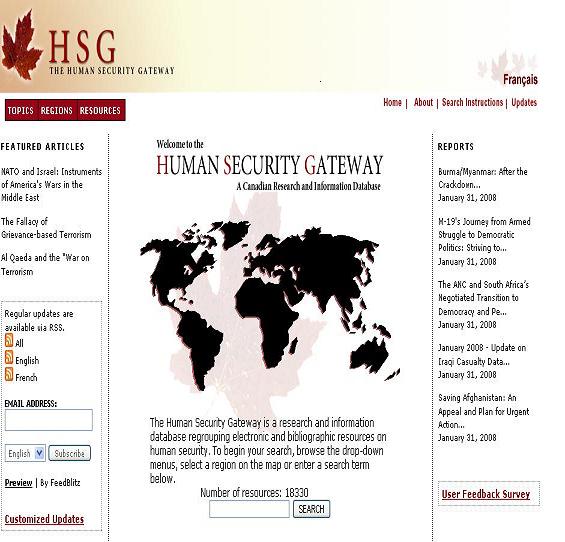
Another excellent source for information related to human security is the Human Security Gateway. Below is a thumbnails which will take you to a screen shot of their home page. (Notice the RSS feed icons in the left sidebar.)

human_security_gateway_homepage1.jpg

The History of Warfare since World War II–via Foods Fighting

We spent much of last Friday’s session understanding various realist approaches to international relations and the importance therein of concepts like anarchy, survival, power and war. Here’s a clear–and highly original–attempt to demonstrate the history of world warfare since WWII. For a menu of the foods and which countries they are meant to represent, click here. Before doing so, which foods do you think represent Great Britain, Germany, France, China, and the United States, respectively?  You can view the film here.

The Important Role of the State

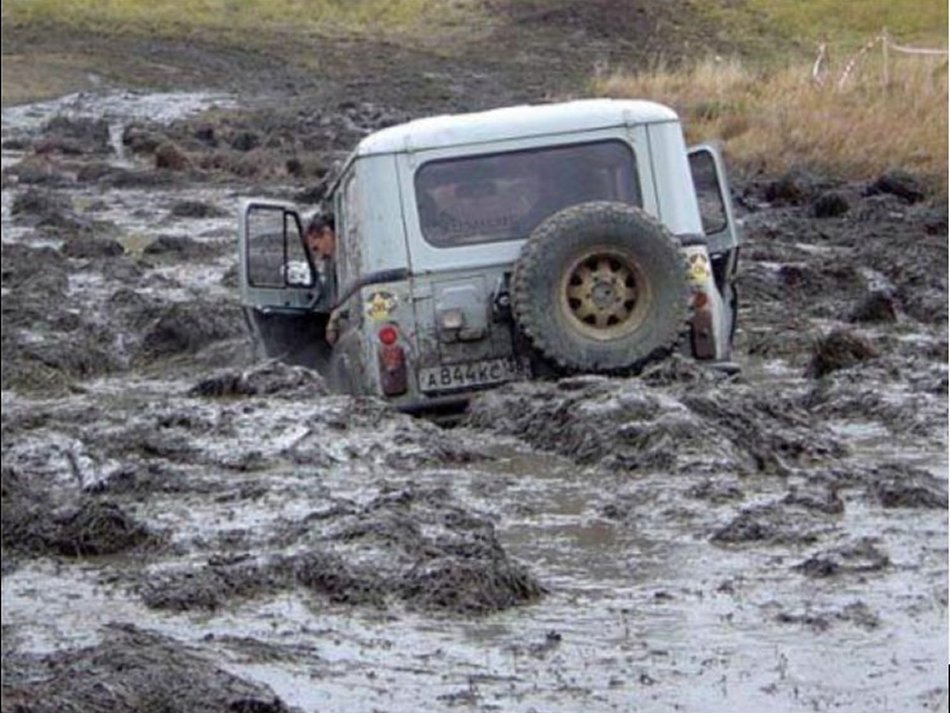
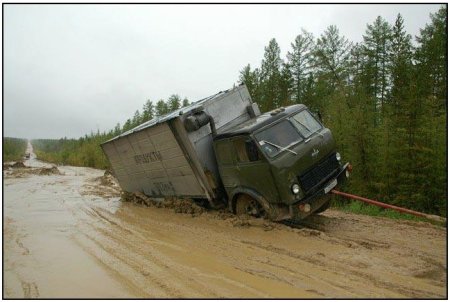
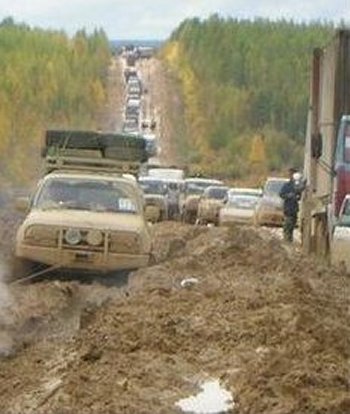
A country’s roads and road system can give outsiders a quick and readily available idea of how well that country is governed. Here are some examples:

A video of part of the drive from the Kenyan city of Mombasa (pop. 700,000) to the town of Kilifi (pop. 75,000). (Try to ignore the cackling of the passengers and driver.)

Here are some photographs of the main highway between Moscow and the Siberian city of Yakutsk. The road is a vital federal highway, believe it or not! See many more photographs here.

russian-road-33.jpg

russian-road-24a.jpgrussian-road-25a.jpgsiberia-06-302.jpg

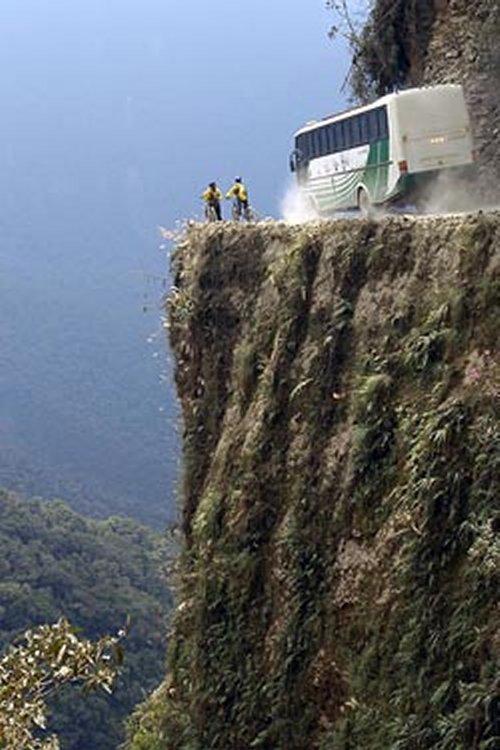
Also take a look at these incredible and frightening photographs from the world’s most dangerous highway. Find many more of these photographs here.

death-road-16.jpg

Mingst and Snyder–Chapter 3 Reading Questions

Morgenthau, Hans–“A Realist Theory of International Politics”
  • Does Morgenthau’s explanation of realist theory focus on any of the levels of analysis in particular? Explain.
  • Morgenthau writes “political realism is aware of the moral significance of political action. It is also aware of the ineluctable tension between the moral command and the requirements of successful political action.” What does he mean by this and why is this important for international relations?
  • How does Morgenthau define political power, and how is it used in internaitonal politics?

Continue reading “Mingst and Snyder–Chapter 3 Reading Questions”

Lies, Damned Lies, and Excel Charts!

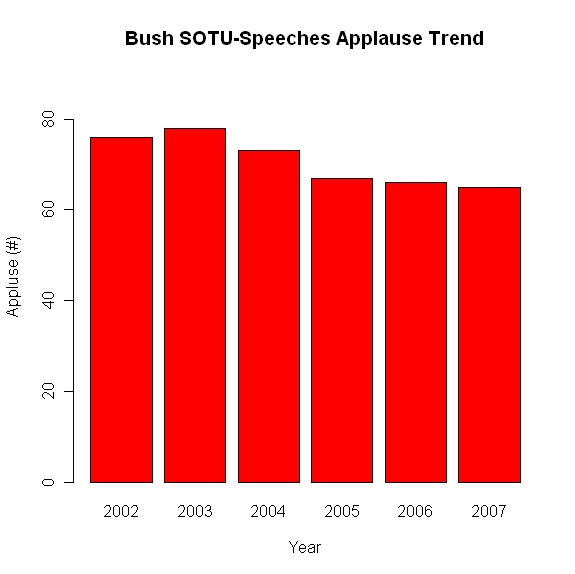
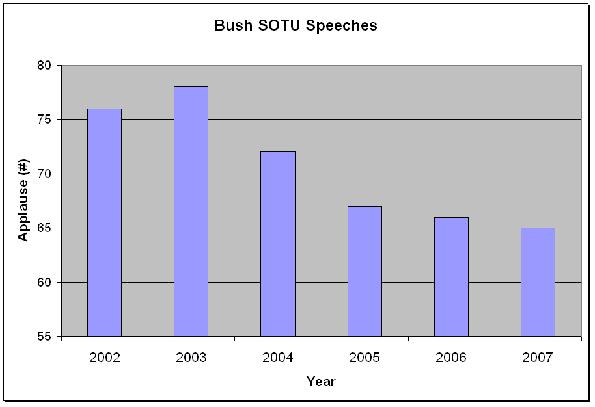
I provide links to many sources that collect data on various political phenomena because I think that describing and measuring are extremely useful tools in helping us understand politics. As Mark Twain was well aware, and as I mentioned in PLSC240 today, often-times researchers (and especially!) politicians use data and statistics to obfuscate reality rather than to illuminate. No sooner had I returned to my office than I saw the following chart on the web (courtesy of democrats.org). Here is a typical example of “massaging” the data to promote a preferred interpretation of political reality. Here’s the original chart:

sotu_speeches_11.jpg

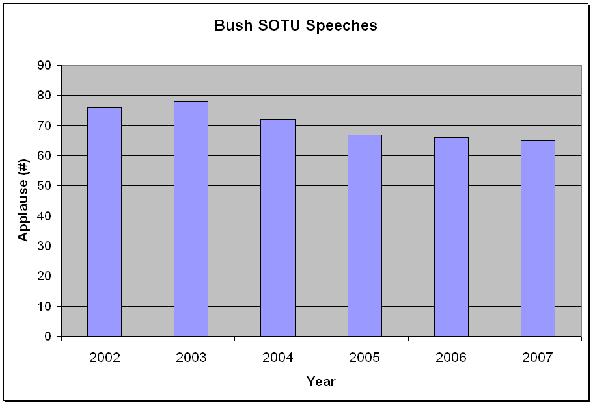
The inference that the creators of the chart want the observer to make is that the number of instances of applause from Bush’s State-of-the-Union (SOTU) speeches has, except for a spike in the immediate pre-Iraq invasion period of January 2003, been dropping, and significantly. Notice the range of the y-axis. Why did the chart creators decide to make 55 the minimum value? I have to give them the benefit of the doubt, however, as this seems to be a built-in feature of Excel (that’s why I encourage students to start using R for graphing capabilities). When I created the chart above myself in Excel, the program chose 55 as the minimum value of the y-axis. What would the chart look like if one were to make the y-axis minimum value zero? Here’s the result:

bush_sotu_zero_axis.jpeg

Now, the impression made upon the observer is that the drop in applause is not that great at all, and most likely within the range of what is called “random error”. Which chart is the correct one? Well, one way of determining the right answer to this would be to compare the SOTU applause trends of other presidents. Is every president guaranteed 40 or 50 bursts of applause no matter how lame the speech is or how unpopular the president is amongst those present? If so, then a minimum value on the y-axis of 40 or 50 would be more appropriate than zero, but I don’t know the answer off-hand.

UCDP/PRIO Armed Conflict Dataset


konfliktkart_8908.jpg

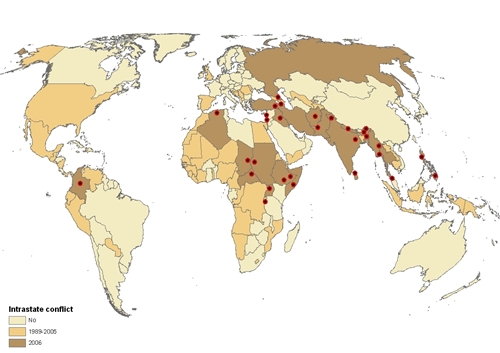
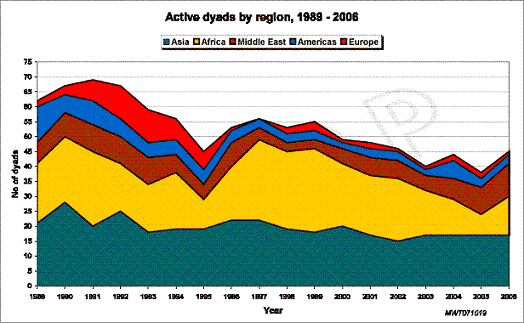
The Centre for the Study of Civil War at the International Peace Research Institute, Oslo (PRIO) and Uppsala Conflict Data Program (UCDP) at the Department of Peace and Conflict Research, Uppsala University, are the home for the Armed Conflict Dataset.  The dataset allows users access to information on such variables as name of conflict, antagonists, whether/not there was third-party intervention, etc., for all global conflicts between 1946 and 2002.  The website also has other data sources and illuminating charts and graphs, an example of which is reproduced below.

dyads_year_reg1.gif

This chart shows the number of conflicts in various regions of the world over time.

Design a site like this with WordPress.com
Get started