Washington Post Reports that China no longer as Attractive an “Outsourcing” Target

The average person may not know the difference between “offshoring” and “outsourcing”, but one would think that it would be a condition of employment for someone who writes for the business section of the Washington Post. In an otherwise informative story on the decreasing attractiveness of China as an “outsourcing” location for US companies, we are witness to another example of a member of the traditional media seemingly uninformed of basic facts.

Outsourcing is simply the idea that a company chooses to have another company produce a good or service rather than produce that same good or service in-house.  Outsourcing has been happening for a long time, and an example is when the Ford Motor Company decided that it would be better to use their productive capacity to produce engines, and outsource the task of making tires to a different company rather than make tires itself.  This helped increase productivity by allowing Ford to concentrate on the making of engines, and have the other company (Goodyear, Bridgestone) focus on making better tires.

Offshoring simply means sending work beyond one’s national boundaries.  Notice that not all offshoring is also outsourcing.  In fact, I have previously read (but I can’t find the source) that most offshoring is, in fact, not also outsourcing.  How can this be?  Well, what happens when General Motors decides to close down a car factory in Flint and make begin producing vehicles in Windsor, Ontario instead?  That production (and the jobs accopanying it) has been offshored (moved to a different country–Canada) but it hasn’t been outsourced, since GM is still producing the vehicles.  Here’s a little chart that will help you understand the difference.

As for the article itself, it demonstrates that rising fuel costs have increased the cost of shipping to such an extent that the potential savings for a US company of producing in China are completely eliminated.  One such company has repatriated production to the US from China (I suppose that’s called “onshoring”?)   We read:

SHANGHAI — Harry Kazazian built his business on sleeping bags that are made in China and shipped across the ocean to the United States, but he realized recently that the math doesn’t work anymore.

With fuel prices at record highs, the cost of sending a standard 40-foot container of goods has gone from $3,000 in 2000 to about $8,000 today, squeezing profit.

So this summer Kazazian, chief executive of Exxel Outdoors, a Los Angeles-based maker of recreational equipment, did something radical: He moved the manufacturing back to Haleyville, Ala.

Soaring energy costs, the falling dollar and inflation are cutting into what U.S. manufacturers call the “China price”– the 40 to 50 percent cost advantage once offered by Chinese producers.

The export model that has powered China and other Asian countries for three decades will be compromised if fuel prices continue to rise, said Stephen Jen, a managing director for Morgan Stanley.

“Globalization has gone a little bit too far. It has overshot,” Jen said. “We’re not saying Asia is going to crumble, but we are saying Asia enjoyed extraordinary conditions in the past. Now the conditions are changing very quickly because of the energy shock, and Asia is coming under pressure.”

The ripple effects have been far-reaching. The trade imbalance between the United States and China — a source of political tension for years — is beginning to right itself as Chinese exports fall and U.S. exports rise. Global trade routes are being transformed, suggesting a possible return to a less integrated world economy.

Dependency Theory and Import Substitution Industrialization (ISI)

PBS broadcast a tremendously informative series called Commanding Heights, which took a look at the the battle over the world’s political economy during the 20th century.  Below you’ll find a portion of the episode on Latin America, which has been uploaded to You Tube.  The clip below explains the concept of dependency theory–the theoretical impetus behind the establishment of the political economic institution of import-substitution-industrialization (ISI).  Unfortunately, ISI did not work very well in practice, and Moises Naim–the editor of Foreign Policy Magazine, explains why in the clip below.

P.S. “The Chicago Boys” were not Michael, Scotty, and Phil. 🙂

Israel and Syria once again Negotiating over Golan Heights

In intro to IR on Wednesday we addressed global environmental issues and we went over this chart outlining Thomas Homer-Dixon’s overview regarding the link between environmental scarcity and security. According to Homer-Dixon, environmental degradation is not only an important economic, social, and health issue, it is crucially an issue of importance for global security.

We see the important link between increased environmental scarcity and social effects (like ethnic conflicts, deprivation conflicts and coups d’etat), facilitated indirectly at times by the conditions of weakened states.

Homer-Dixon argues that these environmentally-driven conflicts will increase the more the environment degrades. Moreover, it is just those places in the world that have the least capacity to deal with the potentially negative effects of environmental degradation whose environments will be most likely to suffer.

In the far left column is “unequal resource access”. One of the most important resources to humankind is water. The conflict between Syria and Israel over the Golan Heights is crucially linked to water. As we learn from the New York Times:

JERUSALEM — Peace overtures between Israel and Syria moved up a gear on Wednesday when a Syrian cabinet minister said that Prime Minister Ehud Olmert of Israel had sent a message to President Bashar al-Assad to the effect that Israel would be willing to withdraw from all the Golan Heights in return for peace with Syria.

The Syrian expatriate affairs minister, Buthaina Shaaban, told Al Jazeera television, “Olmert is ready for peace with Syria on the grounds of international conditions; on the grounds of the return of the Golan Heights in full to Syria.” She said that Turkey had conveyed the message.

Israeli officials did not deny the statement from Damascus but would not confirm it either, offering a more general, positive reaction. “Israel wants peace with Syria; we are interested in a negotiated process,” said Mark Regev, a spokesman for Mr. Olmert. “The Syrians know well our expectations, and we know well their expectations…”

“…Withdrawal from the Golan Heights is a contentious issue in Israel. The territory is a strategic plateau that overlooks a large swath of northern Israel. Israel has objected to past Syrian demands for access to the shore of the Sea of Galilee, a main water source for Israel.

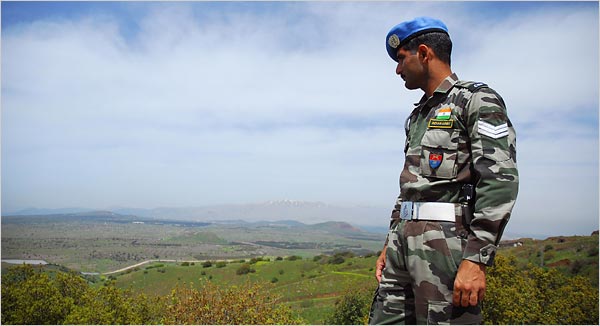
Yehuda Raizner/Agence France-Presse — Getty Images

An Indian member of the United Nations force in the Golan Heights, a strategic

plateau that overlooks a swath of northern Israel.

Rising Food Prices Have Global Political Implications

The issue of rising food prices globally has come under increasing scrutiny lately and has political leaders concerned. The annual meetings of the World Bank and IMF gave prominence to the problem and newspapers and magazines are weighing in with their opinion on the potential short- and long-term implications of the dramatic spike in world food prices. Will this last? Are we finally facing a neo-Malthusian future or will we be able to find a feasible and politically palatable solution to this crisis?

The Economist has a new article on the potentially devastating impact that the rise in food prices. In an article called “The silent tsunami” the editors (who generally espouse a free-market oriented, classically liberal view of the relation between markets and the state) argue that what is needed to avert disaster are “radical solutions.”

PICTURES of hunger usually show passive eyes and swollen bellies. The harvest fails because of war or strife; the onset of crisis is sudden and localised. Its burden falls on those already at the margin.

Today’s pictures are different. “This is a silent tsunami,” says Josette Sheeran of the World Food Programme, a United Nations agency. A wave of food-price inflation is moving through the world, leaving riots and shaken governments in its wake. For the first time in 30 years, food protests are erupting in many places at once. Bangladesh is in turmoil (see article); even China is worried (see article). Elsewhere, the food crisis of 2008 will test the assertion of Amartya Sen, an Indian economist, that famines do not happen in democracies.

Famine traditionally means mass starvation. The measures of today’s crisis are misery and malnutrition. The middle classes in poor countries are giving up health care and cutting out meat so they can eat three meals a day. The middling poor, those on $2 a day, are pulling children from school and cutting back on vegetables so they can still afford rice. Those on $1 a day are cutting back on meat, vegetables and one or two meals, so they can afford one bowl. The desperate—those on 50 cents a day—face disaster.

Roughly a billion people live on $1 a day. If, on a conservative estimate, the cost of their food rises 20% (and in some places, it has risen a lot more), 100m people could be forced back to this level, the common measure of absolute poverty. In some countries, that would undo all the gains in poverty reduction they have made during the past decade of growth. Because food markets are in turmoil, civil strife is growing; and because trade and openness itself could be undermined, the food crisis of 2008 may become a challenge to globalisation.
After arguing that the first step in any proposed solution is for states to adequately fund the World Food Program, the editorial argues for a free-market solution to the underlying problems:

In general, governments ought to liberalise markets, not intervene in them further. Food is riddled with state intervention at every turn, from subsidies to millers for cheap bread to bribes for farmers to leave land fallow. The upshot of such quotas, subsidies and controls is to dump all the imbalances that in another business might be smoothed out through small adjustments onto the one unregulated part of the food chain: the international market.

For decades, this produced low world prices and disincentives to poor farmers. Now, the opposite is happening. As a result of yet another government distortion—this time subsidies to biofuels in the rich world—prices have gone through the roof. Governments have further exaggerated the problem by imposing export quotas and trade restrictions, raising prices again. In the past, the main argument for liberalising farming was that it would raise food prices and boost returns to farmers. Now that prices have massively overshot, the argument stands for the opposite reason: liberalisation would reduce prices, while leaving farmers with a decent living.

Here is a world hunger map from the UN Food Program. What do you think the various colors represent?

Pope Benedict XVI a Foreign Policy Radical

The Pope delivered a speech last week to the United Nations in which he argued–as have many radicals over the last few decades–that the will of the international community to act in order to solve important global problems is being undermined because a few states have accrued too much power.  The Associated Press has more:

NEW YORK – Pope Benedict XVI warned diplomats at the United Nations on Friday that international cooperation needed to solve urgent problems is “in crisis” because decisions rest in the hands of a few powerful nations.

In a major speech on his U.S. trip, Benedict also said that respect for human rights, not violence, was the key to solving many of the world’s problems.

While he didn’t identify the countries that have a stranglehold on global power, the German pope — just the third pontiff to address the U.N. General Assembly — addressed long-standing Vatican concerns about the struggle to achieve world peace and the development of the poorest regions.

On the one hand, he said, collective action by the international community is needed to solve the planet’s greatest challenges.

On the other, “we experience the obvious paradox of a multilateral consensus that continues to be in crisis because it is still subordinated to the decisions of a few.”

The pope made no mention of the United States in his speech, though the Vatican did not support the U.S.-led invasion of Iraq in 2003, which occurred despite the Bush administration’s failure to gain Security Council approval for it. At other moments on his trip, Benedict has been overtly critical of the U.S., noting how opportunity and hope have not always been available to minorities.

The pope said questions of security, development and protection of the environment require international leaders to work together in good faith, particularly when dealing with Africa and other underdeveloped areas vulnerable to “the negative effects of globalization.”

Iraq is a Minefield

Have any of you ever realized that you just may be in a minefield? It’s a difficult conundrum because you don’t want to just stay there, but you also don’t want to move. It seems as though there is no good choice to make. That, according to an analyst at the National Defense University, is the US fate in Iraq currently.

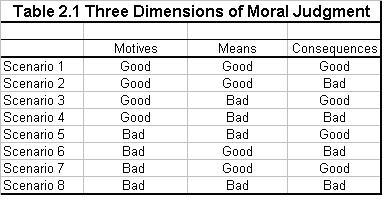
During our relatively short discourse into international ethics, we discussed Table 2.1 from Amstutz’s book, which demonstrates the Three Dimensions of Moral Judgment.

Here it is:

We notice that in order to evaluate the morality of a foreign policy decision, we must judge the motives behind the decision, the means used, and the final result of the decision. A new paper by Joseph J. Collins, of the Institute for National Strategic Studies of the National Defense University analyzes the Bush administration’s decision to invade Iraq in 2003. According to the author,

To date, the war in Iraq is a classic case of failure to adopt and adapt prudent courses of action that balance ends, ways, and means.

The paper is an interesting and nuanced read and I encourage you to take a look. Here is the first page:

Measured in blood and treasure, the war in Iraq has achieved the status of a major war and a major debacle. As of fall 2007, this conflict has cost the United States over 3,800 dead and over 28,000 wounded. Allied casualties accounted for another 300 dead. Iraqi civilian deaths—mostly at the hands of other Iraqis—may number as high as 82,000. Over 7,500 Iraqi soldiers and police officers have also been killed. Fifteen percent of the Iraqi population has become refugees or displaced persons. The Congressional Research Service estimates that the United States now spends over $10 billion per month on the war, and that the total, direct U.S. costs from March 2003 to July 2007 have exceeded $450 billion, all of which has been covered by deficit spending. No one as yet has calculated the costs of long-term veterans’ benefits or the total impact on Service personnel and materiel.


The war’s political impact also has been great. Globally, U.S. standing among friends and allies has fallen. Our status as a moral leader has been damaged by the war, the subsequent occupation of a Muslim nation, and various issues concerning the treatment of detainees. At the same time, operations in Iraq have had a negative impact on all other efforts in the war on terror, which must bow to the priority of Iraq when it comes to manpower, materiel, and the attention of decisionmakers. Our Armed Forces—especially the Army and Marine Corps—have been severely strained by the war in Iraq. Compounding all of these problems, our efforts there were designed to enhance U.S. national security, but they have become, at least temporarily, an incubator for terrorism and have emboldened Iran to expand its influence throughout the Middle East.

As this case study is being written, despite impressive progress in security during the surge, the outcome of the war is in doubt. Strong majorities of both Iraqis and Americans favor some sort of U.S. withdrawal. Intelligence analysts, however, remind us that the only thing worse than an Iraq with an American army may be an Iraq after the rapid withdrawal of that army. The 2007 National Intelligence Estimate (NIE) on Iraq’s future stability said that a rapid withdrawal “almost certainly would lead to a significant increase in the scale and scope of sectarian conflict in Iraq, intensify Sunni resistance to the Iraqi government, and have adverse consequences for national reconciliation.” The NIE goes on to say that neighboring countries might intervene, resulting in massive casualties and refugee flows. No one has calculated the psychopolitical impact of a perceived defeat on the U.S. reputation for power or the future of the overall war on terror. For many analysts (including this one), Iraq remains a “must win,” but for many others, despite the obvious progress under General David Petraeus and the surge, it now looks like a “can’t win.” To date, the war in Iraq is a classic case of failure to adopt and adapt prudent courses of action that balance ends, ways, and means.

Newsweek Editor Fareed Zakaria Says “No” to Olympic Boycott

In a recent column, Newsweek’s Fareed Zakaria argues that the US should not boycott the Olympic Games in Beijing this summer.  He argues that it would have the opposite of the intended effect.  Here are some snippets:

Public humiliation does not work nearly as well on the regime in Beijing as private pressure. At first glance, China’s recent crackdown in Tibet looks like a familiar storyline: a dictatorship represses its people. And of course that’s part of the reality — as it often is in China. But on this issue, the communist regime is not in opposition to its people. The vast majority of Chinese have little sympathy for the Tibetan cause. To the extent that we can gauge public opinion in China and among its diaspora, ordinary Chinese are, if anything, critical of the Beijing government for being too easy on the Tibetans. The real struggle here is between a nationalist majority and an ethnic and religious minority looking to secure its rights.

In these circumstances, a boycott of the Olympics would have precisely the opposite effect that is intended. The regime in Beijing would become only more defensive and stubborn. The Chinese people would rally around the flag and see the West as trying to humiliate China in its first international moment of glory. (There are many suspicions that the United States cannot abide the prospect of a rising China.) For most Chinese, the Games are about the world’s giving China respect, rather than bolstering the Communist Party’s legitimacy…

…Some want to punish China for its association with the Sudanese government, which is perpetrating atrocities in Darfur. But to boycott Beijing’s Games because it buys oil from Sudan carries the notion of responsibility too far. After all, the United States has much closer ties to Saudi Arabia, a medieval monarchy that has funded Islamic terror. Should the world boycott America for this relationship?

Poor Countries, Agriculture, and IMF Policies

There has been a rapid increase in food prices over the last couple of years, seen most dramatically in the recent 30% one-day rise in the price of rice worldwide.  This is putting tremendous pressure on the poor and is leading to instability in countries around the world.  There have been violent demonstrations–and equally violent government responses–to food rioting in Egypt and Haiti in the last couple of weeks.  They may be but a harbinger of the economic and political instability to come.  Here is a report from the BBC, in which an expert argues that IMF policies have contributed to the rise in food prices:

“Poor countries need to invest heavily in agriculture to feed their people.  There’s been a dearth of investment in agriculture in poor countries, mainly because of IMF and World Bank policies…”

The Bretton Woods System and the International Financial System

Anticipating the end of World War II, world leaders gathered in the New Hampshire town of Bretton Woods to create the financial architecture of the post-war global financial system.  The three main pillars were the World Bank, the IMF (both of which were created) and the International Trade Organization (this was never built but the governing philosophy behind it eventually gave rise to the General Agreement and Trade and Tariffs (GATT), which morphed into the World Trade Organization (WTO).  We’ll discuss these institutions in much more detail beginning Monday.

Here is an excerpt from a newsreel describing the meetings at Bretton Woods in 1944:

Lecture on German Political Parties April 17th

Talk about serendipity!  We will finish our mock German election and government formation simulation on Tuesday, April 15th and two days later there will be a guest lecture on campus by Dieter Dettke, Visiting Scholar at the American Institute for Contemporary German Studies and Adjunct Professor at Georgetown University, Security Studies Program.  on “Is Germany Moving to the Left?  The Changing German Party System.

You can find below a copy of the flyer announcing the lecture, which will begin at 5:30 at the Gottwald Science Center Auditorium.  I’ll see you there.

The Richmond Eric M. Warburg Chapter

of the American Council on Germany

cordially invites you to a

Discussion and Reception

with

Dr. Dieter Dettke

Visiting Scholar at the American Institute for Contemporary German Studies and

Adjunct Professor at Georgetown University, Security Studies Program

on

“Is Germany Moving to the Left?

The Changing German Party System"

Thursday, April 17, 2008

5:30 – 6:45 pm

at

The University of Richmond, Gottwald Science Center Auditorium

Directions: If coming from Three Chopt Road, turn onto Boatwright Drive and continue straight ahead at the welcoming wall at the bottom of the winding hill (do not turn left for the main campus gate). After passing the Robins Center on your left and a large parking lot on your right, proceed for another 300 yards on College Road to the Westhampton entrance on your left. (If coming from River Road, turn onto College Road and turn right into the Westhampton entrance.) Continue on Keller Road to the Modlin Center and pass through the archway. Opposite the stop sign are parking spaces in front of the Westhampton Deanery and even more spaces between it and the cafeteria and science center. The science center auditorium is in the Gottwald Science Center across from the cafeteria. (In case the above parking spaces are full,  there is a parking lot behind the Modlin Center which you can access by turning right at the stop sign or left if exiting the parking lot across from the stop sign.)

If you have any questions, please contact Dr. Arthur B. Gunlicks,

Dr. Dieter Dettke is currently a visiting scholar at the American Institute for Contemporary German Studies and Adjunct Professor at Georgetown University, Security Studies Program. He is working on a book on German foreign policy and transatlantic relations – with the working title “In Search of Normalcy: German Foreign and Security Policy Between Realpolitik and the Civilian Power Paradigm.” He has also been a fellow at both the Woodrow Wilson Center and the German Marshall Fund of the United States.

From 1985 to 2006 he served as US Representative and Executive Director of the Washington Office of the Friedrich Ebert Foundation – which is affiliated with Germany’s Social Democratic Party (SPD). Prior to his work with the Ebert Foundation, Dr. Dettke was Political Counsellor of the SPD Parliamentary Group of the German Bundestag (1974 – 1984) and Staff Director of the Working Group on US-German relations. In this capacity, he coordinated all foreign, security and defence policy related issues on the agenda of the German Bundestag and the Committees for Foreign Affairs, Defence, German-German relations, Development Policy and European Affairs.

He has lectured frequently in Europe and the United States on transatlantic relations, German-American security issues and European-American economic relations. He has also presented papers, acted as a discussant and/or chair at U.S. and international conferences of the American Political Science Association, the International Studies Association, the German Studies Association and the American Association of Slavic Studies. In addition, Dr. Dettke testified in Congress on the implications of German unification for the United States and US-European relations.

Dr. Dettke has appeared on the News Hour with Jim Lehrer, C-SPAN, Voice of America as well as other American, German, Swiss, and British television and radio programs to discuss issues and developments related to domestic and foreign policy developments in Europe and the United States. Dr. Dettke studied political science and law at the universities of Bonn and Berlin (Germany) and Strasbourg (France). He was a Fulbright Scholar at the University of Washington in Seattle (1967/68).

Design a site like this with WordPress.com
Get started