Poor Countries, Agriculture, and IMF Policies

There has been a rapid increase in food prices over the last couple of years, seen most dramatically in the recent 30% one-day rise in the price of rice worldwide.  This is putting tremendous pressure on the poor and is leading to instability in countries around the world.  There have been violent demonstrations–and equally violent government responses–to food rioting in Egypt and Haiti in the last couple of weeks.  They may be but a harbinger of the economic and political instability to come.  Here is a report from the BBC, in which an expert argues that IMF policies have contributed to the rise in food prices:

“Poor countries need to invest heavily in agriculture to feed their people.  There’s been a dearth of investment in agriculture in poor countries, mainly because of IMF and World Bank policies…”

60 Minutes Report on Torture in Guantanamo Bay

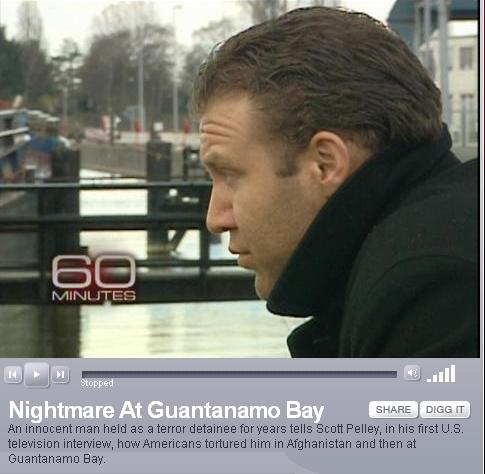
Via the CBS news program 60 Minutes, we learn about a German resident of Turkish origin who was tortured by his captors in Afghanistan and Guantanamo Bay.  From the description:

An innocent man held as a terror detainee for years tells Scott Pelley, in his first U.S. television interview, how Americans tortured him in Afghanistan and then at Guantanamo Bay.

You can find the video report here.

Lecture on German Political Parties April 17th

Talk about serendipity!  We will finish our mock German election and government formation simulation on Tuesday, April 15th and two days later there will be a guest lecture on campus by Dieter Dettke, Visiting Scholar at the American Institute for Contemporary German Studies and Adjunct Professor at Georgetown University, Security Studies Program.  on “Is Germany Moving to the Left?  The Changing German Party System.

You can find below a copy of the flyer announcing the lecture, which will begin at 5:30 at the Gottwald Science Center Auditorium.  I’ll see you there.

The Richmond Eric M. Warburg Chapter

of the American Council on Germany

cordially invites you to a

Discussion and Reception

with

Dr. Dieter Dettke

Visiting Scholar at the American Institute for Contemporary German Studies and

Adjunct Professor at Georgetown University, Security Studies Program

on

“Is Germany Moving to the Left?

The Changing German Party System"

Thursday, April 17, 2008

5:30 – 6:45 pm

at

The University of Richmond, Gottwald Science Center Auditorium

Directions: If coming from Three Chopt Road, turn onto Boatwright Drive and continue straight ahead at the welcoming wall at the bottom of the winding hill (do not turn left for the main campus gate). After passing the Robins Center on your left and a large parking lot on your right, proceed for another 300 yards on College Road to the Westhampton entrance on your left. (If coming from River Road, turn onto College Road and turn right into the Westhampton entrance.) Continue on Keller Road to the Modlin Center and pass through the archway. Opposite the stop sign are parking spaces in front of the Westhampton Deanery and even more spaces between it and the cafeteria and science center. The science center auditorium is in the Gottwald Science Center across from the cafeteria. (In case the above parking spaces are full,  there is a parking lot behind the Modlin Center which you can access by turning right at the stop sign or left if exiting the parking lot across from the stop sign.)

If you have any questions, please contact Dr. Arthur B. Gunlicks,

Dr. Dieter Dettke is currently a visiting scholar at the American Institute for Contemporary German Studies and Adjunct Professor at Georgetown University, Security Studies Program. He is working on a book on German foreign policy and transatlantic relations – with the working title “In Search of Normalcy: German Foreign and Security Policy Between Realpolitik and the Civilian Power Paradigm.” He has also been a fellow at both the Woodrow Wilson Center and the German Marshall Fund of the United States.

From 1985 to 2006 he served as US Representative and Executive Director of the Washington Office of the Friedrich Ebert Foundation – which is affiliated with Germany’s Social Democratic Party (SPD). Prior to his work with the Ebert Foundation, Dr. Dettke was Political Counsellor of the SPD Parliamentary Group of the German Bundestag (1974 – 1984) and Staff Director of the Working Group on US-German relations. In this capacity, he coordinated all foreign, security and defence policy related issues on the agenda of the German Bundestag and the Committees for Foreign Affairs, Defence, German-German relations, Development Policy and European Affairs.

He has lectured frequently in Europe and the United States on transatlantic relations, German-American security issues and European-American economic relations. He has also presented papers, acted as a discussant and/or chair at U.S. and international conferences of the American Political Science Association, the International Studies Association, the German Studies Association and the American Association of Slavic Studies. In addition, Dr. Dettke testified in Congress on the implications of German unification for the United States and US-European relations.

Dr. Dettke has appeared on the News Hour with Jim Lehrer, C-SPAN, Voice of America as well as other American, German, Swiss, and British television and radio programs to discuss issues and developments related to domestic and foreign policy developments in Europe and the United States. Dr. Dettke studied political science and law at the universities of Bonn and Berlin (Germany) and Strasbourg (France). He was a Fulbright Scholar at the University of Washington in Seattle (1967/68).

John McCain Argues for Continued US Military Presence in Iraq on Moral Grounds

Ross Douthat, from the Atlantic.com, has a comment on the first major policy speech by presumptive Republican Presidential candidate John McCain since he mathematically wrapped up the nomination.  The speech is appropriate for our purposes, given that McCain makes a fundamentally moral case for continued US military involvement in Iraq and we have just begin to address the role of morality and ethics in foreign policy in Intro to IR.

“To walk away from the Iraqi people and consign them to … horrendous violence, ethnic cleansing and possibly genocide,” he argued, would represent “an unconscionable act of betrayal, a stain on our character as a great nation.” 

Douthat then compres McCain’s speech on Iraq to that of Barack Obama’s major foreign policy address last week:

If Obama wants to claim the moral as well as the political high ground, he can’t just make the case that Americans will be better off if the United States withdraws from Iraq; he needs to mount a persuasive argument that Iraqis will be better off as well.

Here is an excerpt of McCain’s speech:

40th Anniversary of the Prague Spring and Soviet Invasion of Czechoslovakia

 This Spring marks the 40th anniversary of the Prague Spring–a domestic, Czech-led liberalization and democratization movement in the former Czechoslovakia–and the subsequent Soviet military invasion of that former communist state.  As Czechs sang and wrote their way towards a regime Czechs would describe as “Communism with a human face”, Leonid Brezhnev–the leader of the Soviet Union–rolled Soviet tanks onto the streets of Prague to put an end to Alexander Dubcek’s reforms.  This was the first concrete foreign policy manifestation of the “combating of anti-socialist forces,” which came to be known as the Brezhnev Doctrine.

Euronews has an interesting report on the commemoration of the Prague Spring, which has been uploaded to youtube.  I encourage you to take a look.

First, Conflict Diamonds; now, Junta Jade?

I know; the j in junta is pronounced like an h. Regardless, The Christian Science Monitor asks “Who’s buying Burma’s gems?: Laura Bush’s campaign for a global boycott is being undone by China’s appetite for Olympic souvenirs made of Burmese jade.” The US First Lady argues that those of you purchasing precious gems from Burma are indirectly supporting the rule of the brutal military dictatorship in that southeast Asian country.

burma_jade.jpgIt’s the last hour of the last day of the gems auction in Rangoon, and tired buyers are fanning themselves with worn auction catalogs, and making their final bids.

Over the past five days, jade, rubies, sapphires, and close to $150 million have passed hands here, according to the Union of Myanmar Economic Holdings Ltd., the consortium that dominates Burma’s gemstone trade and is owned by the defense ministry and a clutch of military officers.

Who’s buying? China, India, Singapore, and Thailand are scooping up Burma’s stones. US first lady Laura Bush’s efforts at a global boycott of Burma’s gems seem to have done little to reduce China’s appetite for Burmese jade to make trinkets and souvenirs to sell at the Summer Olympics.

At this recent auction, 281 foreigners attended, leaving behind much-needed foreign currency and generally turning the auction into a resounding success, according to the state-run New Light of Myanmar newspaper.

Mrs. Bush – and human rights campaigners – would not be pleased.

The first lady has taken on the military regime in Burma (Myanmar), urging jewelers not to buy gems from a country where the undemocratic rulers and their cronies amass fortunes selling off the country’s stones, as well as many of the county’s other natural resources – such as minerals, timber, gold, oil, and gas – but keep Burma’s citizens in abject poverty.

She has urged UN Secretary General Ban Ki Moon to act more forcibly on Burma and stood beside President Bush on several occasions recently as he announced the growing list of US sanctions on the country. And, on International Human Right’s Day this past December, Mrs. Bush added her voice to those seeking a global boycott on gems from Burma.

“Consumers throughout the world should consider the implications of their purchase of Burmese gems,” she said in a statement from the White House. “Every Burmese stone bought, cut, polished, and sold sustains an illegitimate, repressive regime.”

Earlier in the semester, we read an article [which he has made available to the general publilc on his web site] by Richard Snyder on the link between “lootable wealth” and political stability. In fact, the final section of his paper deals explicitly with the Burmese tropical timber trade and its role in funding rebel groups. What are the implications of Snyder’s argument for how we–as potential consumers of junta jade–should respond to Laura Bush’s plea? Of course the two phenomena are not exactly the same (Snyder is seeking to understand the link between “lootable wealth” political stability, while Laura Bush is arguing that “lootable wealth” supports dictatorial rule.) Here is the abstract to Snyder’s article:

This article proposes a political economy of extraction framework that explains political order and state collapse as alternative outcomes in the face of lootable wealth. Different types of institutions of extraction can be built around lootable resources – with divergent effects on political stability. If rulers are able to forge institutions of extraction that give them control over revenues generated by lootable resources, then these resources can contribute to political order by providing the income with which to govern. In contrast, the breakdown or absence of such institutions increases the risk of civil war by making it easier for rebels to organize. The framework is used to explain two puzzling cases that experienced sharply contrasting political trajectories in the face of lootable resources: Sierra Leone and Burma. A focus on institutions of extraction provides a stronger understanding of the wide range of political possibilities – from chaos, to dictatorship, to democracy – in resource-rich countries.

The Federal Budget and Military Defense Spending

When we address Chapter 5 of Mingst, we’ll learn about the various sources of power. One of the most important, obviously, is military power. Given President Bush’s latest $3.1 trillion budget proposal, I began to wonder how much of that is apportioned to spending on the military and defense? Fred Kaplan from Slate.com has done the research and has concluded the following:

As usual, it’s about $200 billion more than most news stories are reporting. For the proposed fiscal year 2009 budget, which President Bush released today, the real size is not, as many news stories have reported, $515.4 billion—itself a staggering sum—but, rather, $713.1 billion.

Is that a lot? Is it “staggering”, as Kaplan suggests? Should we be concerned with how much we spend militarily? I think the answer is yes, but in the manner of a discriminating consumer. In other words, what is our “rate of return” on that spending? Is the spending efficient and non-wasteful? Could we be just as safe and powerful if we spent 75%, or 50% of that total? A couple of data points suggest that US military spending does not give us a good rate of return and if national defense were a private industry, we’d be looking for a different supplier. First, how does US military spending compare to how much China, Russia (two potential rivals) or the European Union, or Canada, are spending on defending their states? Here’s an estimate, from the Washington-based think tank GlobalSecurity. org (which has a lot of great data related to security issues):

World Wide Military Expenditures

Country

Military expenditures (US$)

Budget Period

World

$1100 billion

2004 est. [see Note 4]

Rest-of-World [all but USA]

$500 billion

2004 est. [see Note 4]

United States

$623 billion

FY08 budget [see Note 6]

China

$65.0 billion

2004 [see Note 1]

Russia

$50.0 billion

[see Note 5]

France

$45.0 billion

2005

United Kingdom

$42.8 billion

2005 est.

Japan

$41.75 billion

2007

Germany

$35.1 billion

2003

Italy

$28.2 billion

2003

South Korea

$21.1 billion

2003 est.

India

$19.0 billion

2005 est.

Saudi Arabia

$18.0 billion

2005 est.

Australia

$16.9 billion

2006

Turkey

$12.2 billion

2003

Brazil

$9.9 billion

2005 est.

Spain

$9.9 billion

2003

Canada

$9.8 billion

2003

Israel

$9.4 billion

FY06 [see Note 7]

Kaplan observes something even more interesting than the relative amount that the United States is spending–the apportionment of that spending amongst the different military services:

The “Overview” section of the Pentagon’s budget document contains a section called “Program Terminations.” It reads, in its entirety: “The FY 2009 budget does not propose any major program terminations.”

Is it remotely conceivable that the Defense Department is the one federal bureaucracy that has not designed, developed, or produced a single expendable program? The question answers itself.

There is another way to probe this question. Look at the budget share distributed to each of the three branches of the armed services. The Army gets 33 percent, the Air Force gets 33 percent, and the Navy gets 34 percent.

As I have noted before (and, I’m sure, will again), the budget has been divvied up this way, plus or minus 2 percent, each and every year since the 1960s [author’s emphasis]. Is it remotely conceivable that our national-security needs coincide so precisely—and so consistently over the span of nearly a half-century—with the bureaucratic imperatives of giving the Army, Air Force, and Navy an even share of the money? Again, the question answers itself. As the Army’s budget goes up to meet the demands of Iraq and Afghanistan, the Air Force’s and Navy’s budgets have to go up by roughly the same share, as well. It would be a miracle if this didn’t sire a lot of waste and extravagance.

Congress exposes this budget to virtually no scrutiny, fearing that any major cuts—any serious questions—will incite charges of being “soft on terror” and “soft on defense.” But $536 billion of this budget—the Pentagon’s base line plus the discretionary items for the Department of Energy and other agencies—has nothing to do with the war on terror. And it’s safe to assume that a fair amount has little to do with defense. How much it does and doesn’t is a matter of debate. Right now, nobody’s even debating.

defense_budget_2008_2009.jpg

Source for chart: Department of Defense

American Conservatives Against John McCain’s Foreign Policy

A few sessions from now we’ll analyze international relations from a state-level perspective.  The great debate in IR, with respect to the state level, is whether state level characteristics such as economic system, political regime, etc., are determinative in explaining and predicting state behavior at the international level.  As we have already discussed, the neorealists have a ready answer: the only state-level characteristic that matters in foreign affairs is power.  The liberals, of course, have a different viewpoint, as do radicals and constructivists.   Notice one word that was absent from the preceding two sentences–conservative.  What are the elements of a conservative foreign policy?  [There is, of course, a neoconservative approach (or theory) in IR, but what about conservative, with the neo prefix?  Moreover, does the ideological viewpoint of the U.S. President matter in the way that foreign policy decisions in the White House are made?

To help answer the second question, I would like to introduce you to a group of self-professed American conservatives, who banded together in 2002 and created The American Conservative magazine.  How do those in charge of the magazine define conservatism and what are their views of the upcoming presidential election?

We believe conservatism to be the most natural political tendency, rooted in man’s taste for the familiar, for family, for faith in God. We believe that true conservatism has a predisposition for the institutions and mores that exist. So much of what passes for contemporary conservatism is wedded to a kind of radicalism—fantasies of global hegemony, the hubristic notion of America as a universal nation for all the world’s peoples, a hyperglobal economy. In combination with an increasingly unveiled contempt for America’s long-standing allies, this is more a recipe for disaster.

Against it, we take our stand.

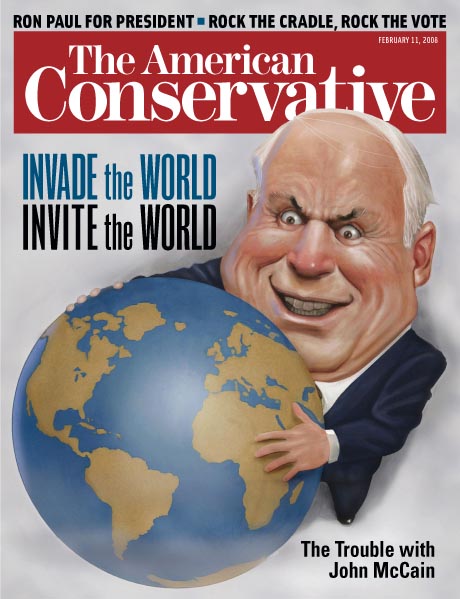
Consistent with their view of conservatism, they are worried (terrified?) with the prospect of a McCain presidency.  Rather than excerpt from a recent article in the magazine that assesses what a President McCain means for the future of American foreign policy, I’ll provide a link to the article and give you the title and a shot of the cover:

“The Madness of John McCain–A militarist suffering from acute narcissism and armed with the Bush Doctrine is not fit to be commander in chief.”

mccain_american_conservative_magazine.jpg

Drezner explains Neo-conservatism

Here‘s a nice, and concise, description from Dan Drezner* of neo-conservatism, the theoretical underpinning of the Bush administration’s foreign policy.

Neo-conservatism borrows many ideas from liberal internationalism, though it promotes those ideas in terms of more expansive aims and aggressive methods. The first sentence of the March 2006 National Security strategy reads, “It is the policy of the United States to seek and support democratic movements and institutions in every nation and culture, with the ultimate goal of ending tyranny in our world.” Like liberal internationalists, neo-conservatives believe that the spread of free markets, democratic values, and human rights leads to a more prosperous and pacific world. But neo-conservatives reject the “third leg” of the Kantian triad: multilateralism. Whereas liberals put greater faith in international institutions as a means of promoting American interests, neo-conservatives view them as constraints on US action: in place of multilateral agreements, neo-consevatives prefer more unilateral and more forceful means of promoting regime change.

*If you are interested in international political economy, you should take a look at Drezner‘s blog.  You also may be interested in his new book–Daniel W. Drezner, All Politics Is Global Princeton: Princeton University Press, 2007).

The Future of US Foreign Policy post-Bush?

Daniel Drezner, an associate professor of international politics at the Fletcher School of Law and Diplomacy at Tufts University, has published an article in the latest issue of Internationale Politik und Gesellschaft (“International Politics and Society”) entitled “The Future of U.S. Foreign Policy.”  In it he envisions what a post-Bush US foreign policy (regardless of which party wins the White House) should look like.  

As we have already discussed, and will discuss further throughout the course, a fundamental tenet of the realist theory of international relations is that the nature of the domestic regime does not matter as it pertains to the manner in which a state acts in the world.  Thus, whether a regime is democratic, authoritarian, or even a theocracy, the compelling logic of trying to ensure security in an anarchic world means that all states will act the same way.  A corollary of that is that it does not matter, say the realists, whether the leadership of a state is more left-wing or more right-wing, the fundamental character of foreign policy will be the same.  Does Drezner agree with the realists?

For Europe, American foreign policy in 2009 will clearly be an improvement on its current incarnation. Regardless of who wins the presidential election, there will likely be a reaching out to Europe as a means of demonstrating a decisive shift from the Bush administration’s diplomatic style. This does not mean, however, that the major irritants to the transatlantic relationship will disappear. On several issues, such as GMOs or the Boeing–Airbus dispute, the status quo will persist. On deeper questions, such as the use of force and the use of multilateralism, American foreign policy will shift, but not as far as Europeans would like. When George W. Bush leaves office, neo-conservatism will go with him. This does not mean, however, that Europeans will altogether agree with the foreign policy that replaces it.

Drezner also has some interesting things to say about neoconservatism, the theory underpinning the Bush administration’s view of international relations:

 It would appear that Americans are now disenchanted with neo-conservatism
as a foreign-policy doctrine. Five years ago, the idea of muscular,
unilaterally-imposed democratization was believed to resonate with
American values in a post-9/11 world. This is no longer the case. In October
2006, a Public Agenda poll found that 83 % of Americans are worried
about the way things are going for the United States in world affairs.
Their new »Anxiety Indicator« found that »a significant majority of the
public is feeling anxious and insecure about the country’s place in the
world.« Iraq – an obsession of neo-conservatives for over a decade now –
is obviously a major cause of this discontent…

…Neo-conservatism will formally expire as the grand strategy of the
United States on January 20, 2009: the date George W. Bush leaves office.
What will take its place? There are myriad ways in which us foreign
policy could diverge from the neo-conservative approach.

Design a site like this with WordPress.com
Get started