Serbian Reactions to Kosovo’s Declaration of Independence

Serbia’s B92–an independent news source in Serbia–reports that protesters have ransacked the Slovenian embassy in Belgrade, and damaged the U.S. Embassy and a McDonald’s. The protesters view the U.S. as the major patron of the Kosovar Albanians and the major facilitator (with help from the E.U.) of today’s declaration of independence. I presume that the Slovenian embassy was attacked because Slovenia is the current holder of the rotating Presidency of the EU. Here’s part of the report (in English), along with footage of the protesters:

BELGRADE — At least 30 policemen and 30 civilians were injured as protesters demonstrated against U.S. and EU Kosovo policy.

Police used tear gas and rubber bullets to disperse rioters that attacked them after vandalizing a McDonald’s restaurant in downtown Belgrade.

Earlier, the Slovenian embassy came under attack when a group of some 30 people broke a police cordon to smash the windows and ransack the building, tearing and burning the furniture inside and flags displayed on the balcony. Police then managed to contain the situation and push them back.

Previuosly, the protesters, several hundred strong, shortly stopped in front of the Serbian government headquarters, to proceed toward the U.S. embassy.

Police were out to secure the parameter, but although the organizers said the protest would be peaceful, cars were being demolished, while stones and lit flares were flying toward the embassy building and the officers themselves.

The Relationship Between Wealth and Health

The BBC reports on fascinating new research, which concludes that “economic growth does not necessarily translate into improvements in child mortality.” There are two points I wish to make about this: First, it illustrates an important trend in the development literature regarding the correct metric to use to determine, and compare, levels of well-being worldwide. Historically, well-being has been captured by the crude instrument of Gross National Product (GDP) per capita, but the realization that, for many reasons, the measure was too crude to be a satisfactory indicator of well-being development led to the introduction of other measures, the most useful of which is the Human Development Index (HDI) put out by the United Nations Development Program (UNDP). (Why might GDP per capita be a misleading indicator of well-being?)

The second point follows from the first; one’s policy prescriptions vis-a-vis issues of development are to a large extent determined by just which indicator of well-being one believes best captures the essential nature of that elusive concept. As such, IGOs such as the World Bank, have focused attention on overall economic growth, while scholars such as Amartya Sen (who champions the “capabilities approach”) do not view growth tout court as a magical anti-poverty elixir.

From the BBC article:

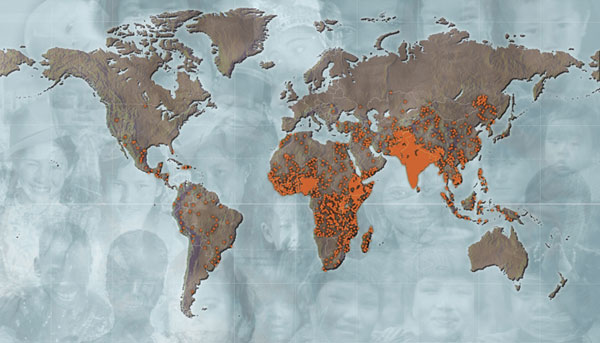
Ten million children still die every year before their fifth birthday, 99% of them in the developing world, according to Save the Children.

A study comparing economic performance with child mortality reveals that some countries have not translated wealth into improvements across society.

Survival is too often just a “lottery”, said Save the Children’s David Mepham.

He said that even the poorest countries can cut child mortality by following simple policies, but at the moment “a child’s chance of making it to its fifth birthday depends on the country or community it is born into”.

Lagging behind

Angola comes at the bottom of a new “Wealth and Survival” league table drawn up by the UN Development Programme (UNDP).

The figures for child mortality in India are shocking
Shireen Miller
Save the children India

There are few countries in the world where there are such stark wealth contrasts as there are between the wealth of oil-rich coastal strip around the Angolan capital Luanda, and the war-ravaged interior.

UNDP statisticians calculate that more than half of the babies who die in Angola could be saved were the country to spread its wealth more fairly.

child_mortality_map.jpg

Click on the map to be taken to the Johns Hopkins Bloomberg School of Public Health’s Magazine for an article on child mortality.

[Each orange dot is equivalent to 5,000 child deaths.]


Kosovar Albanians Declare Independence From Serbia

As of the beginning of 1991, the Socialist Federated Republic of Yugoslavia was an internationally recognized state, which consisted of six republics (Bosnia & Herzegovina, Croatia, Macedonia, Montenegro, Serbia, and Slovenia) and 2 autonomous regions within Serbia–Vojvodina and Kosovo. As of today, with Kosovo declaring its independence from Serbia, the only one of those eight political units that is not an independent state is Vojvodina. The New York Times reports that the euphoric Albanians showed their gratitude to the United States for the development:
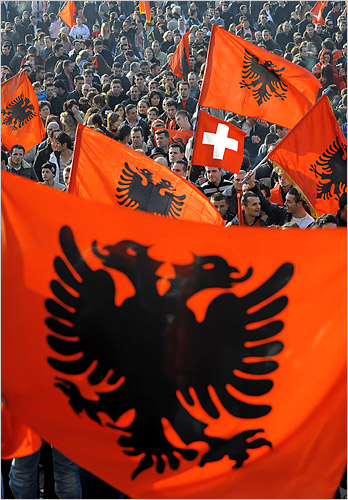
kosovo_independence.jpgPRISTINA, Kosovo — The former Serbian province of Kosovo declared independence on Sunday, sending tens of thousands of euphoric ethnic Albanians into the streets of this war-torn capital to celebrate the end of a long and bloody struggle for national self-determination.

The declaration marks the final dismemberment in the 17-year dissolution of the former Yugoslavia. It also brings to a dramatic climax a showdown between the West — which argues that the former Serbian President Slobodan Milosevic’s brutal subjugation of Kosovo’s majority ethnic Albanians cost Serbia its authority to rule the territory — and Belgrade and its ally Moscow, which counter that Kosovo’s independence declaration is a reckless breach of international law that will spur other secessionist movements across the world.

Ethnic Albanians from across the world streamed into Pristina, braving freezing temperatures and heavy snow, to dance in frenzied jubilation. Beating drums and waiving Albanian flags, they chanted “Independence! Independence! We are free at last!” while an enormous birthday cake was installed on Pristina’s main boulevard.

An outpouring of adulation for the United States — Kosovo’s staunchest ally in its quest for independence and the architect of NATO’s 1999 bombing campaign against Mr. Milosevic — was evident everywhere. Thousands of revelers unfurled giant American flags, carried posters of former President Bill Clinton, and chanted “Thank You U.S.A.!” and “God Bless America.”

Meanwhile, balkaninsight.org reports on an anti-U.S. counter-rally in the streets of the Serbian capital of Belgrade:

17 February 2008 Belgrade _ Hundreds of protesters blocked the Embassy of the United States in downtown Belgrade on Sunday, less than an hour after Kosovo’s leaders unilaterally declared the province’s independence from Serbia.

Protesters in Belgrade pelted the embassy building and police with stones and torches. At least one policeman was carried away in an ambulance. The number of injuries in the crowd could not be verified immediately.

Serbian police in full riot gear had cordoned off the embassy and managed to push protestors away from the embassy. The crowed scattered in nearby streets, but its numbers continued to grow.

Waving Serbian flags, burning signal torches and chanting nationalist and anti-American slogans, the crowd had initially tried to block both entrances to the embassy compound, which stretches over two apartment blocks on Kneza Milosa Street.

“We want to show we hate Yanks and Shiptars [a pejorative for Albanian],” a young protester who identified himself only as Dejan said, using a derogatory Serbian term for Kosovo Albanians.

A good source for views from within Serbia is the B92 broadcast network, whch reports that Serbia has annulled Kosovo’s declaration of independence, judging it to be an illegal act:

BELGRADE — PM Vojislav Koštunica addressed the nation today as ethnic Albanians unilaterally declared Kosovo’s independence.

It a televised address from the seat of the Serbian government in Belgrade, Koštunica rejected this act as illegal, and declared it null and void.

“Kosovo’s unilateral declaration of a false state is the final act of a policy that started with the NATO aggression against Serbia in 1999,” the prime minister said.

“Never has the truth about why Serbia was savagely destroyed by NATO bombs been more clear,” he continued, and added that “NATO’s military interests lie behind the proclamation of this false state.”

From bd at Richmond, here’s a link to reporting by MSNBC on Kosovo.
My Introduction to Comparative Politics Syllabus

Here is a link to my syllabus; I approach the teaching of comparative politics from a thematic perspective.  Rather than impose the study of specific countries and regions of the world on the students, I teach them topics and concepts and leave assignments, papers and other activities as instruments to allow students to study countries and societies that they find interesting.

PLSC240-Spring 2008 Syllabus

The Economist’s Diary on Kenya

The eminent British magazine, The Economist, currently has a correspondent in Kenya writing up daily reports in the Internet edition, which can be viewed here. There is, of course, much to be concerned about in Kenya these days, but as an academic I found the latest dispatch especially interesting:

Morning, Professor Alan Ogot’s office, Kisumu

ALAN Ogot (pictured below), one of Kenya’s leading historians, is the chancellor of Moi University in Eldoret. Like me, he graduated from St Andrew’s University in Scotland, but he was there in the 1950s, and his life before and since has been colourful and consequential.

Mr Ogot spends the first part of our interview delving into Luo history. Contrary to their reputation among some Kikuyus and white Kenyans as agitators, he says the Luo have always done the jobs no one else wanted to do. For a thousand years they have aspired to “fairness” and “reciprocity”. He gives examples of religious and political movements to argue that Luoland was the most progressive part of Kenya. That changed with independence in 1963 and the rise of a Kikuyu elite who mistrusted Luos.

Mr Ogot had lunch with Tom Mboya on the day Mboya was shot dead in 1969. Mboya was one of several Luo politicians tipped for the presidency and Mr Ogot thinks the Luo have never recovered from his death. “What followed was a police state. We were not allowed to speak our mind.”

 Then Mr Ogot moves on to the damage done to academia in Kenya by the post-election violence. He wonders what the future of research is in the country. Some of Africa’s best research institutions are located around Nairobi. Most are closed, he says, some burned, and the best minds driven out.
He points out that Maseno, the local university in Luoland, was over half Kikuyu. “Most of these people are not coming back. Who will provide them with security?” Other universities across the country are being similarly ethnically cleansed. “You call these universities? They’ll be worse than primary schools…”

…Since the election he has hardly left his house. A woman and child were shot dead outside his front gate. The police mistakenly killed a caretaker in a neighbouring house. “They have apologised, but what will that do?”

I’ve highlighted what I think are the interesting parts of the snippet I posted. First, contrary to what I have been reading in the newspapers lately, inter-ethnic relations between the Kukuyu and Luo, specifically, have not been as tolerant and peaceful and many have led us to believe. Second is the horrific damage that is being done to Kenya’s post-secondary educational system as a result of the current political situation there. A Boston Globe column that was published before the elections held out hope for Africa, and pointed to Kenya’s potential role as a leader for the rest of the continent. Now what?

Ethnic Segregation in Kenya Continues Unabated

Kenya seems to be following the template set out in previous inter-ethnic conflicts (see a previous post on the results of residential segregation in Baghdad), where the ultimate result is a more ethnically segregated society.  The “un-mixing of peoples” continues unabated in that increasingly unstable state.  The New York Times reports:

segregation_of_kenya.jpg

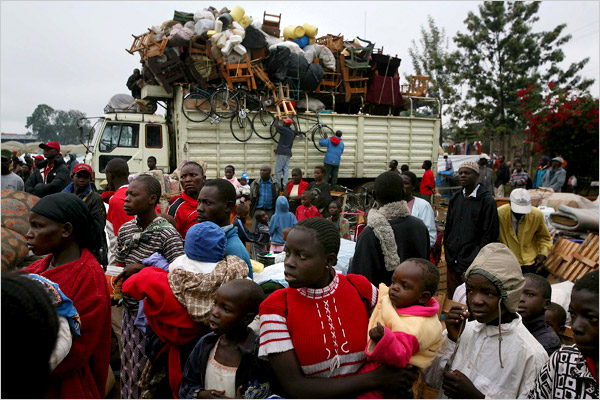
Following a flawed election, and a wave of ethnic and political violence, Kenya, once one of Africa’s most promising nations, is resegregating itself. Members of ethnic groups, like these Luos, left, waited for transportation to their ancestral homes.

Photo: Joao Silva for The New York Times

 OTHAYA, Kenya — Sarah Wangoi has spent her entire life — all 70 years of it — in the Rift Valley. But last month, she was chased off her farm by a mob that called her a foreigner. She now sleeps on the cold floor of a stranger’s house, seeking refuge in an area of Kenya where her ethnic group, the Kikuyu, is strong. It is, supposedly, her homeland.

“I am safe now,” said Ms. Wangoi, though the mob still chases her in her dreams.

Across the country, William Ojiambo sat in a field where the ground was too hard to plow. He, too, sought refuge with his ethnic group, the Luo. He used to live in an ethnically mixed town called Nakuru but was recently evicted by a gang from another ethnic group that burned everything he owned.

“We came here with nothing, like cabbages thrown in the back of a truck,” Mr. Ojiambo said.

Kenya used to be considered one of the most promising countries in Africa. Now it is in the throes of ethnically segregating itself. Ever since a deeply flawed election in December kicked off a wave of ethnic and political violence, hundreds of thousands of people have been violently driven from their homes and many are now resettling in ethnically homogenous zones.

Luos have gone back to Luo land, Kikuyus to Kikuyu land, Kambas to Kamba land and Kisiis to Kisii land. Even some of the packed slums in the capital, Nairobi, have split along ethnic lines.

Roger Clemens, Steroids, and Political Ideologies

In class today, we discussed yesterday’s Congressional hearings dealing with the use of steroids, and other performance-enhancing drugs in baseball, in which our esteemed elected representatives questioned umpteen-time all-star pitcher, Roger Clemens, on his involvement. Those of you who have been following this soap opera understand that one of Clemens’ former trainers, Brian McNamee, and a former teammate, Andy Pettitte, have both accused Clemens of having used steroids and HGH (human growth hormone).

I watched some of the highlights of the testimony, and what was interesting was that here, as in many other contemporary issues in American society, there seemed to be a readily apparent partisan split on the issue, with Republicans believing and supporting Clemens, while Democrats did the opposite. I have no idea why, given the nature of political attitudes and political ideologies, this would be the case. What is it about the issue of steroids in baseball that would “tap into” underlying political attitudes and ideologies in order to make this a clearly ideological issue. Maybe this isn’t an “ideological” issue at all, but a partisan one. By this I mean that for many in this country (especially on Capitol Hill), their partisanship is no longer a means to an underlying ideological end, but an end in and of itself. So if George Bush (with the complicity of both Republican and Democratic-led Congresses during his tenure) spends the people’s money like a drunken soldier, he–a Republican–is immune from criticism by other Republicans, even though his behavior is anathema to conservative economic ideology.

Here is Clemens testifying, and a clip from Mike and the Mad Dog, the most highly rated sports talk show in the New York City area, in which Chris “the Mad Dog” Russo–a Republican–exhorts his listeners in Connecticut to vote long-term Congressman, Christopher Shays (R), out of office for what Russo viewed as Shays’ “grandstanding” during the hearings yesterday.

Mad Dog snarly towards Shays:

Italians and Europeans–The Two Solitudes?

Here is an animated short film by Bruno Bozzetto, which shows the putative differences between Italians and Europeans (notice the not-so-subtle “othering” that is implicit in the title). Have you ever been to Italy? Are these differences real, and if so, can political culture account for them? What underlying differences in political attitudes would help explain the divergence in behaviors demonstrated in the video? It’s interesting that Italy was one of the original six members of the European Union (which was then called the European Coal and Steel Community (ECSC). This was quite monumental as the other five members were on the other side of the Alps. Have a look at Bozzetto’s animated short:

P.S. This could easily be titled “Europe and Croatia!”

Democracy in Russia

From the Chronicle of Higher Education, we learn that Russian President Vladimir Putin’s government has shut down a university that offers “politically sensitive” courses.

A Russian court has ordered a university that receives support from Western organizations and had offered courses in election monitoring to shut down immediately, in what professors said was the first time an entire university had been closed for political reasons under President Vladimir V. Putin.

The ruling, issued by a court in St. Petersburg on Friday, shut down the European University of St. Petersburg just as a new semester was about to start and after many of the 170 students who were scheduled to attend had arrived in the city.

Mr. Putin had criticized the university last fall, accusing it of meddling in Russian politics, according to news reports, and a highly placed government official raised similar concerns in late December, a professor told The Chronicle.

What a terrible offense!  Meddling in Russian politics!  The nerve! We in the West take for granted far too often the nature of the liberties we enjoy.  We in the academic world, in particular, are often unaware of the great dangers that academics in many parts of the world face in trying to perform tasks and research that to us in the West seem mundane.  To increase awareness about the lack of academic freedom in many parts of the world, a group of like-minded individuals has created the Scholars at Risk Network.

PLSC240–Next Blog Assignment

Hello student-bloggers:

Your next blog post will be due on Friday, February 15th at 6:00pm.

The prompt for your post is “The rational choice/political culture debate and [my topic].” Once again, I will emphasize that you have wide latitude to post, and anything will be acceptable as long as it is somehow related to the prompt above. In addition, please take note of the rubric I will be using to grade your blog.  Remember that I will give you a provisional grade as of the mid-term break (this grade will not be factored into your final grade; it is meant to give you an idea of what your blog grade would be at the end of the semester if the character/quality of your posts were to remain the same until the end of the semester).  You can find the rubric in the Assignments folder of Blackboard.

Best of luck,

J.

Design a site like this with WordPress.com
Get started