What are the Fundamental Tenets of Confucianism…Culture as Destiny?

Over the past few weeks, we have addressed the debate regarding the relative explanatory power of cultural versus institutional and rational choice approaches to the analysis of political phenomena.  In the book excerpt, “A Brief History of Human Liberty,” Newsweek editor Fareed Zakaria analyzes the cultural argument regarding economic growth and democracy. He quotes the former Singaporean Prime Minister Lee Kuan Yew:

“…if you want to see how culture works, compare the performance of German workers and Zambian workers anywhere in the world.  You will quickly come to the conclusion that there is something very different in the two cultures that explains the results.”

Zakaria has some sympathy for this argument, but then argues that it is strange that Lee Kuan Yew is such a strong proponent of cultural arguments* given that while Singapore is culturally very similar to its neighbor, Malaysia, Singapore has been much more effective in its economic policies than has its neighbor.  In fact, I would add that a strong argument against cultural explanations of democracy and economic development are the differences between East Germany and West Germany (in the post-WWII-era until unification) and the present difference between North and South Korea.

The 38th parallel may be just a line on a map, and the division of the nation of Korea into two separate states may be a historically contingent act, but it demonstrates the tremendously powerful impact of institutions on a society.  South Korea was able to develop good political and economic institutions, while North Korea has not.  The cultural foundation of each state was similar (although I’m not an expert on Korea, so maybe there was a cultural difference between the “north” and the “south” that can account for the vast differences in the two states today–although I’m highly skeptical) before the division and we know, in a methodological sense, that a constant can not explain an outcome that varies.

Getting back to Zakaria and Lee Yuan Kew, Zakaria writes that

“the key to Singapore’s success…is Lee Kuan Yew, not Confucius.  The point is not that culture is unimportant; on the contrary it matters greatly…But culture can change…A hundred years ago, when East Asia seemed immutably poor, many scholars–most famously Max Weber [we’ve read his Protestant Ethic argument]–argued that Confucian-based cultures discouraged all the attributes necessary for success in capitalism…A decade ago, when East Asia was booming, scholars had turned this explanation on its head, arguing that Confucianism actually emphasized the traits essential for economic dynamism. Today the wheel has turned again and many see in ‘Asian values’ all the ingredients of crony capitalism.”‘

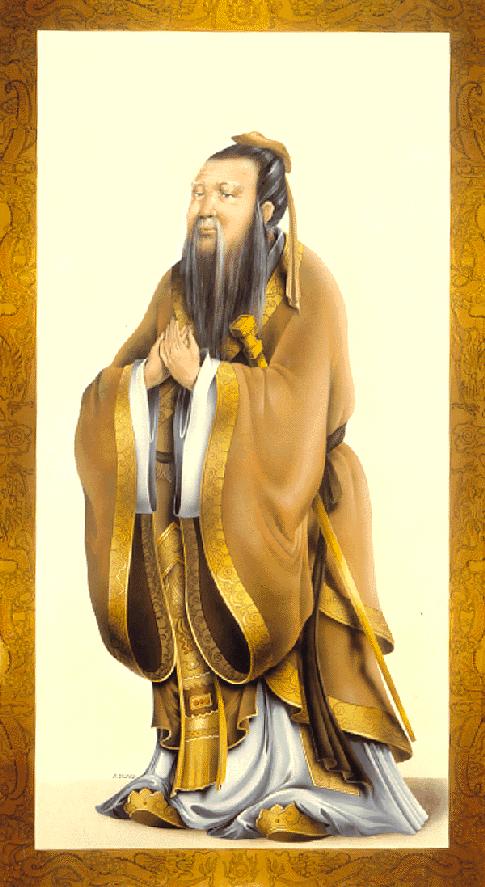
What are these Confucian and ‘Asian values’ about which there has been so much discussion.  Well, needless to say Asia is a vast land mass, with exceedingly high levels of diversity–culturally, linguistically, religiously, racially, etc.  So the concept of ‘Asian values’ may be so amorphous as to http://onpoint.wbur.org/2006/08/15/china-and-confucian-democracy http://onpoint.wbur.org/2006/08/http://onpoint.wbur.org/2006/08/15/china-and-confucian-democracy/china-and-confucian-democracy.  Confucianism, however, is a distinct and compact body of ideas that has a comprehensive philosophical foundation.  What are Confucian values, then and do they help or hinder China’s precarious journey towards democracy and economic development?  Well, here’s an answer from political philosopher Daniel Bell, who insists that ultimately, Confucianism is about three core values.  What are these?  Listen to the first ten minutes of the audio podcast from this episode of “On Point.”  Here’s a link to the URL on which you can find an archived version of the show.
**Here, it should be noted that a reason Lee Kuan Yew is strongly predisposed to arguing on the basis of culture is his contempt for the licentiousness of Western values and his desire to prevent demands for those kinds of freedoms (as long as political liberty) to take root in the strongly authoritarian state of Singapore.  Just read his statements during the infamous Michael Fay incident.

It wasn’t long before Singapore patriarch Lee Kuan Yew weighed in. He reckoned the whole affair revealed America’s moral decay. “The U.S. government, the U.S. Senate and the U.S. media took the opportunity to ridicule us, saying the sentence was too severe,” he said in a television interview. “[The U.S.] does not restrain or punish individuals, forgiving them for whatever they have done. That’s why the whole country is in chaos: drugs, violence, unemployment and homelessness. The American society is the richest and most prosperous in the world but it is hardly safe and peaceful.”

Here’s another story on the incident.

It’s Spring, so how is your Bracket Doing?

pakistan_gilani.jpg
Well, it’s that time of year again. Has your bracket been busted? How many of you can honestly claim that you predicted the upset of Yousaf Raza Gilani becoming Pakistan’s new Prime Minister? Now I realize that most of you were predicting a victory for Ma Ying-jeou in Taiwan’s recent presidential elections. But did you honestly think that he would win by 15! (He won 57.5% of the vote.) Mr. Gilani almost busted my bracket, but I think that I may be able to redeem myself with my pick for the winner of the upcoming Serbian Parliamentary elections (given that the Balkan Conference is a mid-major, that group of countries has not been followed very closely and I have a little bit of an advantage in prognosticating the outcome there).
taiwan_ying_jeou.jpg
Current Prime Minister, Vojislav Koštunica, disbanded his coalition government on March 13 due to tensions within the governing coalition as a result of the declaration of independence by the former Serbian province of Kosovo. New elections are slated to be held on May 11 of this year, with Koštunica’s conservative and nationalistic Democratic Party of Serbia will find its strongest challenge from Serbian President Boris Tadić‘s bloc of pro-democratic and pro-Western parties and the ultra-nationalist Serbian Radical Party. It will be interesting to observe how much the apparent loss of the Kosovo (the “Serbian Jerusalem”) will help the ultra-nationalists and hurt Koštunica.
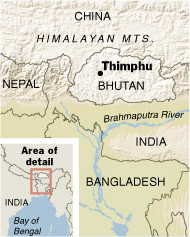
And finally, my surprise pick to get to the Final Four from the East Region is the tiny Himalayan state of Bhutan, which has been flying under the radar but has been getting its democratic game together. As Agence-France Presse reports, democracy is marching inexorably onward in a fit of Fukuyaman glee:
0324-web-bhutanmap.jpgTHIMPHU, Bhutan (Agence France-Presse) — Bhutan stands poised to become the world’s newest democracy on Monday with elections ordered by its revered royal family to end its absolute rule.
The tiny Buddhist state, wedged in the Himalayas between India and China, will elect members for a lower house, ending the century-long rule of the hugely popular Wangchuck dynasty.Bhutan’s Oxford-educated ruler, King Jigme Khesar Namgyel Wangchuck, 28, made a forceful last-minute appeal over the weekend to his subjects — some of whom were initially reluctant to bring in democracy — to vote.

“As you approach the duty of voting at the elections that will bring democracy, do so with pride and confidence of a people that have achieved so much,” he said in a statement published in the nation’s newspapers. “First and foremost, you must vote. Every single person must exercise his or her franchise.”

The king is the fifth ruler in the dynasty, in power since 1907. The path to democracy began in 2001, when the former king, Jigme Singye Wangchuck, handed over the day-to-day tasks of government to a council of ministers, and finally stepped down in favor of his son in late 2006.

Since then, father and son have traveled the country to explain to its 670,000 people why the nation should embrace democracy.

Wow! I think we have one of those rare instances of enlightened despotism.

Ethnic Conflict and Strife

A couple of days ago all blog posts seemed to be related to the theme “the social logic of politics”. Today, there seems to be a surge in episodes of inter-ethnic conflict worldwide. First, we learn from the Washington Post, that there is unrest and violence in the Tibetan capital of Lhasa, where a week of increasing confrontations between native Tibetans and the Chinese government have turned violent, with native Tibetans battling with Chinese police and troops and also attacking ethnic Han Chinese, which is either unprecedented or extremely rare.

BEIJING, March 14 — A week of tense confrontations over Chinese rule in Tibet erupted in violence Friday, as hundreds of protesters clashed with police and set fire to shops in the center of Lhasa. Doctors reported dozens of wounded streaming into area hospitals, and one witness said the downtown area was “in a state of siege.”

The rare breakout of violence, the worst in 20 years in the capital city of a remote mountainous region that is the heart of Tibetan Buddhism, posed a challenge to the Chinese government as it prepares to host the 2008 Olympic Games in August. Seeking to make the Games a worldwide celebration of its swift economic progress during the past three decades, the Chinese government has steadfastly attempted to project an image of harmony and stability, even while tightening its grip over the restive region.

“This spiraling unrest has triggered the scenario the Chinese prayed would not happen,” said Robbie Barnett, director of modern Tibetan studies at Columbia University. “Now we’re just watching the clock tick until people get off the street or the Chinese open fire.”

In a different part of the world, Malaysia, in which once again ethnic Chinese are involved, the New York Times reports on post-electoral tension on the island of Penang:

PENANG, Malaysia — Chanting “Long Live the Malays!” several hundred members of Malaysia’s largest ethnic group gathered Friday on this largely Chinese island, defying a police ban on protests and raising communal tensions after sharp electoral losses by the country’s governing party.

Newly elected state governments have moved rapidly to abolish some of the long-held privileges of ethnic Malays. Those efforts have challenged the core of Malaysia’s ethnic-based political system and inflamed the sensibilities of Malays. Until the March 8 elections, Malays thoroughly dominated politics through the country’s largest party, the United Malays National Organization, known by its initials, U.M.N.O.

The opposition parties that beat U.M.N.O. and its partners in five states say affirmative action should be based on need rather than ethnicity. But the opposition, too, is struggling to contain fissures along ethnic lines as a Chinese opposition party competes with its Malay counterpart.

“We’re living in very sensitive times,” said Tricia Yeoh, director of the Center for Public Policy Studies, an independent research center in Kuala Lumpur, the capital.

The affirmative action program favoring the Malays has been in place for more than three and a half decades and gives Malays everything from discounts on new houses to 30 percent quotas in initial public offerings of companies. It is known as the New Economic Policy.

Finally, in Iraq, where in the last four years the minority Christian community has been decimated, either through targeted killings or ethnic cleansing, we hear news of the killing of a prominent Catholic Bishop:

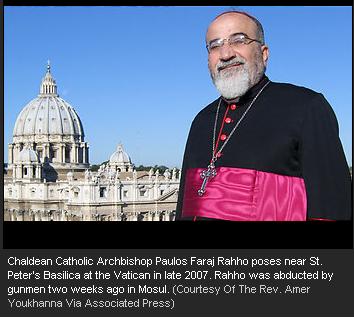
bishop_rahro.jpg BAGHDAD, March 13 — The body of a senior Christian cleric was found Thursday in the northern city of Mosul, two weeks after gunmen abducted him there and killed three of his associates.

The death of Paulos Faraj Rahho, 65, archbishop of Mosul’s Chaldean community, prompted expressions of remorse and condemnation from the Iraqi government and Christian leaders.

Pope Benedict XVI, in a message to the Chaldean patriarch in Iraq, called the killing an “act of inhuman violence that offends the dignity of the human person and seriously harms the cause of fraternal coexistence among the beloved Iraqi people.”

Iraqi Prime Minister Nouri al-Maliki said it was a crime of “aggression aimed at inciting sedition among” Iraqis.

CNN’s Startling use of its “Arab Affairs Editor”

A couple of students in my PLSC250 class have posted a clip of part of CNN’s reaction to news of the death of Al Qaeda’s Number 3 in command. (I thought that I’d never see the day when there was a more dangerous gig than being Spinal Tap’s drummer, but being Al Qaeda’s number 3 must be it.)*

Anyway, the anchor relays the news to viewers and turns to get expert advice from CNN’s “Senior Arab Affairs Editor.” What!?! An Arab affairs editor to give us insight into the area of the Pakistani/Afghan border where there are large numbers of Pashtuns, Tajiks, and Hazara, but no Arabs?

Go and watch the clip for yourself.

*I never thought that I’d be able to fit Al Qaeda and Spinal Tap into the same post.

A bio of Spinal Tap’s first drummer:

pepys.jpgPepys, John “Stumpy” (1943-1969): David and Nigel met the tall, blond geek in 1964 while touring as members of the Johnny Goodshow Revue. At a Southampton pub then known as the Bucket (now the Bucket and Pail), the boys jammed with the bespectacled drummer, nicknamed “the peeper” and then a member of the Leslie Cheswick Soul Explosion (now Les and Mary Cheswick). The three men would go on to form the Thamesmen and later, with Ronnie Pudding and Denny Upham, Spinal Tap, which played its first gig in December 1966. Pepys would die in a bizarre gardening accident shortly after the release of the band’s third album, “Silent But Deadly.” (IST) Nigel: “It was really one of those things the authorities said, ‘Well, best leave it unsolved.’ “

European Politics Source

One of the best sources for European politics in the English language is certainly the Financial Times, published in London. Don’t let the name of the newspaper fool you, the Financial Times writes about much more than financial and economic news. It’s coverage of domestic European politics is first-rate.

Design a site like this with WordPress.com
Get started