‘Game-changing’ news regarding climate change?

You may also have awoken this morning to reports of  a potentially ‘game-changing’ deal between the United States and China, which pledges to reduce greenhouse gas (GHG) emissions. [Note: the US media likes to use the sports-derived phrase ‘game-changing’ to refer to significant events.]  This is certainly a significant development in the politics of climate change. Indeed, the two countries are the world’s largest emitters of GHGs and until today the two have been engaged in a game of what Paul Harris has called “you go first!” From the looks of it, they have both chosen to ‘go first’.

According to news reports, here are some of the details:

[President] Obama is setting a new target for the U.S., agreeing to cut greenhouse gas emissions to 26 to 28 percent below 2005 levels by 2025. The current U.S. target is to reach a level of 17 percent below 2005 emissions by 2020…

[President] Xi committed China to begin reducing its carbon dioxide emissions, which have risen steadily, by about 2030, with the intention of trying to reach the goal sooner, according to a statement released by the White House.

China, the world’s largest greenhouse-gas emitter, also agreed to increase its non-fossil fuel share of energy production to about 20 percent by 2030, according to the White House.

Is the negotiated agreement ideal? Not nearly. China will still be increasing its total GHG emissions until about 2030. Despite this, however, the deal has been met with some praise from environmental groups for the symbolic significance of the deal, which makes the potential for getting a positive deal agreed in Paris next year more likely.

Jake Schmidt, director of international programs for the Natural Resources Defense Council, a Washington-based environmental group, said no other countries can have as big an impact on the climate debate as the U.S. and China.

“They shape how the market invests,” he said. “They’ve also been two of the most difficult players in the history of the climate negotiations so the fact that they are coming out and saying they are going to take deep commitments will be a powerful signal to the rest of the world.”

Of course, not everyone is happy. Soon-to-be US Senate Majority Leader, Mitch McConnell (R-KY) is outraged:

mcconelll climate change

US Midterm Election Results and Climate Change

Election results in the United States are mostly final and the Republican Party has had a big night, capturing control of the US Senate, which combined with a Republican-controlled House of Representative means that President Barack Obama will face a united (in party name, at least) Republican Congress upon the opening of the new Congressional session–the 114th–which meets for the first time in early January of next year.

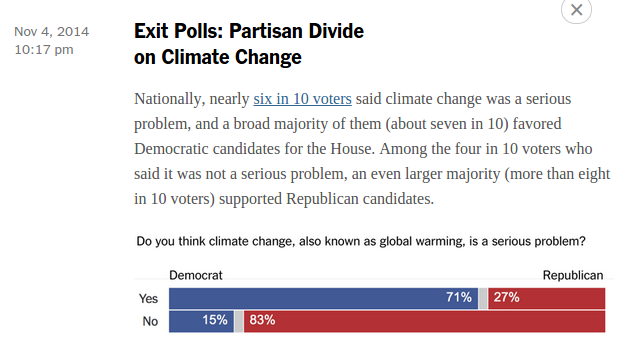
The New York Times has a handy graphic, summarizing the disconcerting results (from the perspective of climate change politics) of exit polls earlier today. This seems to be disheartening news to those who wish to see the United States government become more proactive in the are of climate politics and climate change. As you can see, while six in 10 voters said that climate change is a problem, fully 83\% of the partisans of the majority party in Congress believe the same.

us_midterm_elections_exit_polls_climatechange

Canadian Minister Aglukkaq’s Opening Statement at the 19th COP in Warsaw

In a couple of weeks time, we will be finishing up the course with a UN simulation. Each of the participants will be required to give a 1-minute (maximum!) opening presentation to the conference. Here is the opening statement of Honourable Leona Aglukkaq, Minister of the Environment, Minister of the Canadian Northern Economic Development Agency and Minister for the Arctic Council, to the 19th Conference of the Parties (COP19) to the United Nations Framework Convention on Climate Change (UNFCCC) held in Warsaw, Poland in 2013. Your opening statements should follow a similar structure (but not length!).

Domestic Politics and Climate Change

Last week we discussed the role of domestic politics–institutions, electoral systems, partisanship, etc.,–on national political leaders’ attitudes towards and policies on climate change. We noted that the Canadian federal governments stance toward mitigation and adaptation changed dramatically upon the ascension of the Conservatives to power in 2006 (a minority government). The majority government that Harper was able to win in 2011 signalled the death knell for Canada’s involvement in the Kyoto process as Harper’s government reneged on Canada’s obligations quickly thereafter.

The United States, meanwhile, enters the final week of the biennial “midterm elections”, with most candidates (and the public) focused on issues other than climate change. When climate change is mentioned, however, the candidates responses are not reassuring. Have a look at this video for an impressive compilation of candidates’ responses to whether they believe in the existence of anthropogenic climate change. Incidentally, for a comprehensive debunking of Representative Steve Pearce’s claim that 31,000 scientists signed a petition claiming that there was no global warming, click here.

Climate Policy and Citizen Support

One of the local rags is reporting on a new article (click here for a link to the abstract) in the journal, Global Environmental Change, written jointly by Ekaterina Rhodes, Jonn Axsen, and Mark Jaccard of the School of Resource and Environmental Management at Simon Fraser University.

British Columbians are largely unaware of government climate policies…

An online survey of 475 people found only one in four people could name a single climate policy and among those who could, nearly all of them named the Carbon Tax applied to fossil fuels in B.C.

Only one respondent named the astonishingly effective Renewable & Low Carbon Fuel Requirements Regulation that is responsible for one quarter of our reduction in carbon emissions since 2007. After the policy was explained, 90 per cent of respondents supported the idea.

The study challenges the notion touted by some politicians and most environmental groups that knowledge of climate science and well-informed citizen support are required to implement effective climate policy, said co-author Jonn Axsen, a professor specializing in sustainable energy systems.

In addition to citizens being non-informed about environmental policies, the authors come up with three additional important conclusions:

  • Regulations achieve the highest citizen support, carbon tax the lowest.
  • Citizen awareness and knowledge are not associated with higher policy support.
  • Providing policy information does not increase citizen support.

The second bulleted point above is interesting, implying an inherent tension between what the public prefers–regulation–and what policy-makers prefer–taxation. Policy-makers prefer taxation not only because it is relatively simple policy to implement, but also because it is economically efficient, allowing consumers and producers to place the “correct” value and costs, respectively, on carbon.

By the way, did you know that Canadians are the most scientifically literate people in the world?

New Report Claims that British Columbia Has Geo-hermal Energy

The useful DesmogCanada blog has an informative new post up, describing the results of a new report issued by the Canadian Geothermal Energy Association, which claims that there is enough untapped geothermal energy in British Columbia to power the whole province. Although there are some drawbacks to using geothermal power as a dominant energy source, there are many advantages, the most important of which (from an environmental perspective) is that geothermal energy is virtually carbon-free! (For a short demonstration of how geothermal energy is produced and transported, see the video clip below.} From DesmogCanada:

Geothermal power plants provide a firm source of base load power, similar to a hydro dam. Dr. Stephen Grasby, a geochemist with Natural Resources Canada, says the environmental footprint of geothermal energy is smaller than other renewable energy sources, such as wind and hydro.
“For instance, the surface area required to have developments like a wind farm, that takes a large surface area and has other associated issues with things like bird kill,” he said. Geothermal energy requires only a well and a heat exchange system.
“Drilling is relatively low impact,” he said, adding with a laugh, “worst case scenario is you accidentally discover oil or something.”
According to the CanGEA report, BC has “enormous potential to produce geothermal power,” which makes it shameful that Canada is “currently the only major country located along the Pacific Rim’s Ring of Fire not producing geothermal energy”. Why is this? There are many factors, but the political power of oil and gas interests is certainly an important impediment to constructing a carbon-free, environmentally-sustainable source of energy for our province.

New Pentagon Report sees Climate Change as US National Security Threat

So, if you’re not convinced by the ethical perspectives on climate change, then maybe you’ll be convinced to take it seriously if you are told that it could make state less secure going forward. In a new report from the US Department of Defence (i.e., “The Pentagon”), climate change is seen as a “threat multiplier.” In the language of Homer-Dixon, this means that climate change is viewed not as an exogenous cause of conflict, but as a factor that could negatively influence hypothesized exogenous causes of both civil and inter-state conflict. This is how Bloomberg News responded to the release of the report:

Global warming will worsen many of the challenges the U.S. military already is grappling with, the department said in areport yesterday.

“We refer to climate change as a ‘threat multiplier’ because it has the potential to exacerbate many of the challenges we are dealing with today -– from infectious disease to terrorism,” Secretary of Defense Chuck Hagel said in a blog post. “While scientists are converging toward consensus on future climate projections, uncertainty remains. But this cannot be an excuse for delaying action.”

Here is the report in its entirely. I am also providing a video excerpt of an MSNBC story on the release of the report, which has the added virtue of including an interview with the author of one of the readings that I think at least 2 of you read for Wednesday’s seminar! The author is Chris Parenti, who has written an interesting book called Climate of Chaos.

https://www.youtube.com/watch?v=4eYl0u52RF4

Who owns the arctic? Environment and Security

Our next set of readings assesses the environment/conflict/security nexus. The Environmental Change and Security Program (ECSP) and the Woodrow Wilson International Center for Scholars in Washington, DC, is a fantastic place to find resources related to this topic. Based on the content on its website, it looks to be a very busy place. The ECSP takes a look at the changing environment in the Arctic (due to climate change), and the implications of this from various perspectives–energy, geopolitics, environment, etc.–by asking scholars working on this topic a series of important questions.

How to be an informed climate sceptic

We have spoken repeatedly about the difference between climate science scepticism and climate science denial. Scepticism is at the heart of the scientific enterprise; a sceptical approach to knowledge claims is consistent with the contingent, or provisional, nature of scientific knowledge.

Climate scientists are themselves sceptical about climate science in that they know that while they have learned a great deal about how our climate works, there is much that is either unknown or that can be known better. With that in mind, I provide for your enlightenment a skceptic’s guide to climate science published by the Berkeleyearth.org.  It’s interesting that the Professor of Physics Richard Muller, the founder and scientific director, is a self-admitted ‘converted sceptic’. Indeed, he once believed that the gaps in the scientific knowledge of climate change were so large that he doubted the very existence of global warming. In this op-ed in the New York Times, Muller writes:

Three years ago I identified problems in previous climate studies that, in my mind, threw doubt on the very existence of global warming. Last year, following an intensive research effort involving a dozen scientists, I concluded that global warming was real and that the prior estimates of the rate of warming were correct. I’m now going a step further: Humans are almost entirely the cause.

My total turnaround, in such a short time, is the result of careful and objective analysis by the Berkeley Earth Surface Temperature project, which I founded with my daughter Elizabeth. Our results show that the average temperature of the earth’s land has risen by two and a half degrees Fahrenheit over the past 250 years, including an increase of one and a half degrees over the most recent 50 years. Moreover, it appears likely that essentially all of this increase results from the human emission of greenhouse gases.

These findings are stronger than those of the Intergovernmental Panel on Climate Change, the United Nations group that defines the scientific and diplomatic consensus on global warming.

Although there is strong scientific evidence of human-induced global warming, there are still many issues that are scientifically not settled. Read the following short, but instructive document to learn how to become an informed climate science sceptic. The alternative is to look as uninformed as this guy:

Design a site like this with WordPress.com
Get started