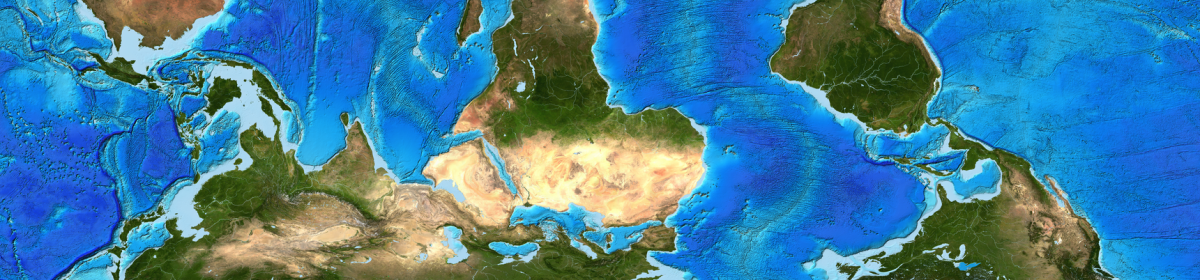
A confluence of events–globalization, technological and communications advances, and halting (or no) democratization–has led to an unprecedented rise in global human trafficking. States and governments have been unable to make a dent in this growing trade, where human beings are sold like cattle to be used as indentured servants and sex slaves. Here is a documentary about one such person, Katia from Ukraine, whose husband’s friend kidnapped and sold her in Turkey, whence she was moved to western Europe where she was forced into prostitution. (The documentary is in five parts. Here is part one.)
Month: February 2008
Samuel Huntington of “Clash of Civilizations” fame, Interviewed
Charlie Rose interviews Huntington on the ideas in his oft-cited and even more criticized “Clash of Civilizations” thesis. Rose calls the clash thesis “provocative.” What do you think about the logic of the clash thesis. Given that you’ve read Amartya Sen’s response to Huntington, what kinds of questions would you have asked Huntington that Rose failed to? (The Huntington interview runs from 1:55 until about 21:00. No, Professor Huntington is not a dead-ringer for John Cleese. That is, in fact, John Cleese, who is interviewed in the middle segment; hence, the screen shot of Cleese.)
Serb Demonstrators Attack US and Croatian Embassies in Belgrade
The Washington Post reports that following a massive (upwards of 150,000 participants) and peaceful demonstration in the Serbian capital of Belgrade, with the theme “Kosovo is Serbia”, a group numbering a few thousand at most has attacked the US and (neighboring) Croatian embassies, setting the US embassy on fire. The demonstrations were held in the aftermath of Albanian Kosovars’ official declaration of independence on Monday. The US is one of many countries to have officially recognized Kosovo as the newest ex-Yugoslav independent state, setting off a public and official outcry on the part of Serbs, for whom Kosovo is the historical birthplace of their nation.
Politicians in Belgrade are caught between their rhetoric to do what it takes (short of violence) to prevent Kosovo from achieving full-fledged independence and the lack of many good non-violent options to do so, given the Serb leadership’s openly declared goal of one day joining the European Union. One possibility would be to energize (or otherwise entice) the Serbs in neighboring Bosnia and Herzegovina to agitate for higher levels of autonomy, or outright independence, stressing the similarities of the situations. This would certainly raise the ire of European leaders and would not earn the Serbs any bonus points in their quest for further integration into European political and economic institutions.
Here is footage from the Belgrade independent media outlet B92:
From the “About Video” (translated by me): Beograd — Stotine nasilnih demonstranata nakon završetka mitinga napalo američku i hrvatsku ambasadu. U 19:13 intervenisala policija.
“Upon the conclusion of the [official] demonstration, undreds of violent demonstrators attacked the American and Croatian embassies. The police intervened at 7:13 pm.”
You can find a gallery of photographs from the day in Belgrade at B92’s website here.
Playing the Dominant Strategy in a Prisoner’s Dilemma Situation
As you’ll see in lecture tomorrow, instrumentally rational players will also choose to “defect” in a priosoner’s dilemma type situation even though they could be much better off absolutely if they and their opponents could learn to cooperate. The chart below has been created using data from the simulation of yesterday. What is take-home message from the chart? Why is the relationship between the phenomena displayed not completely linear? Think about the nature (i.e., the specific rules) of the oil game we played yesterday. (The plot below is a box plot, which is a way of summarizing the means, range, and certain percentiles of the values of a single variable based on another variable.)
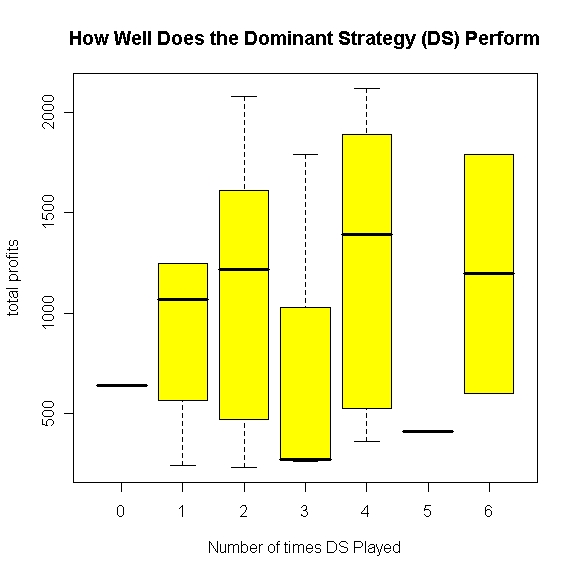
Results from a Prisoner’s Dilemma Simulation–The Oil Game
Today in class, you competed in groups to maximize total profits in a simulation called “the Oil Game.” You represented one of two competing oil producers–Iraz and Sabia–trying to maximize profits selling oil to a net importer of oil–ESYUVI (the names were created using a random letter-generator–I swear!). Most of you recognized very quickly, if not immediately, that the simulation was a modified Prisoner’s Dilemma situation. As I’ll discuss on Friday, in a Prisoner’s Dilemma situation, players acting in an instrumentally rational manner will always choose not to cooperate (i.e., “defect”), because it is a dominant strategy. What makes the situation a dilemma is that the players could do much better were they able to cooperate and trust one another.
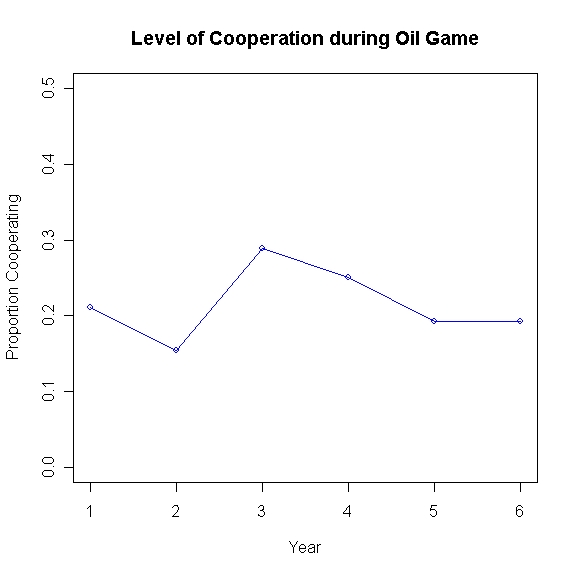
The compelling logic of the prisoner’s dilemma, along with some strong empirical evidence, is used by realists to support their arguments regarding the nature of interaction in the international world. Liberals, on the other hand, argue that there is much more cooperation in the world than realists would predict. Thus, despite the structure of the prisoner’s dilemma, players are able to cooperate in international politics. What factors do you think make cooperation more likely? Less likely? Why?
The results from our simulation today are in graphical form above. You’ll note that communication was not allowed for Years 1, 2, and 4; communication was allowed for Year 3, and communication (to decide what to do for Years 5 and 6) was allowed prior to Year 5. The results from this class are consistent with the expectations. I would note the relatively low level of cooperation throughout, rising only initially after the first episode of communication.
A Good Resource for Information on “Eurasia”

Eurasianet.org has a very informative website that offers news from Eurasia. Here is a snippet from their about page (when you find a source online always read their “about” or “description” page to get an idea of what the organization is, if they have any political biases, etc.):
EurasiaNet provides information and analysis about political, economic, environmental and social developments in the countries of Central Asia and the Caucasus, as well as in Russia, the Middle East, and Southwest Asia. The web site also offers additional features, including newsmaker interviews and book reviews.
Based in New York, EurasiaNet advocates open and informed discussion of issues that concern countries in the region. The web site presents a variety of perspectives on contemporary developments, utilizing a network of correspondents based both in the West and in the region. The aim of EurasiaNet is to promote informed decision making among policy makers, as well as broadening interest in the region among the general public.
EurasiaNet is operated by the Central Eurasia Project of the Open Society Institute.
Today, they report on contested presidential elections in Armenia, where opposition supporters claim fraud has taken place while supporters of current Prime Minister (and declared winner) Serzh Sarkisian believe that their candidate has won with more than 50% of the vote, obviating the need for a run-off election (in many electoral systems, for a candidate to be declared the official winner, s/he must have received a majority (i.e., 50%) of votes cast. If no candidate passes that threshold, a run-off election is held where the two leaders go head-to-head.) You can read the Washington Post’s report here, with a snippet below:
YEREVAN, Armenia — Thousands of opposition supporters marched through Armenia’s capital Wednesday after an election official said complete results showed that the prime minister had won the presidential election.
Allegations of fraud and threats of mass protests have raised concerns about the stability of the volatile, strategic country, located at the juncture of the energy-rich Caspian Sea region and southern Europe and bordering Iran.
An initial count of the ballots showed Prime Minister Serge Sarkisian had nearly 53 percent of the vote in Tuesday’s election, Central Election Commission chief Garegin Azarian said _ enough to win outright and avoid a runoff. Top opposition candidate Levon Ter-Petrosian had 21.5 percent, Azarian said.
Ter-Petrosian’s backers have alleged widespread fraud, and a crowd gathered in central Yerevan to protest the results, swelling to some 20,000 as riot police with truncheons guarded the election commission building a five-minute walk away.
The protesters then marched to the government headquarters in a broad central square, many shouting “Levon!” and raising a clenched fist _ Ter-Petrosian’s campaign symbol. Helmeted police blocked the building, and the protesters moved on, marching toward the election commission building.
“I have no doubt that the authorities have falsified the election and I will protest with all those who also feel cheated,” Simon Grigorian, a 38-year-old engineer, said at the protest.
Meet the Captain of Afghanistan’s National Women’s Soccer Team
A former student of mine in Intro to Comparative Politics has sent me a link to a story on a high school student in New Jersey, who also happens to be an Afghani immigrant and the captain of Afghanistan’s women’s national soccer team. Her story is fascinating and mirrors that of my former student and other young Afghani women who have overcome tremendous obstacles to pursue their educational dreams here in the United States and other western countries. From the article:
BLAIRSTOWN, N.J. — In world religion class, Shamila Kohestani is neither the adolescent who defied the Taliban in Afghanistan nor the symbol of liberation that shared the stage with stars from Hollywood and sports at the 2006 ESPY Awards. She is a teenager whose lips move as she takes notes, and whose list of words to look up grows exponentially each minute, each hour and each day.
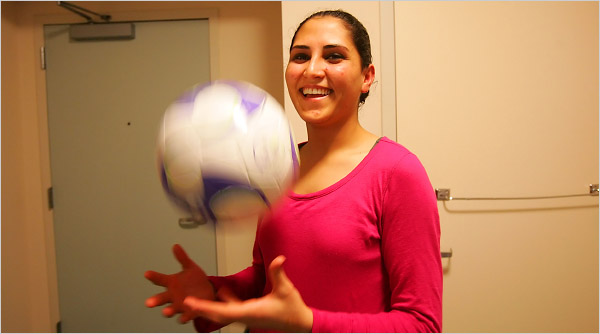
Some of her classmates at Blair Academy here know that Kohestani, 19, is the captain of the Afghanistan national women’s soccer team. Some are aware that she is Muslim. Most know her only as the striking young woman who is eager to stock her iPod with any kind of music they recommend.
Until recently, they had no idea of what Kohestani has already endured in her short life. The music that some of them take for granted is a luxury to her; the classwork they grumble about is a privilege…
…When the Taliban ruled Afghanistan from 1996 to 2001, Kohestani and her six sisters were virtually confined to their small home in Kabul. They were not allowed to attend school or work, and when they appeared in public, they had to be covered in a burqa.
Price of Crude Oil Closes above $100/bbl First Time Ever
 We’ll be playing the “Oil Game” in class tomorrow in PLSC250. When colleagues of mine used this teaching tool in their classes 4 or 5 years ago, the price of oil was about 1/3 of what it is today. In the clip, Brian Williams will tell you that oil reached a “record” high of $100.01 US a barrel. That’s only true if we’re talking about nominal dollars. In terms of real dollars it still has about 4 USD/bbl to go to hit the all-time high set in December 1979. Hmmm…I wonder what was happening in late 1979? Iran, Afghanistan, plus ca change…
Click here to see Maria Bartiromo report from NBC News.
“People are afraid that there is just not enough oil in the world to meet demand; demand which is coming not only from the United States but from emerging economies like China and India.”
Presenting Data Graphically to Increase Understanding and Impact
Jonathan P. Kastellec and Eduardo L. Leoni have written an article, published in a recent issue of Perspectives on Politics, in which they encourage academics to make much more frequent use of graphs to present data that is more commonly presented in tabular form. From the abstract:
When political scientists present empirical results, they are much more likely to use tables than graphs, despite the fact that graphs greatly increases the clarity of presentation and makes it easier for a reader to understand the data being used and to draw clear and correct inferences.
Here is one of their examples, and they are absolutely right; graphical data facilitates the making of almost instantaneous inferences regarding the results (or maybe I’m just a visual learner?).
When presenting data in your papers, think about what you want to say with the data and use the best format available to facilitate that end.
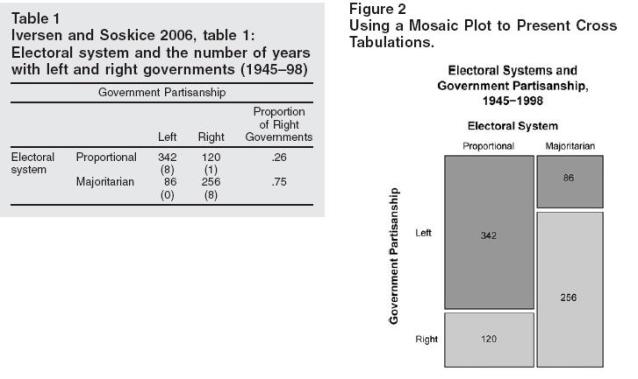
Kastellec and Leoni have crated a website that provides the code necessary to replicate these graphs in the R statistical program (which is a fantastic program that is free to download and use). Here is a link to the code for replicating the graph above.
You’ve got to Fight…for Your Right…to…Gain Citizenship
During our discussion in class today on different forms of group identity, many of you seemed surprised when I mentioned that there were many non-US citizens currently fighting for the US military in Iraq; many (a majority at least) are doing so in exchange for the promise of US citizenship. Which begs the questions, just how many non-citizens are currently serving in the US military? According to this paper (pdf),
“As of February 2003, there were 37,000 non-citizens serving in active duty in the U.S. armed forces, almost 12,000 foreign nationals serving in the selected reserves, and another 8,000 serving in the inactive national guard and ready reserves.”*
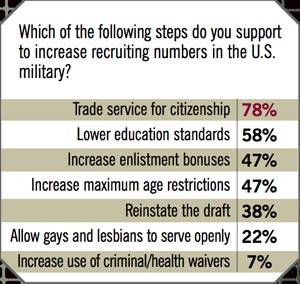
As we learned in class, prior to the establishment and consolidation of nation-states in Europe, post-Westphalia, most political leaders recruited mercenary armies. Thus, the link between military protection and citizenship is a modern phenomenon. This makes the results of a recent survey done by Foreign Policy Magazine very interesting.
Many proposals have been suggested to help the military meet its recruiting and retention needs. But an incredible percentage of the index’s officers favor the same solution: Nearly 80 percent support expanding options for legal, foreign permanent residents of the United States to serve in exchange for U.S. citizenship. A high percentage of officers, about 6 in 10, also support the idea of allowing more recruits who have a high school equivalency degree—but no diploma—to serve. Almost 40 percent favor reinstating the draft.
*Not all of these, of course, are serving in Iraq. Moreover, while it is a seemingly large number it is still a very small percentage of the total military.
 Clouds, Clocks, and Sitting at Tables
You must be logged in to post a comment.