The Relationship Between Wealth and Health

The BBC reports on fascinating new research, which concludes that “economic growth does not necessarily translate into improvements in child mortality.” There are two points I wish to make about this: First, it illustrates an important trend in the development literature regarding the correct metric to use to determine, and compare, levels of well-being worldwide. Historically, well-being has been captured by the crude instrument of Gross National Product (GDP) per capita, but the realization that, for many reasons, the measure was too crude to be a satisfactory indicator of well-being development led to the introduction of other measures, the most useful of which is the Human Development Index (HDI) put out by the United Nations Development Program (UNDP). (Why might GDP per capita be a misleading indicator of well-being?)

The second point follows from the first; one’s policy prescriptions vis-a-vis issues of development are to a large extent determined by just which indicator of well-being one believes best captures the essential nature of that elusive concept. As such, IGOs such as the World Bank, have focused attention on overall economic growth, while scholars such as Amartya Sen (who champions the “capabilities approach”) do not view growth tout court as a magical anti-poverty elixir.

From the BBC article:

Ten million children still die every year before their fifth birthday, 99% of them in the developing world, according to Save the Children.

A study comparing economic performance with child mortality reveals that some countries have not translated wealth into improvements across society.

Survival is too often just a “lottery”, said Save the Children’s David Mepham.

He said that even the poorest countries can cut child mortality by following simple policies, but at the moment “a child’s chance of making it to its fifth birthday depends on the country or community it is born into”.

Lagging behind

Angola comes at the bottom of a new “Wealth and Survival” league table drawn up by the UN Development Programme (UNDP).

The figures for child mortality in India are shocking
Shireen Miller
Save the children India

There are few countries in the world where there are such stark wealth contrasts as there are between the wealth of oil-rich coastal strip around the Angolan capital Luanda, and the war-ravaged interior.

UNDP statisticians calculate that more than half of the babies who die in Angola could be saved were the country to spread its wealth more fairly.

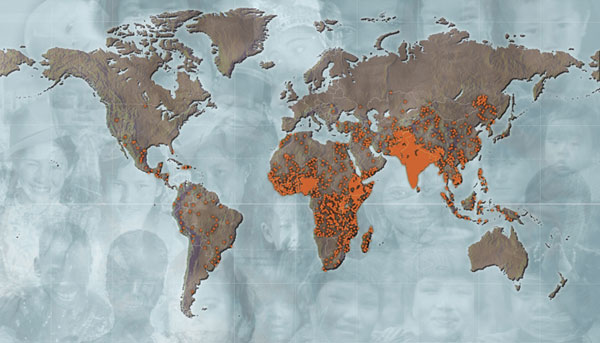
child_mortality_map.jpg

Click on the map to be taken to the Johns Hopkins Bloomberg School of Public Health’s Magazine for an article on child mortality.

[Each orange dot is equivalent to 5,000 child deaths.]


More Trouble in East Timor–President shot in coup attempt

In a previous post, I used the current political situation in the relatively new state of East Timor as an illustration of the importance of having a strong state to facilitate political and economic development.  The situation in that country has become even more dire as we hear that East Timor’s President, Jose Ramos-Horta–a former winner of the Nobel Peace Prize–has been shot in an attempted assassination attempt.  From the BBC:

East Timor’s President Jose Ramos-Horta is in a critical condition and has been put into an induced coma, after being shot by rebel soldiers.

Mr Ramos-Horta was shot in a pre-dawn attack on his Dili home, and later airlifted to Australia for treatment.

Later Prime Minister Xanana Gusmao declared a 48-hour state of emergency, including a night-time curfew.

Mr Gusmao, who was targeted in a separate incident but was unharmed, described the events as a coup attempt.

Rebel leader Alfredo Reinado and another rebel died in the attack on Mr Ramos-Horta.

Australian PM Kevin Rudd pledged to send more peacekeepers to East Timor.

He said the “attempt to assassinate the democratically elected leadership of a close friend and neighbour of Australia’s is a deeply disturbing development”.

Here’s more from the New York Times, and according to this report from Australia’s ABC, UN police failed to help the injured President:

East Timor’s Government says United Nations forces failed to help President Jose Ramos Horta after he was shot in an assassination attempt in Dili this morning.

He was shot in the arm and stomach after fugitive rebel leader Alfredo Reinado launched a pre-dawn raid on his home.

Mr Ramos Horta is now in a serious but stable condition in Royal Darwin Hospital after being evacuated on a Careflight plane this afternoon.

He was sedated on the flight from Dili to Darwin and the hospital says he is suffering three gunshot wounds – two to the upper chest and one to the abdomen.

East Timor Prime Minister Xanana Gusmao, who was also attacked but escaped unharmed, has confirmed that Reinado was shot dead during the raid.

The country’s Foreign Ministry has issued a statement which said that UN police stayed about 300 metres away from where Mr Ramos Horta was shot.

Percentage of the World’s Denizens who Live on Less than $2/day

Using data from the United Nations’ Human Development Index, I put together this table of the thirty states in the world with the highest percentage of residents living on less than two dollars per day. After we have covered (international) political economy later this semester, you’ll know to ask whether the two dollar a day statistic is PPP-adjusted or not. The HDI rank is the Human Development Index rank (out of 177 countries ranked in 2007).

Using Country Watch (you can find a link to it at the course’s page at the library’s website, or click here), we see that Nigeria’s 2006 estimated (ethnic tensions in Africa’s most populous state prevent it from ever completing a census that is acceptable for all interested parties) population is approximately 132 million, meaning that fully 122 million persons in Nigeria survive on less than two dollars per day.

[UPDATE: “A world where some live in comfort and plenty, while half of the human race lives on less than $2 a day, is neither just nor stable. Including all of the world’s poor in a expanding circle of development–and opportunity–is a moral imperative and one of the top priorities of U.S. international policy.

-President George W. Bush, The National Security Strategy of the U.S.A. 2002]

Country

Below 2$/day (%)

HDI Rank

Nigeria

92.4

158

Tanzania (United Republic of)

89.9

159

Rwanda

87.8

161

Burundi

87.6

167

Zambia

87.2

165

Niger

85.8

174

Madagascar

85.1

143

Bangladesh

84

140

Central African Republic

84

171

Zimbabwe

83

151

Gambia

82.9

155

India

80.4

128

Nicaragua

79.9

110

Ghana

78.5

135

Haiti

78

146

Swaziland

77.8

141

Ethiopia

77.8

169

Cambodia

77.7

131

Sierra Leone

74.5

177

Lao P.D.R.

74.1

130

Mozambique

74.1

172

Benin

73.7

163

Pakistan

73.6

136

Mali

72.1

173

Burkina Faso

71.8

176

Nepal

68.5

142

Mauritania

63.1

137

Malawi

62.9

164

Kenya

58.3

148

Data Sources on Development, Poverty, Economics, Environment, etc.

For your edification, but also to help you with your assignments, papers, and blogs, here are some data sources that will allow you to compare levels of development and poverty across the globe. The United Nations Development Programme’s Human Development Report is an excellent source of information on indicators related to development. Click here if you would like to look up data and/or statistics. You can search for statistics by country, indicator, or table.

Another excellent data source is the World Bank Development Indicators collected by the World Bank. This link provides access to the Education, Gender, Health & Nutrition & Population, and Poverty databases as well as Country Statistical Information, and Development Gateway Data and Statistics.

Finally, the United Nations maintains a statistical division, whose website can be found here, and which collects a wide range of data from social and demographic statistics, through economic, environmental and energy statistics, to statistics related to Millennium goal indicators.

Timor Leste (East) and Nation-Building

The International Crisis Group (ICG) has a new report on the situation in Timor Leste. Some of you may be aware that Timor Leste broke away from Indonesia four years ago following a brutal war of secession, during which forces loyal to the Indonesian government were alleged to have committed horrendous crimes against humanity. Thanks to UN intervention, the killing stopped and the small state of Timor Leste gained its independence. Recently, however, the UN-directed nation-building exercise in Timor Leste has imploded, along with domestic order.

According to the ICG.

Four years after Timor-Leste gained independence, its police and army were fighting each other in the streets of Dili. The April-June 2006 crisis left both institutions in ruins and security again in the hands of international forces. The crisis was precipitated by the dismissal of almost half the army and caused the virtual collapse of the police force. UN police and Australian-led peacekeepers maintain security in a situation that, while not at a point of violent conflict, remains unsettled. If the new government is to reform the security sector successfully, it must ensure that the process is inclusive by consulting widely and resisting the temptation to take autocratic decisions. A systematic, comprehensive approach, as recommended by the UN Security Council, should be based on a realistic analysis of actual security and law-enforcement needs. Unless there is a non-partisan commitment to the reform process, structural problems are likely to remain unresolved and the security forces politicised and volatile.

The problems run deep. Neither the UN administration nor successive Timorese governments did enough to build a national consensus about security needs and the kind of forces required to meet them. There is no national security policy, and there are important gaps in security-related legislation. The police suffer from low status and an excess of political interference. The army still trades on its heroism in resisting the Indonesian occupation but has not yet found a new role and has been plagued by regional (east-west) rivalry. There is a lack of transparency and orderly arrangements in political control as well as parliamentary and judicial oversight with respect to both forces.

The situation in Timor Leste illustrates–from the perspective of comparative politics–the importance of the state and its crucial role in facilitating stability by consolidating political power and maintaining, to paraphrase Weber, a monopoly on the legitimate use of political violence. From an IR perspective, we see the difficulty of imposing legitimate order on a society from outside, whether–as is the case here–through intergovernmental organizations (IGOs) like the United Nations, or–as in Iraq–through unilateral, or multilateral means.

Here’s a report from the BBC on the upheavals of April-June 2006.

Design a site like this with WordPress.com
Get started