Dependency Theory and Import Substitution Industrialization (ISI)

PBS broadcast a tremendously informative series called Commanding Heights, which took a look at the the battle over the world’s political economy during the 20th century.  Below you’ll find a portion of the episode on Latin America, which has been uploaded to You Tube.  The clip below explains the concept of dependency theory–the theoretical impetus behind the establishment of the political economic institution of import-substitution-industrialization (ISI).  Unfortunately, ISI did not work very well in practice, and Moises Naim–the editor of Foreign Policy Magazine, explains why in the clip below.

P.S. “The Chicago Boys” were not Michael, Scotty, and Phil. 🙂

How much of Your Income is Spent of Food?

Here is an interesting table from the United States Department of Agriculture (USDA) website, which compares food expenditures across different countries of the world.  Notice the wide disparity between the developed world and many developing countries.  I found it particularly noteworthy that Croatians spend fully 1/3 of their income on food.  I can say that I have first-hand evidence that this is true.  The reasons for this are complex (Croatia is not a poor country, at least compared to those countries with which it shares food expenditure characteristics) but have to do with small population size and small farm size, along with an overvalued (for political reasons) currency vis-a-vis countries from which Croatia imports a lot of foodstuffs.

Look at Pakistan!!  Wow!

Table 97
Percent of household final consumption expenditures spent on food, alcoholic beverages, and tobacco that were consumed at home, by selected countries, 20061
Country/Territory Share of household final consumption expenditures
Food2 Alcoholic beverages and tobacco Total household final consumption expenditures3 Expenditure per capita on food2
Percent U.S. dollars per person
United States
ERS estimate 5.8 NA NA 1,848
Euromonitor estimate 7.2 2.0 30,624 2,204
Singapore 8.1 2.3 12,000 975
Ireland 8.2 5.0 22,022 1,812
United Kingdom 8.7 3.6 24,205 2,097
Canada 9.3 3.8 21,526 1,994
United Arab Emirates 10.1 0.6 8,099 816
Netherlands 10.4 3.0 18,593 1,937
Switzerland 10.4 3.6 29,124 3,040
Denmark 10.9 3.6 24,175 2,629
Austria 11.1 2.6 20,666 2,289
Germany 11.2 3.5 19,811 2,226
Australia 11.2 4.1 19,991 2,247
Sweden 11.9 3.5 19,367 2,302
Kuwait 12.0 1.3 11,083 1,324
Finland 12.4 4.8 19,268 2,392
New Zealand 12.5 4.4 15,107 1,882
Norway 12.8 4.3 28,026 3,591
Hong Kong, China 13.0 0.8 15,199 1,979
Belgium 13.2 3.7 19,313 2,546
France 13.9 3.1 19,931 2,776
Japan 14.3 3.1 19,320 2,768
Spain 14.6 3.3 15,724 2,304
Italy 14.9 2.8 18,396 2,745
Malaysia 15.0 1.2 2,412 361
South Korea 15.1 2.6 9,668 1,464
Greece 15.6 5.0 14,469 2,259
Slovenia 15.9 4.4 9,836 1,568
Czech Republic 17.0 8.0 6,723 1,146
Hungary 17.8 8.2 7,239 1,291
Portugal 18.0 4.0 11,533 2,072
Israel 18.1 1.7 10,624 1,926
Estonia 18.4 8.6 6,206 1,141
Latvia 19.0 6.3 5,606 1,063
Slovakia 19.2 4.9 5,777 1,112
Argentina 20.1 3.3 3,325 667
Saudi Arabia 21.4 1.1 3,519 752
South Africa 21.4 4.6 3,146 674
Poland 22.1 7.4 4,968 1,099
Chile 23.7 0.8 4,332 1,025
Taiwan 23.9 2.1 9,961 2,377
Mexico 24.5 2.5 5,293 1,296
Brazil 24.7 1.9 2,915 721
Lithuania 24.9 6.4 5,752 1,432
Colombia 25.5 4.4 1,741 444
Thailand 25.8 5.6 1,809 467
Indonesia 26.7 2.0 979 262
Philippines 27.4 2.1 943 258
China 27.8 2.2 746 207
Ecuador 28.5 5.8 1,144 326
Turkey 28.7 5.1 3,626 1,040
Bolivia 29.1 2.2 715 208
Venezuela 29.4 3.1 2,413 709
Bulgaria 29.5 4.2 2,796 824
Peru 29.6 2.0 2,002 593
Russia 31.4 2.5 3,278 1,029
Turkmenistan 32.7 2.7 798 261
India 33.4 2.3 421 141
Croatia 33.9 4.1 5,281 1,791
Romania 34.6 5.0 4,285 1,481
Kazakhstan 36.6 3.5 2,267 829
Tunisia 36.7 1.0 1,875 688
Vietnam 39.7 2.9 426 169
Nigeria 40.7 2.5 412 168
Pakistan 41.5 2.5 44 18
Egypt 41.5 2.5 1,032 428
Ukraine 43.1 6.4 1,408 606
Jordan 43.6 5.1 1,648 718
Algeria 43.7 2.0 1,204 526
Morocco 44.8 1.5 1,156 517
Belarus 47.3 6.3 1,835 868
Azerbaijan 51.6 2.4 912 471
NA=Not available.
1The data are computed by Birgit Meade (202-694-5159, bmeade@ers.usda.gov), ERS/USDA, EUROMONITOR data, March 2006.
2Includes nonalcoholic beverages.
3Household expenditures for goods and services.

Happy Tax Day–April 15th

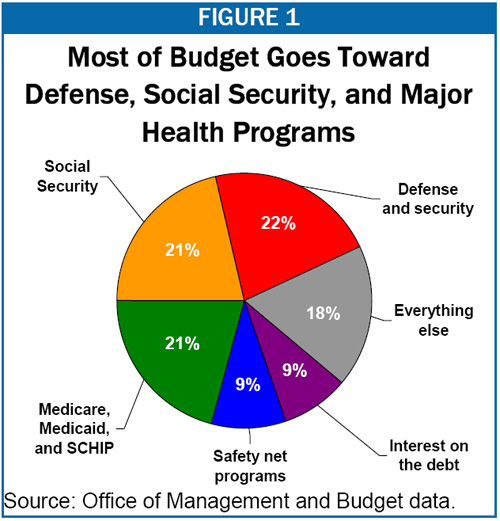
Well, today is tax filing day and I’ve often wondered just where my taxes go.  I’ve often thought that given the extant technological capabilities, and the normative desire for more direct forms of democracy, that each and every taxpaying citizen should be given the opportunity not only to file her taxes electronically, but to be able to specifically allocate her tax dollars to the uses that she sees fit.  How would you choose to allocate your tax dollars?  How does the federal government choose to allocate its tax dollars?  Look at the figure below–from the Office of Management and Budget–to see what the Federal government spends its money on.  This graph goes a long way to undermining the demagoguery of politicians when talking about taxes and spending.  When a politician tells you that he is going to cut taxes and does not mention spending cuts, then he is playing politics (unless, of course, he thinks that budget deficits are a non-issue).

The fact is that discretionary spending is a small minority (18%) of total spending.  In order to put a real dent in the budget deficit and the federal debt (two different–but related–concepts), you must cut entitlements, cut defense spending, raise taxes, or a combination of the three.

Happy Tax Day!

H/T Andrew Sullivan

Rice Prices Surge 30% in one Day

I think I’ll start eating more quinoa.

The Financial Times reports that “fears of unrest rise across Asia as rice price surges 30% in a day.”  In a BBC interview, the director of the International Rice Research Institute (IRRI–don’t tell me you didn’t know one existed) bluntly states why this could be a major problem.

“Rice is the staple food for about half the world’s population, and over half the world’s poor.”

As the FT reports, many events has transpired to cause such a dramatic, sudden rise in the price of this extremely important food staple and the potential political effects.

Rice prices jumped 30 per cent to a record high yesterday, raising fears of fresh outbreaks of social unrest across Asia, where the grain is a staple food for more than 2.5bn people.

The increase came after Egypt, a leading exporter, imposed a formal ban on selling rice abroad to keep local prices down and the Philippines announced plans for a major purchase of the grain in the international market to boost supplies.

Global rice stocks are at their lowest since 1976. While prices of wheat, corn and other agricultural commodities have surged since late 2006, the rice prices increase started in January.

The Egyptian export ban formalises a previous poorly enforced curb and follows similar restrictions imposed by Vietnam and India, the world’s second and third-largest exporters.

Cambodia, a small seller, also announced an export ban.

These foreign sales restrictions have removed about a third of the rice traded in the international market.

Chookiat Ophaswongse, president of the Thai Rice Exporters Association, said: “I have no idea how importing countries will get rice.” He forecast prices would rise further.

Here is the BBC interview with the head of the IRRI:

Unrest in Egypt due to Inflation

The Financial Times reports a rise in social unrest in Egypt, which has been attributed to inflation, rising food costs in particular. Inflation is soaring in most parts of the Middle East, from the affluent enclaves of the United Arab Emirates to the more distressed countries, such as Egypt. The main culprit is the record-level price of oil.

A wave of discontent has been sweeping through Egypt in response to mounting food prices and the return of long queues in front of bakeries selling subsidised bread – the only food item that has not recently risen in price.

Civil servants, industrial workers and even groups considered privileged such as doctors and university lecturers have been staging strikes and demanding higher pay to meet price increases of up to 50 per cent for some basic foods.

State university lecturers have gone on strike this week, bringing many classes to a halt for a day. “Faculty members in Egypt are normally a very conservative group who do not want to expose themselves to trouble,” said Hany Al Husseini, one of the strike organisers. “But now the economic situation has become so bad that people are prepared to do anything.”

Barack Obama on the Financial System, Uncertainty and Risk

In my post below, I linked to an article by Thomas Homer-Dixon in which, among other things, he argued that the problem with the contemporary financial system is that the arcane machinations and lack of transparency (Level-III assets, anyone?)  have transformed the market from one of risk–which can form the basis for a stable financial system–to uncertainty–which cannot.  So the question then, is how to create the conditions under which banks and other financial institutions, and investors can adequately assess risk.  The lack of transparency is the reason that the credit markets have currently seized up and the Federal Reserve has had to come to the rescue of Bear Stearns. (Ben Bernanke–the Chairman of the Federal Reserve–himself has argued that “banks will fail” over the next couple of years.  Indeed, a couple of small regional American banks have already failed.)

By coincidence, Democratic Presidential candidate Barack Obama gave a speech at Cooper Union in New York setting out his vision of how his policies would help the engine  of the American (and international) financial system become more transparent and a solid foundation for the US and world economy.  I encourage you to watch the speech, wherein Obama presents his view of the nature of the relationship between the market and state (government).

“It’s worth taking a moment to reflect on the role that the market has played in the development of the American story.  The great task before our founders was putting into practice the ideal that government could simultaneously serve liberty and advance the common good.  For Alexander Hamilton, the young Secretary of the Treasury, that task was bound to the vigor of the American economy.  Hamilton had a strong belief in the power of the market, but he balanced that belief with the conviction that human enterprise, ‘may be beneficially stimulated by prudent aids and encouragements on the part of the government [state]'”

First, Conflict Diamonds; now, Junta Jade?

I know; the j in junta is pronounced like an h. Regardless, The Christian Science Monitor asks “Who’s buying Burma’s gems?: Laura Bush’s campaign for a global boycott is being undone by China’s appetite for Olympic souvenirs made of Burmese jade.” The US First Lady argues that those of you purchasing precious gems from Burma are indirectly supporting the rule of the brutal military dictatorship in that southeast Asian country.
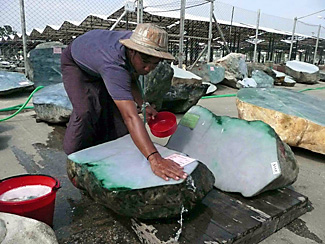
burma_jade.jpgIt’s the last hour of the last day of the gems auction in Rangoon, and tired buyers are fanning themselves with worn auction catalogs, and making their final bids.

Over the past five days, jade, rubies, sapphires, and close to $150 million have passed hands here, according to the Union of Myanmar Economic Holdings Ltd., the consortium that dominates Burma’s gemstone trade and is owned by the defense ministry and a clutch of military officers.

Who’s buying? China, India, Singapore, and Thailand are scooping up Burma’s stones. US first lady Laura Bush’s efforts at a global boycott of Burma’s gems seem to have done little to reduce China’s appetite for Burmese jade to make trinkets and souvenirs to sell at the Summer Olympics.

At this recent auction, 281 foreigners attended, leaving behind much-needed foreign currency and generally turning the auction into a resounding success, according to the state-run New Light of Myanmar newspaper.

Mrs. Bush – and human rights campaigners – would not be pleased.

The first lady has taken on the military regime in Burma (Myanmar), urging jewelers not to buy gems from a country where the undemocratic rulers and their cronies amass fortunes selling off the country’s stones, as well as many of the county’s other natural resources – such as minerals, timber, gold, oil, and gas – but keep Burma’s citizens in abject poverty.

She has urged UN Secretary General Ban Ki Moon to act more forcibly on Burma and stood beside President Bush on several occasions recently as he announced the growing list of US sanctions on the country. And, on International Human Right’s Day this past December, Mrs. Bush added her voice to those seeking a global boycott on gems from Burma.

“Consumers throughout the world should consider the implications of their purchase of Burmese gems,” she said in a statement from the White House. “Every Burmese stone bought, cut, polished, and sold sustains an illegitimate, repressive regime.”

Earlier in the semester, we read an article [which he has made available to the general publilc on his web site] by Richard Snyder on the link between “lootable wealth” and political stability. In fact, the final section of his paper deals explicitly with the Burmese tropical timber trade and its role in funding rebel groups. What are the implications of Snyder’s argument for how we–as potential consumers of junta jade–should respond to Laura Bush’s plea? Of course the two phenomena are not exactly the same (Snyder is seeking to understand the link between “lootable wealth” political stability, while Laura Bush is arguing that “lootable wealth” supports dictatorial rule.) Here is the abstract to Snyder’s article:

This article proposes a political economy of extraction framework that explains political order and state collapse as alternative outcomes in the face of lootable wealth. Different types of institutions of extraction can be built around lootable resources – with divergent effects on political stability. If rulers are able to forge institutions of extraction that give them control over revenues generated by lootable resources, then these resources can contribute to political order by providing the income with which to govern. In contrast, the breakdown or absence of such institutions increases the risk of civil war by making it easier for rebels to organize. The framework is used to explain two puzzling cases that experienced sharply contrasting political trajectories in the face of lootable resources: Sierra Leone and Burma. A focus on institutions of extraction provides a stronger understanding of the wide range of political possibilities – from chaos, to dictatorship, to democracy – in resource-rich countries.

Oil, Islam, and Women

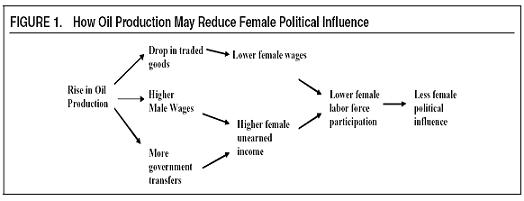
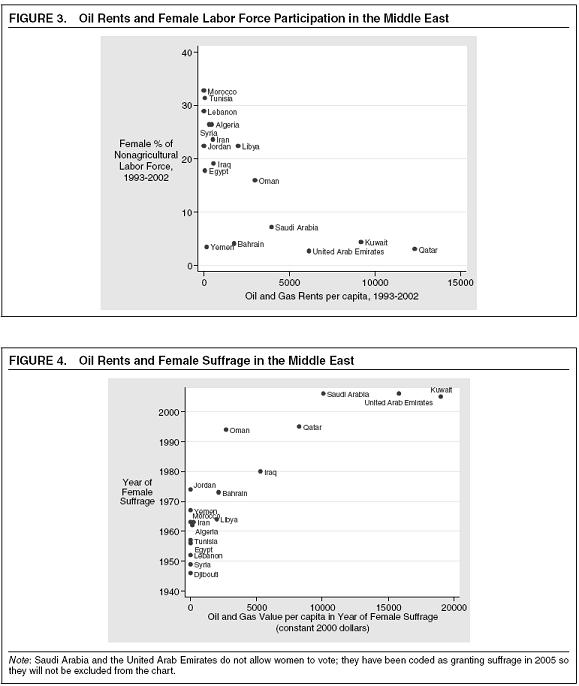
There is a new article [paywall] in the most recent issue of the American Political Science Review written by Michael L. Ross entitled “Oil, Women, and Islam.” Ross has written a lot about the nexus between resources and regime type, the so-called “resource curse” phenomenon. In this article, Ross argues that the well-known empirial link between lack of women’s rights and Islam washes away once controls related to oil production are incorporated into statistical models. (Note that the analysis is restricted to the Middle East.)

Here is the abstract and a couple of his charts:

Women have made less progress toward gender equality in the Middle East than in any other region. Many observers claim this is due to the region’s Islamic traditions. I suggest that oil, not Islam, is at fault; and that oil production also explains why women lag behind in many other countries. Oil production reduces the number of women in the labor force, which in turn reduces their political influence. As a result, oil-producing states are left with atypically strong patriarchal norms, laws, and political institutions. I support this argument with global data on oil production, female work patterns, and female political representation, and by comparing oil-rich Algeria to oil-poor Morocco and Tunisia. This argument has implications for the study of the Middle East, Islamic culture, and the resource curse.

ross_oil_women_1.jpg

ross_oil_women_2.jpg

The Political Economy of Assassination

Today in intro to IR, we discussed the role of individuals in international politics.  On Friday, we’ll look at the policy debate on page 152 of Mingst, where the debate question is “Should ‘bad’ or ‘corrupt’ leaders be forcibly removed by the international community?  Mingst provides arguments for and against.  What about not only removing them, but having them assassinated?  Two economists–Ben Olken and Ben Jones–have decided to take a look at the link between assassinations and other factors such as democratization and economic growth.  What have they found?

Olken wonders whether economic devel­opment and the path to democratization are shaped more by broad historical forces or by the actions of specific leaders—be they demo­cratically elected prime ministers or thuggish authoritarians…

…In “Hit or Miss? The Effect of Assassinations on Institutions and War,” Olken and Jones looked at the effects of political assassination, using a strict empirical methodology that takes into account economic conditions at the time of the killing and what Olken calls a “novel data set” of assas­sination attempts, successful and unsuccessful, between 1875 and 2004.

Olken and Jones discovered that a country was “more likely to see democratization follow­ing the assassination of an autocratic leader,” but found no substantial “effect following assassinations—or assassination attempts—on democratic leaders.” They concluded that “on average, successful assassinations of autocrats produce sustained moves toward democracy.”

…In “Do Leaders Matter? National Leadership and Growth since World War II,” Olken and Jones explored whether “individual political leaders make a difference in economic growth.” This is tricky business for the researcher because, as Olken explains, a country’s economic situa­tion can affect the election of a leader: when the economic outlook is good, for instance, presi­dents are more likely to be reelected. [This is the problem of endogeneity–JD] So Olken and Jones looked at 57 leaders who died in office from accidents or natural causes and “found big changes in growth when autocratic leaders die in office—both positive and negative,” but no sub­stantial change when democratic leaders died in office. “The results suggest,” they write, “that individual leaders can play crucial roles in shap­ing the growth of nations,” provided they are ruling with minimal or nonexistent checks and balances to their power (think Augusto Pinochet or Robert Mugabe).


Map of Economic Freedom

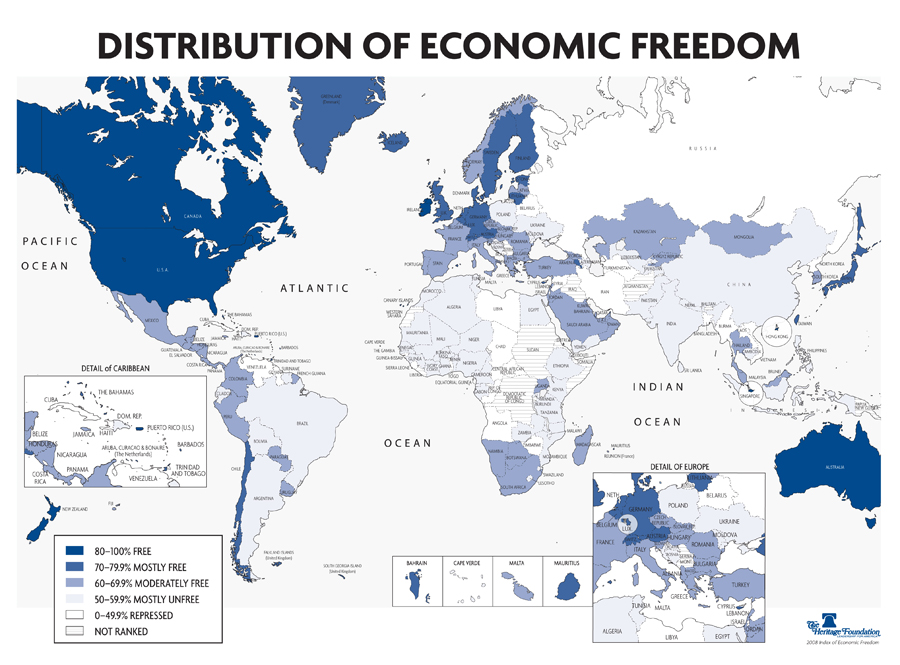
We’ll be comparing countries today based on their respective approaches to political economy; that is, on how the economic systems apportion the relative influences of the market, state, and civil society sector in the economy. Often, work on political economy tends to focus on the state/market nexus at the expense of civil society. We saw earlier in the course (Alesina and Guiliano) that attitudes and ideologies in the civil society sector can have a dramatic impact on economic patterns within society.

At the end of the lecture today, we’ll look at trends in economic liberalization worldwide over the last decade or so by means of a report from the US Federal Reserve Bank of Dallas, and this map from the Heritage Foundation annual report on economic freedom around the world.

(The darker the color, the more economically free is that country’s economy.)

index2008_econfreedommap.jpg

Design a site like this with WordPress.com
Get started