PLSC240–Next Blog Assignment

Hello student-bloggers:

Your next blog post will be due on Friday, February 15th at 6:00pm.

The prompt for your post is “The rational choice/political culture debate and [my topic].” Once again, I will emphasize that you have wide latitude to post, and anything will be acceptable as long as it is somehow related to the prompt above. In addition, please take note of the rubric I will be using to grade your blog.  Remember that I will give you a provisional grade as of the mid-term break (this grade will not be factored into your final grade; it is meant to give you an idea of what your blog grade would be at the end of the semester if the character/quality of your posts were to remain the same until the end of the semester).  You can find the rubric in the Assignments folder of Blackboard.

Best of luck,

J.

Challenges to Rational Choice Theory

The fundemental assumption regarding human behavior, upon which the whole edifice of rational choice theory (RCT) rests is that human beings are rational; specifically, it means that they act in order to maximize their self-interest by “maximizing expected utility”. The construction above takes into account our preferences (utility) and the fact that the link between our actions and outcomes are rarely certain, but that we are able to adequately estimate (beliefs) the likelihood of achieving a specific goal given an accompanying action.

In the example of Lebron James I posted earlier, he has a generally good idea of his preferences (he prefers–other things equal–to hit a 3-pointer over a field goal or a free throw) and his beliefs (he knows his stats regarding his 3-point shooting percentage, his field goal, and free throw percentages as well). Given his beliefs and preferences, Lebron can easily act–and generally does–in an instrumentally rational manner.

How valid, though, is the assumption that human beings do act in an instrumentally rational manner? In other words, do individuals always maximize their expected utility? The short answer is no. Some political scientists believe that political culture often acts to mitigate instrumentally rational behavior. [We’ll discuss this in class on Tuesday.] Whole sub-disciplines in behavioral psychology and behavioral economics can point to copious amounts of research data demonstrating the lack of rationality in human beings, often in fairly simple situations. Michael Sherman asks “why people believe weird [i.e., irrational] things about money”:

Would you rather earn $50,000 a year while other people make $25,000, or would you rather earn $100,000 a year while other people get $250,000? Assume for the moment that prices of goods and services will stay the same.

Surprisingly — stunningly, in fact — research shows that the majority of people select the first option; they would rather make twice as much as others even if that meant earning half as much as they could otherwise have. How irrational is that?

Continue reading “Challenges to Rational Choice Theory”

Reading Questions on Political Culture

Here are questions for the three assigned readings. (Note that I have uploaded a video on Blackboard that explains how to interpret the numerical results from regression analysis.)

Please come to class prepared to answer the following questions:

General Questions

After having read the three required articles, what is your assessment of the concept political culture? Is there evidence that national political cultures exist? Do you have reason to believe that political culture is a concept that can be adequately defined? Can we use the concept political culture to account for cross-national patterns in various political phenomena? How does each of the
authors use the concept political culture and what is their assessment of its utility as an explanatory mechanism in comparative politics?

Inglehart, Ronald–“The Renaissance of Political Culture”

  • What is the significance of Figure 1 n p. 1206?
  • Is there a correlation between life satisfaction and level of economic development [see Figure 2]? Explain.
  • Why does Inglehart analyze the phenomena i) life satisfaction, and ii) interpersonal trust?
  • What is the logic underlying the relationship between culture and economic development as outlined in Weber’s “the Protestant Ethic?”
  • The relative growth rates of Protestant as against non-Protestant countries in the 1970s and 1980s seems to undermine Weber’s “Protestant ethnic” argument. How does Inglehart reconcile the argument with the empirical evidence?
  • What is post-materialism and what is the relationship bebetween post-materialist values and economic growth?

Continue reading “Reading Questions on Political Culture”

Do national cultures exist? Do supra-national cultures exist?

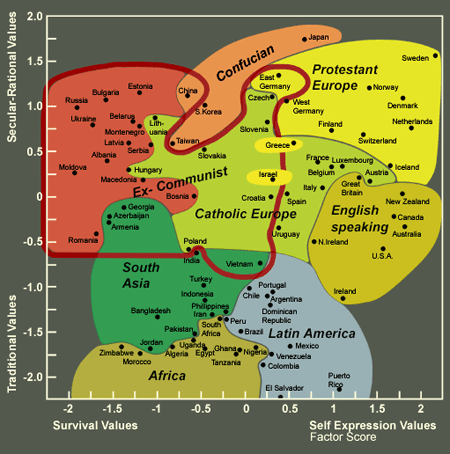
Here is a map from Ronald Inglehart’s World Values Survey organization web site. The site allows users to analyze data collected by the World Values Survey in dozens of countries around the world. We are reading Inglehart’s The Renaissance of Political Culture this week and will analyze the importance of political culture for understanding political outcomes, such as democracy and economic development. Are some cultures more compatible with democracy and economic growth than others? Is culture a more compelling framework for testing political phenomena than is rational choice?

Inglehart-Welzel Cultural Map of the World

This map reflects the fact that a large number of basic values are closely correlated; they can be depicted in just major two dimensions of cross-cultural variation

inglehart_weltzel_value_map.gif

Comparative Welfare States in Advanced Industrial Economies

In a couple of weeks, we–in PLSC240–will address the topic of political economy.  We’ll compare states around the world with respect to institutions such as tax regimes, openness of borders to goods and services imported from abroad, and also with respect to welfare state spending.  Andrew Gelman has posted on his blog a review–which will be published in Political Science Quarterly–of a new book by Clem Brooks and Jeff Manza, titled Why Welfare States Persist.  Not surprisingly, the answer is that they are publicly popular.  What is more interesting, though, is why the size of the welfare state differs amongst countries with relatively similar income levels.  Can you can think a cultural explanation?  Institutional?  Rational Choice?

Rich capitalist democracies around the world differ widely in their welfare states—their systems of government-provided social support–despite having comparable income levels. Brooks and Manza report that welfare state spending constituted 27% of GDP in “social democratic countries” such as Sweden and 26% of GDP in “Christian democratic countries” such as Germany, but only 17% in “liberal democracies” such as the United States and Japan. These differences are correlated with differences in income inequality and poverty rates between countries.

In their book, Brooks and Manza study how countries with different levels of the welfare state differ in their average policy preferences, as measured by a cross-national survey that asks whether respondents think the government should (a) provide a job to everyone who wants one, and (b) reduce income differences between rich and poor. Brooks and Manza find that countries where government jobs policies and redistribution are more popular are the places where the welfare state is larger, and this pattern remains after controlling for time trends, per-capita GDP of the country, immigration, women’s labor force participation, political institutions, and whether the ruling party is religious or on the left.

Next week, you will have a chance to test this hypothesis when we comparatively analyze public opinion attitudes around the world using the World Values Survey.   Is this relationship real?  Does it apply to states that are not advanced industrial economies?  We’ll find out next week.

South Carolina Democratic Primary, Institutional Legacies, and Generational Change

In class on Thursday, I defined institutions and described some of their major characteristics, the most important of which is that an institution endures, sometimes despite the significant impetus for change driven by changing political, social, economic, and technological sources. Last night’s Democratic primary exit polls in South Carolina provide a glimpse into the institution known as the Democratic primary and how that institution has endured over time. Here is a portion of the exit polls from CNN:

sc_primary_exit_polls1.jpg

Notice the three red boxes, which confirm that Obama was able to win a landslide victory in South Carolina despite receiving only 15% of the 60-and-older non-black vote. So what, you may respond, a pattern has emerged showing Obama captures much more support from the under-30 crowd than the over-60 cohort. But if you look at the over-60 black vote, you’ll see that they voted overwhelmingly in favor of Obama. The complete story here is the institutional legacy of the Democratic party in the South and the impact of generational change on the nature of the party. When we cover political attitudes and ideologies in about two weeks time, we’ll read Ronald Inglehart’s work, in which he highlights the importance of inter-generational changes in attitudes brought about by exposure to epoch-changing events. Lyndon Johnson’s signature on the Civil Rights Act in 1964 was just such an event.

Modeling Social Processes–Abortion in Cross-national Comparison

Thanks to a post by Zoe and Geoff, I decided to use the social fact of variation in abortion rates from country to country as the inspiration for class discussion today on the modeling process in social sciences. First, the data* (listing only the top and bottom 10–the US is 30th (out of 90 countries with data available) with a rate of 23.9% in 2003):

Country

Year

%

Russia

2005

52.5

Greenland

2004

50.2

Bosnia and Herzegovina

1988

48.9

Estonia

2004

47.4

Romania

2004

46.9

Belarus

2004

44.6

Hungary

2004

42.0

Guadeloupe

2005

41.4

Ukraine

2004

40.4

Bulgaria

2004

40.3

Suriname

1994

3.0

Puerto Rico

2001

2.2

Malta

2004

1.7

Qatar

2004

1.3

Portugal

2005

0.8

Venezuela

1968

0.8

Mexico

2003

0.2

Poland

2004

0.06

Panama

2000

0.02

Chile

1991

0.02

Now, according to Lave and March, the next step in the model-building process is to consider a social process that would lead to this outcome. There were three potential answers given in class, which correspond to three categories of explanation that we will address throughout the course:

1) Cultural–it would seem that religion is very important to individuals in the countries with the lowest rates. Most of these countries are strongly Catholic and the Church’s official policies are strongly anti-abortion (pro-life). Thus, individuals in these societies are inculcated with a strong view of what to do in the case of an unwanted pregnancy.

2) Rational Choice–one of the groups argued that the decision to abort (or not) a fetus was made on the basis of strategic calculations of self-interest. The countries at the bottom, these students argued, were agricultural and poorer, and children are needed as a source of labor for the household, as a future hedge against retirement for parents who live in societies with a poorly developed social welfare state, with little hope of receiving retirement funds from the government.

3) Institutional–rules, laws, regulations. Some students argued that some countries (like Chile) have laws making abortion illegal, thus either lowering the number overall, or decreasing the incentive for those having illegal abortions to report them to the official authorities.

That was great work; give yourselves a pat on the back or a round of applause.

The third step in the modeling process is, then, to tease out further implications of your preferred hypothesis above. Let’s go back to the cultural explanation. If it’s true that the Catholic Church has a tremendous impact on people’s views of what is right and wrong then, as one student asked, “wouldn’t it also be the case that divorce levels in these countries should be lower than divorce levels in the countries at the top of the list (since the Catholic Church also frowns upon divorce) ?

Continue reading “Modeling Social Processes–Abortion in Cross-national Comparison”

Transparency International Corruption Perceptions Index for 2007

Economists, political scientists and practitioners have long been aware of the deleterious effects of corruption. Transparency International, an international NGO, has been playing a lead role since its inception in 1993 in the fight to highlight the problem of corruption and in creating a forceful international anti-corruption movement. What is corruption?

Corruption is the abuse of entrusted power for private gain. It hurts everyone whose life, livelihood or happiness depends on the integrity of people in a position of authority.

What are some of the effects of corruption, but obvious and hidden?

Corruption hurts everyone, and it harms the poor the most. Sometimes its devastating impact is obvious:

* A father who must do without shoes because his meagre wages are used to pay a bribe to get his child into a supposedly free school.

* The unsuspecting sick person who buys useless counterfeit drugs, putting their health in grave danger.

* A small shop owner whose weekly bribe to the local inspector cuts severely into his modest earnings.

* The family trapped for generations in poverty because a corrupt and autocratic leadership has systematically siphoned off a nation’s riches.

Other times corruption’s impact is less visible:

* The prosperous multinational corporation that secured a contract by buying an unfair advantage in a competitive market through illegal kickbacks to corrupt government officials, at the expense of the honest companies who didn’t.

* Post-disaster donations provided by compassionate people, directly or through their governments, that never reach the victims, callously diverted instead into the bank accounts of criminals.

* The faulty buildings, built to lower safety standards because a bribe passed under the table in the construction process that collapse in an earthquake or hurricane.

Corruption has dire global consequences, trapping millions in poverty and misery and breeding social, economic and political unrest.

Corruption is both a cause of poverty, and a barrier to overcoming it. It is one of the most serious obstacles to reducing poverty.

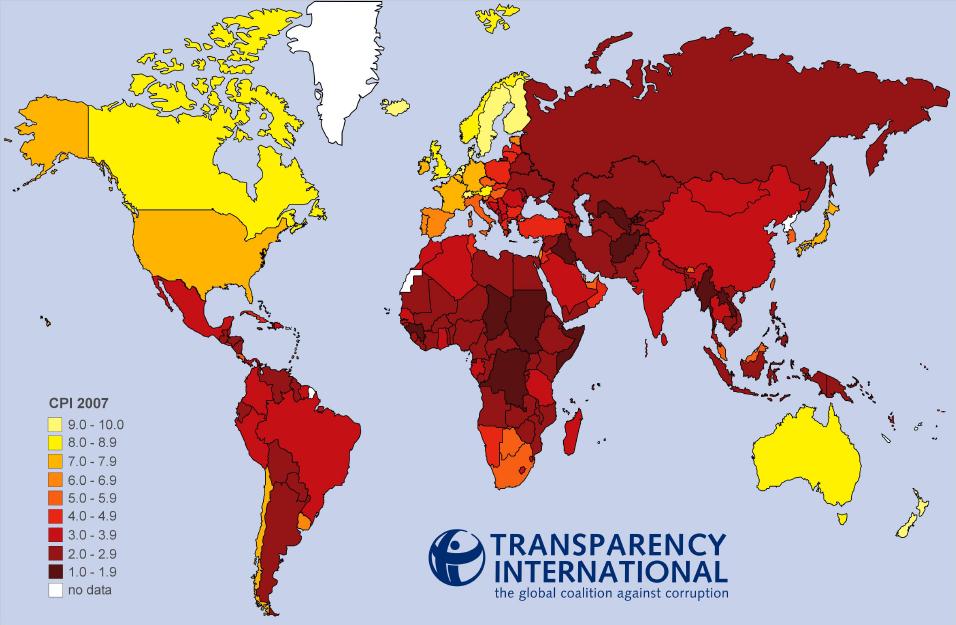
Here is a chart comparing corruption levels around the world in 2007. The higher the cpi score, the higher the level of perceived corruption.

transparency_corruption_world_map_2007.jpg

Islam, Religious Attitudes, and Democracy

There is a lot of ink being spilled on the question of the compatibility of Islam with democracy. Here is a link to a paper by Mark Tessler, published in the journal, Comparative Politics, in 2002.

“Islam and Democracy in the Middle East: The Impact of Religious Orientations on Attitudes Toward Democracy in Four Arab Countries,” Comparative Politics, Vol. 34 (April 2002): 337-354.

If you are on campus, here is a direct link to a pdf version of the article.

From the Abstract:

Continue reading “Islam, Religious Attitudes, and Democracy”

Political Culture and Economic Outcomes

What kind of an impact does political culture have on political and economic outcomes and are there systematic differences across countries? In this new paper, Alberto Alesina and Paola Guiliano use data culled from the World Value Survey to demonstrate an effect between the strength of family ties (which they argue are different across cultures) and economic outcomes.

Here is the abstract and a link to the paper:

We study the importance of culture, as measured by the strenght of family ties, on economic ehavior and attitudes. We define our measure of family ties using individual responses from he World Value Survey regarding the role of the family and the love and respect that children eed to have for their parents for over 70 countries. We show that strong family ties imply more reliance on the family as an economic unit which provides goods and services and less on the market and on the government for social insurance. With strong family ties home production is higher, labor force participation of women and youngsters, and geographical mobility, lower. Families are larger (higher fertility and higher family size) with strong family ties, which is consistent with the idea of the family as an important economic unit. We present evidence in cross country regressions. To assess causality we look at the behavior of second generation immigrants in the US and we employ a variable based on the grammatical rule of pronoun drop as an instrument for family ties. Our results overall indicate a significant influence of the strength of family ties on economic outcomes.

You hopefully remember the graphic of the tripartite division of society that was shown in class last week. The family, as we mentioned, is one of the fundamental institutions of civil society and the level of involvement of the family in economic decisions and economic output varies greatly across countries. As Alesian and Guiliano observe:

Stronger family ties are associated with lower labour force participation, especially that of youngsters who stay at home longer, and that of women who have traditional roles in these societies as “guardians” of the household, fostering and protecting family ties. Thus stronger family ties mean more is produced at home and less in the market. Since official statistics only take market-production into account, countries with larger home production may have a downward bias in their measure of per capita GDP. This may also suggest that it is NOT the lack of child and care facilities that make women stay at home (an argument that one always hear as a self-evident truth, for instance in Italy), but it may be – right or wrong – the result of a family choice.

Design a site like this with WordPress.com
Get started