Lecture on German Political Parties April 17th

Talk about serendipity!  We will finish our mock German election and government formation simulation on Tuesday, April 15th and two days later there will be a guest lecture on campus by Dieter Dettke, Visiting Scholar at the American Institute for Contemporary German Studies and Adjunct Professor at Georgetown University, Security Studies Program.  on “Is Germany Moving to the Left?  The Changing German Party System.

You can find below a copy of the flyer announcing the lecture, which will begin at 5:30 at the Gottwald Science Center Auditorium.  I’ll see you there.

The Richmond Eric M. Warburg Chapter

of the American Council on Germany

cordially invites you to a

Discussion and Reception

with

Dr. Dieter Dettke

Visiting Scholar at the American Institute for Contemporary German Studies and

Adjunct Professor at Georgetown University, Security Studies Program

on

“Is Germany Moving to the Left?

The Changing German Party System"

Thursday, April 17, 2008

5:30 – 6:45 pm

at

The University of Richmond, Gottwald Science Center Auditorium

Directions: If coming from Three Chopt Road, turn onto Boatwright Drive and continue straight ahead at the welcoming wall at the bottom of the winding hill (do not turn left for the main campus gate). After passing the Robins Center on your left and a large parking lot on your right, proceed for another 300 yards on College Road to the Westhampton entrance on your left. (If coming from River Road, turn onto College Road and turn right into the Westhampton entrance.) Continue on Keller Road to the Modlin Center and pass through the archway. Opposite the stop sign are parking spaces in front of the Westhampton Deanery and even more spaces between it and the cafeteria and science center. The science center auditorium is in the Gottwald Science Center across from the cafeteria. (In case the above parking spaces are full,  there is a parking lot behind the Modlin Center which you can access by turning right at the stop sign or left if exiting the parking lot across from the stop sign.)

If you have any questions, please contact Dr. Arthur B. Gunlicks,

Dr. Dieter Dettke is currently a visiting scholar at the American Institute for Contemporary German Studies and Adjunct Professor at Georgetown University, Security Studies Program. He is working on a book on German foreign policy and transatlantic relations – with the working title “In Search of Normalcy: German Foreign and Security Policy Between Realpolitik and the Civilian Power Paradigm.” He has also been a fellow at both the Woodrow Wilson Center and the German Marshall Fund of the United States.

From 1985 to 2006 he served as US Representative and Executive Director of the Washington Office of the Friedrich Ebert Foundation – which is affiliated with Germany’s Social Democratic Party (SPD). Prior to his work with the Ebert Foundation, Dr. Dettke was Political Counsellor of the SPD Parliamentary Group of the German Bundestag (1974 – 1984) and Staff Director of the Working Group on US-German relations. In this capacity, he coordinated all foreign, security and defence policy related issues on the agenda of the German Bundestag and the Committees for Foreign Affairs, Defence, German-German relations, Development Policy and European Affairs.

He has lectured frequently in Europe and the United States on transatlantic relations, German-American security issues and European-American economic relations. He has also presented papers, acted as a discussant and/or chair at U.S. and international conferences of the American Political Science Association, the International Studies Association, the German Studies Association and the American Association of Slavic Studies. In addition, Dr. Dettke testified in Congress on the implications of German unification for the United States and US-European relations.

Dr. Dettke has appeared on the News Hour with Jim Lehrer, C-SPAN, Voice of America as well as other American, German, Swiss, and British television and radio programs to discuss issues and developments related to domestic and foreign policy developments in Europe and the United States. Dr. Dettke studied political science and law at the universities of Bonn and Berlin (Germany) and Strasbourg (France). He was a Fulbright Scholar at the University of Washington in Seattle (1967/68).

Rice Prices Surge 30% in one Day

I think I’ll start eating more quinoa.

The Financial Times reports that “fears of unrest rise across Asia as rice price surges 30% in a day.”  In a BBC interview, the director of the International Rice Research Institute (IRRI–don’t tell me you didn’t know one existed) bluntly states why this could be a major problem.

“Rice is the staple food for about half the world’s population, and over half the world’s poor.”

As the FT reports, many events has transpired to cause such a dramatic, sudden rise in the price of this extremely important food staple and the potential political effects.

Rice prices jumped 30 per cent to a record high yesterday, raising fears of fresh outbreaks of social unrest across Asia, where the grain is a staple food for more than 2.5bn people.

The increase came after Egypt, a leading exporter, imposed a formal ban on selling rice abroad to keep local prices down and the Philippines announced plans for a major purchase of the grain in the international market to boost supplies.

Global rice stocks are at their lowest since 1976. While prices of wheat, corn and other agricultural commodities have surged since late 2006, the rice prices increase started in January.

The Egyptian export ban formalises a previous poorly enforced curb and follows similar restrictions imposed by Vietnam and India, the world’s second and third-largest exporters.

Cambodia, a small seller, also announced an export ban.

These foreign sales restrictions have removed about a third of the rice traded in the international market.

Chookiat Ophaswongse, president of the Thai Rice Exporters Association, said: “I have no idea how importing countries will get rice.” He forecast prices would rise further.

Here is the BBC interview with the head of the IRRI:

President Bush wins European Approval for Missile Defense Shield

Yesterday in intro to IR we discussed the morality of former US President Ronald Reagan’s Strategic Defense Initiative (SDI) from a moral standpoint.  We debated the morality of replacing the theretofore existing principle of Nuclear Deterrence for a missile defense shield meant to destroy launched nuclear weapons, thereby making nuclear weapons essentially useless.  Some quarter of a century later, the New York Times reports that President Bush has won acquiescence from some European allies for his version of a missile defense shield that would cover the European continent.

bush_europe_missile_shield.jpgBUCHAREST, Romania — NATO leaders agreed Thursday to endorse a United States missile defense system based in Europe and to provide more troops for Afghanistan, but they declined, as expected, to back President Bush’s proposal to bring Ukraine and Georgia closer to NATO membership…

“There has been, over 10 years, a real debate as to whether there is a ballistic missile threat,” said Mr. Bush’s national security adviser, Stephen J. Hadley. “And I think that debate ended today.”

The Russian president, Vladimir V. Putin, has objected repeatedly to building parts of the missile defense system in former Soviet bloc states, despite Washington’s assurances that the system is a response to threats from Iran, not from Russia. Mr. Putin, saying the system would fuel a new arms race, has even threatened toaim Russian missiles at the system, while also offering the use of a substitute system in Azerbaijan.

NATO’s final statement invited Russia to cooperate with the United States and Europe on developing defenses jointly.

Konstantin Kosachev, chairman of the international affairs committee of the Russian Parliament, said that missile defense would be high on the agenda for the meeting between Mr. Putin and Mr. Bush in Sochi, a Russian resort, scheduled after the NATO conference, which Mr. Putin is to attend Friday.


UN Peacekeeping Mission in Darfur Failing?

A couple of weeks ago we watched the National Film Board of Canada documentary film, The Peacekeepers, in introduction to IR.   It was a fascinating behind-the-scenes look at the enterprise of UN peacekeeping operations, demonstrating the successes and failures of the UN in attempting to create and keep the pace amongst Congo’s warring factions.  We saw the clash between realist views of international sovereignty, security, and power and the liberal ideal of multinational cooperation.  The New York Times reports today on the potential failure of a relatively new UN peacekeeping operation before it has even started.  Those who have been following the atrocities in the Darfur region of Sudan know that it has taken four years to get a UN peacekeeping force on the ground.  It may already be doomed to failure.  It is uncanny how much of this report sounds like it was taken directly from the documentary about Sudan.

un_darfur.jpg ABU SUROUJ, Sudan — As Darfur smolders in the aftermath of a new government offensive, a long-sought peacekeeping force, expected to be the world’s largest, is in danger of failing even as it begins its mission because of bureaucratic delays, stonewalling by Sudan’s government and reluctance from troop-contributing countries to send peacekeeping forces into an active conflict.

The force, a joint mission of the African Union and the United Nations, officially took over from an overstretched and exhausted African Union force in Darfur on Jan. 1. It now has just over 9,000 of an expected 26,000 soldiers and police officers and will not fully deploy until the end of the year, United Nations officials said.

Even the troops that are in place, the old African Union force and two new battalions, lack essential equipment, like sufficient armored personnel carriers and helicopters, to carry out even the most rudimentary of peacekeeping tasks. Some even had to buy their own paint to turn their green helmets United Nations blue, peacekeepers here said.

The peacekeepers’ work is more essential than ever. At least 30,000 people were displaced last month as the government and its allied militias fought to retake territory held by rebel groups fighting in the region, according to United Nations human rights officials.

U.N. Security Council Silent on Tibet Protests

How do changing ideas about sovereignty–from sovereignty viewed as a “right” to sovereignty viewed as a “responsibilty”–affect the nature of how states act and the functioning of organizations such as the United Nations?  Just before spring break we viewed the documentary The Peacekeepers, where you were able to witness the deliberations that take place behind the scenes at the United Nations and the Security Council specifically. For Wednesday, we’ll read Erik Voeten’s article on “The Political Origins of the UN Security Council’s Ability to Legitimize the Use of Force”, the main point of which is obvious given the title. Today, the Guardian reports that the Security Council remains silent on the current situation in Tibet.

UNITED NATIONS, March 17 (Reuters) – The U.N. Security Council will likely keep silent about China’s crackdown on demonstrations in Tibet, mostly due to belief that provoking Beijing would accomplish nothing, diplomats said on Monday.
China, which has sent in troops to enforce control in the regional capital Lhasa, said earlier that the violent protests by Tibetans were organized by followers of the Dalai Lama seeking to derail the Beijing Olympics in August. Tibet’s exiled spiritual leader has denied this charge.
“The issue did not come up in the council,” China’s Deputy permanent U.N. representative Liu Zhenmin told Reuters after a meeting of the council on unrelated issues. “This has nothing to do with peace and security,” he said. “It is local violence, … a domestic issue.”
China, like the United States, Britain, France and Russia, is a permanent veto-wielding member of the council and would be able to block any attempts by the council to act on Tibet.
Russia’s U.N. Ambassador Vitaly Churkin, currently president of the council, told reporters without elaborating that he did not expect the 15-nation Security Council to discuss Tibet. Several other ambassadors confirmed this view.

Woodrow Wilson at the White House

Here is some fascinating (silent) footage of Woodrow Wilson at the White House, no doubt thinking about his Fourteen Points.  I think he’s on the phone to Clemenceau debating the merits of Point Nine.  It’s interesting how many of the points refer to the establishment of new nation-states (getting nations congruent with borders) and/or adjusting borders to more adequately cohere with notions of justice.

Book Review: “Justice in Conflict? The ICC and Peace Processes”,

icc.jpgWe will be analyzing international law next week upon our return from spring break. The recently established International Criminal Court (ICC), an independent (i.e., it has no linkn to the United Nations, unlike the International Court of Justice–ICJ) international court located in the Hague, has in its short existence (it came into force in 2002) been the subject of heated debate between those who view it as a bold and necessary step in the fight for international justice, and those who view its powers as undermining to a dangerous degree state sovereignty.

This week’s weekly letter from the International Crisis Group (ICG) contains a book review of Nicholas Waddell and Phil Clark’s “Justice in Conflict: The ICC and Peace Processes. The author of the review, Nicholas Gronko, writes:

The International Criminal Court (ICC) is now investigating or prosecuting individuals involved in three of the most devastating conflicts in Africa – Darfur, northern Uganda and the Democratic Republic of Congo (DRC). In each case, the ICC has been forced to confront the challenges inherent in pursuing peace and justice simultaneously. What happens – and what should happen – when efforts to prosecute perpetrators of mass atrocities coincide with a peace process? What is the best approach when the price of a peace deal may be a degree of impunity for those most responsible for such abuses? One common and convenient response is to hide behind truisms and make general statements of principle to the effect that no trade-off is required because peace and justice are inextricably linked. Clearly peace and justice are complementary in that justice can deter abuses and can help make peace sustainable by addressing grievances non-violently. But good things don’t always go together, and to present peace and justice as invariably mutually reinforcing is misleading and unhelpful when the difficult reality of peacemaking often proves otherwise. We review below arguments surrounding the ICC’s impact on prospects for peace in Uganda and go on to offer some general considerations that international policymakers should heed when seeking to balance peace and justice demands.

Here is a look at the 106 (most recent count) signatories to the Statute of Rome (which established the ICC).  States in green are signatories to the statute.

iccmemberstates.png

The United Nations and Peacekeeping in Congo

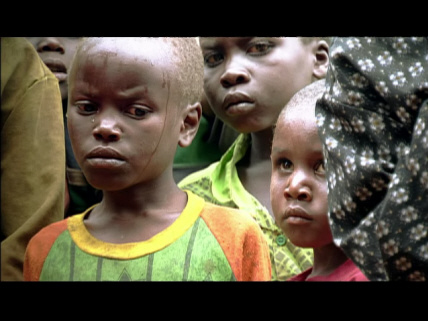
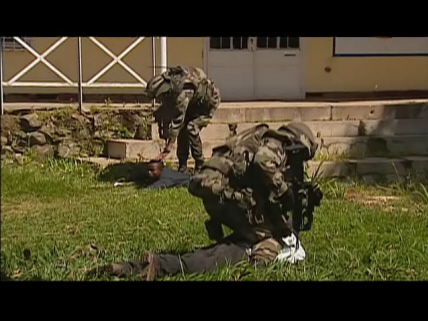
In PLSC250–intro to IR–this week we viewed a documentary made by the National Film Board of Canada, which addresses the UN’s peacekeeping role in Congo. After reading Chapter 7 of Mingst, you should now be aware that the UN in the world’s most important and powerful IGO, and the UN Security Council plays the most prominent global role in the area of international security. Here are a couple of screen shots from the film and the film’s description:

peacekeepers_1.jpg

peacekeepers_2.jpg

With unprecedented access to the United Nations Department of Peacekeeping, The Peacekeepers provides an intimate and dramatic portrait of the struggle to save “a failed state.” The film follows the determined and often desperate manoeuvres to avert another Rwandan disaster, this time in the Democratic Republic of Congo (the DRC).
Focusing on the UN mission, the film cuts back and forth between the United Nations headquarters in New York and events on the ground in the DRC. We are with the peacekeepers in the ‘Crisis Room’ as they balance the risk of loss of life on the ground with the enormous sums of money required from uncertain donor countries. We are with UN troops as the northeast Congo erupts and the future of the DRC, if not all of central Africa, hangs in the balance.
In the background, but often impinging on peacekeeping decisions, are the painful memory of Rwanda, the worsening crisis in Iraq, global terrorism and American hegemony in world affairs. As Secretary General Kofi Annan tells the General Assembly at the conclusion of The Peacekeepers: “History is a harsh judge. The world will not forgive us if we do nothing.” Whether the world’s peacekeeper did enough remains to be seen.

United Nations Security Council Imposes more Sanctions on Iran

In intro to IR, we’ll analyze the role of IGOs, NGOs, and international law in international politics.  Arguably the most important IGO is the United Nations Security Council (UNSC)  Today, the UNSC voted (14-0) to impose tougher sanctions against Iran as a result of that country’s continued pursuit of nuclear weapons.  From the New York Times:

unsc_iran_vote_03mar2008.jpg

UNITED NATIONS — The Security Council on Monday adopted its third resolution imposing sanctions on Iran for its refusal to cease enriching uranium, an activity that the West suspects Iran may be using to create fuel for a nuclear weapon.

 The previous two measures gained the unanimous support of the 15-member panel, but in balloting on Monday Indonesia abstained, saying it “remained to be convinced of the efficacy of adopting additional sanctions at this juncture.” Fourteen countries voted in favor.

The resolution authorizes inspections of cargo to and from Iran that is suspected of carrying prohibited equipment, tightens the monitoring of Iranian financial institutions and extends travel bans and asset freezes against persons and companies involved in the nuclear program.

It adds 13 names to the existing list of 5 individuals and 12 companies subject to travel and asset restrictions. The new names include people with direct responsibility for building fast-spinning centrifuges that enrich uranium ore and a brigadier general engaged in “efforts to get around the sanctions” in the two earlier resolutions.

Notice two things: first, the use of “targeted sanctions.”  Second, the story byline reads “United Nations”, not New York.  I wonder if this is standard practice for stories originating from the United Nations headquarters in New York.  Does anyone know?

Mapping the Future from CSIS

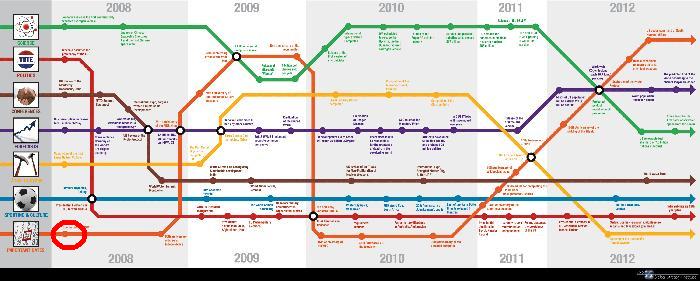
The Center for Strategic and International Studies has a fascinating new subway-style map, which interactively maps the global future on the basis of various themes–construction, sporting and culture, science, politics, etc. Each node of information on the interactive map is a hyperlink that takes the reader to a web page with detailed information about the topic.

Below is a much reduced version of the map.  If you click on the word map above, you’ll be taken to the large interactive version of the map. Click on the link (which I’ve indicated using the red circle) and you’ll be taken to a page where you’ll be told the following:

As a result of the internal reorganization of the U.S. military command structure, a new headquarters dedicated exclusively to Africa is expected to become fully operational in 2008. The United States Africa Command, or AFRICOM, will report to the Secretary of Defense on U.S. military relations with 53 African countries, with a focus on war prevention and capacity-building programs. The ultimate stated goal of the program is to enable “a more stable environment in which political and economic growth can take place.” For the fiscal year 2008, AFRICOM is expected to have a $75 billion budget. 

mapping_future2.jpg

h/t to V. Wang.

Design a site like this with WordPress.com
Get started