Is NAFTA good or bad for US Workers and the US Economy?

With Democratic Presidential candidates Hillary Clinton and Barack Obama tussling over the relative  merits of the North American Free Trade Agreement, this Boston Globe column, in which Canadian Trade Minister David Emerson is quoted, is useful as quick background reading.  NAFTA, signed by former President Bill Clinton and ratified by the US Congress in teh mid-1990s, sought to bring down trade barriers amongst the Mexican, Canadian, and United States’ economies.  A common lament amongst those in rust-belt states and along the Mexican border is that the agreement has sent millions of jobs formerly held by Americans to Canada and Mexico.  Emerson cautions us to be wary of this claim, parsing the logic:

I strongly believe that the growth in protectionist sentiment is somewhat misplaced and irrational. It’s people who are concerned about the loss of jobs over the last 10 years which largely — analytically — has been shown to be driven by technology,” he told reporters.

“To the degree that it’s the result of liberalized trade, it’s more to do with the Asian dynamos like China and India and Vietnam, and countries like that. It’s not NAFTA that is hurting the North American worker. It’s not,” Emerson said.

“In fact, NAFTA is probably the friend of the North American worker because it enables us to achieve a level of efficiency and competitiveness that helps us take on the real competitive threats.”

Emerson said he had urged his counterparts in Canada’s 10 provinces to stress this message in dealings with the governors of U.S. states and members of the U.S. Congress.

“When you recognize that 39 out of 50 states have Canada as their number one export market, you start to realize governors and congressmen at the local level have an awful lot at stake, and we need to make sure they understand that,” Emerson said.

“Premiers and provincial ministers are very good, they have lots of contacts. The federal government cannot do it all.”

Prime Minister Stephen Harper has expressed confidence that, despite the rhetoric, the North American Free Trade Agreement will not be reopened. Emerson was not quite as confident.

“We’ve all been hearing the comments of presidential candidates, of congressmen. Protectionist forces have been gathering steam for some years and they’re showing no signs of abating,” he said.

Globalization, the Catholic Church, and Classroom Pedagogy

A while back I had the opportunity to allow a job candidate to come in and use my intro to IR class to give a her candidate classroom lecture. Following the 40-minute lecture–after the candidate and the rest of the faculty had left the room–I asked my students to anonymously write down their impressions of the teaching style of the job candidate. One of the responses was particularly illuminated and the latest news about the Catholic Church’s efforts to reform the concept of sin reminded me of that student’s response. The student’s response was (and I’m paraphrasing here):

“I didn’t like that she went around the room and made everyone answer her introductory question. I pay $40,000 in tuition annually and I have the right to sit in the classroom and be bored and do nothing if that’s what I want to do.”

I felt sorry for this student, because s/he has forgotten a couple of important rules about life, let alone post-secondary education: first, you only get out of something what you put in. Second, and more important, the whole classroom experience is a social experience, and the outcome of the educational process is not only a function of what the student him/herself is doing, and what the instructor is doing, but what others in the classroom are doing as well.

Apropos of the preceding, here is news from the London Times online, which demonstrates the Catholic Church’s approach to the concept of sin:

seven_poster.jpg…[Bishop Gianfranco Girotti] said that priests must take account of “new sins which have appeared on the horizon of humanity as a corollary of the unstoppable process of globalisation”. Whereas sin in the past was thought of as being an invididual matter, it now had “social resonance”.

“You offend God not only by stealing, blaspheming or coveting your neighbour’s wife, but also by ruining the environment, carrying out morally debatable scientific experiments, or allowing genetic manipulations which alter DNA or compromise embryos,” he said.

Bishop Girotti said that mortal sins also included taking or dealing in drugs, and social injustice which caused poverty or “the excessive accumulation of wealth by a few”.

He said that two mortal sins which continued to preoccupy the Vatican were abortion, which offended “the dignity and rights of women”, and paedophilia, which had even infected the clergy itself and so had exposed the “human and institutional fragility of the Church”.

Maybe it’s time for Brad Pitt and Morgan Freeman to do a sequel to Seven. 🙂

The World Health Organization on Drug-Resistant From of Tuberculosis

The Vancouver Sun reports on the most recent announcement of the World Health Organization (WHO) regarding the dangerous multi-drug resistant strain of tuberculosis (MDR-TB) .

A report published Tuesday, Anti-Tuberculosis Drug Resistance in the World, is the largest survey to date on the scale of drug resistance in tuberculosis. It is based on information collected between 2002 and 2006 on 90,000 TB patients in 81 countries.

The organization [WHO] estimates there are nearly half a million new cases of multi-drug resistant TB every year.

“TB drug resistance needs a frontal assault. If countries and the international community fail to address it aggressively now we will lose this battle,” said WHO spokesman, Dr. Mario Raviglione. “In addition to specifically confronting drug-resistant TB and saving lives, programs worldwide must immediately improve their performance in diagnosing all TB cases rapidly and treating them until cured, which is the best way to prevent the development of drug resistance.”

The report also found that extensively drug-resistant tuberculosis (XDR-TB), a virtually untreatable form of the respiratory disease, has been recorded in 45 countries.

But the true scale of the problem, internationally, remains unknown. Only six countries in Africa – the region with the highest incidence of TB in the world – were unable to provide drug resistance data.

We’ll take a look at the global challenge posed by diseases such as TB in the last week of the semester.

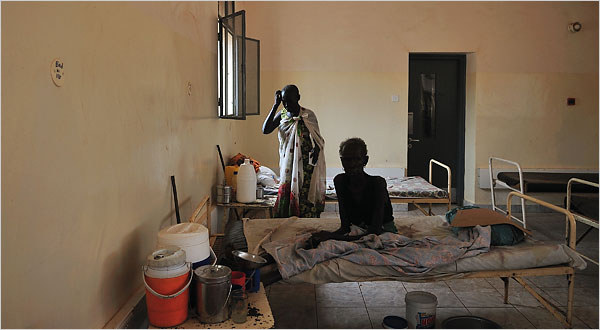
UPDATE: The New York Times also has this story on its front page, with a photograph of a TB clinic in Sudan.

tb_sudan.jpg

Human Trafficking–Katia’s Story

A confluence of events–globalization, technological and communications advances, and halting (or no) democratization–has led to an unprecedented rise in global human trafficking. States and governments have been unable to make a dent in this growing trade, where human beings are sold like cattle to be used as indentured servants and sex slaves. Here is a documentary about one such person, Katia from Ukraine, whose husband’s friend kidnapped and sold her in Turkey, whence she was moved to western Europe where she was forced into prostitution. (The documentary is in five parts. Here is part one.)

How do you Affect International Relations in your Daily Life?

In Mingst’s first chapter, she asks “How does international relations affect you in your daily life?” More potentially meaningful information may be garnered by turning that question over on its head: “how do you affect international relations in your daily life?” Are you thinking of buying a new cell phone? What will you do with your old one? You may want to think twice about your decision, as it could have an effect on people thousands of miles away.

…did you know that throwing your old cell phone in the garbage helps support civil war in central Africa, driving endangered gorillas closer to extinction in the process? A little explanation: A used cell phone’s value lies mainly in small amounts of minerals in its circuits — gold, nickel and especially tantalum, a high-melting-point metal sometimes referred to as coltan. Like something from a Clive Cussler thriller, tantalum is vital to manufacturing cell phones and many other electronic devices, but 80 percent of the world’s reserves are in the DRC (Democratic Republic of the Congo). There, it is mined under frequently appalling conditions and fought over during the DRC’s ongoing civil and international wars. Tantalum-mining revenues help fuel these wars, along with the associated destruction of human lives and gorilla habitat.

Tantalum and other minerals command a premium, so cell-phone manufacturers have turned to recycling because it’s easier (and more ethical) than dealing with warlords — or commodities brokers who buy from them. An entire tantalum-recycling economy has sprung up, and now accounts for 20 to 25 percent of manufacturing input per year.

In addition, cell phones and their electronic cousins may also contain potentially toxic compounds of lead and arsenic, so it behooves us to keep them from winding up in landfills and afterward, the water supply.

Here are some of the ways that you can keep your old phone’s minerals and plastics in circulation while easing your conscience about making calls using the equivalent of a conflict diamond.

Your next blog entry will be dedicated to documenting either how international relations affects you or how you affect international relations, or both.

Here is a compelling documentary.

Globalization, Migration and Music

What do you get when you combine a Bosnian lead singer, Croatian and Bulgarian guitarists, Japanese bass player, American drummer and violinist, move them all to the Pacific Northwest of the United States? The answer is “Kultur Shock”, whose “gypsy-punk” fusion can inspire even the most jaded of Political Science professors. From the Seattle Post-Intelligencer:

WHAT: Multinational Seattle rock band featuring Srdjan “Gino” Yevdjevich (lead vocals, percussion), Mario Butkovic (guitar, vocals), Masa Kobayashi (bass, vocals), Val Kiossovski (guitar, vocals), Chris Stromquist (drums, vocals) and Matty Noble (violin)

SOUND: The band describes its incendiary music as “Balkan punk-rock/Gypsy-metal/wedding-meets-riot music from Bulgaria, Bosnia, Croatia, Japan and the United States. We have six members, and no two of us really speak the same language.”

QUOTE: “Right now we are stuck between two worlds. One we left (that of our homelands), but we did not become a part of the other world, the hip rock-star world,” the band says on its Web site. “We had to work for our living like all the other immigrants, and working means sweat, sweat means stinky — not cool. What we’ve worked so hard to build over these 10 years is this ‘monster’ we play on stage. And we dare you to try and stop us, because we’re not going to stop ourselves.”

Here’s a sample of their sound:

Croatia: A Human Trafficking Victim Speaks With RFE/RL

The extent of human trafficking, for prostitution mainly, but also for indentured servitude has increased dramatically since the collapse of communism in eastern Europe. A more interdependent and globalized world leads to opportunities for many, but also to horror and destitution for an increasing number of the world’s most vulnerable. Here is an account of a Croatian victim from Radio Free Europe/Radio Liberty (RFE/RL–an excellent website for information on the former communist world, the Middle East, and parts of western Asia).

ZAGREB, June 15, 2006 (RFE/RL) — Trafficking in women for the purpose of sexual exploitation is becoming increasingly widespread in countries undergoing transition. Many young women seeking better jobs and better lives find themselves against their will in secret brothels of Western countries. Such is the warning of nongovernmental women’s unions in Croatia, where 45 victims of trafficking have been identified in the last four years. Unofficial numbers are many times greater.

“It happened abroad,” says Martina, a 29-year-old trafficking victim from Zagreb. “I was sold for 3,500 euros [$4,400]. I was beaten, raped, forced against my will. They would put out cigarette butts on me and cut me with razors.

It was like a horror movie, she says. Martina was 19 years old at that time, trained as a cook. She lived in the suburbs of Zagreb and desired a better job and a better life. She met a young man who told her about his brother who had a restaurant in Italy, but who had a hard time finding good employees.

‘It Sounded Rather Convincing’

“He told me that if I really wanted to work I could come with him, but that if I did not intend to pursue work there I could be back in Croatia in three days,” Martina said. “It sounded rather convincing. Given that my life had been miserable since I was born — my father was an alcoholic and my mother ill — I went there without a second thought.”

“As soon as I arrived and as soon as he brought me to his apartment, everything started. He told me there was no work and that I had crossed the border in order to work as a prostitute, that he had paid a ton of money for me and that he will come for me in three days, and that I had to be ready by then,” she continued. “I told him to get his mother ready instead, and then he hit me on the head with his fist. Since we were in the kitchen I turned around and struck him with a pot. Naturally, I was no match for him physically. He beat and raped me constantly for three days, to the point where I was lying in blood and urine while tied to a bed. He then brought two of his friends who raped me, put out cigarette butts on me, and cut me with razors.”

Martina was locked in a Rome apartment for two months. Instead of working in a restaurant, she was beaten and raped daily until she was “broken” and had become a sexual slave. Then, she says, the man who bought her took her out to the street.

Four Passports

“That man was from Bosnia,” she said. “We found in his apartment four passports and another girl from Croatia who was also a mother of three. That was a complete horror. They beat me endlessly. A girl of 16 from Albania almost bled to death in my arms because they had pushed a car antenna into her vagina. A girl from Bosnia was found dead. That is when I completely broke down.”

Two prostitutes appearing in a World Cup-related advertisement in Halle, Germany (epa)She said she had been completely dulled, as if separated from her own body. Even when there was a chance of escape she remained a prostitute.

“There was no way for me to be freed from what had happened to me,” Martina said. “I endured this for six years. I went to the street with prostitutes, not in order to work, but to see the people who come to them and who force them to do this. Then I would throw a bottle of gasoline on their car or puncture their tires. I didn’t care what would happen. I did one or three customers — I didn’t care. I didn’t look at those people.”

Martina was a typical, vulnerable young woman without steady employment or family support. Nobody wondered about her disappearance. After all, even her own father beat her from a very young age. Sadly, that experience prepared her for what she endured in Rome.

Globalization, Economic Development and Indentured Servitude

We will be addressing the topic of globalization later in the semester and will be viewing this video on the use of what amounts to slave labor in the silk industry in India.

I found this on the Human Trafficking and Modern-day Slavery website.

Human Trafficking Website 2007-2008. Country by country reports of human trafficking, modern day slavery, contemporary slavery, debt bondage, serfdom, forced labor, forced marriage, transferring of wives, inheritance of wives, and transfer of a child for purposes of exploitation.

Globalization and Collective Action

Deborah Yasher wrote an interesting article on the link between globalization and collective action. If you are on campus, here is a link to a pdf version of the article. A well-known phenomenon in the field of social movements and collective is the so-called “free-rider problem”. From the Stanford Encyclopedia of Philosophy:

In many contexts, all of the individual members of a group can benefit from the efforts of each member and all can benefit substantially from collective action. For example, if each of us pollutes less by paying a bit extra for our cars, we all benefit from the reduction of harmful gases in the air we breathe and even in the reduced harm to the ozone layer that protects us against exposure to carcinogenic ultraviolet radiation (although those with fair skin benefit far more from the latter than do those with dark skin). If all of us or some subgroup of us prefer the state of affairs in which we each pay this bit over the state of affairs in which we do not, then the provision of cleaner air is a collective good for us. (If it costs more than it is worth to us, then its provision is not a collective good for us.)

Unfortunately, my polluting less does not matter enough for anyone — especially me — to notice. Therefore, I may not contribute my share toward not fouling the atmosphere. I may be a freerider on the beneficial actions of others. This is a compelling instance of the logic of collective action, an instance of such grave import that we pass laws to regulate the behavior of individuals to force them to pollute less.

Review Article

Globalization and Collective Action

Activists beyond Borders: Advocacy Networks in International Politics

Margaret E. Keck; Kathryn Sikkink
Has Globalization Gone Too Far?

Dani Rodrik
Limits of Citizenship: Migrants and Postnational Membership in Europe

Yasemin Nuhoğlu Soysal
Review author[s]: Deborah J. Yashar
Comparative Politics, Vol. 34, No. 3. (Apr., 2002), pp. 355-375.


Foreign Direct Investment(FDI)–an Indicator of Globalization

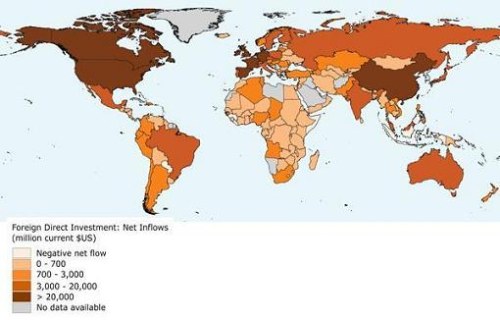
As we will see, globalization is a word (and phenomenon) that is analogous to a Rorschach test in that everyone seems to have his, or her, own slightly unique definition of what it actually means. There is wide agreement, however, that an important characteristic of contemporary globalization is the level of economic integration internationally. One such component of that integration is foreign direct investment (FDI). From the World Resources Institute, here is a map that shows the differing levels of FDI around the globe. The patterns should, by now, be exceedingly familiar.

world_fdi_map_450.jpg

Here is the map description:

Foreign direct investment data do not give a complete picture of international investment in an economy. Balance of payments data on foreign direct investment do not include capital raised locally, which has become an important source of financing for investment projects in some developing countries. In addition, foreign direct investment data capture only cross-border investment flows involving equity participation and thus omit nonequity cross-border transactions such as intrafirm flows of goods and services. For a detailed discussion of the data issues see the World Bank’s World Debt Tables 1993-1994 (volume 1, chapter 3). Also, cross-country comparisons may not be accurate, because of differences in the definition of what constitutes foreign direct investment.

Source: World Bank Group. 2004, World Development Indicators Online. Washington, DC:World Bank.
Available On-line at: Source Link

Design a site like this with WordPress.com
Get started