Michael Ignatieff and Humanitarian Intervention

Current leader of the Canadian Federal Liberal Party, Michael Ignatieff has long been involved in the issue of human rights–as a historian, journalist, public intellectual, and as the former Carr Professor and Director of the Carr Center for Human Rights Policy at the Kennedy School of Government.

In the aftermath of the contentious NATO military intervention in Kosovo (1999), Ignatieff sat down with WBUR’s Chris Lydon to assess what had gone right (and wrong) during the intervention. A self-identified member of the “something must be done [to stop alleged Serbian war crimes against the Kosovar Albanians]”, Ignatieff stands by his support for the intervention, claiming that, on the whole, the benefits outweighed the costs.

Sarah Palin should have taken PLSC250

Had one of my Introduction to International Relations students been taking questions from Charlie Gibson tonight, s/he would have been well prepared to answer his question regarding the “Bush Doctrine”.  As my students (still?) know, the “Bush Doctrine” was most clearly and forcefully enunciated in the 2002 National Security Strategy of the United States.  While there are three major components to the “Bush Doctrine”, the most important of which (at least the one that received the most attention and presented the most radical departure from the part-realist, part-liberal, bi-partisan, pre-9/11 US foreign policy framework was the idea of using preemptive military force, without the need for there to be an imminent threat.

Democratic critics have often charged Bush and his administration with claiming that Saddam Hussein posed an “imminent threat”, but I have yet to see any evidence that anyone speaking for the administration did so.  And it’s not a surprise, as the Bush Doctrine allows the use of force without imminent threat.  Maybe Governor Palin should bring some of those critics along with her to my class.  And if the Republican Party would like to hire a IR tutor for Governor Palin, they’ll find my rates more than reasonable.

Pope Benedict XVI a Foreign Policy Radical

The Pope delivered a speech last week to the United Nations in which he argued–as have many radicals over the last few decades–that the will of the international community to act in order to solve important global problems is being undermined because a few states have accrued too much power.  The Associated Press has more:

NEW YORK – Pope Benedict XVI warned diplomats at the United Nations on Friday that international cooperation needed to solve urgent problems is “in crisis” because decisions rest in the hands of a few powerful nations.

In a major speech on his U.S. trip, Benedict also said that respect for human rights, not violence, was the key to solving many of the world’s problems.

While he didn’t identify the countries that have a stranglehold on global power, the German pope — just the third pontiff to address the U.N. General Assembly — addressed long-standing Vatican concerns about the struggle to achieve world peace and the development of the poorest regions.

On the one hand, he said, collective action by the international community is needed to solve the planet’s greatest challenges.

On the other, “we experience the obvious paradox of a multilateral consensus that continues to be in crisis because it is still subordinated to the decisions of a few.”

The pope made no mention of the United States in his speech, though the Vatican did not support the U.S.-led invasion of Iraq in 2003, which occurred despite the Bush administration’s failure to gain Security Council approval for it. At other moments on his trip, Benedict has been overtly critical of the U.S., noting how opportunity and hope have not always been available to minorities.

The pope said questions of security, development and protection of the environment require international leaders to work together in good faith, particularly when dealing with Africa and other underdeveloped areas vulnerable to “the negative effects of globalization.”

Iraq is a Minefield

Have any of you ever realized that you just may be in a minefield? It’s a difficult conundrum because you don’t want to just stay there, but you also don’t want to move. It seems as though there is no good choice to make. That, according to an analyst at the National Defense University, is the US fate in Iraq currently.

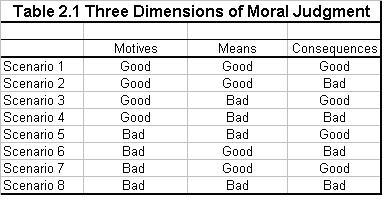
During our relatively short discourse into international ethics, we discussed Table 2.1 from Amstutz’s book, which demonstrates the Three Dimensions of Moral Judgment.

Here it is:

We notice that in order to evaluate the morality of a foreign policy decision, we must judge the motives behind the decision, the means used, and the final result of the decision. A new paper by Joseph J. Collins, of the Institute for National Strategic Studies of the National Defense University analyzes the Bush administration’s decision to invade Iraq in 2003. According to the author,

To date, the war in Iraq is a classic case of failure to adopt and adapt prudent courses of action that balance ends, ways, and means.

The paper is an interesting and nuanced read and I encourage you to take a look. Here is the first page:

Measured in blood and treasure, the war in Iraq has achieved the status of a major war and a major debacle. As of fall 2007, this conflict has cost the United States over 3,800 dead and over 28,000 wounded. Allied casualties accounted for another 300 dead. Iraqi civilian deaths—mostly at the hands of other Iraqis—may number as high as 82,000. Over 7,500 Iraqi soldiers and police officers have also been killed. Fifteen percent of the Iraqi population has become refugees or displaced persons. The Congressional Research Service estimates that the United States now spends over $10 billion per month on the war, and that the total, direct U.S. costs from March 2003 to July 2007 have exceeded $450 billion, all of which has been covered by deficit spending. No one as yet has calculated the costs of long-term veterans’ benefits or the total impact on Service personnel and materiel.


The war’s political impact also has been great. Globally, U.S. standing among friends and allies has fallen. Our status as a moral leader has been damaged by the war, the subsequent occupation of a Muslim nation, and various issues concerning the treatment of detainees. At the same time, operations in Iraq have had a negative impact on all other efforts in the war on terror, which must bow to the priority of Iraq when it comes to manpower, materiel, and the attention of decisionmakers. Our Armed Forces—especially the Army and Marine Corps—have been severely strained by the war in Iraq. Compounding all of these problems, our efforts there were designed to enhance U.S. national security, but they have become, at least temporarily, an incubator for terrorism and have emboldened Iran to expand its influence throughout the Middle East.

As this case study is being written, despite impressive progress in security during the surge, the outcome of the war is in doubt. Strong majorities of both Iraqis and Americans favor some sort of U.S. withdrawal. Intelligence analysts, however, remind us that the only thing worse than an Iraq with an American army may be an Iraq after the rapid withdrawal of that army. The 2007 National Intelligence Estimate (NIE) on Iraq’s future stability said that a rapid withdrawal “almost certainly would lead to a significant increase in the scale and scope of sectarian conflict in Iraq, intensify Sunni resistance to the Iraqi government, and have adverse consequences for national reconciliation.” The NIE goes on to say that neighboring countries might intervene, resulting in massive casualties and refugee flows. No one has calculated the psychopolitical impact of a perceived defeat on the U.S. reputation for power or the future of the overall war on terror. For many analysts (including this one), Iraq remains a “must win,” but for many others, despite the obvious progress under General David Petraeus and the surge, it now looks like a “can’t win.” To date, the war in Iraq is a classic case of failure to adopt and adapt prudent courses of action that balance ends, ways, and means.

Newsweek Editor Fareed Zakaria Says “No” to Olympic Boycott

In a recent column, Newsweek’s Fareed Zakaria argues that the US should not boycott the Olympic Games in Beijing this summer.  He argues that it would have the opposite of the intended effect.  Here are some snippets:

Public humiliation does not work nearly as well on the regime in Beijing as private pressure. At first glance, China’s recent crackdown in Tibet looks like a familiar storyline: a dictatorship represses its people. And of course that’s part of the reality — as it often is in China. But on this issue, the communist regime is not in opposition to its people. The vast majority of Chinese have little sympathy for the Tibetan cause. To the extent that we can gauge public opinion in China and among its diaspora, ordinary Chinese are, if anything, critical of the Beijing government for being too easy on the Tibetans. The real struggle here is between a nationalist majority and an ethnic and religious minority looking to secure its rights.

In these circumstances, a boycott of the Olympics would have precisely the opposite effect that is intended. The regime in Beijing would become only more defensive and stubborn. The Chinese people would rally around the flag and see the West as trying to humiliate China in its first international moment of glory. (There are many suspicions that the United States cannot abide the prospect of a rising China.) For most Chinese, the Games are about the world’s giving China respect, rather than bolstering the Communist Party’s legitimacy…

…Some want to punish China for its association with the Sudanese government, which is perpetrating atrocities in Darfur. But to boycott Beijing’s Games because it buys oil from Sudan carries the notion of responsibility too far. After all, the United States has much closer ties to Saudi Arabia, a medieval monarchy that has funded Islamic terror. Should the world boycott America for this relationship?

Lecture on German Political Parties April 17th

Talk about serendipity!  We will finish our mock German election and government formation simulation on Tuesday, April 15th and two days later there will be a guest lecture on campus by Dieter Dettke, Visiting Scholar at the American Institute for Contemporary German Studies and Adjunct Professor at Georgetown University, Security Studies Program.  on “Is Germany Moving to the Left?  The Changing German Party System.

You can find below a copy of the flyer announcing the lecture, which will begin at 5:30 at the Gottwald Science Center Auditorium.  I’ll see you there.

The Richmond Eric M. Warburg Chapter

of the American Council on Germany

cordially invites you to a

Discussion and Reception

with

Dr. Dieter Dettke

Visiting Scholar at the American Institute for Contemporary German Studies and

Adjunct Professor at Georgetown University, Security Studies Program

on

“Is Germany Moving to the Left?

The Changing German Party System"

Thursday, April 17, 2008

5:30 – 6:45 pm

at

The University of Richmond, Gottwald Science Center Auditorium

Directions: If coming from Three Chopt Road, turn onto Boatwright Drive and continue straight ahead at the welcoming wall at the bottom of the winding hill (do not turn left for the main campus gate). After passing the Robins Center on your left and a large parking lot on your right, proceed for another 300 yards on College Road to the Westhampton entrance on your left. (If coming from River Road, turn onto College Road and turn right into the Westhampton entrance.) Continue on Keller Road to the Modlin Center and pass through the archway. Opposite the stop sign are parking spaces in front of the Westhampton Deanery and even more spaces between it and the cafeteria and science center. The science center auditorium is in the Gottwald Science Center across from the cafeteria. (In case the above parking spaces are full,  there is a parking lot behind the Modlin Center which you can access by turning right at the stop sign or left if exiting the parking lot across from the stop sign.)

If you have any questions, please contact Dr. Arthur B. Gunlicks,

Dr. Dieter Dettke is currently a visiting scholar at the American Institute for Contemporary German Studies and Adjunct Professor at Georgetown University, Security Studies Program. He is working on a book on German foreign policy and transatlantic relations – with the working title “In Search of Normalcy: German Foreign and Security Policy Between Realpolitik and the Civilian Power Paradigm.” He has also been a fellow at both the Woodrow Wilson Center and the German Marshall Fund of the United States.

From 1985 to 2006 he served as US Representative and Executive Director of the Washington Office of the Friedrich Ebert Foundation – which is affiliated with Germany’s Social Democratic Party (SPD). Prior to his work with the Ebert Foundation, Dr. Dettke was Political Counsellor of the SPD Parliamentary Group of the German Bundestag (1974 – 1984) and Staff Director of the Working Group on US-German relations. In this capacity, he coordinated all foreign, security and defence policy related issues on the agenda of the German Bundestag and the Committees for Foreign Affairs, Defence, German-German relations, Development Policy and European Affairs.

He has lectured frequently in Europe and the United States on transatlantic relations, German-American security issues and European-American economic relations. He has also presented papers, acted as a discussant and/or chair at U.S. and international conferences of the American Political Science Association, the International Studies Association, the German Studies Association and the American Association of Slavic Studies. In addition, Dr. Dettke testified in Congress on the implications of German unification for the United States and US-European relations.

Dr. Dettke has appeared on the News Hour with Jim Lehrer, C-SPAN, Voice of America as well as other American, German, Swiss, and British television and radio programs to discuss issues and developments related to domestic and foreign policy developments in Europe and the United States. Dr. Dettke studied political science and law at the universities of Bonn and Berlin (Germany) and Strasbourg (France). He was a Fulbright Scholar at the University of Washington in Seattle (1967/68).

President Bush wins European Approval for Missile Defense Shield

Yesterday in intro to IR we discussed the morality of former US President Ronald Reagan’s Strategic Defense Initiative (SDI) from a moral standpoint.  We debated the morality of replacing the theretofore existing principle of Nuclear Deterrence for a missile defense shield meant to destroy launched nuclear weapons, thereby making nuclear weapons essentially useless.  Some quarter of a century later, the New York Times reports that President Bush has won acquiescence from some European allies for his version of a missile defense shield that would cover the European continent.

bush_europe_missile_shield.jpgBUCHAREST, Romania — NATO leaders agreed Thursday to endorse a United States missile defense system based in Europe and to provide more troops for Afghanistan, but they declined, as expected, to back President Bush’s proposal to bring Ukraine and Georgia closer to NATO membership…

“There has been, over 10 years, a real debate as to whether there is a ballistic missile threat,” said Mr. Bush’s national security adviser, Stephen J. Hadley. “And I think that debate ended today.”

The Russian president, Vladimir V. Putin, has objected repeatedly to building parts of the missile defense system in former Soviet bloc states, despite Washington’s assurances that the system is a response to threats from Iran, not from Russia. Mr. Putin, saying the system would fuel a new arms race, has even threatened toaim Russian missiles at the system, while also offering the use of a substitute system in Azerbaijan.

NATO’s final statement invited Russia to cooperate with the United States and Europe on developing defenses jointly.

Konstantin Kosachev, chairman of the international affairs committee of the Russian Parliament, said that missile defense would be high on the agenda for the meeting between Mr. Putin and Mr. Bush in Sochi, a Russian resort, scheduled after the NATO conference, which Mr. Putin is to attend Friday.


Is NAFTA good or bad for US Workers and the US Economy?

With Democratic Presidential candidates Hillary Clinton and Barack Obama tussling over the relative  merits of the North American Free Trade Agreement, this Boston Globe column, in which Canadian Trade Minister David Emerson is quoted, is useful as quick background reading.  NAFTA, signed by former President Bill Clinton and ratified by the US Congress in teh mid-1990s, sought to bring down trade barriers amongst the Mexican, Canadian, and United States’ economies.  A common lament amongst those in rust-belt states and along the Mexican border is that the agreement has sent millions of jobs formerly held by Americans to Canada and Mexico.  Emerson cautions us to be wary of this claim, parsing the logic:

I strongly believe that the growth in protectionist sentiment is somewhat misplaced and irrational. It’s people who are concerned about the loss of jobs over the last 10 years which largely — analytically — has been shown to be driven by technology,” he told reporters.

“To the degree that it’s the result of liberalized trade, it’s more to do with the Asian dynamos like China and India and Vietnam, and countries like that. It’s not NAFTA that is hurting the North American worker. It’s not,” Emerson said.

“In fact, NAFTA is probably the friend of the North American worker because it enables us to achieve a level of efficiency and competitiveness that helps us take on the real competitive threats.”

Emerson said he had urged his counterparts in Canada’s 10 provinces to stress this message in dealings with the governors of U.S. states and members of the U.S. Congress.

“When you recognize that 39 out of 50 states have Canada as their number one export market, you start to realize governors and congressmen at the local level have an awful lot at stake, and we need to make sure they understand that,” Emerson said.

“Premiers and provincial ministers are very good, they have lots of contacts. The federal government cannot do it all.”

Prime Minister Stephen Harper has expressed confidence that, despite the rhetoric, the North American Free Trade Agreement will not be reopened. Emerson was not quite as confident.

“We’ve all been hearing the comments of presidential candidates, of congressmen. Protectionist forces have been gathering steam for some years and they’re showing no signs of abating,” he said.

“Truman lost China” and the effect of “the stuff of politics” on IR

In our discussion of the international (or system) level-of-analysis in IR, we noted some of the strengths and weaknesses of focusing explanation and description at that level. While system-level explanations are helpful in that they are comprehensive and holistic, a major disadvantage of that level is that it misses, or neglects, the “stuff of politics.” What does that mean?

ping_pong_diplomacy.jpgHere’s an explanation by way of example. The image below is of Richard Nixon and Mao ZeDong engaging in “ping pong diplomacy”* with Chinese Prime Minister Zhou Enlai looking on approvingly [why is Mao using a “Western” grip?]. Those of you who know a little bit about US-China diplomatic history understand the importance of the “Nixon goes to China” moment. The most significant point, for our purposes, is that this meeting signaled the re-establishment of diplomatic relations between the United States and “Red China”, after they had been cut off due to the 1949 victory of Mao’s Communists in the Chinese Civil War. It was not surprising that it was Nixon–a Republican–who was able to make this diplomatic gesture, since it would have been politically impossible for a Democratic president to have done the same. This is because President Harry S. Truman, and the whole of the Democratic party by association, had been vilified for having “lost China” to Communism. This is the kind of “stuff of politics” that is ignored when looking at IR from only an international (or system-level) perspective. Here is a clip from a documentary analyzing Nixon’s visit to China:

*Nixon and Mao never did play ping-pong (as far as I know), but their meeting was given the name “ping-pong diplomacy” since the first post-1949 diplomatic US visitors to China were table tennis players.

Roundtable–Globalizing Sport: National Rivalry and International Community in the 1930s

As we discussed in PLSC250, Woodrow Wilson set out an idealistic vision of the post-WWI world in his famous “Fourteen Points” address to Congress in 1918. As we all know, the vision was almost immediately undermined and finally turn asunder when Nazi Germany showed the rest of Europe–and the world–that military and economic power would triumph over cooperation and peace. Barbara J. Keys has written a compelling monograph on a little-researched aspect of that era–the role of sport in international politics. Of course, many are familiar with Hitler’s use of the Berlin Olympics in 1936 as a propaganda tool, but that is but one event. In Globalizing Sport: National Rivalry and International Community in the 1930s, Keys demonstrates “how sports revealed international contact zones as well as distinctive qualities of nationhood.”*   Here is a lengthy excerpt from Thomas Zeiler’s introduction to a roundtable at H-Diplo on the Keys’ book:

  “I see great things in baseball.”  Although we cannot confirm that poet Walt Whitman actually authored this famous quote back in the 1840s, we do know that he later believed the sport to be a shaper of American character that reflected the country’s democratic institutions, striving disposition, and rising geo-political and economic greatness.  In the
middle of the next century, intellectual historian Jacques Barzun also viewed the sport as a mirror of national traits.  In God’s Country and Mine:  A Declaration of Love Spiced with a Few Harsh Words (1954), he offered the oft-quoted words, “Whoever wants to know the heart and mind of America had better learn baseball.”  A half century after this publication, we come to Barbara Keys’ masterful work on how sports revealed international contact zones as well as distinctive qualities of nationhood.  Arriving in the age of globalization, her study properlysituates sports as a transnational movement amidst and between the national of Whitman and Barzun and the vast global arena.

Of course, as readers will discover, Keys’ focus is not on baseball, but she does examine the primary influence of nationalism on sporting events, particularly the Olympics movement and also other aspects such as athleticism and soccer.  Among many others, the main contribution of this book to the literature on diplomacy, sports, and culture regards Keys’ analysis of the tension between the manipulation of sports as an expression of national identity and sports’ position as a transnational carrier of culture abroad. 

*From Zeiler’s introduction to the roundtable in H-Diplo.

Design a site like this with WordPress.com
Get started