De-baathification and Democratic Transition / Consolidation in Iraq

There are many challenges during in the transition from an authoritarian regime to one based on democratic principles. In single-party dictatorships, the issue of what to do with the “shock troops” of the regime–the rank-and-file (and some not so rank-and-file) party members who were not leaders in any sense of the word but did provide the regime with the labor and muscle power necessary for the quotidian functioning of the society. These would include civil workers, police, teachers and professors, enlisted soldiers, etc.

Upon eliminating the Saddam Hussein regime in 2003, the United States was faced with the task of what to do with the hundreds of thousands of Baath Party members who were viewed as having intimate ties to the Hussein regime. In what is widely considered one of the biggest mistakes of the post-overthrow occupation, Paul Bremer fired, and otherwise had removed from their jobs, hundreds of thousands of these lower ranking Baath party members. In a potentially positive sign (the devil, as always, is in the sectarian details), Iraq’s parliament has recently passed a law allowing many of these individuals to return to their former jobs. From the Associated Press:

Iraq’s parliament passed a benchmark law Saturday allowing lower-ranking former members of Saddam Hussein’s Baath party to reclaim government jobs, the first major piece of U.S.-backed legislation it has adopted…

The seismic piece of legislation had been demanded by the United States since November 2006 and represented the first legislative payoff for Bush’s decision to deploy 30,000 additional troops to the country to quell violence…

It was not immediately clear how many former Baathists would benefit from the new legislation, titled the Accountability and Justice law. But the move was seen as a key step in the reconciliation process.

Continue reading “De-baathification and Democratic Transition / Consolidation in Iraq”
Coalition Government set to be Formed in Croatia

In a previous post, I noted the relatively democratic nature of the post-election bargaining amongst the various parties, coalitions, and options. Party leaders and other officials assured the public that a new governing coalition would be sworn in before the expiration of the constitutionally-mandated period. This has, indeed, been the case with an 83-member coalition government presiding over the Croatian Parliament’s (Sabor) 153-seat single chamber. The Financial Times reports on some highlights of the new government:

he prime minister, who has governed in a minority coalition for the past four years, secured a slender parliamentary majority through deals earlier this week with the Peasants and Social Liberal parties and the Serb ethnic-minority party.

Other ethnic-minority representatives and a pensioners’ party member bring the new governing coalition to a comfortable 83-seat total.

A Serb member enters the cabinet for the first time as one of four deputy prime ministers, while the new governing coalition also includes the first-ever member of parliament from the Roma minority.

Ethnicity and Democratic Stability

Ethnic identity and the interaction of ethnic groups form form the basis of a disparate and burgeoning literature in the field of comparative politics (and economics, sociology, psychology, etc.) Two important sub-literatures in this field analyze the effect of ethnicity, and ethnic homogeneity and democratic stability. The first is Arend Lijphart’s consociational theory (consociationalism) and Shepsle and Rabushka’s “ethnic outbidding” model.

Islam, Religious Attitudes, and Democracy

There is a lot of ink being spilled on the question of the compatibility of Islam with democracy. Here is a link to a paper by Mark Tessler, published in the journal, Comparative Politics, in 2002.

“Islam and Democracy in the Middle East: The Impact of Religious Orientations on Attitudes Toward Democracy in Four Arab Countries,” Comparative Politics, Vol. 34 (April 2002): 337-354.

If you are on campus, here is a direct link to a pdf version of the article.

From the Abstract:

Continue reading “Islam, Religious Attitudes, and Democracy”

“And you thought choosing your Spring Course Schedule was difficult…”

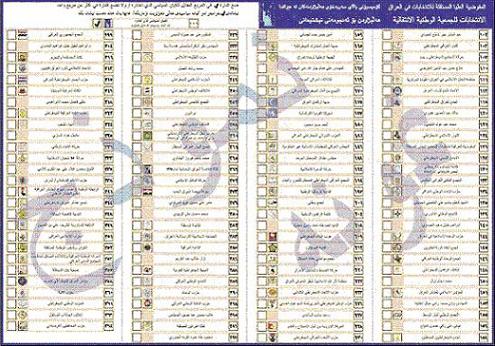
Here is a picture of the ballot that faced Iraqis as they arrived at the polls in late January, 2005. That’s correct; each of those is a different political party, 111 in all!

iraq_2005_ballot1.jpg

And what about the results? Here was the structure of the parliament following the January 2005 Parliamentary elections: Continue reading ““And you thought choosing your Spring Course Schedule was difficult…””

Afrobarometer–Key Findings

The very first Afrobarometer Briefing Paper–here’s the link to a PDF version–(April 2002) presents some key findings regarding the views of African residents in about a dozen African countries on phenomena such as democracy, freedom, governance, etc. Here are a few I found interesting:

  • Corruption is seen as pervasive

Whereas about one-half of survey respondents think that corruption among public officials is common (52 percent), about one-third think it is rare (35 percent). Perceived corruption is highest in Ghana, Nigeria, Tanzania, and Zimbabwe, and lowest in Botswana, Lesotho and Namibia. Generally, however, people perceive more corruption than they themselves have personally experienced. Such perceptions, and the social inequalities they reflect, tend to corrode satisfaction with economic reform policies and with democracy.

In class, I use the module on economic and political development as an opportunity to ask students if they have ever tried to bribe an official for any reason whatsoever. The answer amongst my mostly suburban-bred American students is a unanimous “no.” Generally only I (and sometimes a foreign student) raise our hands to answer in the affirmative. I try to impress upon the students that bribery and corruption is a normal part of life in most non-Western countries. In most citizens’ dealings with official (read: governmental and quasi-governmental) institutions, bribing at least one official is absolutely necessary to get anything done.

Continue reading “Afrobarometer–Key Findings”

Afrobarometer Public Opinion Surveys

The Afrobarometer survey allows public access to its data, with a two-year time lag. From a description found on its home page, the Afrobarometer is “a comparative series of public attitude surveys on democracy, markets, and civil society in Africe.” The site is full of resources, in addition to the data, such as publications (including downloadable working papers), results, news and events.

afrobarometer1.jpg

Here are the countries surveyed and the years for each:

Country
Round 1
Round 2
Round 3
Other
Benin
2005
Botswana
1999
2003
2005
Cape Verde
2002
2005
Ghana
1999
2002
2005
1997
Kenya
2003
2005
Lesotho
2000
2003
2005
Madagascar
2005
Malawi
1999
2003
2005
Mali
2001
2002
2005
Mozambique
2002
2005
Namibia
1999
2003
2006
2002
Nigeria
2000
2003
2005
2001, 2007
Senegal
2002
2005
South Africa
2000
2002
2006
1994, 1995, 1997, 1998, 2004
Tanzania
2001
2003
2005
Uganda
2000
2002
2005
Zambia
1999
2003
2005
1993, 1996
Zimbabwe
1999
2004
2005

Winter 2008 issue of Orbis dedicated to “Assessing Democratic Transitions”

Just a note to remind me that the Winter 2008 issue of Orbis has a symposium on entitled “Assessing Democratic Transitions Today.” Here is the partial table of contents:

Introduction Adrian A. Basora
Must Democracy Continue to Retreat in Postcommunist Europe and Eurasia? Adrian A. Basora
The Tasks of Democratic Transition and Transferability Valerie Bunce
Ukraine: Lessons Learned from Other Post-Communist Transitions Mykola Riabchuk
Central Asia: U.S. Bases and Democratization Alexander Cooley
East and South East Asia: Lessons from Democratic Transitions Tom Ginsburg
Can Outsiders Bring Democracy to Post-Conflict States? John R. Schmidt

Toward Muslim Democracies–Reading Questions

Professor Saad Eddin Ibrahim, a leading advocate for human rights and democracy in Egypt (and the broader Arab world), and professor of political sociology at the American University of Cairo, delivered the annual Lipset “Lecture on Democracy in the World” in 2006. He makes a couple of interesting points regarding the link between Islam and democracy. Here are some questions related to the reading:

  1. What proportion of the world’s Muslims currently lives in states with democratic regimes? Are these states full liberal democracies?
  2. What does he term the “lagging third”, and where can it be found?
  3. What is ironic about some of the countries in the “lagging third?”
  4. What two historical events, according to Ibrahim, are responsible for putting a halt to democratization in the Middle East?
  5. What, according to Ibrahim, is the link between the creation of Israel and the presence of authoritarian regimes in the Arab world?
  6. Are Arab-Islamic regimes authoritarian due to Arab-Muslim cultural and religious exceptionalism?
  7. How does he characterize the Arab dictators’ “cynical appeal.”
  8. In the battle between “autocrats” and “theocrats” with whom should liberal liberal democrats (such as he) side? Why?
  9. How can the role of the Catholic in Poland during Communism inform the potential role of the mosque in the Arab world?
  10. What does the Arabic shura mean?
  11. How does Ibrahim view the the electoral victories of Hamas (in the Palestinian territory) and radical Shia groups in Iraq? Is the detrimental or beneficial to democracy in these places?
  12. What is the “one person, one vote, one time” phenomenon, and should we be worried about its potential appearance in the Arab world?

Ibrahim, Saad Eddin. 2007. “Toward Muslim Democracies,” Journal of Democracy, Vol. 18, No.2, 5-13.

Informal Institutions and Democracy in Africa

Using results from the Afrobarometer surveys, Michael Bratton has written an article in a recent issue of Journal of Democracy (you must have access to JoD articles to read this) on the relationship between formal and informal institutions and democracy in a sample of African countries.

This is a blurb from the article about Afrobarometer: “[Bratton] is also founder and director of the Afrobarometer, a collaborative international survey-research project that measures public opinion regarding democracy, markets, and civil society in eighteen African countries.”

Design a site like this with WordPress.com
Get started