Human Security Resources

A general trend has developed, amongst governments, academics, and (especially) activists working in IGOs and NGOs worldwide that has moved the focus of security away from traditional concepts–such as protecting borders from external threat–to a new approach that focuses specifically on human security. What is “human security?” Well, the Human Security Report Project, at Vancouver, Canada’s Simon Fraser University, defines human security in this way:

Unlike traditional concepts of security, which focus on defending borders from external military threats, human security is concerned with the security of individuals…

For some proponents of human security, the key threat is violence; for others the threat agenda is much broader, embracing hunger, disease and natural disasters. Largely for pragmatic reasons, the Human Security Report Project has adopted the narrower concept of human security that focuses on protecting individuals and communities from violence.

Traditional security policy emphasizes military means for reducing the risks of war and for prevailing if deterrence fails. Human security’s proponents, while not eschewing the use of force, have focused to a much greater degree on non-coercive approaches. These range from preventive diplomacy, conflict management and post–conflict peacebuilding, to addressing the root causes of conflict by building state capacity and promoting equitable economic development.

The website has an informative and very useful set of links to various organizations, governmental institutions, research institutes, etc., that focus on issues of human security.

Another excellent source for information related to human security is the Human Security Gateway. Below is a thumbnails which will take you to a screen shot of their home page. (Notice the RSS feed icons in the left sidebar.)
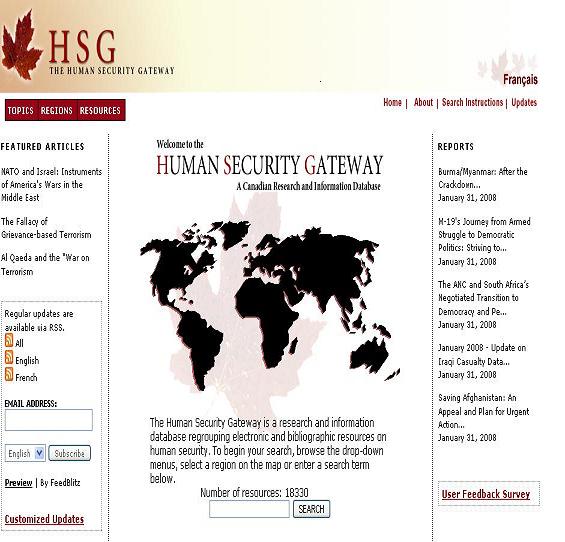
human_security_gateway_homepage1.jpg

UCDP/PRIO Armed Conflict Dataset


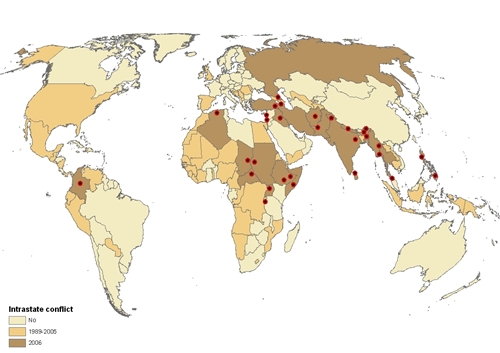
konfliktkart_8908.jpg

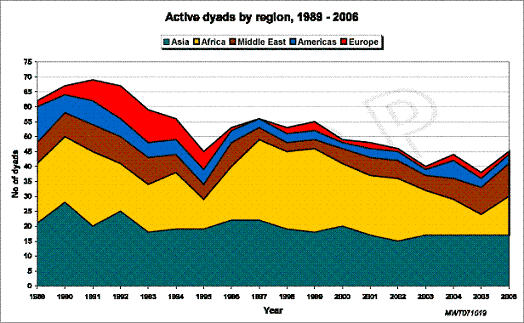
The Centre for the Study of Civil War at the International Peace Research Institute, Oslo (PRIO) and Uppsala Conflict Data Program (UCDP) at the Department of Peace and Conflict Research, Uppsala University, are the home for the Armed Conflict Dataset.  The dataset allows users access to information on such variables as name of conflict, antagonists, whether/not there was third-party intervention, etc., for all global conflicts between 1946 and 2002.  The website also has other data sources and illuminating charts and graphs, an example of which is reproduced below.

dyads_year_reg1.gif

This chart shows the number of conflicts in various regions of the world over time.

Kenyan Violence Menacing for Intertribal Marriages

Kenya’s political troubles have had a immediate impact on marriages composed of partners of different tribes. Individuals in inter-tribal or inter-ethnic marriages are often twice cursed in the event of inter-ethnic violence. On the one hand, each marriage partner is increasingly distrusted by members of the other ethnic/tribal group. But what makes matter even worse is that they are also ostracized and often the victims of violence on the part of members of their own group. Their sin is that, having married someone from the rival ethnic group/tribe, they are no longer seen as trustworthy. In noticed in Croatia that this led to counter-intuitive outcomes where individuals who had married spouses of the other ethnic group often become publicly intolerant toward members of the spouse’s group. This was not the result of true ethnic hostility but in order to prove the individual’s ethnic/nationalist bona fides to his (and it was mostly males in this case) own ethnic brethren.

Here is a report from the Associated Press about a woman in Kenya whose husband had to leave home, fearing for his life.

He doesn’t call. He doesn’t write. His cell phone has been switched off for weeks. After 17 years, Naomi Kering’s husband is gone — one more intertribal marriage fallen victim to the violence that has followed Kenya‘s disastrous presidential election.

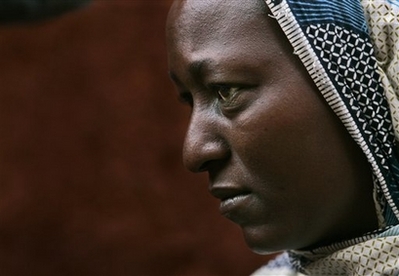
“The kids always ask me, ‘Where is he?’ And I always say he is going to come back,” Kering, a 34-year-old of the Kalenjin tribe, told The Associated Press as she stood in the rubble of her home, torched by a mob last month because her kenya_divided_love_abc5031.jpghusband is a Kikuyu. “But I hope he stays away, because I love him and I want him to be safe.”

Since the Dec. 27 vote, marriages that united different ethnic groups have felt the strain as communities shun the Kikuyu tribe of President Mwai Kibaki, whose disputed re-election unleashed a wave of bloodshed that has killed at least 685 people.

Until now, marriages like Kering’s were common enough to go largely unnoticed, representing hope for what Kenya could be as a nation. But now the fabric of Kenyan society is fraying, forcing families to confront tribal identities many had cast aside long ago.

“This election has changed the very essence of these marriages,” said the Rev. Charles Kirui, a Catholic priest whose church in the nearby town of Burnt Forest shelters hundreds of Kikuyus. “Marriages are breaking up because of a tribal conflict, which means we really have a problem in Kenya.”

There are no figures on how many families are affected, but the impact is particularly felt in the heart of opposition territory in western Kenya, where tribal tensions have been most inflamed by the election.

This country of 38 million was once seen as a stable democracy on a violent continent. But it depended on a delicate balance of intertribal power.

Congo Civil War Kills 45,000 Persons Monthly

We’ll be covering war and strife later in the semester and we’ll note that the nature of warfare has changed over the years. Whereas most wars in the past were of the inter-state variety, contemporary wars are mostly intra-state (i.e, wars resulting from civil and ethnic conflict). A worrisome characteristic of these contemporary wars is that the vast majority of victims are civilians and they generally succumb to factors, such as disease and hunger, not related to direct conflict. In a new report by the International Red Cross, we learn that 45,000 persons have died (and continue to die) monthly from civil war in Congo.

25congo600.jpg

The effects of one of the bloodiest wars in modern history continue to unfold in relative obscurity in the Democratic Republic of Congo, where 5.4 million lives have been lost as a result of conflict since 1998, according to a nationwide mortality survey that will be released today.

While the conflict in the Darfur region of neighbouring Sudan has begun to draw substantial international attention, the humanitarian crisis resulting from conflict in the Congo has received almost none. About 200,000 people have been killed in Darfur, and two million displaced.

“People aren’t dying dramatically in Congo,” said Richard Brennan, a lead researcher with the U.S.-based International Rescue Committee, which conducted the survey. “It’s not like a Rwandan genocide where people die in a very dramatic and acute manner. They are dying quietly and anonymously.”

In fact, very few of the recorded deaths were caused directly by violence, roughly 0.4 per cent nationwide, the report says. Instead, the principal causes of death across Congo, a largely undeveloped country the size of Western Europe, were malnutrition, preventable diseases and pregnancy-related conditions.
“Our experience in poorly developed countries over the last 20 years is that in most conflicts, the majority of deaths, frequently over 90 per cent, are due to the indirect consequences of that conflict,” Dr. Brennan said. “They are no less devastating, but they are very much below our radar screen in the West.”

How do you Affect International Relations in your Daily Life?

In Mingst’s first chapter, she asks “How does international relations affect you in your daily life?” More potentially meaningful information may be garnered by turning that question over on its head: “how do you affect international relations in your daily life?” Are you thinking of buying a new cell phone? What will you do with your old one? You may want to think twice about your decision, as it could have an effect on people thousands of miles away.

…did you know that throwing your old cell phone in the garbage helps support civil war in central Africa, driving endangered gorillas closer to extinction in the process? A little explanation: A used cell phone’s value lies mainly in small amounts of minerals in its circuits — gold, nickel and especially tantalum, a high-melting-point metal sometimes referred to as coltan. Like something from a Clive Cussler thriller, tantalum is vital to manufacturing cell phones and many other electronic devices, but 80 percent of the world’s reserves are in the DRC (Democratic Republic of the Congo). There, it is mined under frequently appalling conditions and fought over during the DRC’s ongoing civil and international wars. Tantalum-mining revenues help fuel these wars, along with the associated destruction of human lives and gorilla habitat.

Tantalum and other minerals command a premium, so cell-phone manufacturers have turned to recycling because it’s easier (and more ethical) than dealing with warlords — or commodities brokers who buy from them. An entire tantalum-recycling economy has sprung up, and now accounts for 20 to 25 percent of manufacturing input per year.

In addition, cell phones and their electronic cousins may also contain potentially toxic compounds of lead and arsenic, so it behooves us to keep them from winding up in landfills and afterward, the water supply.

Here are some of the ways that you can keep your old phone’s minerals and plastics in circulation while easing your conscience about making calls using the equivalent of a conflict diamond.

Your next blog entry will be dedicated to documenting either how international relations affects you or how you affect international relations, or both.

Here is a compelling documentary.

Crisis Group Named in Top Ten Global Think Tanks

The Crisis Group is a non-governmental Organization (NGO) that does great work on conflict around the world. From the group’s website, we find out:

The International Crisis Group has been listed as one of the “Top 10 Think Tanks in the World” in a new survey, based on peer review, conducted over 18 months by the Think Tanks and Civil Societies Program at the Philadelphia-based Foreign Policy Research Institute.

The Crisis Group have archived the Foreign Policy Research Institute’s report here.

From the group’s “about” page, we learn about the Crisis Group’s purpose:

The International Crisis Group (Crisis Group) is an independent, non-profit, non-governmental organisation, with some 145 staff members on five continents, working through field-based analysis and high-level advocacy to prevent and resolve deadly conflict.

Crisis Group’s approach is grounded in field research. Teams of political analysts are located within or close by countries at risk of outbreak, escalation or recurrence of violent conflict. Based on information and assessments from the field, it produces analytical reports containing practical recommendations targeted at key international decision-takers. Crisis Group also publishes CrisisWatch, a twelve-page monthly bulletin, providing a succinct regular update on the state of play in all the most significant situations of conflict or potential conflict around the world.

The State–Weber’s definition, the role of legitimacy & Iraq

The state is an important concept in politics, and it is often one that is difficult to grasp for many students new to the study of comparative politics. Probably the most studied work on the state is that of German social scientist Max Weber, who in a lecture given in 1918 (which would eventually be published in 1919 under the name “The Politics of Vocation”) set out a formal definition of the state, and demonstrated the link between that and what is called “legitimacy”.

Below the fold, I’ll provide what I consider to be the crucial part of Weber’s lecture, with an assessment of how this relates to the contemporary situation in Iraq below:
Continue reading “The State–Weber’s definition, the role of legitimacy & Iraq”

Design a site like this with WordPress.com
Get started