New and Old Wars Reading Questions

Here are some questions that we will try to answer in class, based on the Mueller, Kalyvas, Collier & Hoeffler, and Kaldor readings:

Thematic Questions:

  1. How has the nature of warfare changed (or has it) over the course of the last 70 years or so? Provide evidence from at least four sources.
  2. Comparatively assess the arguments of Collier & Hoeffer, Kalyvas, Mueller, and Kaldor. What are some commonalities? Divergence of opinion?
  3. What are the policy implications–from a humanitarian perspective–of taking each of the authors’ arguments seriously? Discuss.

Collier & Hoeffler (2004) “Greed and Grievance in Civil War

  1. De fine `greed’ and `grievance’ in the context of the analysis of rebellion/civil war.
  2. What are the types of causal mechanisms that each term implies?
  3. What do C & L mean by `opportunity’?
  4. Based on the statistical results, what conclusion do C & L draw regarding the causes of the onset of rebellion?
  5. What is the analytical importance of diaspora communities?
  6. How important are ethnic grievances in fomenting rebellion?

. Mueller (2000) The Banality of `Ethnic War’

  1. Why does Mueller put the words ethnic war in scare quotes in the title?
  2. What does Mueller mean when he says that ethnic war is `banal?’
  3. What evidence does Mueller use to support his main argument(s)?
  4. According to Mueller, what are the stages of ethnic war and ethnic cleansing?
  5. What is `ethnic cleansing’?
  6. Did ethnicity play any role in the inter-ethnic violence in Yugoslavia and Rwanda? Continue reading “New and Old Wars Reading Questions”

The “New Humanitarianism” and Rule vs. Act Utilitarianism (Consequentialism)

In chapter 3 of Humanitarian Intervention Weiss analyses “new wars” and “new humanitarianisms.”  The changing nature of humanitarian work is characterized by many things, but I’d like to focus on one particularly, which will lead us to a discussion of the importance of neutrality and the concepts of rule and act utilitarianism.

Weiss argues that humanitarian responses, by NGOs particularly,  are becoming more ambitious in scope and thereby shifting from a focus on short-term emergency relief to “attacking the root causes and post-conflict peacebuilding.” He continues,

“rather than provide band-aids, they [humanitarians] wish to use assistance and protection as levers. Many aid agencies desire to spread development, democracy, and human rights and create stable, effective, and legitimate states.” (76)

This has led, concomitantly, to a change in the humanitarian principles of neutrality and impartiality. These principles, Weiss notes, “made sense if the objective was to provide relief and gain access to affected populations.” These principles, it is argued, foundered upon the reality that contemporary wars–“new wars”–were creating “unanticipated and unintended negative consequences.” Moreover, in a world in which the combatants are state militaries, neutrality and impartiality retained some internal logic. However, as genocidaires and other ty[es of rebel groups become the main combatants in civil wars and the predominant perpetrators of crimes against humanity, the principles of neutrality and impartiality come to be seen increasingly as relics of a bygone era.

A few students took issue with this argument, insisting that there are also likely to be unintended consequences of humanitarian organizations repudiating the principles of neutrality and impartiality. They mentioned some of these in class. This prompted a quick excursion by me into the difference between act and rule utilitarianism/consequentialism. I’ll explain below the fold:

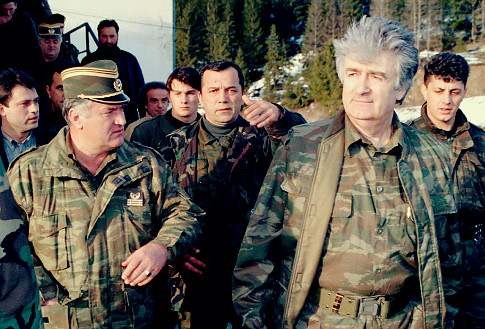
Bosnia Muslim leaders argued that the neutrality policy allowed Messrs. Karadzic and Mladic free reign in their campaign to ethnically cleanse large swaths of Bosnia of (well-fed) Muslims.

Continue reading “The “New Humanitarianism” and Rule vs. Act Utilitarianism (Consequentialism)”

Michael Ignatieff and Humanitarian Intervention

Current leader of the Canadian Federal Liberal Party, Michael Ignatieff has long been involved in the issue of human rights–as a historian, journalist, public intellectual, and as the former Carr Professor and Director of the Carr Center for Human Rights Policy at the Kennedy School of Government.

In the aftermath of the contentious NATO military intervention in Kosovo (1999), Ignatieff sat down with WBUR’s Chris Lydon to assess what had gone right (and wrong) during the intervention. A self-identified member of the “something must be done [to stop alleged Serbian war crimes against the Kosovar Albanians]”, Ignatieff stands by his support for the intervention, claiming that, on the whole, the benefits outweighed the costs.

Events/Lectures that may be of Interest

I’ll use this blog to keep you informed about lectures and events that may be of interest to you that are taking place on campus or in the greater Vancouver area. There are two events this week that are relevant.

This evening, Monday September 13th, at 7:00pm the Philosophers’ Cafe is kicking off the first event of its fall series at the Shadbolt Centre for the Arts at Deer Lake in Burnaby. This evening’s discussion is titled “Mixed Up: Is Canada’s cultural mix more like a melting pot, mosaic or matrix?” We’ll be addressing issues of identity and culture in about two weeks time in IS 210. The admission is $5, and the event will be moderated by Randall Mackinnon, who has served as a president, board member, executive and consulting staff for a diversity of community service organizations since 1970. For more information about tonight’s event and directions to the venue, click here.

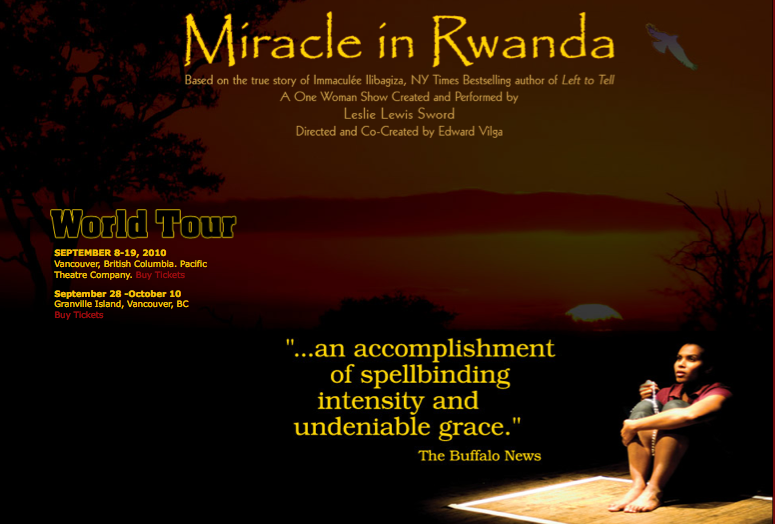
The second event is a one-woman show entitled Miracle in Rwanda, which is showing all of this week at Pacific Theatre Company and will also have a two-week run on Granville Island beginning later this month. To learn more about the show, and to purchase tickets, go here.

Update: The website I linked to above links to the wrong page. Miracle in Rwanda is part of this year’s Vancouver Fringe Festival. Here’s the correct link to information regarding show times and tickets.

Is there a causal link between Natural Resources and Conflict?

The “resource curse” is the name given to the alleged causal links between a country’s abundance of natural resourcee and the existence of all sorts of “bad things”, such as authoritarianism, economic stagnation and/or outright economic decline, increased probability of attempted coups d’etat, etc.  In our session on political economy we read Jensen and Wantchekon’s article on the link between natural resource wealth and authoritarianism, specifically, and we also looked at Richard Snyder’s article on the putative link between the existence of what he calls “lootable wealth” and political (in)stability in a state.  Their conclusions were at times complementary but at times divergent.  What matters (at least for political stability), according to Snyder, is the ability of the rulers (i.e., the government) to partake of the rents/riches accrued by the exploitation of the particular “lootable” resource.

Snyder’s is, of course, not the final word on the topic and there is an avalanche of published research on this very topic.  A new resource that can be used to find data on the link between natural resources and conflict–political, civil, etc.–is the Resource Conflcit Monitor, maintained by the Bonn International Center for Conversion.  From their web site:

Many developing countries rich in natural resources, such as diamonds and oil, have been plagued by poverty, environmental degradation and violent conflicts. In many of these countries, the natural wealth has not led to sustainable development. On the contrary, in some instances resource wealth has provided the funding and reasons for sustaining civil wars. This so-called ‘resource curse’ brought a lot of attention to the link between resources and conflict over the past decade. ’Governance’ has been identified as key factor for understanding the resource-conflict dynamic and for mitigating its negative impact in developing countries. ‘Resource governance’ in the present context describes the way in which governments regulate and manage the use of natural resources as well as the redistribution of costs and revenues deriving from those resources

The Resource Conflict Monitor (RCM) monitors how resource-rich countries manage, administer and govern their natural resources and illustrates the impact of the quality of resource governance on the onset, intensity and duration of violent conflict. The RCM serves as a tool for identifying and supporting viable resource governance and contributes to conflict prevention, post-conflict reconstruction and sustainable development….

There is an informative, and user-friendly, application that provides historical annual information on conflict and resources in individual countries.  Here is the result for Sierra Leone, the specifics of which should be familiar to those of you who watched Cry Freetown.  For an explanation of “resource governance” and “resource regime compliance, go here and scroll down.

There’s an additional methodological point that is crying out to be made here.  Notice that the level of conflict intensity first decreases rather significantly between 1996 and 1997, then increases dramatically between 1997-1999, to then fall just as dramatically between 2000 and 2002, while at the same time “resource governance” and “resource regime compliance” do not change much at all.  This means that we have to be very careful about attributing the level of conflict to the two afore-mentioned phenomena.  Maybe the causal link between these two and conflict intensity is not monotonic, maybe there is a threshold effect at work, or maybe the existence of an abundance of natural resources is a sufficient (under certain conditions) cause of conflict intensity.  On the whole, though, there certainlly doesn’t seem to be a clear linear, and/or monotonic relationship between resources and conflict (at least in Sierra Leone,  between 1996-2006)

The United Nations and Peacekeeping in Congo

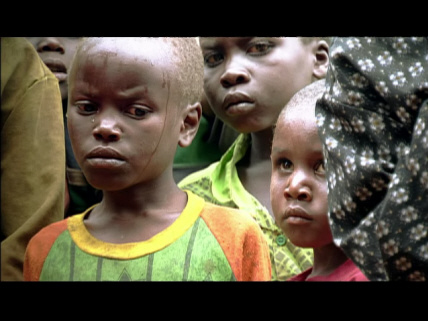
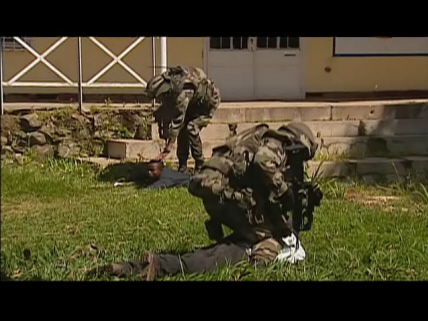
In PLSC250–intro to IR–this week we viewed a documentary made by the National Film Board of Canada, which addresses the UN’s peacekeeping role in Congo. After reading Chapter 7 of Mingst, you should now be aware that the UN in the world’s most important and powerful IGO, and the UN Security Council plays the most prominent global role in the area of international security. Here are a couple of screen shots from the film and the film’s description:

peacekeepers_1.jpg

peacekeepers_2.jpg

With unprecedented access to the United Nations Department of Peacekeeping, The Peacekeepers provides an intimate and dramatic portrait of the struggle to save “a failed state.” The film follows the determined and often desperate manoeuvres to avert another Rwandan disaster, this time in the Democratic Republic of Congo (the DRC).
Focusing on the UN mission, the film cuts back and forth between the United Nations headquarters in New York and events on the ground in the DRC. We are with the peacekeepers in the ‘Crisis Room’ as they balance the risk of loss of life on the ground with the enormous sums of money required from uncertain donor countries. We are with UN troops as the northeast Congo erupts and the future of the DRC, if not all of central Africa, hangs in the balance.
In the background, but often impinging on peacekeeping decisions, are the painful memory of Rwanda, the worsening crisis in Iraq, global terrorism and American hegemony in world affairs. As Secretary General Kofi Annan tells the General Assembly at the conclusion of The Peacekeepers: “History is a harsh judge. The world will not forgive us if we do nothing.” Whether the world’s peacekeeper did enough remains to be seen.

Janjaweed Militia Renews Scorched-Eart Policy in Darfur

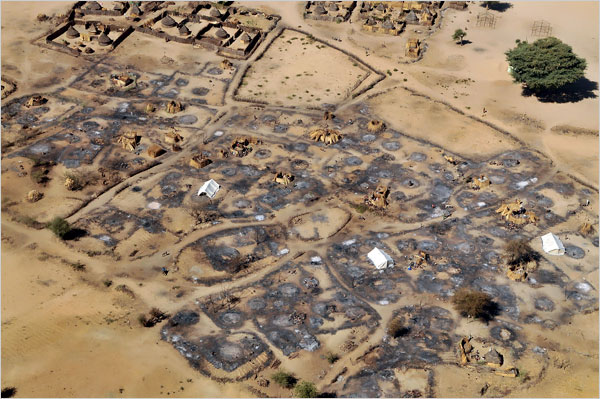
The New York Times reports that the notorious Janjaweed militia is once again active in Darfur.

 darfur_scortched_earth.jpg

Abu Surouj, Sudan, after government forces and allied militias burned the town last month. Such attacks in Sudan are a return to the tactics that terrorized Darfur in the early, bloodiest stages of the conflict.

Photo: Lynsey Addario for The New York Times

 SULEIA, Sudan — The janjaweed are back.

They came to this dusty town in the Darfur region of Sudan on horses and camels on market day. Almost everybody was in the bustling square. At the first clatter of automatic gunfire, everyone ran.

The militiamen laid waste to the town — burning huts, pillaging shops, carrying off any loot they could find and shooting anyone who stood in their way, residents said. Asha Abdullah Abakar, wizened and twice widowed, described how she hid in a hut, praying it would not be set on fire.

“I have never been so afraid,” she said.

The attacks by the janjaweed, the fearsome Arab militias that came three weeks ago,, were a return to the tactics that terrorized Darfur in the early, bloodiest stages of the conflict.

Such brutal, three-pronged attacks of this scale — involving close coordination of air power, army troops and Arab militias in areas where rebel troops have been — have rarely been seen in the past few years, when the violence became more episodic and fractured. But they resemble the kinds of campaigns that first captured the world’s attention and prompted the Bush administration to call the violence in Darfur genocide.

I noticed the same pattern during the wars in the former Yugoslavia in the 1990s, with militia groups acting in close concert with government support.  In my study of the Croatian region of Baranya, I noticed that the villages in which civilians were killed all had one thing in common–they were on (or very near) a major regional road.  This meant that government military forces (with their tanks and armed personnel carriers) had easy access to these villages, allowing the militias to swoop in and do their thing.

The Economist’s Diary on Kenya

The eminent British magazine, The Economist, currently has a correspondent in Kenya writing up daily reports in the Internet edition, which can be viewed here. There is, of course, much to be concerned about in Kenya these days, but as an academic I found the latest dispatch especially interesting:

Morning, Professor Alan Ogot’s office, Kisumu

ALAN Ogot (pictured below), one of Kenya’s leading historians, is the chancellor of Moi University in Eldoret. Like me, he graduated from St Andrew’s University in Scotland, but he was there in the 1950s, and his life before and since has been colourful and consequential.

Mr Ogot spends the first part of our interview delving into Luo history. Contrary to their reputation among some Kikuyus and white Kenyans as agitators, he says the Luo have always done the jobs no one else wanted to do. For a thousand years they have aspired to “fairness” and “reciprocity”. He gives examples of religious and political movements to argue that Luoland was the most progressive part of Kenya. That changed with independence in 1963 and the rise of a Kikuyu elite who mistrusted Luos.

Mr Ogot had lunch with Tom Mboya on the day Mboya was shot dead in 1969. Mboya was one of several Luo politicians tipped for the presidency and Mr Ogot thinks the Luo have never recovered from his death. “What followed was a police state. We were not allowed to speak our mind.”

 Then Mr Ogot moves on to the damage done to academia in Kenya by the post-election violence. He wonders what the future of research is in the country. Some of Africa’s best research institutions are located around Nairobi. Most are closed, he says, some burned, and the best minds driven out.

He points out that Maseno, the local university in Luoland, was over half Kikuyu. “Most of these people are not coming back. Who will provide them with security?” Other universities across the country are being similarly ethnically cleansed. “You call these universities? They’ll be worse than primary schools…”

…Since the election he has hardly left his house. A woman and child were shot dead outside his front gate. The police mistakenly killed a caretaker in a neighbouring house. “They have apologised, but what will that do?”

I’ve highlighted what I think are the interesting parts of the snippet I posted. First, contrary to what I have been reading in the newspapers lately, inter-ethnic relations between the Kukuyu and Luo, specifically, have not been as tolerant and peaceful and many have led us to believe. Second is the horrific damage that is being done to Kenya’s post-secondary educational system as a result of the current political situation there. A Boston Globe column that was published before the elections held out hope for Africa, and pointed to Kenya’s potential role as a leader for the rest of the continent. Now what?

More Trouble in East Timor–President shot in coup attempt

In a previous post, I used the current political situation in the relatively new state of East Timor as an illustration of the importance of having a strong state to facilitate political and economic development.  The situation in that country has become even more dire as we hear that East Timor’s President, Jose Ramos-Horta–a former winner of the Nobel Peace Prize–has been shot in an attempted assassination attempt.  From the BBC:

East Timor’s President Jose Ramos-Horta is in a critical condition and has been put into an induced coma, after being shot by rebel soldiers.

Mr Ramos-Horta was shot in a pre-dawn attack on his Dili home, and later airlifted to Australia for treatment.

Later Prime Minister Xanana Gusmao declared a 48-hour state of emergency, including a night-time curfew.

Mr Gusmao, who was targeted in a separate incident but was unharmed, described the events as a coup attempt.

Rebel leader Alfredo Reinado and another rebel died in the attack on Mr Ramos-Horta.

Australian PM Kevin Rudd pledged to send more peacekeepers to East Timor.

He said the “attempt to assassinate the democratically elected leadership of a close friend and neighbour of Australia’s is a deeply disturbing development”.

Here’s more from the New York Times, and according to this report from Australia’s ABC, UN police failed to help the injured President:

East Timor’s Government says United Nations forces failed to help President Jose Ramos Horta after he was shot in an assassination attempt in Dili this morning.

He was shot in the arm and stomach after fugitive rebel leader Alfredo Reinado launched a pre-dawn raid on his home.

Mr Ramos Horta is now in a serious but stable condition in Royal Darwin Hospital after being evacuated on a Careflight plane this afternoon.

He was sedated on the flight from Dili to Darwin and the hospital says he is suffering three gunshot wounds – two to the upper chest and one to the abdomen.

East Timor Prime Minister Xanana Gusmao, who was also attacked but escaped unharmed, has confirmed that Reinado was shot dead during the raid.

The country’s Foreign Ministry has issued a statement which said that UN police stayed about 300 metres away from where Mr Ramos Horta was shot.

It Just Keeps on Getting Worse: Violence Escalates in Chad

From the BBC, we learn that the situation in the African state of Chad is going downhill quickly. According to the Failed States Index compiled by the Fund For Peace, Chad was the 5th most failed state in 2007. Chad has been affected negatively by the ongoing conflict and genocide in the neighboring state of Sudan.

Thousands of people are fleeing the Chad capital, N’Djamena, after two days of fierce fighting between government and rebel forces in the city.

chad.jpgThe government says it has pushed the rebels out of the city but they say they withdrew to give civilians the chance to evacuate. Aid workers report that fighting is continuing outside the city, while dead bodies litter the streets.

The UN Security Council has urged member states to help the government. The BBC’s Laura Trevelyan at the UN in New York says this non-binding statement gives the go-ahead to France and other countries to help President Idriss Deby’s forces against the rebels.

Chad’s former colonial power France has a military base in Chad and has previously helped the government with logistics and intelligence. Thousands of people have been streaming across the Ngueli bridge, which separates Chad from Cameroon.

Local officials have told the UN refugee agency that thousands were also crossing at the border town of Kousseri. “We’re expecting a lot more people coming,” said UNHCR spokesman Ron Redmond. He also said he was extremely concerned for the 240,000 Darfur refugees in Chad.

The International Crisis Group released a report back in 2006 detailing the situation in Chad and fearing a return to war in that country. You can view the executive summary here, where there is a link to the full report (the full report is only in French, however). Here is a snippet from that summary:

The April 2006 rebel offensive brought Chad to the brink of all-out civil war. The victory that President Idriss Déby ultimately achieved in pushing the United Front for Democracy and Change (FUCD) back from the gates of the capital, N’Djamena, to its Darfur sanctuary settled nothing on the military front and underscored the political fragility of the regime. The army’s success was primarily due to French logistical and intelligence support, while the setback paradoxically may encourage the armed opposition groups to forge closer links in order to pursue a war of attrition in the north, the east and along the border with the Central African Republic. The crisis is far from resolved, and is likely to be an enduring one.

Only weeks before the 3 May presidential elections, Déby had to fight off spectacular defections of senior figures from the army and the political elite as well as assassination attempts, all likewise aimed at preventing him from gaining a third term but he won the controversial elections with 64.67 per cent of the vote.[1] Though opposition groups challenged the result, France and the wider international community hastily accepted it to avoid further destabilisation, while declaring that they now expected the president to democratise his regime.

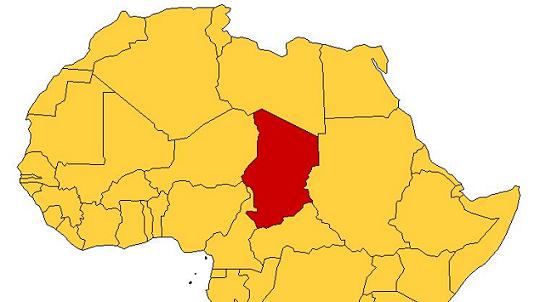
Chad (red on the map) is in north-central Africa and is on the eastern border of Sudan.

chad_map.jpg

Design a site like this with WordPress.com
Get started