The Onion on UN Report Declaring China Air Pollution Champion

In their inimitable way, the fine people at the Onion have used a new UN report on air pollution as the source for this satirical report. China is now the world’s worst (or best–I suppose it depends on one’s perspective) air polluter. Some memorable quotes from the Chinese “Ambassador” interviewed in the report:

“The labor of my people have [sic] made the sky black with the smoke of progress. We are overjoyed!”

“The sky over China is now a rainbow of grays reflecting all the shades of our prosperity.”

“Close to one million people will die of cancer in China this year. Cancer is a very modern disease!”

Newsweek Editor Fareed Zakaria Says “No” to Olympic Boycott

In a recent column, Newsweek’s Fareed Zakaria argues that the US should not boycott the Olympic Games in Beijing this summer.  He argues that it would have the opposite of the intended effect.  Here are some snippets:

Public humiliation does not work nearly as well on the regime in Beijing as private pressure. At first glance, China’s recent crackdown in Tibet looks like a familiar storyline: a dictatorship represses its people. And of course that’s part of the reality — as it often is in China. But on this issue, the communist regime is not in opposition to its people. The vast majority of Chinese have little sympathy for the Tibetan cause. To the extent that we can gauge public opinion in China and among its diaspora, ordinary Chinese are, if anything, critical of the Beijing government for being too easy on the Tibetans. The real struggle here is between a nationalist majority and an ethnic and religious minority looking to secure its rights.

In these circumstances, a boycott of the Olympics would have precisely the opposite effect that is intended. The regime in Beijing would become only more defensive and stubborn. The Chinese people would rally around the flag and see the West as trying to humiliate China in its first international moment of glory. (There are many suspicions that the United States cannot abide the prospect of a rising China.) For most Chinese, the Games are about the world’s giving China respect, rather than bolstering the Communist Party’s legitimacy…

…Some want to punish China for its association with the Sudanese government, which is perpetrating atrocities in Darfur. But to boycott Beijing’s Games because it buys oil from Sudan carries the notion of responsibility too far. After all, the United States has much closer ties to Saudi Arabia, a medieval monarchy that has funded Islamic terror. Should the world boycott America for this relationship?

SKY News Report on Situation in Tibet

Here is an interesting video, which captures the events surrounding an organized (by the Chinese authorities) visit of non-Chinese journalists to the capital city of Tibet, Lhasa.  It seems as though events conspired against the Chinese authorities just a little bit:

U.N. Security Council Silent on Tibet Protests

How do changing ideas about sovereignty–from sovereignty viewed as a “right” to sovereignty viewed as a “responsibilty”–affect the nature of how states act and the functioning of organizations such as the United Nations?  Just before spring break we viewed the documentary The Peacekeepers, where you were able to witness the deliberations that take place behind the scenes at the United Nations and the Security Council specifically. For Wednesday, we’ll read Erik Voeten’s article on “The Political Origins of the UN Security Council’s Ability to Legitimize the Use of Force”, the main point of which is obvious given the title. Today, the Guardian reports that the Security Council remains silent on the current situation in Tibet.

UNITED NATIONS, March 17 (Reuters) – The U.N. Security Council will likely keep silent about China’s crackdown on demonstrations in Tibet, mostly due to belief that provoking Beijing would accomplish nothing, diplomats said on Monday.
China, which has sent in troops to enforce control in the regional capital Lhasa, said earlier that the violent protests by Tibetans were organized by followers of the Dalai Lama seeking to derail the Beijing Olympics in August. Tibet’s exiled spiritual leader has denied this charge.
“The issue did not come up in the council,” China’s Deputy permanent U.N. representative Liu Zhenmin told Reuters after a meeting of the council on unrelated issues. “This has nothing to do with peace and security,” he said. “It is local violence, … a domestic issue.”
China, like the United States, Britain, France and Russia, is a permanent veto-wielding member of the council and would be able to block any attempts by the council to act on Tibet.
Russia’s U.N. Ambassador Vitaly Churkin, currently president of the council, told reporters without elaborating that he did not expect the 15-nation Security Council to discuss Tibet. Several other ambassadors confirmed this view.

Chinese Conceptions of “Rights”: From Mencius to Mao–and Now

Elizabeth has written the above-titled article, which has been published in the most recent issue of Perspectives on Politics. I will be adding this to the readings under the topic of democracy. I’ll adjust the syllabus on Blackboard accordingly and provide an electronic link to the full-text article on the electronic version of the syllabus. You can also link to the article here. [Updated: The link doesn’t work; go to Blackboard for the link.]

We will address the implications of “Asian values” for democracy and seek to understand the moral underpinnings of Chinses society (remember that we are not equating “Asian” with Chinese; Asia is a vast and heterogeneous continent), and whether western conceptions of democracy and human rights are necessary. How is political authority legitimized in Chinese society, according to Mencius, Confucius, and Mao? Here is the abstract to Perry’s article:

The recent explosion of popular protest in China, often framed as a demand for the fulfillment of “rights,” has captured widespread attention. Some observers interpret the protests as signs of a “moral vacuum.” Others see the unrest as signaling a powerful new “rights consciousness.” In either case, the protests are often regarded as a major challenge to the stability of the political system. In this article, an examination of Chinese conceptions of “rights,” as reflected in the ethical discourses of philosophers, political leaders, and protesters (and as contrasted with American understandings of rights), provides the basis for questioning prevailing assumptions about the fragility of the Chinese political order. For over two millennia, Chinese political thought, policy, and protest have assigned central priority to the attainment of socioeconomic security. As a result, the meaning of “rights” inChinese political discourse differs significantly from the Anglo-American tradition. Viewed in historical context, China’s contemporary “rights” protests seem less politically threatening. The Chinese polity appears neither as vacuous nor as vulnerable as it is sometimes assumed to be.

CO2 Emissions in China Increasing Faster than Previously Believed

In intro to comparative, we have generally compared spatially across countries (or states). There is a lot of explanatory power, however, that can be achieved by modeling and comparing political phenomena at the sub-national level. Maximilian Auffhammer and Richard Carson–two economists–have done this by modeling the rise in Chinese CO2 emissions, using a panel data set at the provincial level in China. Their data set includes 30 provincial-level entities (or provinces) analyzed between 1985 and 2004. See a post I made on China’s pollution problems and economic growth here. I’ve reproduced a slide show from the post below. Here’s a snippet from their paper, which can be accessed here:

[rockyou id=99737780&w=500&h=350]

The People’s Republic of China (PRC) has long been seen as the key future participant to an effective agreement limiting the adverse impacts of climate change. It is currently the number two emitter of carbon dioxide (CO2) and is about to overtake the United States, who has held this position since 1890, as the leading emitter. Further, the United States has long preconditioned its adherence to any international agreement such as the Kyoto Protocol on China’s formal concurrence that it would also undertake substantial CO2 reductions. Efforts to reach such an agreement failed in the late 1990’s during the Clinton administration and the Bush administration decided not to pursue policies that would allow it to sign the treaty and have it rati¯ed by the U.S. Senate.

This paper presents econometric forecasts that strongly suggest that the short to medium term path of Chinese CO2 emissions has increased by a factor of two or more since that time. Our best forecast has China’s CO2 emissions surpassing the United States before the year 2010 rather than 2020 as previously anticipated (Intergovernmental Panel on Climate Change, 2000; Siddiqi, Streets, Wu and He, 1994; Panayotou, Sachs and Zwane, 2002). Our focus in this paper is on exploring alternative econometric specifications for forecasting China’s CO2 emissions using a rich new panel dataset from 1985 to 2004 at the provincial level. The prediction of a dramatic recent increase in the predicted path of China’s CO2 emissions over the short to medium term horizon is shown to be robust to a wide range of alternative specifications. We show, however, that it is possible to strongly reject both the standard engineering specifications that appear in the Intergovernmental Panel on Climate Change (2000), and the recent Stern Report (2006) as well as the popular environmental Kuznets curve specification. All of the “best” models are dynamic in nature employing some type of lag structure, which is consistent with the nature of an installed durable capital stock.

“Truman lost China” and the effect of “the stuff of politics” on IR

In our discussion of the international (or system) level-of-analysis in IR, we noted some of the strengths and weaknesses of focusing explanation and description at that level. While system-level explanations are helpful in that they are comprehensive and holistic, a major disadvantage of that level is that it misses, or neglects, the “stuff of politics.” What does that mean?

ping_pong_diplomacy.jpgHere’s an explanation by way of example. The image below is of Richard Nixon and Mao ZeDong engaging in “ping pong diplomacy”* with Chinese Prime Minister Zhou Enlai looking on approvingly [why is Mao using a “Western” grip?]. Those of you who know a little bit about US-China diplomatic history understand the importance of the “Nixon goes to China” moment. The most significant point, for our purposes, is that this meeting signaled the re-establishment of diplomatic relations between the United States and “Red China”, after they had been cut off due to the 1949 victory of Mao’s Communists in the Chinese Civil War. It was not surprising that it was Nixon–a Republican–who was able to make this diplomatic gesture, since it would have been politically impossible for a Democratic president to have done the same. This is because President Harry S. Truman, and the whole of the Democratic party by association, had been vilified for having “lost China” to Communism. This is the kind of “stuff of politics” that is ignored when looking at IR from only an international (or system-level) perspective. Here is a clip from a documentary analyzing Nixon’s visit to China:

*Nixon and Mao never did play ping-pong (as far as I know), but their meeting was given the name “ping-pong diplomacy” since the first post-1949 diplomatic US visitors to China were table tennis players.

“Who” is China? A Constructivist Approach to Security

William A. Callahan is a fellow at the Woodrow Wilson Center for International Scholars who is currently working on a project that links Chinese notions of self-identity and that country’s broader security environment.  As you may have guessed, Callahan approaches the topic from a constructivist perspective, in which issues of culture and identity are paramount.  A realist would never ask “who” is China, but “what” is China.   Here’s a snippet:

Who is China? This question is fundamental to the internal debate among Chinese elites as they grapple with national identity which, in turn, affects policy decisions…culture and history are intimately linked to China’s current foreign policy outlook.

Callahan’s book project analyzes how history, geography, and ethnicity shape China’s relations with the world. “To understand this, we must look at how China relates to itself,” he said. “China’s national security is closely tied to its national insecurities.”

One such insecurity is its shame over lost territory. Callahan cited “national humiliation maps” that outline historical China’s imperial boundaries juxtaposed with present-day borders. “These maps, which are produced for public consumption, narrate how China lost territory to imperialist invaders in the 19th century—especially Taiwan to Japan and the North and West to Russia,” said Callahan. “China lost a large chunk of territory. The humiliation—and how to cleanse it—is an important point that shapes China’s nationalism and pride.”

In fact, most demonstrations in China about any given problem usually have a historical aspect, he said, such as in 1999, when the United States bombed the Chinese Embassy in Belgrade, which was viewed in China as a humiliation similar to those of a century ago at the hands of the West.

“Idealized versions of China’s imperial past are now inspiring Chinese scholars’ and policymakers’ plans for China’s future—and the world’s future—in ways that challenge the international system,” said Callahan. This makes the study of identity politics all the more critical.

China and Japan, for example, have close economic relations but cool social and political ties. Callahan said, “China relates to Japan as an evil state, recalling World War II atrocities, such as the Nanjing massacre, and this memory has taken over the relationship.”

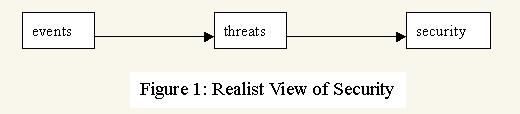
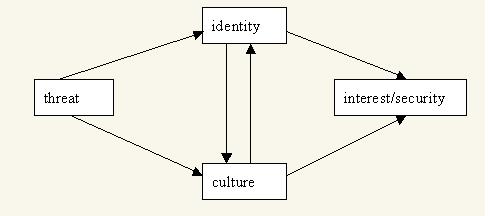
Notice the importance of the premise in the penultimate paragraph: that “idealized versions of China’s past” (i.e., culture and identity) are having a causal impact on China’s foreign policy.  This contrasts starkly with realist conceptions of the nature of international relations.  Below are two diagrams from Shih demonstrating the difference between realist and constructivist conceptions of security.

shih_realist_security.jpg

shih_constructivist_security.jpg

Notice that the impact of threats on security is not direct in the constructivist view; rather, it is mediated by culture and identity, both of which also affect each other.

Empty Olympic Promises? China as Global Citizen

The New York Times editorial board has chosen to use its valuable op-ed space to evaluate the nature of China’s behavior on the world stage.   The granting of the 2008 Summer Olympic Games to China years ago was meant to serve as a “carrot” in the carrot-and-stick approach being used by sovereign states, like the US, Canada, etc., and IGOs, like the United Nations to nudge China along the road to democratic reform and the protection of personal liberties in that communist state.  Has it worked?  Here’s a data point that rebuts the theory:

Six months out from the 2008 Olympics, China has jailed another inconvenient dissident. Hu Jia was dragged from his home by state police agents, and last week he was formally charged with inciting subversion. To earn the right to host the Games, China promised to improve its human rights record. Instead, it appears determined to silence anyone who dares to tell the truth about its abuses.

Mr. Hu and his wife, Zeng Jinyan, are human rights activists who spent much of 2006 restricted to their apartment. She used the power of the Internet to blog about life under detention while he wrote online about peasant protests and human rights cases.

Mr. Hu’s recent testimony, by telephone, to the European Parliament about Olympics-related rights violations may have been the last straw. Ms. Zeng and the couple’s two-month-old baby remain in their apartment under house arrest, with telephone and Internet connections now severed.

Improving its human rights record isn’t China’s only unmet commitment to the International Olympic Committee. It also promised to improve air quality. Now athletes and their coaches are figuring out how to spend as little time as possible in China’s smog-swamped capital, where they may need masks to breathe.

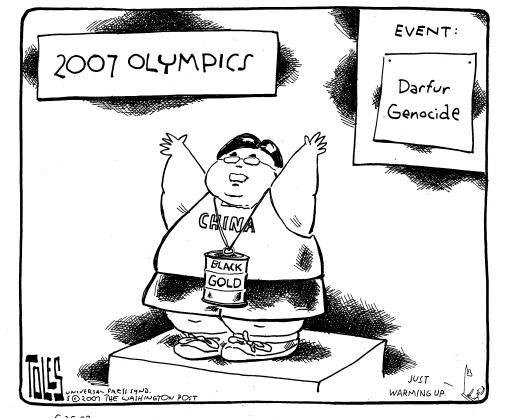
I’ve written about China before and mentioned the work of an NGO whose goal is to make the Chinese Olympics, the “Genocide Olympics”, highlighting China’s complicity in the genocide in Darfur.  See this post also by one of my students in Intro to IR.

The “Genocide Olympics”?

china_darfur.jpg

(Image from the San Francisco Chronicle)

In a piece published today New York Times op-ed columnist, Nicholas Kristof, addresses the link between China’s foreign policy goals and the continuing genocide in the Sudanese region of Darfur. Hundreds of thousands have been killed or have died from starvation, disease and malnutrition, and millions have been displaced, whether internally or as refugees abroad, for which, Kristof argues, China bears some moral culpability. Kristof is not alone in this view and the NGO, Olympic Dream for Darfur, has decided to try to do something about it by establishing the “Genocide Olympics” campaign, which is meant to shame China into changing its policies toward Sudan.* Will this work? Is it good foreign policy? Is it morally acceptable to mix sport with politics? Remember, there is historical precedent for this type of thing as the United States boycotted the 1980 Moscow Olympics in retaliation for the Soviet invasion of Afghanistan. Quoting Kristof:

The Beijing Olympics this summer were supposed to be China’s coming-out party, celebrating the end of nearly two centuries of weakness, poverty and humiliation.

Instead, China’s leaders are tarnishing their own Olympiad by abetting genocide in Darfur and in effect undermining the U.N. military deployment there. The result is a growing international campaign to brand these “The Genocide Olympics.”

This is not a boycott of the Olympics. But expect Darfur-related protests at Chinese Embassies, as well as banners and armbands among both athletes and spectators. There’s a growing recognition that perhaps the best way of averting hundreds of thousands more deaths in Sudan is to use the leverage of the Olympics to shame China into more responsible behavior.

The central problem is that in exchange for access to Sudanese oil, Beijing is financing, diplomatically protecting and supplying the arms for the first genocide of the 21st century. China is the largest arms supplier to Sudan, officially selling $83 million in weapons, aircraft and spare parts to Sudan in 2005, according to Amnesty International USA. That is the latest year for which figures are available.

As the highlighted portion of the quote above implies, China is acting in a fundamentally realist manner, eschewing moral concerns in order to increase its power and security.

*Please do not refer to Sudan as the Sudan, or to Ukraine as the Ukraine, but Sudan and Ukraine, respectively, as they are no longer regions within colonial empires, but are independent states in their own right. Adding the in front of their country names is anachronistic.

Design a site like this with WordPress.com
Get started