Egypt’s Mubarak Seeks Dissolution of Government Amidst Mass Protests

In today’s session of IS 210 we analysed the concept of the state and also talked about the related political concepts of regime and government. We noted that they were conceptually distinct political phenomena with differing levels of institutionalisation–with the state being the most institutionalised, and the government being the least.

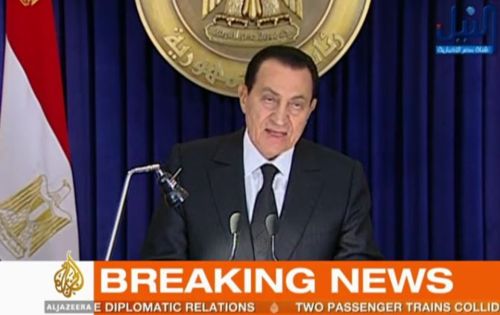
In the midst of continuing mass demonstrations against his rule in Egypt, president Hosni Mubarak has asked the government to resign. Mubarak seemingly hopes that the government’s resignation will appease the demonstrators. What’s interesting from our perspective–as students of comparative government–is that Mubarak hopes to maintain his regime at the expense of the government. It is accurate to call the current leadership of Mubarak a regime, since the norms/rules associated with political authority at the national level have been institutioinalised over the course of the almost three-decade reign by Mubarak as Egypt’s president. The question then becomes will the protesters be satisfied with a change in government alone, or will they insist on a change in the nature of this authoritarian regime, which will obviously not be effected without the removal from office of Mubarak himself. As in the case of many authoritarian regimes, in Egypt it is also true that the autocrat is the regime himself.

Here’s more from the CBC on Mubarak’s latest moves:

Egyptian President Hosni Mubarak says he has asked the government to resign and promised reforms as protests engulf his country.

In a televised speech broadcast early Saturday local time, Mubarak used his first public comments since the unrest began to defend the security crackdown on demonstrations.

“I assure you … I’m working for the people…. as long as you’re respecting the law,” Mubarak said.

“We have to be careful of anything that would allow chaos,” he said.

At the same, Mubarak tried to speak to the demonstrators who have filled Egypt’s streets for days.

“I’ll always be on the side of the poor,” he said. “I am with bettering the economy.”

Mubarak, who has ruled Egypt for three decades, has been facing the biggest pressure of his tenure.

Before the president spoke, tens of thousands of anti-government protesters defied a night curfew and some reportedly set fire to Mubarak’s party headquarters in Cairo. Flames were seen licking at the National Democratic Party headquarters shortly after 6 p.m. local time, though it was not immediately confirmed how the fire began.

The best real-time coverage of the political events in Egypt is, in my opinion, Al-Jazeera. You can watch live streaming coverage of Al-Jazeera here.
A Wave of Protests across North Africa and the Middle East

Following closely in the aftermath of the dramatic changes that have taken place in Tunisia recently, the political unrest seems to have swept its way across northern Africa, with the situation in Egypt now drawing most of the attention. Alan Cowell of the New York Times writes:

After days of protests that have toppled one president and shaken many others, governments across the Middle East braced on Friday for http://www.guardian.co.uk/global/blog/http://www.guardian.co.uk/global/blog/2011/jan/25/middleeast-tunisia://www.guardian.co.uk/global/blog/2011/jan/25/middleeast-tunisia/jan/25/middleeast-tunisia outbursts of rage and discontent directed at entrenched regimes confronting an exceptional clamor for democracy.

The immediate epicenter of the protests was Egypt, where Internet and cellphone connections were closed or restricted in Cairo, Alexandria and other places. Riot police took to the streets of Cairo before the Friday noon prayers that in http://www.guardian.co.uk/global/blog/2011/jan/25/middleeast-tunisia parts of the Islamic world have been a prelude to unrest as worshippers pour onto the streets.

The protests have underscored the blistering pace of events that have transformed the visage of the Arab world, particularly among regimes that have traditionally enjoyed the support of successive administrations in Washington.

Note the words that I have changed to red in the quote above. Is this author using these words as synonyms? If so, is he using them as precisely as he could be? Is he using them incorrectly?

For more information, here’s a useful set of reports, with myriad links to video and audio, from the UK Guardian’s Jack Shenker reporting in Cairo. In addition, the CBC website has an interesting flash-type graphic showing how the geographical extent of the spread of the protests.

Tunisia’s President Steps Down and Flees Country

We’re witnessing the fall of another autocrat, this time in the northern African country of Tunisia. The (as of earlier today) former president, Zine al-Abidine Ben Ali, has stepped down amidst worsening violence and protests, ending 23 years of autocrat rule. The BBC reports:

Tunisia’s president has stepped down after 23 years in power amid unprecedented protests on the streets of the capital Tunis.

Prime Minister Mohammed Ghannouchi said he would be taking over from President Zine al-Abidine Ben Ali. A state of emergency has been declared amid protests over corruption, unemployment and rising prices.

BBC sources say Mr Ben Ali has flown to the Mediterranean island of Malta, but this has yet to be confirmed.

Earlier, police fired tear gas as thousands of protesters gathered outside the interior ministry.

Doctors say that 13 people were killed in overnight clashes in Tunis, and there are unconfirmed reports that five people have been killed in protests on Friday outside the capital.

Troops have surrounded the country’s main international airport, Tunis Carthage, and the country’s air space has been closed.

In an address on state television, Mr Ghannouchi said: “Since the president is temporarily unable to exercise his duties, it has been decided that the prime minister will exercise temporarily the duties.”
Tunisia’s President Zine al-Abidine Ben Ali addresses the nation in this still image taken from video, January 13, 2011. Zine al-Abidine Ben Ali was only Tunisia’s second president since independence from France in 1956

Mr Ghannouchi, 69, a former finance minister who has been prime minister since 1999, will serve as interim president. Earlier, the president – who had said in a TV address on Thursday night that he would relinquish power in 2014 – said he was dismissing the government and dissolving parliament, and that new elections would be held within six months.

The state of emergency decree bans more than three people from gathering together in the open, and imposes a night-time curfew. Security forces have been authorised to open fire on people not obeying their orders. Human rights groups say dozens of people have died in recent weeks as unrest has swept the country and security forces have cracked down on the protests.

The protests started after an unemployed graduate set himself on fire when police tried to prevent him from selling vegetables without a permit. He died a few weeks later.

If Tunisia manages to use this moment as the springboard towards democratisation, it would be only the second true democracy in the Middle East/North Africa. According to the Freedom House organisation, that region of the world is the least democratic, as the map below demonstrates

Freedom in the World 2010

Ganguly on Structural Sources of Authoritarianism in Pakistan

In Intro to Comparative Politics, we devote a considerable amount of time to understanding regime types–what factors contribute to differences amongst authoritarian regimes, why democracies find it difficult to build deep roots in some places, what are the sources of authoritarianism and democracy.

Sumit Ganguly, an expert on nationalism, and south Asian nationalism in particular, recently gave a talk at a round table organized by the Institute of Peace and Conflict Studies (which is based in New Delhi) on the sources of authoritarianism in Pakistan.  The recent decision by embattled Pakistan President Pervez Musharraf to step down draws further attention to the nature of the political regime in Pakistan.

Ganguly evaluates, then dismisses, three standard arguments about the structural sources of authoritarianism, then proceeds to offer an alternative, which he believes more successfully accounts for the persistence of authoritarianism in Pakistan.  Ganguly argues that the most compelling structural explanation can be found in an analysis of three main components of the national movement in Pakistan–its structure, ideology and organization,

“The Pakistan movement stood in sharp contrast to its Indian counterpart which, under the towering influence of Gandhi and Nehru, had been democratized and came to represent a cross section of the populace. The Congress had also cultivated ideas of democracy through debate and compromise which were not alien to its leadership at the time of independence. On the other hand, the Pakistan movement under the tutelage of the Muslim League suffered from an extremely limited base confined geographically to what broadly constitutes the modern day state of Uttar Pradesh (UP). The socio-economic profile of its leadership was confined to the ranks of UP notables who largely hailed from feudal backgrounds. Against such a setting, M.A Jinnah successfully built up the Muslim League centered on his personality and the idea that the Congress would not guarantee the rights of Muslims.”

Is there a causal link between Natural Resources and Conflict?

The “resource curse” is the name given to the alleged causal links between a country’s abundance of natural resourcee and the existence of all sorts of “bad things”, such as authoritarianism, economic stagnation and/or outright economic decline, increased probability of attempted coups d’etat, etc.  In our session on political economy we read Jensen and Wantchekon’s article on the link between natural resource wealth and authoritarianism, specifically, and we also looked at Richard Snyder’s article on the putative link between the existence of what he calls “lootable wealth” and political (in)stability in a state.  Their conclusions were at times complementary but at times divergent.  What matters (at least for political stability), according to Snyder, is the ability of the rulers (i.e., the government) to partake of the rents/riches accrued by the exploitation of the particular “lootable” resource.

Snyder’s is, of course, not the final word on the topic and there is an avalanche of published research on this very topic.  A new resource that can be used to find data on the link between natural resources and conflict–political, civil, etc.–is the Resource Conflcit Monitor, maintained by the Bonn International Center for Conversion.  From their web site:

Many developing countries rich in natural resources, such as diamonds and oil, have been plagued by poverty, environmental degradation and violent conflicts. In many of these countries, the natural wealth has not led to sustainable development. On the contrary, in some instances resource wealth has provided the funding and reasons for sustaining civil wars. This so-called ‘resource curse’ brought a lot of attention to the link between resources and conflict over the past decade. ’Governance’ has been identified as key factor for understanding the resource-conflict dynamic and for mitigating its negative impact in developing countries. ‘Resource governance’ in the present context describes the way in which governments regulate and manage the use of natural resources as well as the redistribution of costs and revenues deriving from those resources

The Resource Conflict Monitor (RCM) monitors how resource-rich countries manage, administer and govern their natural resources and illustrates the impact of the quality of resource governance on the onset, intensity and duration of violent conflict. The RCM serves as a tool for identifying and supporting viable resource governance and contributes to conflict prevention, post-conflict reconstruction and sustainable development….

There is an informative, and user-friendly, application that provides historical annual information on conflict and resources in individual countries.  Here is the result for Sierra Leone, the specifics of which should be familiar to those of you who watched Cry Freetown.  For an explanation of “resource governance” and “resource regime compliance, go here and scroll down.

There’s an additional methodological point that is crying out to be made here.  Notice that the level of conflict intensity first decreases rather significantly between 1996 and 1997, then increases dramatically between 1997-1999, to then fall just as dramatically between 2000 and 2002, while at the same time “resource governance” and “resource regime compliance” do not change much at all.  This means that we have to be very careful about attributing the level of conflict to the two afore-mentioned phenomena.  Maybe the causal link between these two and conflict intensity is not monotonic, maybe there is a threshold effect at work, or maybe the existence of an abundance of natural resources is a sufficient (under certain conditions) cause of conflict intensity.  On the whole, though, there certainlly doesn’t seem to be a clear linear, and/or monotonic relationship between resources and conflict (at least in Sierra Leone,  between 1996-2006)

Political Terror Scale

Authoritarian regimes use both “carrots” and “sticks” in order to control their citizens. The “sticks” approach encompasses everything from surveillance to outright physical brutality.  While the use of physical terror to undermine the bodily integrity of their citizens by authoritarian regimes is fairly well known, it is also evident that democracies are not immune to using this form of control over their populations.  Almost by definition, authoritarian regimes terror-prone, but how much more so than democracies. You can fine the answers to this at the Political Terror Scale website, where they have a set of interesting interactive maps.

How is “political terror” defined?  Well, they have created a scale (from 1-5) which is an indicator of the level of political terror citizens in a country face in any given year. The definitions for each of the categories is below.

El Salvador during the 1980s was ruled by a military regime, which used to death squads to “disappear” its internal opponents.  U2 took note:

rating scale Political Terror Scale Levels
Level 5 : Terror has expanded to the whole population. The leaders of these societies place no limits on the means or thoroughness with which they pursue personal or ideological goals.
Level 4 : Civil and political rights violations have expanded to large numbers of the population. Murders, disappearances, and torture are a common part of life. In spite of its generality, on this level terror affects those who interest themselves in politics or ideas.
Level 3 : There is extensive political imprisonment, or a recent history of such imprisonment. Execution or other political murders and brutality may be common. Unlimited detention, with or without a trial, for political views is accepted.
Level 2 : There is a limited amount of imprisonment for nonviolent political activity. However, few persons are affected, torture and beatings are exceptional. Political murder is rare.
Level 1 : Countries under a secure rule of law, people are not imprisoned for their view, and torture is rare or exceptional. Political murders are extremely rare.
Design a site like this with WordPress.com
Get started