CNN’s Startling use of its “Arab Affairs Editor”

A couple of students in my PLSC250 class have posted a clip of part of CNN’s reaction to news of the death of Al Qaeda’s Number 3 in command. (I thought that I’d never see the day when there was a more dangerous gig than being Spinal Tap’s drummer, but being Al Qaeda’s number 3 must be it.)*

Anyway, the anchor relays the news to viewers and turns to get expert advice from CNN’s “Senior Arab Affairs Editor.” What!?! An Arab affairs editor to give us insight into the area of the Pakistani/Afghan border where there are large numbers of Pashtuns, Tajiks, and Hazara, but no Arabs?

Go and watch the clip for yourself.

*I never thought that I’d be able to fit Al Qaeda and Spinal Tap into the same post.

A bio of Spinal Tap’s first drummer:

pepys.jpgPepys, John “Stumpy” (1943-1969): David and Nigel met the tall, blond geek in 1964 while touring as members of the Johnny Goodshow Revue. At a Southampton pub then known as the Bucket (now the Bucket and Pail), the boys jammed with the bespectacled drummer, nicknamed “the peeper” and then a member of the Leslie Cheswick Soul Explosion (now Les and Mary Cheswick). The three men would go on to form the Thamesmen and later, with Ronnie Pudding and Denny Upham, Spinal Tap, which played its first gig in December 1966. Pepys would die in a bizarre gardening accident shortly after the release of the band’s third album, “Silent But Deadly.” (IST) Nigel: “It was really one of those things the authorities said, ‘Well, best leave it unsolved.’ “

US Intelligence Director Assesses Al Qaeda Threat

A new article in the New York Times analyzes Mike McConell’s Tuesday testimony to the Senate Intelligence Committee.  How successful has the war on terror been in destroying th threat capability of that terrorist network?  According to McConell’s testimony, not too successful, unfortunately:

Al Qaeda is gaining in strength from its refuge in Pakistan and is steadily improving its ability to recruit, train and position operatives capable of carrying out attacks inside the United States, the director of national intelligence told a Senate panel on Tuesday.

The director, Mike McConnell, told lawmakers that Osama bin Laden and his deputy, Ayman al-Zawahri, remained in control of the terrorist group and had promoted a new generation of lieutenants. He said Al Qaeda was also improving what he called “the last key aspect of its ability to attack the U.S.” — producing militants, including new Western recruits, capable of blending into American society and attacking domestic targets.

A senior intelligence official said Tuesday evening that the testimony was based in part on new evidence that Qaeda operatives in Pakistan were training Westerners, most likely including American citizens, to carry out attacks. The official said there was no indication as yet that Al Qaeda had succeeded in getting operatives into the United States.

One point merits comment: The ability of a non-territorially-based network to threaten powerful states like the US is severely diminished without protection from states, like Pakistan.  Why Pakistan is an ideal refuge for Al Qaeda is a complicated story, but it goes back to the initial founding of the state in the 1940s, and the fact that the Pakistani state has never truly controlled–ie., asserted the monopoly of political violence in the parts of Pakistan in which members of Al Qaeda are currently taking refuge.  A more forceful response from the Pakistani government could have truly powerful destabilizing effects on Pakistan, and on the region as a whole.

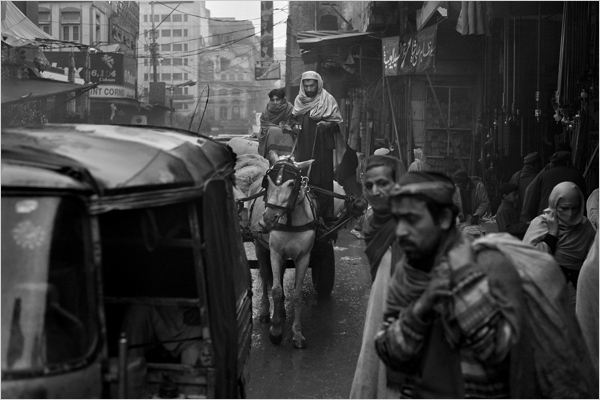
See this slide show at the following link, for a fascinating look at Peshawar, a Pakistani city right at the heart of the battle:

peshawar.jpg

The Federal Budget and Military Defense Spending

When we address Chapter 5 of Mingst, we’ll learn about the various sources of power. One of the most important, obviously, is military power. Given President Bush’s latest $3.1 trillion budget proposal, I began to wonder how much of that is apportioned to spending on the military and defense? Fred Kaplan from Slate.com has done the research and has concluded the following:

As usual, it’s about $200 billion more than most news stories are reporting. For the proposed fiscal year 2009 budget, which President Bush released today, the real size is not, as many news stories have reported, $515.4 billion—itself a staggering sum—but, rather, $713.1 billion.

Is that a lot? Is it “staggering”, as Kaplan suggests? Should we be concerned with how much we spend militarily? I think the answer is yes, but in the manner of a discriminating consumer. In other words, what is our “rate of return” on that spending? Is the spending efficient and non-wasteful? Could we be just as safe and powerful if we spent 75%, or 50% of that total? A couple of data points suggest that US military spending does not give us a good rate of return and if national defense were a private industry, we’d be looking for a different supplier. First, how does US military spending compare to how much China, Russia (two potential rivals) or the European Union, or Canada, are spending on defending their states? Here’s an estimate, from the Washington-based think tank GlobalSecurity. org (which has a lot of great data related to security issues):

World Wide Military Expenditures

Country

Military expenditures (US$)

Budget Period

World

$1100 billion

2004 est. [see Note 4]

Rest-of-World [all but USA]

$500 billion

2004 est. [see Note 4]

United States

$623 billion

FY08 budget [see Note 6]

China

$65.0 billion

2004 [see Note 1]

Russia

$50.0 billion

[see Note 5]

France

$45.0 billion

2005

United Kingdom

$42.8 billion

2005 est.

Japan

$41.75 billion

2007

Germany

$35.1 billion

2003

Italy

$28.2 billion

2003

South Korea

$21.1 billion

2003 est.

India

$19.0 billion

2005 est.

Saudi Arabia

$18.0 billion

2005 est.

Australia

$16.9 billion

2006

Turkey

$12.2 billion

2003

Brazil

$9.9 billion

2005 est.

Spain

$9.9 billion

2003

Canada

$9.8 billion

2003

Israel

$9.4 billion

FY06 [see Note 7]

Kaplan observes something even more interesting than the relative amount that the United States is spending–the apportionment of that spending amongst the different military services:

The “Overview” section of the Pentagon’s budget document contains a section called “Program Terminations.” It reads, in its entirety: “The FY 2009 budget does not propose any major program terminations.”

Is it remotely conceivable that the Defense Department is the one federal bureaucracy that has not designed, developed, or produced a single expendable program? The question answers itself.

There is another way to probe this question. Look at the budget share distributed to each of the three branches of the armed services. The Army gets 33 percent, the Air Force gets 33 percent, and the Navy gets 34 percent.

As I have noted before (and, I’m sure, will again), the budget has been divvied up this way, plus or minus 2 percent, each and every year since the 1960s [author’s emphasis]. Is it remotely conceivable that our national-security needs coincide so precisely—and so consistently over the span of nearly a half-century—with the bureaucratic imperatives of giving the Army, Air Force, and Navy an even share of the money? Again, the question answers itself. As the Army’s budget goes up to meet the demands of Iraq and Afghanistan, the Air Force’s and Navy’s budgets have to go up by roughly the same share, as well. It would be a miracle if this didn’t sire a lot of waste and extravagance.

Congress exposes this budget to virtually no scrutiny, fearing that any major cuts—any serious questions—will incite charges of being “soft on terror” and “soft on defense.” But $536 billion of this budget—the Pentagon’s base line plus the discretionary items for the Department of Energy and other agencies—has nothing to do with the war on terror. And it’s safe to assume that a fair amount has little to do with defense. How much it does and doesn’t is a matter of debate. Right now, nobody’s even debating.

defense_budget_2008_2009.jpg

Source for chart: Department of Defense

American Conservatives Against John McCain’s Foreign Policy

A few sessions from now we’ll analyze international relations from a state-level perspective.  The great debate in IR, with respect to the state level, is whether state level characteristics such as economic system, political regime, etc., are determinative in explaining and predicting state behavior at the international level.  As we have already discussed, the neorealists have a ready answer: the only state-level characteristic that matters in foreign affairs is power.  The liberals, of course, have a different viewpoint, as do radicals and constructivists.   Notice one word that was absent from the preceding two sentences–conservative.  What are the elements of a conservative foreign policy?  [There is, of course, a neoconservative approach (or theory) in IR, but what about conservative, with the neo prefix?  Moreover, does the ideological viewpoint of the U.S. President matter in the way that foreign policy decisions in the White House are made?

To help answer the second question, I would like to introduce you to a group of self-professed American conservatives, who banded together in 2002 and created The American Conservative magazine.  How do those in charge of the magazine define conservatism and what are their views of the upcoming presidential election?

We believe conservatism to be the most natural political tendency, rooted in man’s taste for the familiar, for family, for faith in God. We believe that true conservatism has a predisposition for the institutions and mores that exist. So much of what passes for contemporary conservatism is wedded to a kind of radicalism—fantasies of global hegemony, the hubristic notion of America as a universal nation for all the world’s peoples, a hyperglobal economy. In combination with an increasingly unveiled contempt for America’s long-standing allies, this is more a recipe for disaster.

Against it, we take our stand.

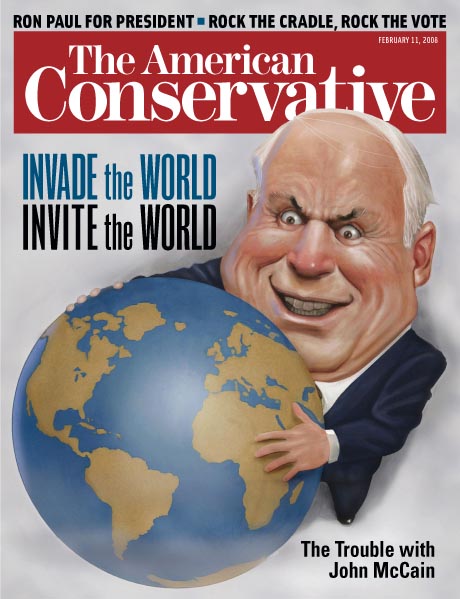
Consistent with their view of conservatism, they are worried (terrified?) with the prospect of a McCain presidency.  Rather than excerpt from a recent article in the magazine that assesses what a President McCain means for the future of American foreign policy, I’ll provide a link to the article and give you the title and a shot of the cover:

“The Madness of John McCain–A militarist suffering from acute narcissism and armed with the Bush Doctrine is not fit to be commander in chief.”

mccain_american_conservative_magazine.jpg

State Capacity and the US Federal Budget

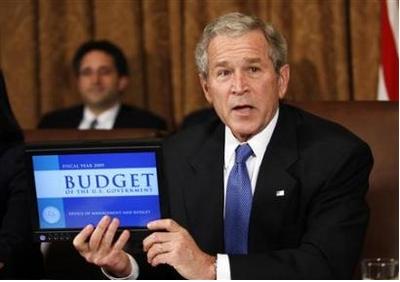
bush_budget.jpgWe’re currently discussing and analyzing the state, and its important role in comparative politics. One of the dimensions on which we can compare state power is “capacity.” What is capacity? According to O’Neil (p.38-39), “capacity is the ability of the state to wield power in order to carry out the basic tasks of providing security and reconciling freedom and equality. A state with high capacity is able to formulate and enact fundamental policies and ensure stability and security for both itself and its citizens.” We were presented with evidence today of a demonstration of the high capacity of the United States as President George W. Bush unveiled his new 3.1 trillion-dollar (I’m no mathematician, but that’s at least a couple of gazillion dollars, isn’t it?) budget. Any state that can make its citizens cough up that much money, more or less willingly, has to have high capacity.

The photograph is from Yahoo News, click here to see a video clip of the president submitting this year’s federal budget, the first one in American history to be submitted in electronic form. As the president correctly surmised, “this will save a lot of trees!”

Empty Olympic Promises? China as Global Citizen

The New York Times editorial board has chosen to use its valuable op-ed space to evaluate the nature of China’s behavior on the world stage.   The granting of the 2008 Summer Olympic Games to China years ago was meant to serve as a “carrot” in the carrot-and-stick approach being used by sovereign states, like the US, Canada, etc., and IGOs, like the United Nations to nudge China along the road to democratic reform and the protection of personal liberties in that communist state.  Has it worked?  Here’s a data point that rebuts the theory:

Six months out from the 2008 Olympics, China has jailed another inconvenient dissident. Hu Jia was dragged from his home by state police agents, and last week he was formally charged with inciting subversion. To earn the right to host the Games, China promised to improve its human rights record. Instead, it appears determined to silence anyone who dares to tell the truth about its abuses.

Mr. Hu and his wife, Zeng Jinyan, are human rights activists who spent much of 2006 restricted to their apartment. She used the power of the Internet to blog about life under detention while he wrote online about peasant protests and human rights cases.

Mr. Hu’s recent testimony, by telephone, to the European Parliament about Olympics-related rights violations may have been the last straw. Ms. Zeng and the couple’s two-month-old baby remain in their apartment under house arrest, with telephone and Internet connections now severed.

Improving its human rights record isn’t China’s only unmet commitment to the International Olympic Committee. It also promised to improve air quality. Now athletes and their coaches are figuring out how to spend as little time as possible in China’s smog-swamped capital, where they may need masks to breathe.

I’ve written about China before and mentioned the work of an NGO whose goal is to make the Chinese Olympics, the “Genocide Olympics”, highlighting China’s complicity in the genocide in Darfur.  See this post also by one of my students in Intro to IR.

It Just Keeps on Getting Worse: Violence Escalates in Chad

From the BBC, we learn that the situation in the African state of Chad is going downhill quickly. According to the Failed States Index compiled by the Fund For Peace, Chad was the 5th most failed state in 2007. Chad has been affected negatively by the ongoing conflict and genocide in the neighboring state of Sudan.

Thousands of people are fleeing the Chad capital, N’Djamena, after two days of fierce fighting between government and rebel forces in the city.

chad.jpgThe government says it has pushed the rebels out of the city but they say they withdrew to give civilians the chance to evacuate. Aid workers report that fighting is continuing outside the city, while dead bodies litter the streets.

The UN Security Council has urged member states to help the government. The BBC’s Laura Trevelyan at the UN in New York says this non-binding statement gives the go-ahead to France and other countries to help President Idriss Deby’s forces against the rebels.

Chad’s former colonial power France has a military base in Chad and has previously helped the government with logistics and intelligence. Thousands of people have been streaming across the Ngueli bridge, which separates Chad from Cameroon.

Local officials have told the UN refugee agency that thousands were also crossing at the border town of Kousseri. “We’re expecting a lot more people coming,” said UNHCR spokesman Ron Redmond. He also said he was extremely concerned for the 240,000 Darfur refugees in Chad.

The International Crisis Group released a report back in 2006 detailing the situation in Chad and fearing a return to war in that country. You can view the executive summary here, where there is a link to the full report (the full report is only in French, however). Here is a snippet from that summary:

The April 2006 rebel offensive brought Chad to the brink of all-out civil war. The victory that President Idriss Déby ultimately achieved in pushing the United Front for Democracy and Change (FUCD) back from the gates of the capital, N’Djamena, to its Darfur sanctuary settled nothing on the military front and underscored the political fragility of the regime. The army’s success was primarily due to French logistical and intelligence support, while the setback paradoxically may encourage the armed opposition groups to forge closer links in order to pursue a war of attrition in the north, the east and along the border with the Central African Republic. The crisis is far from resolved, and is likely to be an enduring one.

Only weeks before the 3 May presidential elections, Déby had to fight off spectacular defections of senior figures from the army and the political elite as well as assassination attempts, all likewise aimed at preventing him from gaining a third term but he won the controversial elections with 64.67 per cent of the vote.[1] Though opposition groups challenged the result, France and the wider international community hastily accepted it to avoid further destabilisation, while declaring that they now expected the president to democratise his regime.

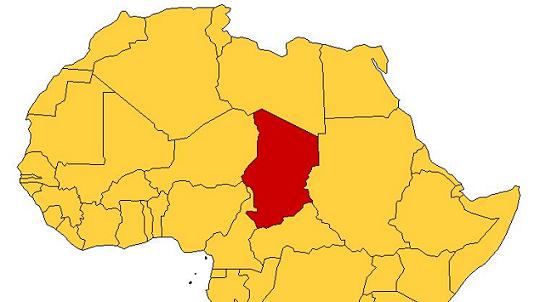
Chad (red on the map) is in north-central Africa and is on the eastern border of Sudan.

chad_map.jpg

Centrist wins run-off Election for Serbian Presidency

The BBC reports that centrist candidate Boris Tadić has won more than 50% of the vote in the second round of the Serbian presidential elections held on Sunday. Turnout was high and the Serbian electorate has, with a slight majority, signaled its intention of looking towards the future and the West, rather than returning to the nationalist rhetoric and policies of Serbia’s recent past.

Serbian President Boris Tadic, 3 February 2008

Mr Tadic wants to push forward his European integration agenda

Serbia’s pro-Western president, Boris Tadic, has won a second round election run-off against nationalist challenger Tomislav Nikolic, who conceded defeat. Mr Tadic was re-elected by more than 50% of voters in a contest that saw a high voter turnout.

Car horns could be heard around Belgrade as Tadic supporters took to the streets of the Serbian capital to celebrate the victory.

The election was seen as a referendum on Serbia’s relations with Europe.

“Serbia has shown its great democratic potential,” said Mr Tadic said in his victory speech, in which he lauded Mr Nikolic for his performance in the knife-edge contest, and said the country still had hard work ahead.

Design a site like this with WordPress.com
Get started