
What is Comparative Politics?

Most students (and non-students, for that matter) have only a vague idea of the content of “comparative politics.” In other sub-disciplines in political science, such as American Politics, and International Relations, the subject matter is almost self-explanatory. In a subsequent post, I’ll tell you what I think comparative politics is about. For now, I provide for you (once again, free of charge!) a sample of the titles of some recent articles published in one of the leading journals in the field of comparative politics, the aptly titled Comparative Politics.

Volume 40, Number 2, January 2007

  • John Sidel, “Social Origins of Dictatorship and Democracy Revisited: Colonial State and Chinese Immigrant in the Making of Modern Southeast Asia”
  • Frances Hagopian, “Latin American Catholicism in an Age of Religious and Political Pluralism: A Framework for Analysis”
  • Gary L Goodman and Jonathan T. Hiskey, “Exit without Leaving: Political Disengagement in High Migration Municipalities in Mexico”
  • Ozge Kemahlioglu, “Particularistic Distribution of Investment Subsidies under coalition Governments: The Case of Turkey”
  • Lianjiang Li, “Political Trust and Petitioning in the Chinese Countryside”

Volume 40, Number 1, October 2007

  • J. Samuel Valenzuela, Timothy R. Scully, and Nicolás Somma, “The Enduring Presence of Religion in Chilean Ideological Positionings and Voter Options”
  • Christina Davis and Jennifer Oh, “Repeal of the Rice Laws in Japan: The Role of International Pressure to Overcome Vested Interests”
  • Linda J. Cook, “Negotiating Welfare in Postcommunist States”
  • Wim van Oorschot and Wilfred Uunk, “Welfare Spending and the Public’s Concern for Immigrants: Multilevel Evidence for Eighteen European Countries”
  • Christian Albrekt Larsen, “How Welfare Regimes Generate and Erode Social Capital: The Impact of Underclass Phenomena”
  • Review Article: Veljko Vujačić, “Elites, Narratives, and Nationalist Mobilization in the Former Yugoslavia”
Continue reading “What is Comparative Politics?”

The Failed States Index by the Fund for Peace

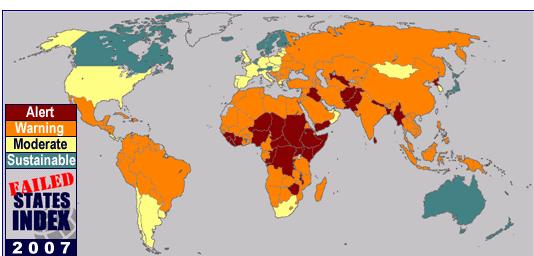
Here is another great resource compiled by the Fund for Peace. The Failed States Index tracks the stability of, at last count (2007) 177 states around the world on the basis of twelve indicators, grouped into social, economic and political categories. Some of the specific indicators are demographic pressures, a legacy of vengeance, uneven economic development and the rise of factionalized elites. Once again, there is a wealth of information and data at the Fund for Peace website, which goes beyond the Failed States Index. Here is a map based on data from 2007:

failed_states_index_2007.jpg

Continue reading “The Failed States Index by the Fund for Peace”

Transparency International Corruption Index

Here’s another excellent source of information from an NGO, Transparency International, that investigates, writes about, and collects data dealing with corruption. This NGO puts out an annual Transparency Index, listing countries around the world with respect to the level of corruption in each.

What is Transparency International?

Transparency International, the global civil society organisation leading the fight against corruption, brings people together in a powerful worldwide coalition to end the devastating impact of corruption on men, women and children around the world.
TI’s mission is to create change towards a world free of corruption.

Transparency International challenges the inevitability of corruption, and offers hope to its victims. Since its founding in 1993, TI has played a lead role in improving the lives of millions around the world by building momentum for the anti-corruption movement. TI raises awareness and diminishes apathy and tolerance of corruption, and devises and implements practical actions to address it.

Here is a link to the Corruption Perceptions Index (CPI), and Bribe Payers Index (BPI), among others. There is a wealth of information on this site related to corruption.

Afrobarometer–Key Findings

The very first Afrobarometer Briefing Paper–here’s the link to a PDF version–(April 2002) presents some key findings regarding the views of African residents in about a dozen African countries on phenomena such as democracy, freedom, governance, etc. Here are a few I found interesting:

  • Corruption is seen as pervasive

Whereas about one-half of survey respondents think that corruption among public officials is common (52 percent), about one-third think it is rare (35 percent). Perceived corruption is highest in Ghana, Nigeria, Tanzania, and Zimbabwe, and lowest in Botswana, Lesotho and Namibia. Generally, however, people perceive more corruption than they themselves have personally experienced. Such perceptions, and the social inequalities they reflect, tend to corrode satisfaction with economic reform policies and with democracy.

In class, I use the module on economic and political development as an opportunity to ask students if they have ever tried to bribe an official for any reason whatsoever. The answer amongst my mostly suburban-bred American students is a unanimous “no.” Generally only I (and sometimes a foreign student) raise our hands to answer in the affirmative. I try to impress upon the students that bribery and corruption is a normal part of life in most non-Western countries. In most citizens’ dealings with official (read: governmental and quasi-governmental) institutions, bribing at least one official is absolutely necessary to get anything done.

Continue reading “Afrobarometer–Key Findings”

Afrobarometer Public Opinion Surveys

The Afrobarometer survey allows public access to its data, with a two-year time lag. From a description found on its home page, the Afrobarometer is “a comparative series of public attitude surveys on democracy, markets, and civil society in Africe.” The site is full of resources, in addition to the data, such as publications (including downloadable working papers), results, news and events.

afrobarometer1.jpg

Here are the countries surveyed and the years for each:

Country
Round 1
Round 2
Round 3
Other
Benin
2005
Botswana
1999
2003
2005
Cape Verde
2002
2005
Ghana
1999
2002
2005
1997
Kenya
2003
2005
Lesotho
2000
2003
2005
Madagascar
2005
Malawi
1999
2003
2005
Mali
2001
2002
2005
Mozambique
2002
2005
Namibia
1999
2003
2006
2002
Nigeria
2000
2003
2005
2001, 2007
Senegal
2002
2005
South Africa
2000
2002
2006
1994, 1995, 1997, 1998, 2004
Tanzania
2001
2003
2005
Uganda
2000
2002
2005
Zambia
1999
2003
2005
1993, 1996
Zimbabwe
1999
2004
2005

Winter 2008 issue of Orbis dedicated to “Assessing Democratic Transitions”

Just a note to remind me that the Winter 2008 issue of Orbis has a symposium on entitled “Assessing Democratic Transitions Today.” Here is the partial table of contents:

Introduction Adrian A. Basora
Must Democracy Continue to Retreat in Postcommunist Europe and Eurasia? Adrian A. Basora
The Tasks of Democratic Transition and Transferability Valerie Bunce
Ukraine: Lessons Learned from Other Post-Communist Transitions Mykola Riabchuk
Central Asia: U.S. Bases and Democratization Alexander Cooley
East and South East Asia: Lessons from Democratic Transitions Tom Ginsburg
Can Outsiders Bring Democracy to Post-Conflict States? John R. Schmidt

Croatia has a new Government?

After inter-party negotiations, which have lasted since election night–November 25th–it looks as though Ivo Sanader, head of the center-right Croatian Democratic Community (HDZ), will finally embark on his second governing mandate, this time as the head of a potentially unwieldy coalition government. The big news, however, is that the elections themselves, and the aftermath, proceeded in a fair and just manner, signaling Croatia’s ever deepening democratization. The Financial Times reports from Zagreb:

“He [Sanader] assured me he has the support of 77 elected parliamentary deputies,” [President] Mr Mesic said. The HDZ holds 66 seats – 10 more than the SDP, yet still 11 short of a majority. Mr Sanader appears close to forming a cabinet with the third-place Liberal-Peasant list and could also, as he did before, bring aboard parties for ethnic minorities, including Serbs.

But he could find himself politically weaker than in the past four years, when he ruled through a minority coalition in which the HDZ retained all cabinet ministries.

Hope for a united Iraq?

Apropos of one of the paper topics I assigned my class this past semester, here is an article that addresses the potential for a shared sense of community and destiny in Iraq. Based on this article, however, it seems that the basis for unity in Iraq is, in fact, the presence of the US military in that country. If this is true, then it leaves the Bush administration–and any future US president–caught between a rock and a hard place. Here are some snippets:

“raqis of all sectarian and ethnic groups believe that the U.S. military invasion is the primary root of the violent differences among them, and see the departure of “occupying forces” as the key to national reconciliation, according to focus groups conducted for the U.S. military last month.

That is good news, according to a military analysis of the results. At the very least, analysts optimistically concluded, the findings indicate that Iraqis hold some “shared beliefs” that may eventually allow them to surmount the divisions that have led to a civil war.”

Toward Muslim Democracies–Reading Questions

Professor Saad Eddin Ibrahim, a leading advocate for human rights and democracy in Egypt (and the broader Arab world), and professor of political sociology at the American University of Cairo, delivered the annual Lipset “Lecture on Democracy in the World” in 2006. He makes a couple of interesting points regarding the link between Islam and democracy. Here are some questions related to the reading:

  1. What proportion of the world’s Muslims currently lives in states with democratic regimes? Are these states full liberal democracies?
  2. What does he term the “lagging third”, and where can it be found?
  3. What is ironic about some of the countries in the “lagging third?”
  4. What two historical events, according to Ibrahim, are responsible for putting a halt to democratization in the Middle East?
  5. What, according to Ibrahim, is the link between the creation of Israel and the presence of authoritarian regimes in the Arab world?
  6. Are Arab-Islamic regimes authoritarian due to Arab-Muslim cultural and religious exceptionalism?
  7. How does he characterize the Arab dictators’ “cynical appeal.”
  8. In the battle between “autocrats” and “theocrats” with whom should liberal liberal democrats (such as he) side? Why?
  9. How can the role of the Catholic in Poland during Communism inform the potential role of the mosque in the Arab world?
  10. What does the Arabic shura mean?
  11. How does Ibrahim view the the electoral victories of Hamas (in the Palestinian territory) and radical Shia groups in Iraq? Is the detrimental or beneficial to democracy in these places?
  12. What is the “one person, one vote, one time” phenomenon, and should we be worried about its potential appearance in the Arab world?

Ibrahim, Saad Eddin. 2007. “Toward Muslim Democracies,” Journal of Democracy, Vol. 18, No.2, 5-13.

Design a site like this with WordPress.com
Get started