Why do Young Canadians Vote Less than Others?

In POLI 1100 today, we looked at a table (from Dyck–Studying Politics) that demonstrated low (relative to other age groups) levels of political interest and politics are amongst young Canadians. We explored (that is, I asked students to conjecture about) some of the potential reasons for this in class.

A recent report by Marion Menard of the Social Affairs Division of the Canadian Library of Parliament explores a few potential causes of low voter turnout amongst Canadian youth. She lists four:

1 No Issues of Interest to Young People?

The explanation most often provided is that the issues that are important to young people are not part of the political parties’ election platforms. However, this hypothesis is challenged by political scientists who conducted a study for Elections Canada following the federal election in 2004. According to Elizabeth Gidengil and her fellow researchers, for instance, health was cited as a key issue for all survey respondents, regardless of age:

Issues that concern many young people are on the political agenda, and the political parties are taking positions on these issues. The problem seems to be that too often these messages are just not registering with a significant proportion of younger Canadians

2 Lack of Political Knowledge?

The authors of the Gidengil study asserted that there were “striking” gaps in young Canadians’ knowledge of politics.6 There is also consensus in the academic community that a significant number of young voters go to the polls without the necessary tools to make an informed decision.7 According to researchers, young people know little or nothing about the politicians and have no idea how the political institutions that run the country function. In a study conducted for the Institute for Research on Public Policy (IPRP), Henry Milner established a cause and effect relationship between the level of political knowledge and youth electoral participation.

3 Lack of Trust in the System?

According to Brenda O’Neill of the University of Manitoba, beyond limited knowledge about the political system, voters both young and old show a lack of interest in public affairs. She says that many voters doubt that voting every four years can truly influencethe decision-making process, and as a result, people stay away from the polls, which can lead to distrust and even cynicism over time

4 Media Influence?

When the issue of cynicism is raised, the media are often singled out as the culprits. Television is mentioned in particular since it tends to focus on the conflicts in politics.10

Yet media use reportedly has a positive impact overall on the acquisition of political knowledge, although its efficacy depends on the medium used. Reading newspapers and news websites has a strong positive impact on the electoral participation of young Canadians, while watching television and listening to the radio do not have as marked an effect.

Which of these do you think is the most important? If so, what is a potential remedy (assuming you share the view that youth political participation should be increased)?

The History of the Recall in BC Provincial Politics

As we noted in POLI 1100 earlier today, the recall mechanism is one of the tools of direct democracy that citizens can use to influence the political process. A student asked whether any provincial politician (in BC) had ever been recalled. The answer is that since the passage of The Recall and Initiative Act (1996), of 24 attempts at recall, not a single one of them proved successful. (Of course, we witnessed the successful recall effort last year of the HST legislation brought in by the Campbell government.) In 23 of these efforts not enough valid signatures were collected, while in one effort the MLA–Paul Reitsma (Lib–Parskville-Qualicum)–resigned prior to the process reaching its conclusion.

Here is an overview of the recall process, from Elections BC:

Recall is a process that allows registered voters to petition for the removal of a Member of the Legislative Assembly between elections.

Any registered voter can apply to have a petition issued for the recall of their MLA (the elected Member representing their electoral district in the Legislative Assembly). A registered voter who wants to start a recall petition must obtain an application form from the Chief Electoral Officer. The completed application form must be submitted to the Chief Electoral Officer with a non-refundable processing fee of $50 and include a statement of 200 words or less of why, in the opinion of the applicant, the Member should be recalled. A Member cannot be recalled during the first 18 months after their election.

If the application is complete and meets the requirements of the Recall and Initiative Act, a petition is issued to the applicant (called a “proponent”) within seven days. The proponent then has 60 days to collect signatures from more than 40% of the voters who were registered to vote in the Member’s electoral district in the last election, and who are currently registered as voters in B.C. The proponent may be helped by volunteers when canvassing for signatures.

When all the signed petition sheets are submitted, the Chief Electoral Officer has 42 days to verify that enough eligible individuals have signed the petition. If enough valid signatures are on the petition, and the financing rules have been met by the proponent, the Member ceases to hold office and a by-election must be called within 90 days. A recalled Member can run as a candidate in the by-election.


Reporters without Borders is an important international NGO

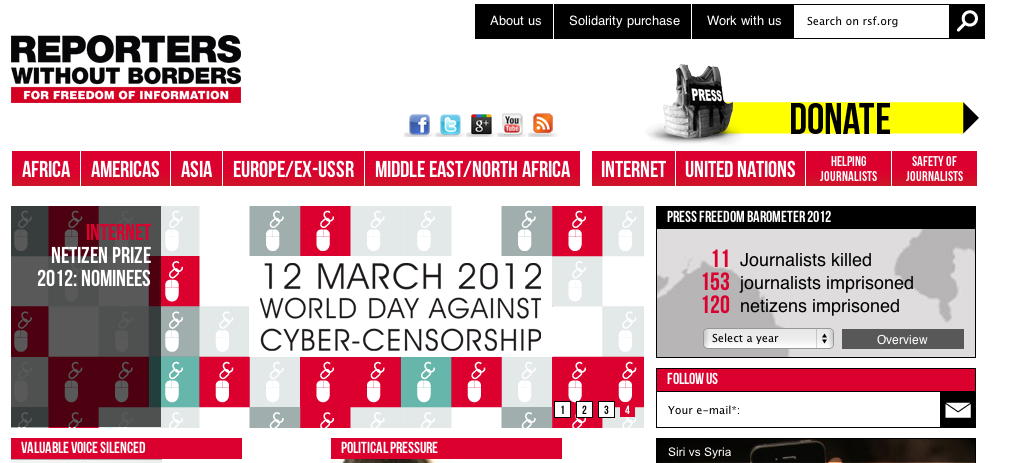
We read about the importance of international NGOs in Chapter 7 of Mingst and Arreguin-Toft this past week. Prompted by this blog post of a student of mine in POLI 1140, I have decided to highlight the work of Reporters without Borders. If you are interested in learning more about the challenges that journalists and “netizens” (after all, with the advent of the Internet we are all potential budding citizen-journalists), their website can be accessed here.

Below is a screen-shot of the front page where we see that as of this point in 2012, 11 journalists have been killed, an additional 153 journalists have been imprisoned, while 120 netizens have also been imprisoned. Clicking on the links to the graphic on their website will take you to more detailed information regarding the individuals behind these numbers. Of the 120 netizens who have been imprisoned, 68 are from China, 20 from Iran, and 18 from Vietnam.

Here’s an interesting blog post from a student of mine regarding the death of journalist Marie Colvin in the embattled Syrian city of Homs.

78o36's avatarlangarapolisciblog1

Marie Colvin a well-known war reporter who has sported an eye patch since she was wounded in 2001 while reporting in Sri Lanka, was killed the other day during the siege of Homs. Bashar al-Assad a dictator in Syria has been struggling to put down a revolt that has been ongoing for some time. The government is currently not allowing reporters into Syria; this is most likely a ploy to cover up war crimes. Currently the UN is not involved in the Syrian conflict due to China and Russia both voting no against intervention in Syria. Bashar al-Assad’s regime was believed to have targeted the building where Marie Colvin was staying to disrupt or kill journalists who use satellite phones to communicate with their news affiliates. The regime was believed to have tracked the use of satellite phones to try and pinpoint journalists. Citizens are looking to overthrow Bashar al-Assad and the…

View original post 74 more words

Proportional Representation versus First-Past-the-Post

As we learned in POLI 1100 today, Canada is one of small number of countries that continues to have a first-past-the-post system for national elections. What this means is that we divide the country up into 308 single-member districts (divided principally on the basis of the “representation by population” principle), from each of which exactly one individual is elected to represent that district in the House of Commons in Ottawa. In our case, a winner only has to have a plurality of the vote in that district to be elected the winner. What this does is it tends to give larger parties overrepresentation in parliament based on their actual electoral strength. It also gives regionally-concentrated parties (like the Bloc Quebecois) overrepresentation in parliament vis-a-vis parties whose electoral support is more diffuse geographically.

As we can see from the 2008 federal election results, the Green Party received almost 7% of the total national vote, yet because the vote was dispersed across the whole of the country, did not receive a single mandate in the House of Commons. The Bloc Quebecois, meanwhile, gained 50 seats in parliament with a slightly larger percentage of the vote than the Greens! Why? Because the BQ’s votes were geographically concentrated within a minority of ridings in the province of Quebec.

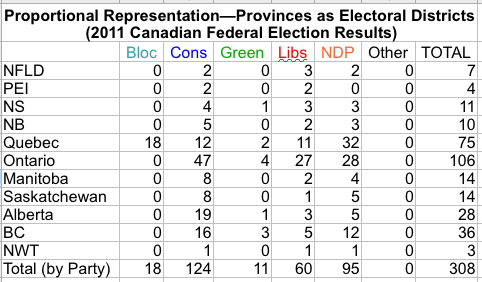
Turning now to the 2011 federal election, in which Stephen Harper’s Conservative Party won a majority in the House of Commons with 166 seats (and 39.6% of the vote). See the results below.

What if, on the other hand, Canada had a proportional representation system in which each province was its own electoral district and seats for the House of Commons were apportioned on the basis of the relative proportion of votes won by each party in each province? What would the results look like? With the help of my students, we were able to calculate the hypothesized makeup of the House of Commons were Canada to have such an electoral system.

Notice that the total number of MPs for the Conservative Party has dropped considerably such that the party no longer has a majority in the House of Commons. In fact, no single party has a majority! In order to form a relatively stable government, the Conservatives would have to find willing coalition partners. Unfortunately for them, however, other than the BQ, there is no immediately suitable coalition partner, given the respective ideological stances of the parties in parliament. Even with the BQ, the Conservatives could not get a governing majority, coming up 15 seats short. An NDP/Liberal?Green coalition, on the other hand, would work both ideologically and in terms of numbers (166 seats, exactly the same number as the Conservatives have today).

Note also how much a proportional representation system would help the Green Party–from only 1 seat in the House to 11 seats!

Which system would you prefer? Do you think that we should maintain the status quo? Should we change to PR? What are some of the advantages and disadvantages of each?

Writing to your MP in Support of a Bill in the House of Commons

In POLI 1100, we have been discussing the concept and structure of legislatures. Near the end of Chapter 8 we looked at the path a bill has to traverse in Parliament before it becomes law (see Figure 8.2 of the Dyck textbook, p. 235). We viewed a video clip of MP Ruby Dhalla introducing a bill to amend the residency provisions of the OAS act. (If you don’t know what OAS stands for, watch the short video.)

We have learned in the past couple of weeks that most of the contact that you, as a Canadian citizen, have with the government is via the political executive, whether at the provincial or federal level. Apart from voting for your MP (MLA), there is very little contact between you and the legislative branch of our government. This week’s blog assignment can help change that. As I’ve noted on Blackboard, for this week’s blog assignment you can choose to write on anything to do with “legislatures”. You may, however, choose to write a letter to your MP (or any MP) in support (or opposition to) any bill that is currently in middle of the legislative process in Parliament. Here are the steps:

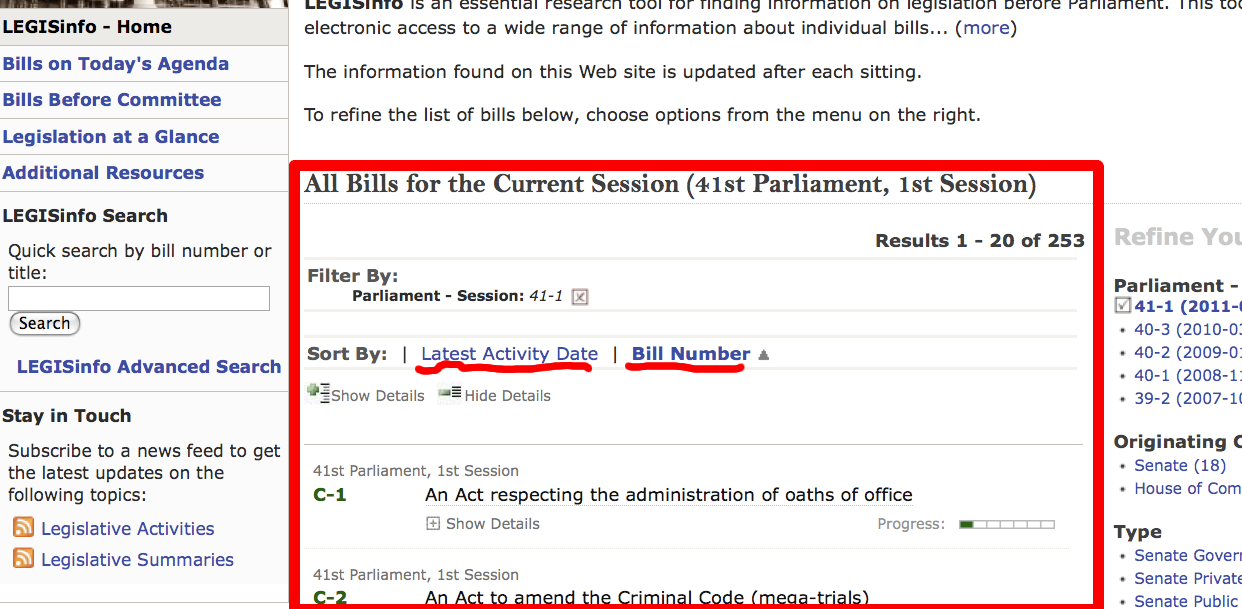
1. Go to http://www.parl.gc.ca (and select your language of choice):

2. Click on “Bills before Parliament” on the left (see the screenshot below). (“Projets de loi a l’etude au Parliament”, en francais)

3. On the next page, you will see, amongst other things, a list of the “All Bills for the Current Session (41st Parliament, 1st Session). The Bills can be sorted by number (as seen below), or by “Latest Activity Date”.

4. Find a Bill that interests you, and write a letter to the MP who is sponsoring the bill. Here’s an example of a letter I wrote below:

Mr. Jean Rousseau, M.P. House of Commons
Ottawa, Ontario
K1A 0A6

Cher Monsieur Rousseau:

I am writing to you in support of Bill C-312, The Democratic Representation Act, which is currently at the Second Reading state of the legislative process in the House of Commons. As I understand it, the bill is meant to assuage the concerns of the Quebecois regarding the province of Quebec’s decreasing population, as a share of Canadian population as a whole. Bill C-312, should it be adopted into law, would maintain proportional representation of Quebec’s delegation in the House of Commons at 2006 levels, regardless of the relative proportion of Quebec’s population in the future.

While some might see this as anti-democratic in that this law would mandate a divergence from the idea that every citizen’s vote should be counted equally, I believe that the the violation of this core principle is justified in this case. (Indeed, in many areas of politics and public policy, debates centre around clashes of competing (and contradictory), fundamentally legitimate–morally and politically–principles.) In this case, the competing principle is the protection of a strong Quebec, and Quebecois society, which I believe is of inestimable value to Canadian society as a whole.

In the view of this Canadian citizen, who since immigrating to this wonderful country as an infant, has lived in the western province of British Columbia (when not living outside the country), Canada’s French heritage is an indispensable part of our country’s unique heritage and is part of the basis for the creation of what is today (though we know it hasn’t always been) a tolerant multicultural society, which is the envy of many around the world.

Sincerely,
Josip (Joseph) Dasovic
Dept of History, Latin, and Political Science
Langara College
Vancouver, BC

Do you agree with my position? Should we violate the principle of “one-person, one-vote” in the way intended by Bill C-312?


Globalization and the Nation-State

In a previous blog assignment, my POLI 1100 students were asked to answer the question: “is globalization the death-knell of the nation-state’? Here are some representative responses

This is from the bordersandwalls blog:

Professor Chomsky suggests that defining globalization is ideological, the definition depends on how you look at it. By looking at globalization from the perspective of Adam Smith and the free movement of people, one could suggest that globalization is on the decline. Militarized borders have stopped the free movement of people and agreements like NAFTA, which was suppose to increase globalization, have actually led to increased nationalism at the expense of the people of Mexico.

And here is an opposing view, from langarafalcons blog:

In my opinion, the answer is yes. An interesting article (which can be found here) from the New York Times quotes MIT’s head of  Media Laboratory Joichi Ito as saying that the Middle East is going to be the next Silicon Valley. Ito believes that the region will become a technological hub, with promising investment opportunities to attract North American technological investors. While this an economic issue, I believe it relates to the topic of globalization and nationalism as well.,, The way technology shapes our lives, is a threat to traditional Middle East cultures. With social networks like Twitter and Facebook, the Middle East is constantly more exposed to North American society.

In a recent post on the same topic, Dani Rodrik (from Harvard) mused about the re-birth of the nation-state. He calls the conventional view that globalization has condemned the nation-state “to irrelevance” one of the foundational myths of our times. Rodrik notes:

The revolution in transport and communications, we hear, has vaporized borders and shrunk the world. New modes of governance, ranging from transnational networks of regulators to international civil-society organizations to multilateral institutions, are transcending and supplanting national lawmakers. Domestic policymakers, it is said, are largely powerless in the face of global markets. The global financial crisis has shattered this myth. Who bailed out the banks, pumped in the liquidity, engaged in fiscal stimulus, and provided the safety nets for the unemployed to thwart an escalating catastrophe? Who is re-writing the rules on financial-market supervision and regulation to prevent another occurrence? Who gets the lion’s share of the blame for everything that goes wrong? The answer is always the same:

I’m fairly certain that you know the answer to the question already, but have a look at Rodrik’s piece for his insight into the renaissance of the nation-state.

Another interesting student post on political ideology

alicesweeney's avataralicesweeney

After taking the Political Compass Test, I found the outcome interesting when I compared it to an individual who is a generation older than I am.

Dalai Lama is one of the political leaders that is closest to me in political ideology.

In contrast, this is the political ideology of somebody who is one generation older than I am.

My result as compared to the person who was one generation older than me shows that the differences may be due to age. Conservatism is about preservation and liberalism is about changing things. It would make sense that someone who is younger is still surrounded by diversity. On the other hand, as you age, you become adapted to a certain way of life so it is easy to become conservative. From this test it would seem likely that every young generation would  find the next generation to be more conservative. In Dasovic’s post, however, research has shown…

View original post 358 more words

Functions of Constitutions

In a response to a story that I blogged about yesterday, New Yorker Magazine Senior Editor, Hendrik Hertzberg, takes issue with the claim that the US Constitution has become increasingly irrelevant as a model for constitution-builders worldwide. Hertzberg writes:

The problem is that the study focusses almost exclusively on rights—the individual and civil rights that are specified in written constitutions. But it almost totally ignores structures—the mundane mechanisms of governing, the nuts and bolts, which is mainly what constitutions, written and unwritten, are about, and which determine not only whether rights are truly guaranteed but also whether a government can truly function in accordance with democratic norms. Or function at all with any semblance of efficiency, effectiveness, and accountability.

In Chapter 6 of the Dyck text, we learn that there are five main functions of any constitution, the first one of which “to define the structure of major institutions of government.” Other major functions are:

  • To divide powers and responsibilities among the various institutions of government
  • To regulate relations between the citizen and the state (this is where rights–civil, legal, political, sometimes economic, social and cultural–are enumerated)
  • To serve as a political symbol
  • To specify a method for amending the constitution

What does the study in question say about whether the US Constitution is being used as a template in these other areas? You’ll have to wait until the study is published in June of this year to find out.


Great Post on Political Ideology from a Student of Mine

Here’s a link to a great blog post from a POLI 1100 student of mine about political ideology and the role of the family as an agent of political socialization. Here’s an excerpt:

When I got my mother to take the political compass test I was sure her result was going to show that she was much more conservative that I was. I believe I thought this because whenever my older coworkers and I discuss issues that are being highlighted in the media, most of their views on those issues seem extremely conservative to me. Or at least, more conservative than that of my own…

…My mother’s ranking on the political compass, and my ranking on the political compass turned out to be almost the same. This was interesting to me because for the 18 years of my life I spent living with her, we barely said three words to each other everyday, much less discuss politics. So my political opinions were formed from other adults around me, such as teachers and my friends parents.

This is a very interesting observation. In a book I co-authored with Alan Zuckerman and Jennifer Fitzgerald, data analysis of panel surveys in Great Britain and Germany, led to some intriguing results. One of the more interesting was the role of the family matriarch–the mother–as the lynchpin in the familial political socialization process. While it is conventionally believed that the patriarch is more influential in a child’s political socialization, this was not true in our study. Mothers spent much more time with their children than did fathers (the data sets tracked this phenomenon), and it should not be surprising that, while often mothers don’t talk about politics with their children explicitly, their quotidian interactions with their children leave the latter with all sorts of clues and cues about the way to think and act about issues that are foundationally political. For example, where to school one’s child–public secular versus private parochial school–is a fundamentally political decision, yet parents may not express their reasoning for this in explicitly political terms.

Go read the rest of the blog post, and check out our book as well.

Design a site like this with WordPress.com
Get started