Ganguly on Structural Sources of Authoritarianism in Pakistan

In Intro to Comparative Politics, we devote a considerable amount of time to understanding regime types–what factors contribute to differences amongst authoritarian regimes, why democracies find it difficult to build deep roots in some places, what are the sources of authoritarianism and democracy.

Sumit Ganguly, an expert on nationalism, and south Asian nationalism in particular, recently gave a talk at a round table organized by the Institute of Peace and Conflict Studies (which is based in New Delhi) on the sources of authoritarianism in Pakistan.  The recent decision by embattled Pakistan President Pervez Musharraf to step down draws further attention to the nature of the political regime in Pakistan.

Ganguly evaluates, then dismisses, three standard arguments about the structural sources of authoritarianism, then proceeds to offer an alternative, which he believes more successfully accounts for the persistence of authoritarianism in Pakistan.  Ganguly argues that the most compelling structural explanation can be found in an analysis of three main components of the national movement in Pakistan–its structure, ideology and organization,

“The Pakistan movement stood in sharp contrast to its Indian counterpart which, under the towering influence of Gandhi and Nehru, had been democratized and came to represent a cross section of the populace. The Congress had also cultivated ideas of democracy through debate and compromise which were not alien to its leadership at the time of independence. On the other hand, the Pakistan movement under the tutelage of the Muslim League suffered from an extremely limited base confined geographically to what broadly constitutes the modern day state of Uttar Pradesh (UP). The socio-economic profile of its leadership was confined to the ranks of UP notables who largely hailed from feudal backgrounds. Against such a setting, M.A Jinnah successfully built up the Muslim League centered on his personality and the idea that the Congress would not guarantee the rights of Muslims.”

Israel and Syria once again Negotiating over Golan Heights

In intro to IR on Wednesday we addressed global environmental issues and we went over this chart outlining Thomas Homer-Dixon’s overview regarding the link between environmental scarcity and security. According to Homer-Dixon, environmental degradation is not only an important economic, social, and health issue, it is crucially an issue of importance for global security.

We see the important link between increased environmental scarcity and social effects (like ethnic conflicts, deprivation conflicts and coups d’etat), facilitated indirectly at times by the conditions of weakened states.

Homer-Dixon argues that these environmentally-driven conflicts will increase the more the environment degrades. Moreover, it is just those places in the world that have the least capacity to deal with the potentially negative effects of environmental degradation whose environments will be most likely to suffer.

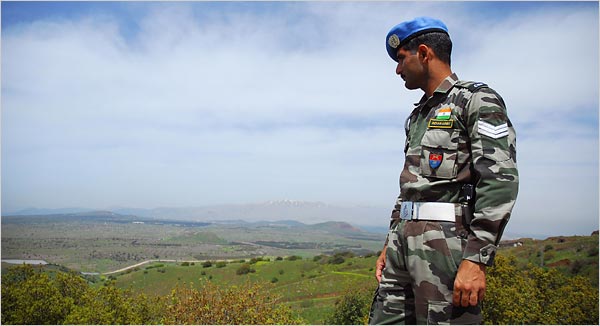
In the far left column is “unequal resource access”. One of the most important resources to humankind is water. The conflict between Syria and Israel over the Golan Heights is crucially linked to water. As we learn from the New York Times:

JERUSALEM — Peace overtures between Israel and Syria moved up a gear on Wednesday when a Syrian cabinet minister said that Prime Minister Ehud Olmert of Israel had sent a message to President Bashar al-Assad to the effect that Israel would be willing to withdraw from all the Golan Heights in return for peace with Syria.

The Syrian expatriate affairs minister, Buthaina Shaaban, told Al Jazeera television, “Olmert is ready for peace with Syria on the grounds of international conditions; on the grounds of the return of the Golan Heights in full to Syria.” She said that Turkey had conveyed the message.

Israeli officials did not deny the statement from Damascus but would not confirm it either, offering a more general, positive reaction. “Israel wants peace with Syria; we are interested in a negotiated process,” said Mark Regev, a spokesman for Mr. Olmert. “The Syrians know well our expectations, and we know well their expectations…”

“…Withdrawal from the Golan Heights is a contentious issue in Israel. The territory is a strategic plateau that overlooks a large swath of northern Israel. Israel has objected to past Syrian demands for access to the shore of the Sea of Galilee, a main water source for Israel.

Yehuda Raizner/Agence France-Presse — Getty Images

An Indian member of the United Nations force in the Golan Heights, a strategic

plateau that overlooks a swath of northern Israel.

Weber’s Theory of Social Action

Weber’s theory of social action is important because it sets out, I believe, more clearly than any other theorist the idea behind social action, and the foundations for explanation in the social sciences.

Andrew Roberts, at the University of Middlesex, has written a critical commentary on Weber’s concept of social action:

Continue reading “Weber’s Theory of Social Action”

Design a site like this with WordPress.com
Get started