What does the HDI measure?

This post is prompted by an e-mail from one of the students in my Comparative World Government class. Here’s the e-mail message:

I’m just studying and going through my notes, and had a quick question. In topic 4 when you were talking about GDPs and the Gini Index you said that there actually was a correlation between countries with a high GDP and a low Gini index, but isn’t GDP used in calculating the gini index? So wouldn’t it kind of skew the data, forcing the gini index to be more likely to follow the same pattern as the GDP?

Just curious

Here is my response:

Thanks for the question. I’m almost certain that I didn’t say that, since there’s generally no correlation between the Gini Index and the GDP. Some rich countries have relatively high equality (Sweden, for example) and some have high inequality (USA). Conversely, some poor countries have high levels of equality (India), while some poor countries have very high levels of inequality (Central African Republic).

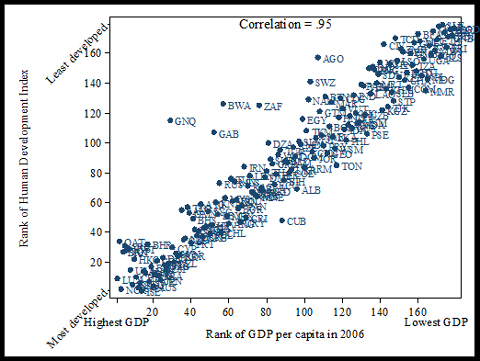
What I most likely said was that there was a very high correlation between a country’s GDP and is score on the Human Development Index (HDI). Just a bit of research…turns up this interesting bit of analysis by Justin Wolfers at the NY Times Freakonomics blog, showing a correlation of 0.95 between a country’s HDI rank and GDP rank (2006). That’s an exceptionally high correlation, suggesting that the HDI isn’t measuring much more than the country’s level of GDP.

Wolfers created a graph using the 2006 data for GDP rank and HDI rank, while I provide for your viewing pleasure below.

An Alternative to GDP as a Measure of Welfare

Over the course of the semester, we’ll address the issue of economic growth and economic well-being. We’ll ask–and attempt to answer–question such as “why are most African countries still so poor?”, “why has there been an economic miracle in many parts of east Asia?”, etc. As we’ll see, the most widely used measure of economic welfare (or well-being) is gross domestic product (GDP), which is a measure of the total goods and services produced in a country in a given year.

Evidence suggests that the higher a country’s GDP, the better that country’s residents live; that is, they are better off. Recently, there has been increasing criticism of the focus on GDP as a measure of societal welfare. Think of the recent oil spill of the US coast in the Gulf of Mexico. The money spent to (attempt to) clean the waters and beaches served to increase the GDP in this area during the clean-up. It doesn’t take too much imagination to understand that this increase in GDP was probably not a boost in the general welfare of the individuals living in the region.

Robert Kennedy, at the start of his ill-fated run for the US presidency in 1968, remarked about GDP:

“The GDP* measures everything except that which makes life worthwhile.”

In a recent TED talk, statistician Nic Marks tackles some of the issues of using the GDP as a measure of a society’s “success.” From the abstract:

Statistician Nic Marks asks why we measure a nation’s success by its productivity — instead of by the happiness and well-being of its people. He introduces the Happy Planet Index, which tracks national well-being against resource use (because a happy life doesn’t have to cost the earth). Which countries rank highest in the HPI? You might be surprised.

Washington Post Reports that China no longer as Attractive an “Outsourcing” Target

The average person may not know the difference between “offshoring” and “outsourcing”, but one would think that it would be a condition of employment for someone who writes for the business section of the Washington Post. In an otherwise informative story on the decreasing attractiveness of China as an “outsourcing” location for US companies, we are witness to another example of a member of the traditional media seemingly uninformed of basic facts.

Outsourcing is simply the idea that a company chooses to have another company produce a good or service rather than produce that same good or service in-house.  Outsourcing has been happening for a long time, and an example is when the Ford Motor Company decided that it would be better to use their productive capacity to produce engines, and outsource the task of making tires to a different company rather than make tires itself.  This helped increase productivity by allowing Ford to concentrate on the making of engines, and have the other company (Goodyear, Bridgestone) focus on making better tires.

Offshoring simply means sending work beyond one’s national boundaries.  Notice that not all offshoring is also outsourcing.  In fact, I have previously read (but I can’t find the source) that most offshoring is, in fact, not also outsourcing.  How can this be?  Well, what happens when General Motors decides to close down a car factory in Flint and make begin producing vehicles in Windsor, Ontario instead?  That production (and the jobs accopanying it) has been offshored (moved to a different country–Canada) but it hasn’t been outsourced, since GM is still producing the vehicles.  Here’s a little chart that will help you understand the difference.

As for the article itself, it demonstrates that rising fuel costs have increased the cost of shipping to such an extent that the potential savings for a US company of producing in China are completely eliminated.  One such company has repatriated production to the US from China (I suppose that’s called “onshoring”?)   We read:

SHANGHAI — Harry Kazazian built his business on sleeping bags that are made in China and shipped across the ocean to the United States, but he realized recently that the math doesn’t work anymore.

With fuel prices at record highs, the cost of sending a standard 40-foot container of goods has gone from $3,000 in 2000 to about $8,000 today, squeezing profit.

So this summer Kazazian, chief executive of Exxel Outdoors, a Los Angeles-based maker of recreational equipment, did something radical: He moved the manufacturing back to Haleyville, Ala.

Soaring energy costs, the falling dollar and inflation are cutting into what U.S. manufacturers call the “China price”– the 40 to 50 percent cost advantage once offered by Chinese producers.

The export model that has powered China and other Asian countries for three decades will be compromised if fuel prices continue to rise, said Stephen Jen, a managing director for Morgan Stanley.

“Globalization has gone a little bit too far. It has overshot,” Jen said. “We’re not saying Asia is going to crumble, but we are saying Asia enjoyed extraordinary conditions in the past. Now the conditions are changing very quickly because of the energy shock, and Asia is coming under pressure.”

The ripple effects have been far-reaching. The trade imbalance between the United States and China — a source of political tension for years — is beginning to right itself as Chinese exports fall and U.S. exports rise. Global trade routes are being transformed, suggesting a possible return to a less integrated world economy.

What is (are) LICUS?

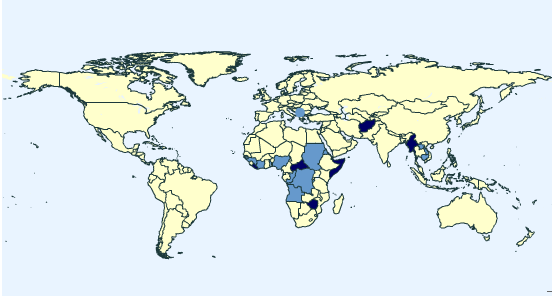
To me, it sounds like a species of tropical plant, but it is an acronym used by the World Bank and other IGOs and NGOs to refer to a specific group of less-developed countries.  According the the World Bank, LICUS, which is an acronym for Low Income Countries Under Stress, are

are countries with weak policies, institutions, and governance.

The World Bank’s IEG (Independent Evaluation Group) set out to evaluate the role of the Bank’s efforts to aid these countries in their bid to develop economically and politically.  From the report:

Home to almost 500 million people, roughly half of whom earn less than a dollar a day, fragile states, until recently known in the World Bank as low-income countries under stress (LICUS), have attracted increasing attention. Concern is growing about the ability of these countries to reach development goals as well as about the adverse economic effects they have on neighboring countries and the global spillovers that may follow.

With their multiplicity of chronic problems, these countries pose some of the toughest development challenges. Poor governance and extended internal conflicts are common among these countries, which all face similar hurdles: weak security, fractured societal relations, corruption,breakdown in the rule of law, and lack of mechanisms for generating legitimate power and authority. As low-income countries, LICUS also have a huge backlog of investment needs and limited government resources to meet them. 

Past international engagement with these countries has failed to yield significant improvements, and donors and others continue to struggle with how best to assist fragile states. LICUS are characterized by weak policies, institutions, and governance. The Bank identified 25 such countries in fiscal year 2005. These 25 countries have a number of similarities: their infant mortality rate is a third higher than that of other low-income countries, life expectancy is 12 years lower, and their maternal mortality rate is about 20 percent higher.

There are also important differences among LICUS. Some grew at around 4 percent per annum during 1995-2003. Others had negative growth rates of a similar magnitude. Some have abundant natural resources, while others are resource-poor. These differences are recognized in four business models that the Bank developed to work with countries in crisis: deterioration, prolonged crisis or impasse, post-conflict or political transition, and gradual improvement.

Countries in light blue are characterized as “core” LICUS countries, while those in dark blue are “severe” LICUS countries.


Dependency Theory and Import Substitution Industrialization (ISI)

PBS broadcast a tremendously informative series called Commanding Heights, which took a look at the the battle over the world’s political economy during the 20th century.  Below you’ll find a portion of the episode on Latin America, which has been uploaded to You Tube.  The clip below explains the concept of dependency theory–the theoretical impetus behind the establishment of the political economic institution of import-substitution-industrialization (ISI).  Unfortunately, ISI did not work very well in practice, and Moises Naim–the editor of Foreign Policy Magazine, explains why in the clip below.

P.S. “The Chicago Boys” were not Michael, Scotty, and Phil. 🙂

Poor Countries, Agriculture, and IMF Policies

There has been a rapid increase in food prices over the last couple of years, seen most dramatically in the recent 30% one-day rise in the price of rice worldwide.  This is putting tremendous pressure on the poor and is leading to instability in countries around the world.  There have been violent demonstrations–and equally violent government responses–to food rioting in Egypt and Haiti in the last couple of weeks.  They may be but a harbinger of the economic and political instability to come.  Here is a report from the BBC, in which an expert argues that IMF policies have contributed to the rise in food prices:

“Poor countries need to invest heavily in agriculture to feed their people.  There’s been a dearth of investment in agriculture in poor countries, mainly because of IMF and World Bank policies…”

Ken Roth Lecture on Human Rights and the Environment

We watched a video of a lecture given by Ken Roth (the Executive Director of the human rights NGO, Human Rights Watch) on the link between human rights and environmental degradation.  You can watch the entire lecture on youtube.  It is also embedded below.  Here is the description of the lecture:

Human Rights Watch Executive Director Ken Roth explains how environmental abuse has led to human rights violations in Darfur, Nigeria, Indonesia and Angola in the first of this season’s Joan B. Kroc Institute for Peace & Justice Distinguished Lecture Series at the University of San Diego. Series: “Joan B. Kroc Institute for Peace & Justice Distinguished Lecture Series” [10/2007]

Economic Growth and Pollution in Budapest

In intro to comparative, in a few weeks time, we’ll cover developments in the post-communist world of Eastern Europe. Here is an interesting report from one of my home towns (I lived and studied in Budapest for a year in the late 1990s) that looks at the effects of economic growth on first lowering and now raising levels of pollution in the majestic Hungarian capital.

budapest.jpg Climb into the Buda Hills and look back at the flatlands of Pest and the pollution is obvious: a yellow-gray cloud that blankets the Hungarian capital much of the time.

Indeed, 19 years after the collapse of communism, Budapest’s air quality has become a problem again. Pollution exceeded recommended levels 115 days last year, 80 days more than permitted under European Union (EU) guidelines. [of which Hungary is a member.] In late December and early January, the capital experienced one of its most prolonged smog events in a decade.

When communism imploded in 1989, Budapest’s air was atrocious. With their two-cycle engines, fleets of Trabant automobiles spewed black clouds of lead-laden exhaust, while city busses and industrial facilities pumped eye-stinging emissions into the air. During the 1990s the air cleared as factories installed pollution controls, leaded gasoline was banned, and newer, cleaner Western cars replaced dirty Soviet ones.

But in recent years, those gains have been reversed as many Hungarians now drive to work from increasingly far-flung suburban areas. Lead and sulfur dioxide have been replaced by dangerous concentrations of tiny exhaust particles.

“We’ve exchanged [Victorian-era] London-type smog for Los Angles-type smog,” laments Janos Zlinszky of the Regional Environmental Center for Central and Eastern Europe. “The nature of our environmental problems is shifting.”

Across east-central Europe, a region once blighted by Communist-era pollution, economic development is bringing on a new set of environmental problems and, in some cases, bringing back old ones.

The Relationship Between Wealth and Health

The BBC reports on fascinating new research, which concludes that “economic growth does not necessarily translate into improvements in child mortality.” There are two points I wish to make about this: First, it illustrates an important trend in the development literature regarding the correct metric to use to determine, and compare, levels of well-being worldwide. Historically, well-being has been captured by the crude instrument of Gross National Product (GDP) per capita, but the realization that, for many reasons, the measure was too crude to be a satisfactory indicator of well-being development led to the introduction of other measures, the most useful of which is the Human Development Index (HDI) put out by the United Nations Development Program (UNDP). (Why might GDP per capita be a misleading indicator of well-being?)

The second point follows from the first; one’s policy prescriptions vis-a-vis issues of development are to a large extent determined by just which indicator of well-being one believes best captures the essential nature of that elusive concept. As such, IGOs such as the World Bank, have focused attention on overall economic growth, while scholars such as Amartya Sen (who champions the “capabilities approach”) do not view growth tout court as a magical anti-poverty elixir.

From the BBC article:

Ten million children still die every year before their fifth birthday, 99% of them in the developing world, according to Save the Children.

A study comparing economic performance with child mortality reveals that some countries have not translated wealth into improvements across society.

Survival is too often just a “lottery”, said Save the Children’s David Mepham.

He said that even the poorest countries can cut child mortality by following simple policies, but at the moment “a child’s chance of making it to its fifth birthday depends on the country or community it is born into”.

Lagging behind

Angola comes at the bottom of a new “Wealth and Survival” league table drawn up by the UN Development Programme (UNDP).

The figures for child mortality in India are shocking
Shireen Miller
Save the children India

There are few countries in the world where there are such stark wealth contrasts as there are between the wealth of oil-rich coastal strip around the Angolan capital Luanda, and the war-ravaged interior.

UNDP statisticians calculate that more than half of the babies who die in Angola could be saved were the country to spread its wealth more fairly.

child_mortality_map.jpg

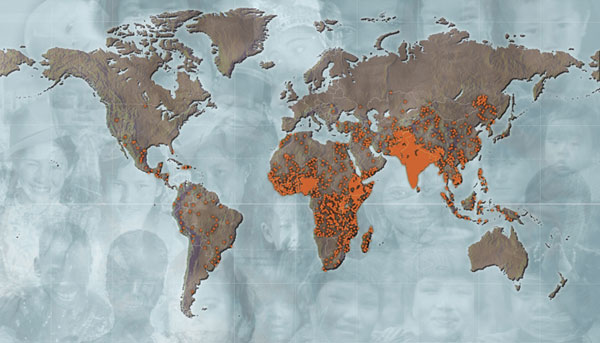
Click on the map to be taken to the Johns Hopkins Bloomberg School of Public Health’s Magazine for an article on child mortality.

[Each orange dot is equivalent to 5,000 child deaths.]


Human Security Resources

A general trend has developed, amongst governments, academics, and (especially) activists working in IGOs and NGOs worldwide that has moved the focus of security away from traditional concepts–such as protecting borders from external threat–to a new approach that focuses specifically on human security. What is “human security?” Well, the Human Security Report Project, at Vancouver, Canada’s Simon Fraser University, defines human security in this way:

Unlike traditional concepts of security, which focus on defending borders from external military threats, human security is concerned with the security of individuals…

For some proponents of human security, the key threat is violence; for others the threat agenda is much broader, embracing hunger, disease and natural disasters. Largely for pragmatic reasons, the Human Security Report Project has adopted the narrower concept of human security that focuses on protecting individuals and communities from violence.

Traditional security policy emphasizes military means for reducing the risks of war and for prevailing if deterrence fails. Human security’s proponents, while not eschewing the use of force, have focused to a much greater degree on non-coercive approaches. These range from preventive diplomacy, conflict management and post–conflict peacebuilding, to addressing the root causes of conflict by building state capacity and promoting equitable economic development.

The website has an informative and very useful set of links to various organizations, governmental institutions, research institutes, etc., that focus on issues of human security.

Another excellent source for information related to human security is the Human Security Gateway. Below is a thumbnails which will take you to a screen shot of their home page. (Notice the RSS feed icons in the left sidebar.)

human_security_gateway_homepage1.jpg

Design a site like this with WordPress.com
Get started