CDU and Greens form Coalition Government in Hamburg

ollowing our mock election and government formation simulation, I thought it might be of interest to you to note that the CDU and the Green Party of have formed an historic alliance in the city-state government of Hamburg (Hamburg is one of the sixteen German states, or Lander). Der Spiegel (the German equivalent of Time magazine) has more on the new coalition government.

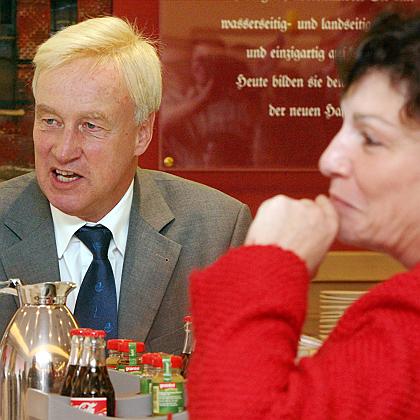
Hamburg mayor Ole von Beust, a Christian Democrat, has found \

The conservative Christian Democrats and the environmental Green Party have long been skeptical of one another. But now, the two have joined forces to form a government in the German city-state of Hamburg.

Members of the German Green Party and the conservative Christian Democrats (CDU) have arrived at an agreement “in principle” to govern together in Hamburg, SPIEGEL ONLINE has learned from Green Party sources. It would be the first CDU-Green coalition at the state level in German politics.

We just have to put it in writing,” said the source, who asked not to be named. “It’s just a matter of the preamble (to the coalition agreement), and such things.”

The coalition agreement will reportedly be unveiled late Thursday — which implies that some points of disagreement, like a Hamburg-area schools policy and the fate of two coal-fired power plants, have been settled.

“We have nothing else to discuss in a full meeting,” said a spokeswoman for the Greens, Antje Möller, after the last round of talks on Wednesday. The two sides had reached an understanding, she said, on “the points which still remained.”

(Picture Caption:Hamburg mayor Ole von Beust, a Christian Democrat has found “common ground” with Green leader Christa Goetsch.)

Thomas Friedman’s First Law of Petropolitics

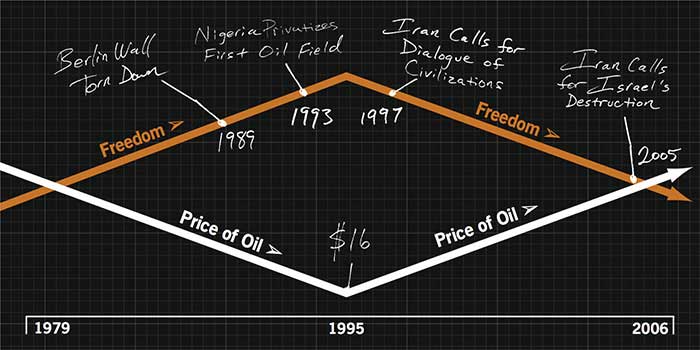
New York Times columnist wrote a fairly interesting article in Foreign Policy magazine a couple of years entitled “The First Law of Politics.” Here are some excerpts:

When I heard the president of Iran, Mahmoud Ahmadinejad, declare that the Holocaust was a “myth,” I couldn’t help asking myself: “I wonder if the president of Iran would be talking this way if the price of oil were $20 a barrel today rather than $60 a barrel.” When I heard Venezuela’s President Hugo Chávez telling British Prime Minister Tony Blair to “go right to hell” and telling his supporters that the U.S.-sponsored Free Trade Area of the Americas “can go to hell,” too, I couldn’t help saying to myself, “I wonder if the president of Venezuela would be saying all these things if the price of oil today were $20 a barrel rather than $60 a barrel, and his country had to make a living by empowering its own entrepreneurs, not just drilling wells.”

As I followed events in the Persian Gulf during the past few years, I noticed that the first Arab Gulf state to hold a free and fair election, in which women could run and vote, and the first Arab Gulf state to undertake a total overhaul of its labor laws to make its own people more employable and less dependent on imported labor, was Bahrain. Bahrain happened to be the first Arab Gulf state expected to run out of oil. It was also the first in the region to sign a free trade agreement with the United States. I couldn’t help asking myself: “Could that all just be a coincidence? Finally, when I looked across the Arab world, and watched the popular democracy activists in Lebanon pushing Syrian troops out of their country, I couldn’t help saying to myself: “Is it an accident that the Arab world’s first and only real democracy happens not to have a drop of oil?”

The more I pondered these questions, the more it seemed obvious to me that there must be a correlation—a literal correlation that could be measured and graphed—between the price of oil and the pace, scope, and sustainability of political freedoms and economic reforms in certain countries.

Mock German Election Simulation–Government Formation Results

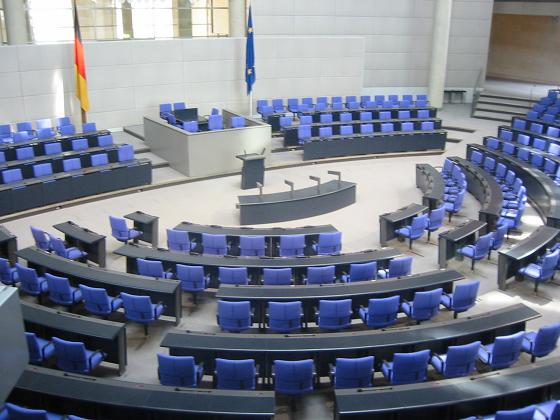
In the second part of our mock German election simulation–the government formation negotiations–we were able to get a new government voted into power by the recently elected Bundestag.  (I refer you to this post for more information about the electoral results.)

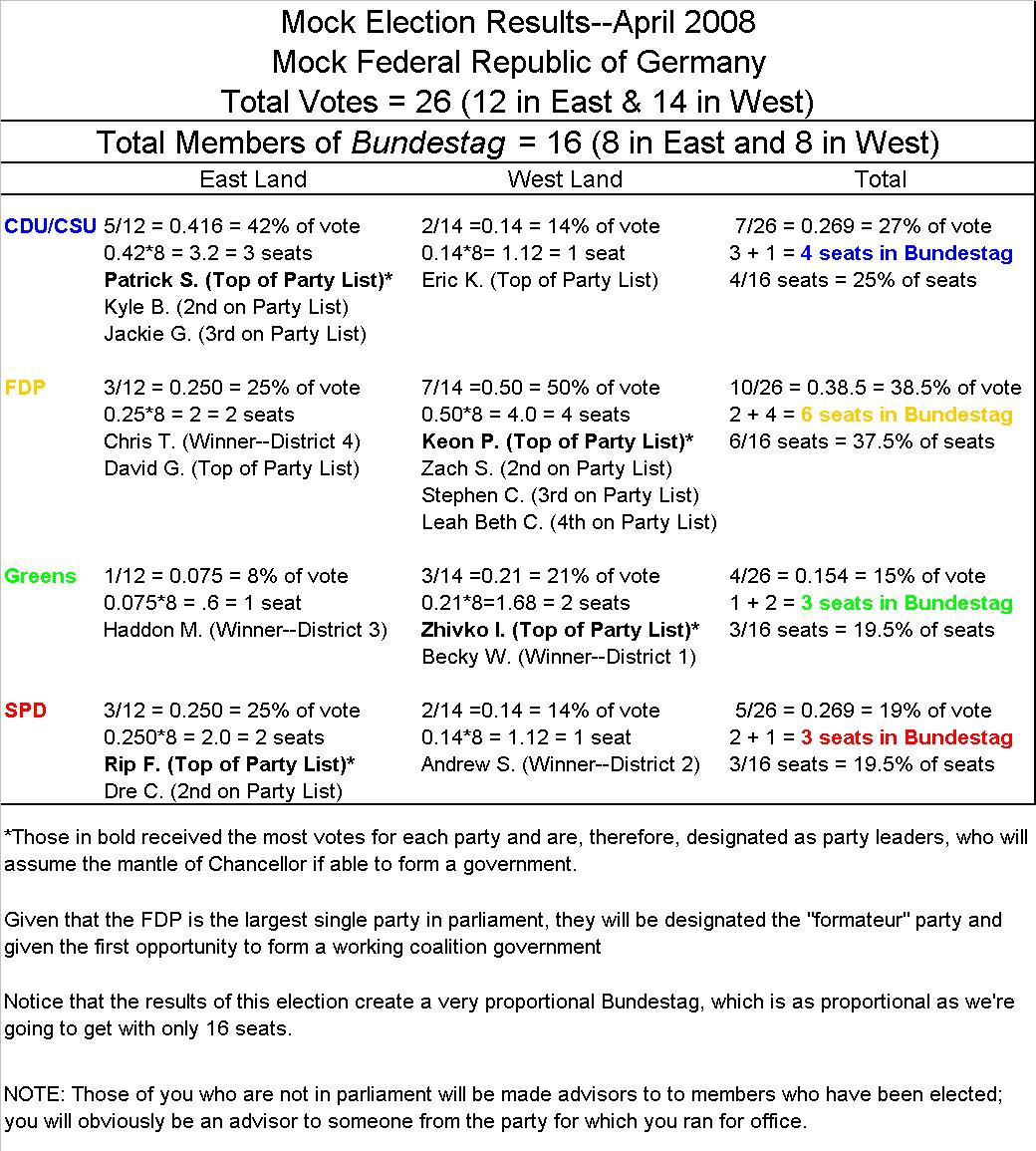
To remind you, following the election, we had the composition of the Bundestag was:

FDP–6 mandate (formateur party)

CDU/CSU–4 mandates

SPD–3 mandates

Greens–3 mandates

In order to have a secure governing coalition, a governing coalition of at least 9 mandates would be needed in this sixteen-member parliament.

The FDP were unable to convince any of the other parties to form a governing coalition with them, and the government that was voted into office, by a majority vote of 10-6 was a three-party coalition of the Greens, CDU/CSU, and the SPD.

In the end, it was the personal ambition of the CDU/CSU leader–Patrick S.–that ruled the day.  He wanted to become Chancellor and this steely determination served him well as he, with his fellow party members and advisory committee, was able to effectively forge a rather wieldy three-party governing coalition.

Why did Patrick S. want to become Chancellor so desperately?  There have been reports in some of the leading journals that it has been his dream since childhood.  But in a sit-down interview with Deutsche Welle following his ascension to the Chancellorship, Chancellor S. claimed that it was because this election was crucial to the future of the German state.  According to the Chancellor, he and his party believe that a moral crisis of epic proportions has descended upon Germany and only his party had the necessary moral acuity to set Germany back on the correct path.

The Chancellor and the six-member Cabinet is composed of the following:

Chancellor–Patrick S. (CDU/CSU)

Minister of Education–Becky W. (Greens)

Minister of the Interior–Erick K. (CDU/CSU)

Minister of the Environment–Zhivko I. (Greens)

Minister of Foreign Affairs–Kyle B. (CDU/CSU)

Minister of Health–Rip F. (SPD)

Minister of Labor–Andrew S. (SPD)

One of the advisers to the SPD commented that the SPD actually had refused to sign a coalition agreement offered to them by the FDP, which in retrospect, was better for the SPD than the one they signed ultimately.  There seemed to be a consensus within the SPD that the arrogance of the FDP had created friction between the two potential coalition partners.

I look forward to reading your impressions of the simulation exercise on your blogs.

India’s Finance Minister Calls Biofeuls a “Crime Against Humanity”

In the WSJ article reference below, it is noted that one of the reasons for the dramatic rise in food prices over the last few years has been the decision by rich countries–particularly the United States–to use agricultural products not for food, but for fuel for motor vehicles. In fact, according to this NPR report:

“The grain required to fill a 25-gallon SUV tank with ethanol will feed one person for a year,” [Lester] Brown [author of the book Plan B 3.0: Mobilizing to Save Civilization] says. “And what we are seeing now is the emergence of direct competition between the 860 million people in the world who own automobiles and who want to maintain their mobility while the 2 billion poorest people in the world simply want to survive.”

For audio of the NPR report, click the link above.

Indeed, the issue of biofeuls is more than simply a matter of geopolitics. It has come to be viewed as a moral dilemma. Once again, from the WSJ article:

“When millions of people are going hungry, it’s a crime against humanity that food should be diverted to biofuels,” said India’s finance minister, Palaniappan Chidambaram, in an interview. Turkey’s finance minister, Mehmet Simsek, said the use of food for biofuels is “appalling.”

James Connaughton, chairman of the White House’s council on environmental quality, said biofuels are only one contributor to rising food prices. Rising prices for energy and electricity also contribute, as does strong demand for food from big developing countries like China.

But beyond taking shots at the U.S., there was little agreement this weekend on what should be done.

Wall Street Journal Reports on Rise in Food Prices, Riots

The WSJ has published a report on the outcome of last week’s annual meetings of the World Bank and the IMF and how leaders there proposed to deal with the very real problem of rapidly rising food prices worldwide. For a variety of reasons, there has been a dramatic surge in the prices of all commodities, including primary agricultural products, like rice and wheat. This has already led to rioting in Haiti and Egypt (see a previous blog post here) and could lead to even more social and political unrest in developing countries around the world, where large majorities rely on rice and wheat as staple foods. Here are some excerpts from the WSJ article:

WASHINGTON — Finance ministers gathered this weekend to grapple with the global financial crisis also struggled with a problem that has plagued the world periodically since before the time of the Pharaohs: food shortages.

Surging commodity prices have pushed up global food prices 83% in the past three years, according to the World Bank — putting huge stress on some of the world’s poorest nations. Even as the ministers met, Haiti’s Prime Minister Jacques Edouard Alexis was resigning after a week in which that tiny country’s capital was racked by rioting over higher prices for staples like rice and beans.

Rioting in response to soaring food prices recently has broken out in Egypt, Cameroon, Ivory Coast, Senegal and Ethiopia. In Pakistan and Thailand, army troops have been deployed to deter food theft from fields and warehouses. World Bank President Robert Zoellick warned in a recent speech that 33 countries are at risk of social upheaval because of rising food prices. Those could include Indonesia, Yemen, Ghana, Uzbekistan and the Philippines. In countries where buying food requires half to three-quarters of a poor person’s income, “there is no margin for survival,” he said.

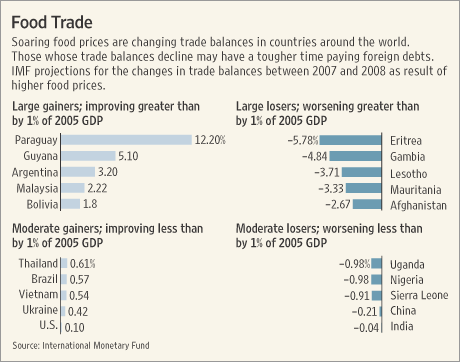
I encourage you to read the whole article, which is free on the WSJ web site. Here is a chart demonstrating how rising food prices have affected balance of payments accounts in select countries around the world. As the graphic states, worsening balance of payments figures will make it much more difficult for some countries to pay off foreign debt and provide the infrastructure necessary for further economic and social development.

Happy Tax Day–April 15th

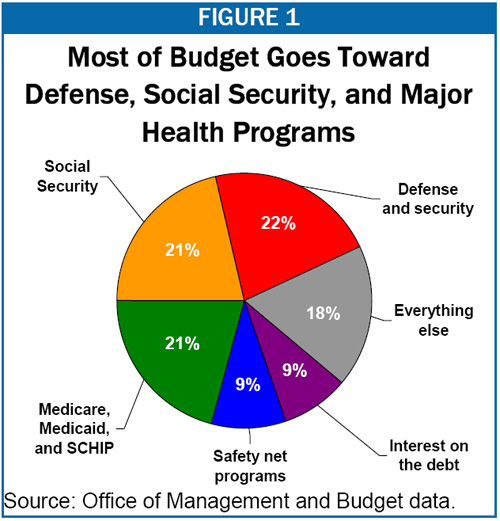
Well, today is tax filing day and I’ve often wondered just where my taxes go.  I’ve often thought that given the extant technological capabilities, and the normative desire for more direct forms of democracy, that each and every taxpaying citizen should be given the opportunity not only to file her taxes electronically, but to be able to specifically allocate her tax dollars to the uses that she sees fit.  How would you choose to allocate your tax dollars?  How does the federal government choose to allocate its tax dollars?  Look at the figure below–from the Office of Management and Budget–to see what the Federal government spends its money on.  This graph goes a long way to undermining the demagoguery of politicians when talking about taxes and spending.  When a politician tells you that he is going to cut taxes and does not mention spending cuts, then he is playing politics (unless, of course, he thinks that budget deficits are a non-issue).

The fact is that discretionary spending is a small minority (18%) of total spending.  In order to put a real dent in the budget deficit and the federal debt (two different–but related–concepts), you must cut entitlements, cut defense spending, raise taxes, or a combination of the three.

Happy Tax Day!

H/T Andrew Sullivan

FDP Wins Plularity of Bundestag Seats in Mock German Election–Spring 2008

[UPDATE: I made a mistake when I was initially tabulating results, necessitating a slight change in the composition of the Bundestag. As it now stands, the problem occurred in West Land, where is seems some poll workers had imbibed a little bit too much of that noted Bavarian beverage, bier. A recount (which is easy given that paper ballots were used) results in the following change: one more mandate for the FDP in West Land–I’ve slotted in the 4th candidate from the FDP party list from that Land–and one fewer mandate for the SPD in the same Land. Therefore, the final results are FDP-6; CDU-4; Greens-3; SPD-3. The party leader of FDP will still be given the role of party formateur.]

[UPDATE 2: The aforementioned poll workers have been fired and are now in AA.]

[UPDATE 3: Please see below how the adviser roles have been distributed.]

Here are the results from the mock election to the lower house of the German Reichstag held this afternoon. Those of you who were not elected to represent your district or Land in the Bundestag will nonetheless also be actively involved (as advisers to your fellow party members) in the second part of the simulation–negotiations to form a government. I will send more instructions regarding that portion of the simulation later this weekend. As you can see below, the FDP has won a plurality in the Bundestag and will be given first crack at putting together a workable coalition, trying to reach a formal agreement with one of the other parties. Signing coalition agreements with either the CDU/CSU or the SPD are most likely (given that there is a total of 16 seats in our parliament) but don’t count out a coalition with the Greens either.

As I mentioned earlier, I’ll have more information regarding the specifics of the coalition negotiations and also post a sample coalition agreement form on Blackboard later, but in the meantime think about the most important elements of the negotiation process:

  1. Which party/parties will form the government? Remember you need a majority in parliament to vote the new government into power.
  2. Who will become the Chancellor (i.e., the Prime Minister)?
  3. What will be the general orientation of the government’s policy-making agenda? Given the campaign pledges you made (either to your district and/or your Land) can you plausibly vote for a government that is dedicated to carrying out this policy agenda?
  4. What about some of the policy specifics? Changes to the citizenship law? Higher taxes on carbon emitting industries? Higher (lower) income/consumption taxes? Anything else of importance to you or your district/Land?
  5. Who will get which Ministerial Portfolios? Who will become Foreign Minister? Minister of the Environment? Minister of Health? Minister of Finance? Minister of Justice? Minister of Labor?
  6. Which individuals will be given these portfolios?

I will set up a new folder in the Discussion Board section of Blackboard so that you can all begin the “feeling out” process prior to the official negotiations on Tuesday afternoon.

Click here to see the current members of the German Federal Cabinet (which is the Chief Executive), which is made up of the Chancellor (currently Angela Merkel) and 15 Cabinet ministers.

NOTE: You will notice that some of you who ran for election in districts have nonetheless been elected to parliament on the basis of party lists. I had to do this, given the relatively small number of students in the class. In general, the party lists are much larger than the ones you saw on your ballots as there were simply not enough students and I wanted to have four SMDs. Therefore, where it was warranted, I moved non-SMD-winners over to party lists (i.e., when the proportion of votes generated a number of seats for that party in excess of the number of individuals on the party list. Of course, this would never happen in a real German election as the party lists always have many more candidates than the party will end up earning on the basis of PR. I’ll go over this on Tuesday.

Here are the advisers and the party member whom you will be advising over the course of the government formation negotiations on Tuesday.

Reagan to Gorbachev–“Tear Down This Wall”

Getting ready for our mock German election tomorrow has me thinking about the German political system, the respective political parties, and German reunification.  It reminded me of this famous speech by President Ronald Reagan at Brandenburg Gate in (West) Berlin.

Lecture on German Political Parties April 17th

Talk about serendipity!  We will finish our mock German election and government formation simulation on Tuesday, April 15th and two days later there will be a guest lecture on campus by Dieter Dettke, Visiting Scholar at the American Institute for Contemporary German Studies and Adjunct Professor at Georgetown University, Security Studies Program.  on “Is Germany Moving to the Left?  The Changing German Party System.

You can find below a copy of the flyer announcing the lecture, which will begin at 5:30 at the Gottwald Science Center Auditorium.  I’ll see you there.

The Richmond Eric M. Warburg Chapter

of the American Council on Germany

cordially invites you to a

Discussion and Reception

with

Dr. Dieter Dettke

Visiting Scholar at the American Institute for Contemporary German Studies and

Adjunct Professor at Georgetown University, Security Studies Program

on

“Is Germany Moving to the Left?

The Changing German Party System"

Thursday, April 17, 2008

5:30 – 6:45 pm

at

The University of Richmond, Gottwald Science Center Auditorium

Directions: If coming from Three Chopt Road, turn onto Boatwright Drive and continue straight ahead at the welcoming wall at the bottom of the winding hill (do not turn left for the main campus gate). After passing the Robins Center on your left and a large parking lot on your right, proceed for another 300 yards on College Road to the Westhampton entrance on your left. (If coming from River Road, turn onto College Road and turn right into the Westhampton entrance.) Continue on Keller Road to the Modlin Center and pass through the archway. Opposite the stop sign are parking spaces in front of the Westhampton Deanery and even more spaces between it and the cafeteria and science center. The science center auditorium is in the Gottwald Science Center across from the cafeteria. (In case the above parking spaces are full,  there is a parking lot behind the Modlin Center which you can access by turning right at the stop sign or left if exiting the parking lot across from the stop sign.)

If you have any questions, please contact Dr. Arthur B. Gunlicks,

Dr. Dieter Dettke is currently a visiting scholar at the American Institute for Contemporary German Studies and Adjunct Professor at Georgetown University, Security Studies Program. He is working on a book on German foreign policy and transatlantic relations – with the working title “In Search of Normalcy: German Foreign and Security Policy Between Realpolitik and the Civilian Power Paradigm.” He has also been a fellow at both the Woodrow Wilson Center and the German Marshall Fund of the United States.

From 1985 to 2006 he served as US Representative and Executive Director of the Washington Office of the Friedrich Ebert Foundation – which is affiliated with Germany’s Social Democratic Party (SPD). Prior to his work with the Ebert Foundation, Dr. Dettke was Political Counsellor of the SPD Parliamentary Group of the German Bundestag (1974 – 1984) and Staff Director of the Working Group on US-German relations. In this capacity, he coordinated all foreign, security and defence policy related issues on the agenda of the German Bundestag and the Committees for Foreign Affairs, Defence, German-German relations, Development Policy and European Affairs.

He has lectured frequently in Europe and the United States on transatlantic relations, German-American security issues and European-American economic relations. He has also presented papers, acted as a discussant and/or chair at U.S. and international conferences of the American Political Science Association, the International Studies Association, the German Studies Association and the American Association of Slavic Studies. In addition, Dr. Dettke testified in Congress on the implications of German unification for the United States and US-European relations.

Dr. Dettke has appeared on the News Hour with Jim Lehrer, C-SPAN, Voice of America as well as other American, German, Swiss, and British television and radio programs to discuss issues and developments related to domestic and foreign policy developments in Europe and the United States. Dr. Dettke studied political science and law at the universities of Bonn and Berlin (Germany) and Strasbourg (France). He was a Fulbright Scholar at the University of Washington in Seattle (1967/68).
Mock German Election and Government Formation Simulation

Here is a great link to information about the German electoral and political party system. You can find all sorts of information and links (to youtube videos even!) related to German political parties and the electoral system. Here are a couple of images from the link above:

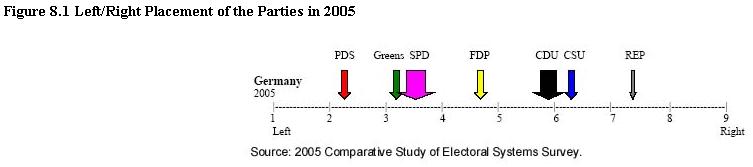
The first is a one-dimensional left-right placement of political parties. Remember that given our relatively small class size, you will be a representative of only one of four parties–CDU/CSU, FDP, SPD, Green Party. [Update: I notice that they have the CDU and CSU listed as separate parties, which they technically are.  As I noted in the assignment instructions, the CSU is essentially the CDU, but in Bavaria.  They always forms coalitions in the Bundestag when deciding on government formation.]

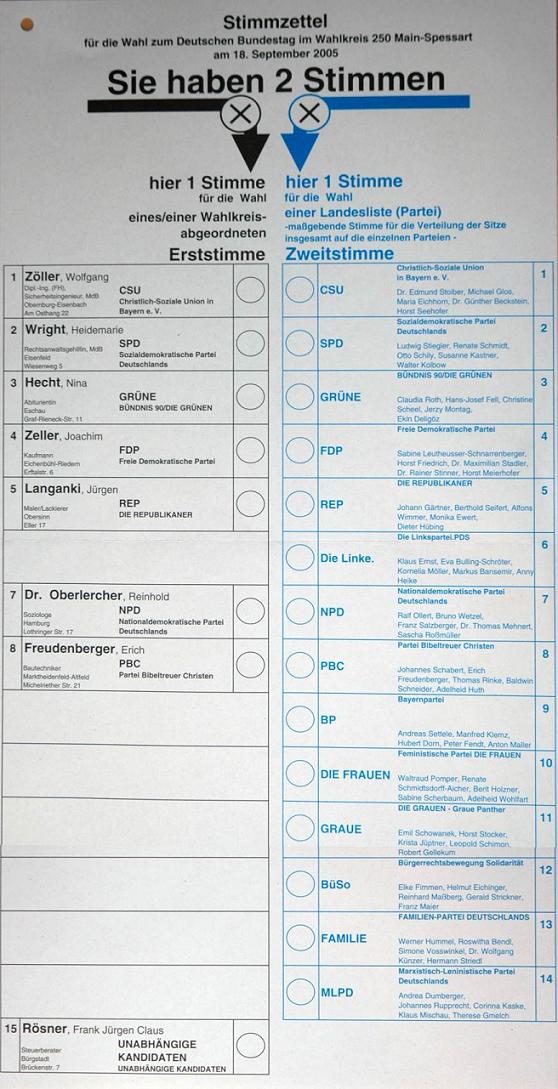
The second image is the unique two-vote electoral ballot; remember that Germans get to vote twice–once for a candidate to fill one of the 299 single-member districts, and once for a party list in a multi-member district. You’ll notice the left side of the ballot has the individual candidate’s name prominently displayed, whereas the party-list side (the right-side of the ballot) has the party name prominently displayed.

Here’s a nice breakdown of the characteristics of demographic support for each of the parties during the 2005 Bundestag elections, the result of which was a “grand coalition” between Angela Merkel’s CDU/CSU (Merkel was voted in by parliament as the Chancellor) and Gerhard Schroeder’s SPD.

Design a site like this with WordPress.com
Get started