
The University of Pennsylvania has recently founded the Penn Program on Ethnic Conflict. This will most likely become a very good resource for those seeking to learn more about this important topic.
Author: jd
Summer Research and Funding Opportunity for Undergraduates
Here is a wonderful opportunity to do some faculty-monitored research this summer and get paid for it. Those of you who took my PLSC240 course may certainly be interested, but I would also encourage PLSC250 students to apply.
Here are the details:
16 January 2008
Dear Colleague,
I am writing to let you know of an opportunity for your students that I hope you will bring to their attention. Pending funding approval from the National Science Foundation, this summer (2008), the Department of Political Science at Oklahoma State University will host the fourth annual Democracy and World Politics Summer Research Program for undergraduates. This program presents a valuable opportunity for undergraduate students to conduct faculty -mentored research projects.
Supported by summer stipends, research funds, and travel funds, students will work in one of three issue areas:
- Foreign Policy in a Democracy
- Democratization and Democracy Promotion
- Democracy and Conflict
The program is designed to provide undergraduate students with valuable educational experiences through its support of research participation. Oklahoma State University’s summer program has been supported by major funding from the National Science Foundation’s Research Experience for Undergraduates program, along with additional funding from the Department of Political Science and the College of Arts and Sciences at Oklahoma State University.
Successful applicants will spend about 9 weeks at Oklahoma State (June/July) during the summer of 2008, where they will work with a team of faculty members and visiting scholars to develop research questions and design and complete projects within the issue-areas just noted. Supporting activities will include research methods seminars, intensive project development workshops, guest presentations by visiting scholars, and community-forming events. Student participation will culminate in a presentation of papers at the National
Conference for Undergraduate Research (if accepted). Additionally, each year visiting scholars with substantive specialization in the programs issue areas will participate, lending their insights and expertise to the program and to student projects. . Last year, Dr. Paul Diehl (University of Illinois), Dr. Sara Mitchell (University of Iowa), Dr. Kelly Kadera (University of Iowa), Dr. Patrick James (University of Southern California), and Dr. Ralph Carter (Texas Christian University) participated. I hope to enlist these and possibly others this year.The students who participate in the program receive the following support:
- A stipend of $4,000.
- Room and board at Oklahoma State University for the duration of the program.
- Up to $500 in travel costs to and from Oklahoma StateUniversity for non-OSU students.
- Up to $200 in research support funds (by application) for project support.
- Funds for registration, travel, and lodging for participation in a conference in the subsequent spring (up to $900 per student).
I am writing to ask your help in recruiting good candidates for this program. Please share this information with students you believe would be good candidates for this valuable experience and encourage them to apply. All application material is located on the Oklahoma State University Department of Political Science website at
http://polsci.okstate.edu/REU%20Material%202008(2).htm. The application deadline is March 15, 2008.You or your students may contact me for additional information about the program for applications.
Thanks. I hope to see some applications from your students!
Sincerely,
Dr. James M. Scott
Department of Political Science
Oklahoma State University
Stillwater, OK 74078
Office: 405-744-5569
Fax: 405-744-6534
http://polsci.okstate.edu/REU%20Material%202008(2).htm.
Kenya, ethnic diversity, and fractionalization scores
Had you taken my Introduction to Comparative Politics class in the fall of 2007, you would have been faced with writing a paper in response to this:
There is much debate regarding the determinants of, and obstacles to, democratization. Are states that rely on natural resources for a large share of their GDP less likely to become and remain democratic? Does ethnic diversity present an obstacle to the democratization and democratic consolidation of a regime? Your term paper will answer one of these two questions either in the affirmative or the negative.
In addition to making the theoretical argument, students were asked to use Iraq and one other state to illustrate and support their argument(s). A few students chose to write on Kenya. I hope they go back and read their papers in light of the current situation in that multi-ethnic state.
Is Kenya ethnically diverse? How can we measure ethnic (or religious, or linguistic) diversity? There is a formula called the fractionalization index, which essentially gives us an idea of how diverse a state is. You can find a table–in Appendix A (which I have excerpted here) of over 100 states around the world with their corresponding fractionalization scores (in three categories), in this National Bureau of Economic Research (NBER) paper by Alesina et al. here The higher the value the higher the level of diversity. Notice the relatively low diversity of states like Poland and Norway and the high amount of diversity of almost all African states. Which is the best way to measure “diversity”? Ethnically? Linguistically? By religion?
|
Country
|
Date (Ethnicity Data)
|
Ethnic
|
Language
|
Religion
|
| Afghanistan |
1995
|
0.7693
|
0.6141
|
0.2717
|
| Canada |
1991
|
0.7124
|
0.5772
|
0.6958
|
| China |
1990
|
0.1538
|
0.1327
|
0.6643
|
| Croatia |
1991
|
0.3690
|
0.0763
|
0.4447
|
| Kenya |
2001
|
0.8588
|
0.8860
|
0.7765
|
| Malawi |
1998
|
0.6744
|
0.6023
|
0.8192
|
| Mozambique |
1983
|
0.6932
|
0.8125
|
0.6759
|
| Nigeria |
1983
|
0.8505
|
0.8503
|
0.7421
|
| Norway |
1998
|
0.0586
|
0.0673
|
0.2048
|
| Portugal |
1998
|
0.0468
|
0.0198
|
0.1438
|
| USA |
2000
|
0.4901
|
0.2514
|
0.8241
|
Links to Student Blogs in PLSC250–Section 03
Here is where I would like you to leave information about your blog. Please click and a comment giving the rest of us the information necessary to add your blog to our blogroll.Blog name:URL: leave out the “www”The First Initial and last name of the blog partners.
_PLSC250-03-blogname
M. Student and K. Student
Links to Student Blogs in PLSC250–Section 02
Here is where I would like you to leave information about your blog. Please click and a comment giving the rest of us the information necessary to add your blog to our blogroll.Blog name:URL: leave out the “www”
The First Initial and last name of the blog partners.
_PLSC250-01-blogname
M. Student and K. Student
Links to Student Blogs in PLSC250–Section 01
Here is where I would like you to leave information about your blog. Please click and a comment giving the rest of us the information necessary to add your blog to our blogroll.
Blog name:
URL: leave out the “www”
The First Initial and last name of the blog partners.
_PLSC250-01-blogname
M. Student and K. Student
China Forex Reserves top $1.5 trillion (with a “t”)
We won’t explicitly cover IPE (international political economy) until the second half of the semester, but it will certainly come up when dealing with views about what constitutes power (state power, specifically). How does the fact that China has built up a 1.53 trillion dollar Forex (foreign exchange) reserve affect its power relationship with the United States? Should the US be worried? Do you know if this affects, or could affect how much interest you pay on your mortgage, car or student loan?
James Fallows has a new article in the Atlantic, in which he analyzes the nature of the China-US trade relationship. He writes:
Through the quarter-century in which China has been opening to world trade, Chinese leaders have deliberately held down living standards for their own people and propped them up in the United States. This is the real meaning of the vast trade surplus—$1.4 trillion and counting, going up by about $1 billion per day—that the Chinese government has mostly parked in U.S. Treasury notes. In effect, every person in the (rich) United States has over the past 10 years or so borrowed about $4,000 from someone in the (poor) People’s Republic of China. Like so many imbalances in economics, this one can’t go on indefinitely, and therefore won’t. But the way it ends—suddenly versus gradually, for predictable reasons versus during a panic—will make an enormous difference to the U.S. and Chinese economies over the next few years, to say nothing of bystanders in Europe and elsewhere.
You can find more about the specifics of China’s forex holdings here.
Debaathification redux
In an earlier post, I noted that the Iraqi parliament had passed a law allowing the re-hiring of rank-and-file members of the Baathist party, who had lost their jobs in one fell swoop as a result of a decision by Paul Bremer in the immediate aftermath of the US-led invasion. As has been the case on numerous prior occasions in Iraq, the news may not be as good as originally hoped. From the NY Times we find:
A day after the Iraqi Parliament passed legislation billed as the first significant political step forward in Iraq after months of deadlock, there were troubling questions — and troubling silences — about the measure’s actual effects.
The measure, known as the Justice and Accountability Law, is meant to open government jobs to former members of the Baath Party of Saddam Hussein — the bureaucrats, engineers, city workers, teachers, soldiers and police officers who made the government work until they were barred from office after the American invasion in 2003.
But the legislation is at once confusing and controversial, a document riddled with loopholes and caveats to the point that some Sunni and Shiite officials say it could actually exclude more former Baathists than it lets back in, particularly in the crucial security ministries.
Once again, the crux of the issue in Iraq is the sectional and interethnic struggle amongst Sunni Arabs, Shia Arabs, and non-Arab Kurds, and who get what, when, and where. There are no easy answers.
Pew Global Attitudes Project
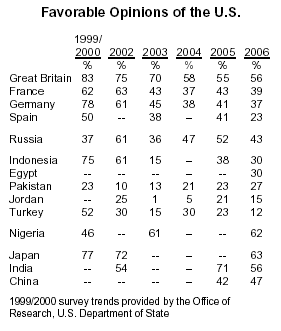
In the past, while talking with students, listening to discussion in class or grading papers, I’ve often heard unsubstantiated claims such as “the world is not with President Bush”, or “even the Europeans hate us”, etc. Noting that these claims are unsubstantiated does not mean they are not true. What it does mean is that I need further proof of the veracity of the claims than simply the student’s recitation of that claim. Similarly, you should be skeptical in class if I try to claim something without providing evidence to support that claim. With respect to statements such as the ones I referenced above, the Pew Global Attitudes Project is a fantastic resource. This organization polls publics around the world on a host of issues related to international politics, international affairs, and the domestic ramifications of international events and issues.
So just how do people around the world view the United States, and how has that opinion changed since 2000? Well, look no further than this report here:


Now, if a student were to write, according to widely available survey evidence, Europeans (at least in Great Britain, France, Spain, and Germany) hold a much less favorable view of the US in 2006 than they did in 2000 (Pew Global 2006), then that would be more compelling.
McClatchy–Kenyan president lost election, U.S. exit poll indicates
The McClatchy Washington Bureau is an excellent resource for news on political events around the world. Here they report on the results of an exit poll commissioned by a US-government backed foundation, which claims to show the incumbent Kenyan president was soundly defeated in the recent disputed election that has set off rioting and inter-ethnic killing sprees.
NAIROBI, Kenya — An exit poll carried out on behalf of a U.S. government-backed foundation indicated that Kenyan President Mwai Kibaki suffered a resounding defeat in last month’s disputed election, according to officials with knowledge of the document.
The poll by the Washington-based International Republican Institute — not yet publicly released — further undermines Kibaki’s claims of a narrow re-election victory. The outcome has sparked protests and ethnically driven clashes nationwide, killing hundreds.
Opposition leader Raila Odinga led Kibaki by roughly 8 percentage points in the poll, which surveyed voters as they left polling places during the election Dec. 27, according to one senior Western official who’s seen the data, who spoke on condition of anonymity because of the sensitivity of the issue. That’s a sharp departure from the results that Kenyan election officials certified, which gave Kibaki a winning margin of 231,728 votes over Odinga, about 3 percentage points.
U.S. and European observers have criticized the official results, which came after long, unexplained delays in counting the votes, primarily from Kibaki strongholds. Jendayi Frazer, the assistant secretary of state for African affairs, said over the weekend that there were “serious irregularities in the vote tallying, which made it impossible to determine with certainty the final result.”
It wasn’t clear why the International Republican Institute — which has conducted opinion polls and observed elections in Kenya since 1992 — isn’t releasing its data. A spokesman for the U.S. Embassy in Kenya confirmed that a poll was conducted but referred questions to the institute, where officials couldn’t be reached for comment.
Kenyan activists called on U.S. officials to release any data that would shed light on election fraud.
 Clouds, Clocks, and Sitting at Tables
You must be logged in to post a comment.