Partition as a Solution to Ethnic Conflict/Violence

Today in class we discussed ethnic identity and various types of inter-ethnic violence. We saw that a large literature in political science (and related disciplines) sees the very fact of cultural (and especially ethnic) heterogeneity is being the source of much that goes wrong within states and societies. In a previous post, I mentioned Robert Putnam’s recent findings that trust is lower in more heterogeneous societies; there is a burgeoning literature on the deleterious economic impact of ethnic (and other forms of) identity (public goods provision, for example, is lower in more heterogeneous societies).

If the very fact of heterogeneity is the cause of conflict and violence, then wouldn’t a reasonable solution to inter-ethnic conflict/violence be to create new more ethnically homogeneous states out of a single ethnically diverse one? Some argue that this may be a legitimate solution to the extant difficulties in Iraq. Chaim Kaufmann has argued in favor of just this approach. Here (pdf) is an article written by Nicholas Sambanis setting out, then critiquing Chaim Kaufmann’s hypotheses regarding the usefulness of partition to resolve endemic inter-ethnic violence.

You can view a fascinating BBC documentary on the partition of India in 1947 here. Here’s an important quote from the documentary:

“…as a British barrister draws a line on a map…”

Much of the violence that occurred during the partition was the result of Muslims and Hindus (of course, the Sikh/Punjab problem adds another layer of complexity altogether) trying to be on (or being forced to move to) the right side of that barrister’s line. Millions were killed.

U.S. Formally Recognizes Kosovo Independence

We discussed in class today that of the four characteristics of a state, the only one that Kosovo had, at that point, not fulfilled was international recognition by other states. According to this Washington Post story, the United States has begun to change that:

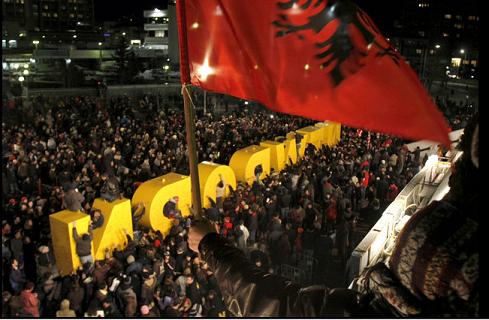
kosovo_independence1.jpgPresident Bush hailed the newly independent Kosovo and officially recognized it as a state and a “close friend” on Monday, expressing strong support for the new Balkans nation even as he rebuffed protests by Serbia and Russia.

The formal announcement came in a statement issued by Secretary of State Condoleezza Rice, who is traveling in Africa with the president. “The United States has today formally recognized Kosovo as a sovereign and independent state,” she said. “We congratulate the people of Kosovo on this historic occasion.”

I understand what it feels like to be a Kosovar Albanian today as it takes me back to 15 January 1992, when European and other states, including the United States, formally recognized the independence of the Republic of Croatia. I can also sympathize with Serbs, who must feel like their heart has been ripped out of their body given that Kosovo is integral to history and spirit of the Serbian nation. Ivo Banac has written that “the history of the Balkans is a history migrations, not only peoples, but of lands.” The Serbian nation was founded on land that the Serbs no longer control politically as a result of the vicissitudes of politics in that part of the world and the drift of the center of gravity of Serb political northward over the centuries. It is incumbent upon the new Kosovo government and the international community to allow Serbs to continue to have access to the sacred religious and spiritual monuments of their past.

You can see a comprehensive slide show of photographs marking the situation here.

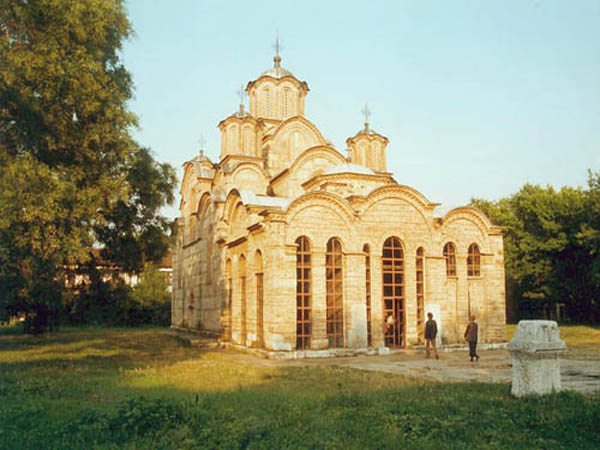
Below is a photograph of the famous Serbian Christian Orthodox Gračanica Monastery in Kosovo.

gracanica1.jpg

Life, Liberty, and the Pursuit of Happiness

We hold these truths to be self-evident, that all men are created equal, that they are endowed by their Creator with certain unalienable Rights, that among these are Life, Liberty and the pursuit of Happiness.

All of us immediately recognize these powerful sentences as being part of the Declaration of Independence of the United States of America. Happiness is an important concept and has been the object of increased study in political science and comparative politics. Ronald Inglehart (he of World Values Survey fame) argues that there is a strong relationship between happiness and democracy across countries. Inglehart writes:

Correlation is not causation, and this linkage could reflect any of the following things: (1) living under democratic institutions makes people much happier than living under authoritarian institutions; or (2) high levels of subjective well-being are conducive to democratic institutions; or (3) the correlation could be spurious, due to the fact that both subjective well-being and democracy are strongly correlated with some other variable such as high levels of economic development.

Solving this puzzle has far-reaching implications. If the linkage is not spurious and democracy makes people happy, this provides a strong additional argument on behalf of democracy; while if high levels of happiness are conducive to democracy, this can lead to a better understanding of how democracy emerges and flourishes. Using World Values Survey data on happiness levels from 1981 to 2006, and the Freedom House measures of democracy levels from 1972 to 2005, this paper analyzes the relationships between happiness and democracy in order to determine what is causing what.

How happy are Americans? How happy are Germans, Chinese, or Brazilians, for that matter? Who are the happiest people on earth? According to the new World Database of Happiness, it’s the Danes, Swiss and Maltese. Is this a political cultural trait, as Inglehart assumes, or are there structural and institutional factors at work? All three countries are rather small, and European. (Malta and Denmark are, additionally, amongst the most homogeneous states in the world, and this could be having an effect, given new research by Robert Putnam on the potential socially, politically, and economically detrimental effects of ethnic diversity.) Americans, by the way, are ranked #25 in level of happiness.

Serbian Reactions to Kosovo’s Declaration of Independence

Serbia’s B92–an independent news source in Serbia–reports that protesters have ransacked the Slovenian embassy in Belgrade, and damaged the U.S. Embassy and a McDonald’s. The protesters view the U.S. as the major patron of the Kosovar Albanians and the major facilitator (with help from the E.U.) of today’s declaration of independence. I presume that the Slovenian embassy was attacked because Slovenia is the current holder of the rotating Presidency of the EU. Here’s part of the report (in English), along with footage of the protesters:

BELGRADE — At least 30 policemen and 30 civilians were injured as protesters demonstrated against U.S. and EU Kosovo policy.

Police used tear gas and rubber bullets to disperse rioters that attacked them after vandalizing a McDonald’s restaurant in downtown Belgrade.

Earlier, the Slovenian embassy came under attack when a group of some 30 people broke a police cordon to smash the windows and ransack the building, tearing and burning the furniture inside and flags displayed on the balcony. Police then managed to contain the situation and push them back.

Previuosly, the protesters, several hundred strong, shortly stopped in front of the Serbian government headquarters, to proceed toward the U.S. embassy.

Police were out to secure the parameter, but although the organizers said the protest would be peaceful, cars were being demolished, while stones and lit flares were flying toward the embassy building and the officers themselves.

The Relationship Between Wealth and Health

The BBC reports on fascinating new research, which concludes that “economic growth does not necessarily translate into improvements in child mortality.” There are two points I wish to make about this: First, it illustrates an important trend in the development literature regarding the correct metric to use to determine, and compare, levels of well-being worldwide. Historically, well-being has been captured by the crude instrument of Gross National Product (GDP) per capita, but the realization that, for many reasons, the measure was too crude to be a satisfactory indicator of well-being development led to the introduction of other measures, the most useful of which is the Human Development Index (HDI) put out by the United Nations Development Program (UNDP). (Why might GDP per capita be a misleading indicator of well-being?)

The second point follows from the first; one’s policy prescriptions vis-a-vis issues of development are to a large extent determined by just which indicator of well-being one believes best captures the essential nature of that elusive concept. As such, IGOs such as the World Bank, have focused attention on overall economic growth, while scholars such as Amartya Sen (who champions the “capabilities approach”) do not view growth tout court as a magical anti-poverty elixir.

From the BBC article:

Ten million children still die every year before their fifth birthday, 99% of them in the developing world, according to Save the Children.

A study comparing economic performance with child mortality reveals that some countries have not translated wealth into improvements across society.

Survival is too often just a “lottery”, said Save the Children’s David Mepham.

He said that even the poorest countries can cut child mortality by following simple policies, but at the moment “a child’s chance of making it to its fifth birthday depends on the country or community it is born into”.

Lagging behind

Angola comes at the bottom of a new “Wealth and Survival” league table drawn up by the UN Development Programme (UNDP).

The figures for child mortality in India are shocking
Shireen Miller
Save the children India

There are few countries in the world where there are such stark wealth contrasts as there are between the wealth of oil-rich coastal strip around the Angolan capital Luanda, and the war-ravaged interior.

UNDP statisticians calculate that more than half of the babies who die in Angola could be saved were the country to spread its wealth more fairly.

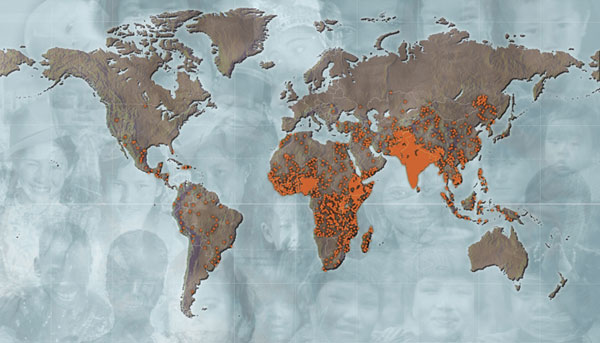
child_mortality_map.jpg

Click on the map to be taken to the Johns Hopkins Bloomberg School of Public Health’s Magazine for an article on child mortality.

[Each orange dot is equivalent to 5,000 child deaths.]


Kosovar Albanians Declare Independence From Serbia

As of the beginning of 1991, the Socialist Federated Republic of Yugoslavia was an internationally recognized state, which consisted of six republics (Bosnia & Herzegovina, Croatia, Macedonia, Montenegro, Serbia, and Slovenia) and 2 autonomous regions within Serbia–Vojvodina and Kosovo. As of today, with Kosovo declaring its independence from Serbia, the only one of those eight political units that is not an independent state is Vojvodina. The New York Times reports that the euphoric Albanians showed their gratitude to the United States for the development:
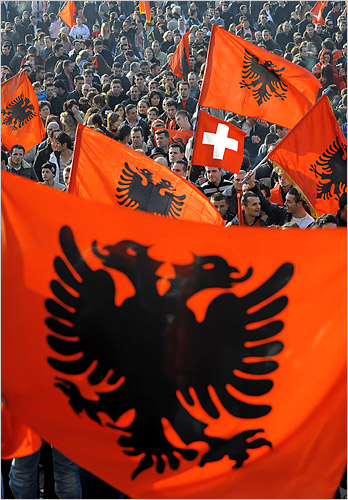
kosovo_independence.jpgPRISTINA, Kosovo — The former Serbian province of Kosovo declared independence on Sunday, sending tens of thousands of euphoric ethnic Albanians into the streets of this war-torn capital to celebrate the end of a long and bloody struggle for national self-determination.

The declaration marks the final dismemberment in the 17-year dissolution of the former Yugoslavia. It also brings to a dramatic climax a showdown between the West — which argues that the former Serbian President Slobodan Milosevic’s brutal subjugation of Kosovo’s majority ethnic Albanians cost Serbia its authority to rule the territory — and Belgrade and its ally Moscow, which counter that Kosovo’s independence declaration is a reckless breach of international law that will spur other secessionist movements across the world.

Ethnic Albanians from across the world streamed into Pristina, braving freezing temperatures and heavy snow, to dance in frenzied jubilation. Beating drums and waiving Albanian flags, they chanted “Independence! Independence! We are free at last!” while an enormous birthday cake was installed on Pristina’s main boulevard.

An outpouring of adulation for the United States — Kosovo’s staunchest ally in its quest for independence and the architect of NATO’s 1999 bombing campaign against Mr. Milosevic — was evident everywhere. Thousands of revelers unfurled giant American flags, carried posters of former President Bill Clinton, and chanted “Thank You U.S.A.!” and “God Bless America.”

Meanwhile, balkaninsight.org reports on an anti-U.S. counter-rally in the streets of the Serbian capital of Belgrade:

17 February 2008 Belgrade _ Hundreds of protesters blocked the Embassy of the United States in downtown Belgrade on Sunday, less than an hour after Kosovo’s leaders unilaterally declared the province’s independence from Serbia.

Protesters in Belgrade pelted the embassy building and police with stones and torches. At least one policeman was carried away in an ambulance. The number of injuries in the crowd could not be verified immediately.

Serbian police in full riot gear had cordoned off the embassy and managed to push protestors away from the embassy. The crowed scattered in nearby streets, but its numbers continued to grow.

Waving Serbian flags, burning signal torches and chanting nationalist and anti-American slogans, the crowd had initially tried to block both entrances to the embassy compound, which stretches over two apartment blocks on Kneza Milosa Street.

“We want to show we hate Yanks and Shiptars [a pejorative for Albanian],” a young protester who identified himself only as Dejan said, using a derogatory Serbian term for Kosovo Albanians.

A good source for views from within Serbia is the B92 broadcast network, whch reports that Serbia has annulled Kosovo’s declaration of independence, judging it to be an illegal act:

BELGRADE — PM Vojislav Koštunica addressed the nation today as ethnic Albanians unilaterally declared Kosovo’s independence.

It a televised address from the seat of the Serbian government in Belgrade, Koštunica rejected this act as illegal, and declared it null and void.

“Kosovo’s unilateral declaration of a false state is the final act of a policy that started with the NATO aggression against Serbia in 1999,” the prime minister said.

“Never has the truth about why Serbia was savagely destroyed by NATO bombs been more clear,” he continued, and added that “NATO’s military interests lie behind the proclamation of this false state.”

From bd at Richmond, here’s a link to reporting by MSNBC on Kosovo.
Pearl Jam and R.E.M

If I had to guess as to which theory of international relations the lead singers of two of my favorite bands, Eddie Vedder (Pearl Jam) and Michael Stipe (R.E.M.) would subscribe, I’d say radicalism, and radicalism, respectively. Here’s a version of what can only be characterized correctly as a protest song, Begin the Begin, from one of R.E.M.’s earliest albums. The lyrics are below. There’s certainly no compromise in this song; they argue, like all radicals, for radical systemic change; if you don’t like the system, “begin the begin.”

(chorus)
Birdie in the hand for life’s rich demand
The insurgency began and you missed it
I looked for it and I found it
Myles Standish proud, congratulate me

A philanderer’s tie, a murderer’s shoe

Life’s rich demand creates supply in the hand
Of the powers, the only vote that matters
Silence means security silence means approval

On Zenith, on the TV, tiger run around the tree
Follow the leader, run and turn into butter

Let’s begin again, begin the begin
Let’s begin again like Martin Luther zen
The mythology begins the begin
Answer me a question I can’t itemize
I can’t think clear, you look to me for reason
It’s not there, I can’t even rhyme here in the begin

A philanderer’s tie, a murderer’s shoe
Example: the finest example is you

(repeat chorus)

A philanderer’s tie, a murderer’s shoe
Let’s begin again, begin the begin
Let’s begin again

My Introduction to Comparative Politics Syllabus

Here is a link to my syllabus; I approach the teaching of comparative politics from a thematic perspective.  Rather than impose the study of specific countries and regions of the world on the students, I teach them topics and concepts and leave assignments, papers and other activities as instruments to allow students to study countries and societies that they find interesting.

PLSC240-Spring 2008 Syllabus

The Economist’s Diary on Kenya

The eminent British magazine, The Economist, currently has a correspondent in Kenya writing up daily reports in the Internet edition, which can be viewed here. There is, of course, much to be concerned about in Kenya these days, but as an academic I found the latest dispatch especially interesting:

Morning, Professor Alan Ogot’s office, Kisumu

ALAN Ogot (pictured below), one of Kenya’s leading historians, is the chancellor of Moi University in Eldoret. Like me, he graduated from St Andrew’s University in Scotland, but he was there in the 1950s, and his life before and since has been colourful and consequential.

Mr Ogot spends the first part of our interview delving into Luo history. Contrary to their reputation among some Kikuyus and white Kenyans as agitators, he says the Luo have always done the jobs no one else wanted to do. For a thousand years they have aspired to “fairness” and “reciprocity”. He gives examples of religious and political movements to argue that Luoland was the most progressive part of Kenya. That changed with independence in 1963 and the rise of a Kikuyu elite who mistrusted Luos.

Mr Ogot had lunch with Tom Mboya on the day Mboya was shot dead in 1969. Mboya was one of several Luo politicians tipped for the presidency and Mr Ogot thinks the Luo have never recovered from his death. “What followed was a police state. We were not allowed to speak our mind.”

 Then Mr Ogot moves on to the damage done to academia in Kenya by the post-election violence. He wonders what the future of research is in the country. Some of Africa’s best research institutions are located around Nairobi. Most are closed, he says, some burned, and the best minds driven out.
He points out that Maseno, the local university in Luoland, was over half Kikuyu. “Most of these people are not coming back. Who will provide them with security?” Other universities across the country are being similarly ethnically cleansed. “You call these universities? They’ll be worse than primary schools…”

…Since the election he has hardly left his house. A woman and child were shot dead outside his front gate. The police mistakenly killed a caretaker in a neighbouring house. “They have apologised, but what will that do?”

I’ve highlighted what I think are the interesting parts of the snippet I posted. First, contrary to what I have been reading in the newspapers lately, inter-ethnic relations between the Kukuyu and Luo, specifically, have not been as tolerant and peaceful and many have led us to believe. Second is the horrific damage that is being done to Kenya’s post-secondary educational system as a result of the current political situation there. A Boston Globe column that was published before the elections held out hope for Africa, and pointed to Kenya’s potential role as a leader for the rest of the continent. Now what?

Human Effects on the World’s Oceans

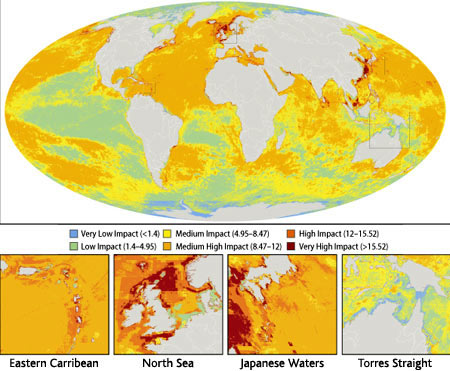
Here is a map that is unlike any of the maps of the world that I’ve posted previously. The obvious difference is that the whole of the world’s land mass is an undifferentiated white. What this map shows is the impact of human beings on (the destruction of) the world’s oceans and seas. From Science Now

ocean_impact_map.jpgFour years in the making, a groundbreaking new map of the state of the world’s oceans was released today, and its message is stark: Human activity has left a mark on nearly every square kilometer of sea, severely compromising ecosystems in more than 40% of waters.

The map, presented here at the annual meeting of the American Association for the Advancement of Science (publisher of ScienceNOW)–and published tomorrow in Science–combines 17 anthropogenic stressors, including coastal runoff and pollution, warming water temperature due to human-induced climate change, oil rigs that damage the sea floor, and five different kinds of fishing. Hundreds of experts worked to weigh and compare the stressors, overlaying them on top of maps that the scientists built of various ecosystems, with data obtained from shipping maps, satellite imagery, and scientific buoys. Then marine scientists modeled how different ecosystems would be affected by the stressors, mapping so-called impact scores onto square-kilometer-sized parcels worldwide. The scores correspond to colored pixels on the new map.

Design a site like this with WordPress.com
Get started