Personality Characteristics of Individual Leaders–Hugo Chavez and George W. Bush

In class on Wednesday, we’ll be analyzing the individual level of analysis in international relations. Do individuals matter? In other words, do they have an effect independent of the state and systemic levels, or do individuals lie at the periphery of international relations? Margaret Hermann–a political psychologist–has found that that leaders can be characterized based on a host of personality characteristics. Some of these are nationalism, need for power, need for affiliation, distrust of others, etc. On the basis of a composite of these characteristics, Hermann believed that leaders were more likely to have one or the other of two foreign policy orientations–independent leader, participatory leader. Watch these two clips and think about how you would characterize Chávez’s and Bush’s foreign policy orientations, respectively.

The Global Perspectives box on p. 146 in Mingst, asks the following questions:

  1. Is it personality or policies that have made Chavez popular and powerful? Using Herman’s personality characteristics, how would you classify Chavez?
  2. How has the person of Chavez augmented the power of the Venezuelan state?

The same could be asked of President Bush:

  1. Is it personality or policies that have made President Bush popular and powerful? Using Herman’s personality characteristics, how would you classify Bush?
  2. How has the person of Bush augmented the power of the US state?
The Fluid Religious Marketplace in the United States

The New York Times reports on a new poll released by the Pew Forum on Religion and Public Life, which shows a relatively high level of fluidity in the religious identities of residents here in the United States. Analysts and scholars of the role of religion in public life have long understood the US exceptionalism with respect to the important role and place of religion in public life. This has occurred despite (although some would argue because of) the official church-state separation in US society. Most other states with developed economies are much more secular than is the United States, even though some of these states (such as Great Britain and Germany) do not have state/church separation.

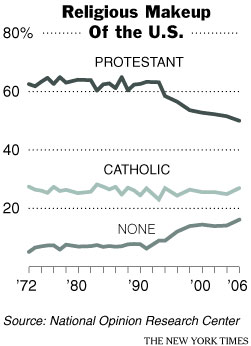
The main take-home message of this new Pew Poll, I think, is the fluidity of religious identity here in the United States, where religion is more individualized and personalized and really becomes a type of individual identity. (Remember in Chapter 3 of O’Neil where we differentiated between individual and group identity and discussed whether religious identity could be both.) Conversely, in countries like France, Great Britain, Germany, etc., religion is much more a social–i.e., group–(rather than a religious) identity and is, therefore, much more immutable. Here is an excerpt from the article, with a graphic:

us_religious_makeup.jpgWASHINGTON — More than a quarter of adult Americans have left the faith of their childhood to join another religion or no religion, according to a survey of religious affiliation by the Pew Forum on Religion and Public Life.

The report, titled “U.S. Religious Landscape Survey,” depicts a highly fluid and diverse national religious life. If shifts among Protestant denominations are included, then it appears that 44 percent of Americans have switched religious affiliations.

For at least a generation, scholars have noted that more Americans are moving among faiths, as denominational loyalty erodes. But the survey, based on telephone interviews with more than 35,000 Americans, offers one of the clearest views yet of that trend, scholars said. The United States Census does not track religious affiliation.

It shows, for example, that every religion is losing and gaining members, but that the Roman Catholic Church “has experienced the greatest net losses as a result of affiliation changes.” The survey also indicates that the group that had the greatest net gain was the unaffiliated. Sixteen percent of American adults say they are not part of any organized faith, which makes the unaffiliated the country’s fourth-largest “religious group.”

That 44 percent of Americans have switched religious affiliation is astounding. What are the implcations of this? I can think of two immediately…

You can find the Pew Forum on Religion and Public Life here. Here is a link to a video interview with Pew Forum Director Luis Lugo who talks about the next step in data analysis. Lugo characterizes the United States as having a dynamic “religious marketplace.” Here is a link to an interview with Neela Bannerjee, the New York Times journalist, who wrote the article.

The World Health Organization on Drug-Resistant From of Tuberculosis

The Vancouver Sun reports on the most recent announcement of the World Health Organization (WHO) regarding the dangerous multi-drug resistant strain of tuberculosis (MDR-TB) .

A report published Tuesday, Anti-Tuberculosis Drug Resistance in the World, is the largest survey to date on the scale of drug resistance in tuberculosis. It is based on information collected between 2002 and 2006 on 90,000 TB patients in 81 countries.

The organization [WHO] estimates there are nearly half a million new cases of multi-drug resistant TB every year.

“TB drug resistance needs a frontal assault. If countries and the international community fail to address it aggressively now we will lose this battle,” said WHO spokesman, Dr. Mario Raviglione. “In addition to specifically confronting drug-resistant TB and saving lives, programs worldwide must immediately improve their performance in diagnosing all TB cases rapidly and treating them until cured, which is the best way to prevent the development of drug resistance.”

The report also found that extensively drug-resistant tuberculosis (XDR-TB), a virtually untreatable form of the respiratory disease, has been recorded in 45 countries.

But the true scale of the problem, internationally, remains unknown. Only six countries in Africa – the region with the highest incidence of TB in the world – were unable to provide drug resistance data.

We’ll take a look at the global challenge posed by diseases such as TB in the last week of the semester.

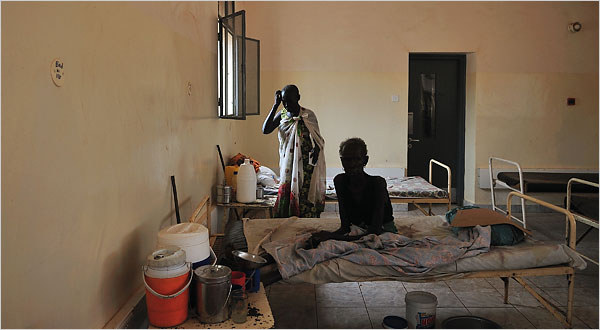
UPDATE: The New York Times also has this story on its front page, with a photograph of a TB clinic in Sudan.

tb_sudan.jpg

Map of Economic Freedom

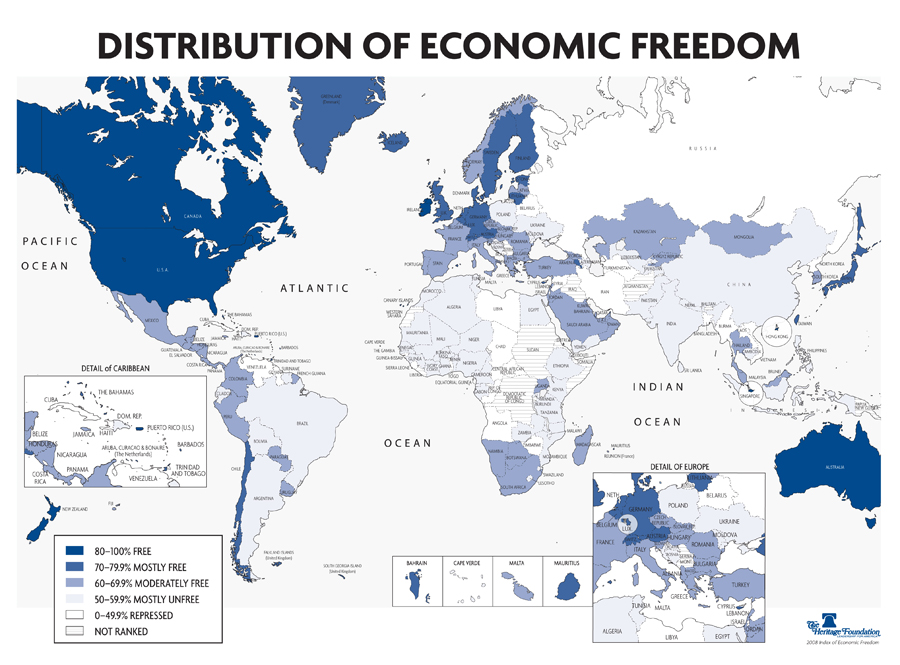
We’ll be comparing countries today based on their respective approaches to political economy; that is, on how the economic systems apportion the relative influences of the market, state, and civil society sector in the economy. Often, work on political economy tends to focus on the state/market nexus at the expense of civil society. We saw earlier in the course (Alesina and Guiliano) that attitudes and ideologies in the civil society sector can have a dramatic impact on economic patterns within society.

At the end of the lecture today, we’ll look at trends in economic liberalization worldwide over the last decade or so by means of a report from the US Federal Reserve Bank of Dallas, and this map from the Heritage Foundation annual report on economic freedom around the world.

(The darker the color, the more economically free is that country’s economy.)

index2008_econfreedommap.jpg

Violin Diplomacy in North Korea

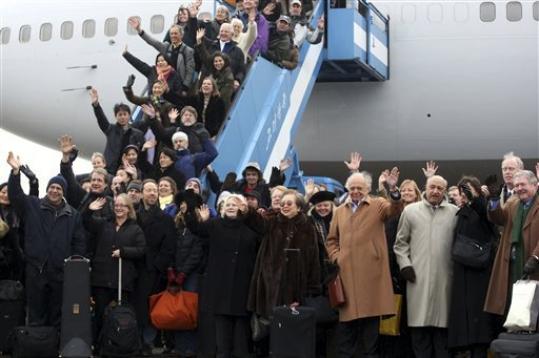
You remember the “ping-pong diplomacy” of the Nixon years? Well, get ready for a little bit of “violin diplomacy”, with news that the New York Philharmonic Orchestra has landed in Pyongyang, the capital of the most politically isolated state on earth, North Korea. The Boston Globe reports and uses the occasion to look back at other episodes of cultural diplomacy:

539w.jpg
Members of the New York Philharmonic orchestra wave as they arrive at the airport in Pyongyang for a two day visit to North Korea on Monday, Feb. 25, 2008. (AP Photo/David Guttenfelder)
Some other noteworthy episodes of cultural diplomacy, according to the Boston Globe:
CHINAApril 1971 — The U.S. Table Tennis Team accepts a surprise invitation from China, making the group the first American non-communist delegation allowed into China since the communist takeover in 1949. This “pingpong diplomacy” helps lay the path for President Richard Nixon’s historic trip to China the following year.1979 — Acclaimed violinist Isaac Stern embarks on a cultural tour of China in which he performs and mentors young Chinese musicians, encounters that are chronicled in an Oscar-winning documentary, “Mozart to Mao.”IRAN Continue reading “Violin Diplomacy in North Korea”

Patriotism–What is it? How can we Measure it?

As budding “social scientists” (the scare quotes are legitimate), it is good form to not only define concepts that are malleable but also to provide qualitative and/or quantitative evidence regarding their existence. A recent brouhaha in American politics centers around the political concept patriotism. What is it? How do we know it exists? Can it be measured? These are all important questions, so important, in fact, that they could determine the outcome of the next US presidential election.

In intro to comparative, we’ve been analyzing social identities, ethnic, national, etc. As we know from reading O’Neil, patriotism is based on the idea of citizenship–an individual’s relationship to the state in which s/he lives. O’Neil defines patriotism as “pride in one’s state.”

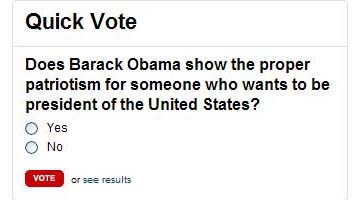
As near as I can tell, some opponents of Barack Obama’s candidacy have based some of their resistance on what they view as his lack of patriotism. If I’m reading this correctly, the base their argument on the fact that Obama does not (in fact, may even refuse to) wear a lapel pin in the shape of an American flag. This is interesting since it also touches upon issues of national identity; remember that we tried to determine just what is meant to be American. Does one have to wear an American flag lapel pin to be considered patriotic? If any of you think that this is an issue of negligible import, I refer you to this screen shot of the CNN website:

cnn-obama-patriotism.jpg

Given that I’m not a citizen of the United States, I’ll leave that for others to answer. I am, however, a citizen of the Republic of Croatia and this episode does remind me of an incident from the mid 1990s, which I, then working for the Helsinki Committee for Human Rights, witnessed. Join me after the jump.

hrvatska-zastava.jpgThe Croatian flag is a tri-color, with horizontal fields of red, white, and blue (from top to bottom), which contains the coat of arms–the “Šahovnica“–in the middle field. The šahovnica has been used in various guises throughout Croatian history as a symbol of Croatian nationhood. While Croats have lived under many different types of regime–Communist Yugoslavia, the Fascist Ustasa regime during WWII, the unitarist, Serb-dominated inter-war regime, the Austro-Hungarian monarchy (you get the point!)–the šahovnica has remained a constant expression and symbol of the Croatian people.

Continue reading “Patriotism–What is it? How can we Measure it?”

Cuba’s Human Welfare Indicators

Recent news regarding Fidel Castro’s plans to step aside in favor of his brother have returned Cuba to the news headlines here in the United States.  It has prompted some to take stock of Castro’s tenure as Cuba’s leader of nearly five decades.  Unfortunately, much of what we are likely to read will be ideologically-driven and devoid of much empirical substance.  For a comparative look at Castro’s and Batista’s regimes, we turn to Cal-Berkeley economist Brad DeLong:

ist2_64313_vintage_1950s_cars_in_havana_cuba.jpgThe hideously depressing thing is that Cuba under Battista [sic]–Cuba in 1957–was a developed country. Cuba in 1957 had lower infant mortality than France, Belgium, West Germany, Israel, Japan, Austria, Italy, Spain, and Portugal. Cuba in 1957 had doctors and nurses: as many doctors and nurses per capita as the Netherlands, and more than Britain or Finland. Cuba in 1957 had as many vehicles per capita as Uruguay, Italy, or Portugal. Cuba in 1957 had 45 TVs per 1000 people–fifth highest in the world. Cuba today has fewer telephones per capita than it had TVs in 1957.

You take a look at the standard Human Development Indicator variables–GDP per capita, infant mortality, education–and you try to throw together an HDI for Cuba in the late 1950s, and you come out in the range of Japan, Ireland, Italy, Spain, Israel. Today? Today the UN puts Cuba’s HDI in the range of Lithuania, Trinidad, and Mexico. (And Carmelo Mesa-Lago thinks the UN’s calculations are seriously flawed: that Cuba’s right HDI peers today are places like China, Tunisia, Iran, and South Africa.)

Thus I don’t understand lefties who talk about the achievements of the Cuban Revolution: “…to have better health care, housing, education, and general social relations than virtually all other comparably developed countries.” Yes, Cuba today has a GDP per capita level roughly that of–is “comparably developed”–Bolivia or Honduras or Zimbabwe, but given where Cuba was in 1957 we ought to be talking about how it is as developed as Italy or Spain.

This week in intro to comparative, we’ll discuss various indicators of well-being and welfare, such as GDP per capita and the HDI, comparing the indicators themselves and comparing different countries.

US Missile Test–Sign of an Arms Race in Space?

The United States military has shot down a stray satellite via sea-launched missile. While the Pentagon insists that the episode was meant to prevent the falling satellite from becoming a potential hazard upon its descent to earth, military analysts are not persuaded. It will be difficult to disabuse those with a realist mindset that the exercise was not in response to China’s similar missile exercise in January 2007. Time Magazine’s Jeffrey Kluger writes:

sm3_missle_0220.jpgThis week, the Pentagon tried something different. On Wednesday evening, it announced that it successfully launched a sea-based missile and shot down a crippled satellite gliding 150 miles overhead, in a $60 million effort to blast it out of the sky before it could tumble home and hurt someone. It’s been a neat little feat on the part of the military planners — but that doesn’t mean they’re telling the whole truth about why they bothered in the first place.

The clay pigeon in the military’s cross hairs was an unnamed, 5,000-lb. spy satellite that was launched in 2006 and never quite got its purchase in space, suffering a malfunction almost immediately upon its arrival in orbit. Comparatively low-orbiting craft like this one tumble back to Earth faster than high-orbiting ones, as the upper wisps of the planet’s atmosphere produce increasing amounts of drag, pulling the object lower and lower. This one was on a trajectory that would have caused it to begin its terminal plunge sometime in March, sending it on a fiery descent that should have entirely — or at least mostly — incinerated it.

So why make the effort at such a complicated bit of sharpshooting just to bag a target that was coming down anyway? The Pentagon says it’s all about safety. Five thousand pounds of out-of-control satellite can do an awful lot of damage if it drops on the wrong spot. What’s more, this particular satellite is carrying a 500-lb. tank of frozen hydrazine fuel — nasty stuff if you’re unlucky enough to inhale it. Striking the ground at reentry speed, the gas could immediately disperse over a patch of ground as big as two football fields…

The more believable explanation for the duck hunt is that it’s been an exercise in politics rather than safety. Washington was none too pleased in January of 2007 when China shot down one of its own weather satellites after it had outlived its usefulness, a bit of technological sword-rattling that proved it could target any other nation’s orbiting hardware with equal ease. Beijing too made vague claims of worrying about the public weal, but Washington saw the act more as the political statement it probably was, and concluded — correctly — that American spy satellites are not quite as safe as they once were. An American shootdown would be one way to return the gesture. The timing is particularly suspicious since Russia and China issued a joint condemnation of the militarization of space only days before the Pentagon went public with its plans. While Beijing’s sudden pacifism is hardly credible after it own exercise in cosmic skeet-shooting, neither is the Washington’s insistence that there is no linkage between the two events.

Another possibility is that the Pentagon was indeed nervous about something aboard the satellite, but not the tank of fuel. Spy satellites are, by definition, made of secret hardware, and nothing so pleases one military power as the chance to seize and pick over the technology of another. Should American camera and communications components fall into the wrong hands, whatever tactical advantage was gained in developing them would be lost.

Serbian President Reacts to Yesterday’s Violence in Belgrade

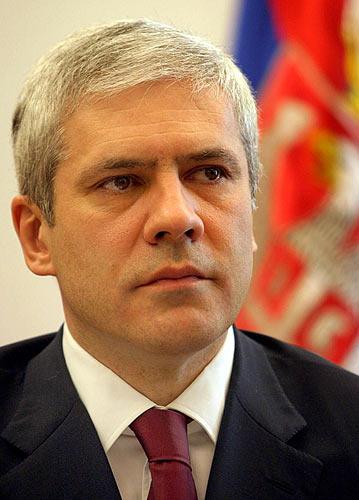
Recently elected Serbian President, Boris Tadić, has responded to yesterday evening’s violence in Belgrade, which involved the torching of the US Embassy by an unruly mob numbering hundreds.  The mob was but a tiny minority of the crowd of hundreds of thousands, which had gathered earlier in the day to peacefully protest Kosovo’s declaration of independence on Monday of this week.  Tadić, a the leader of the moderate Democratic Party in Serbia, had this to say about the events:

tadic.jpg Tadić, who was in Romania Thursday, today said he has “asked all relevant institutions for reports on yesterday’s unrest in Belgrade”.
For the same reason, he was called a session of the Council for National Security…

…Tadić is also strongly condemning the violence, looting and burning, that ended in one death and nearly 200 injured, as well as huge material damage to the city.

“There is no justification for violence, no one must dare to justify it with a single word,” his press service said in a statement…

…Tadić went on to say that “this is not Serbia and Serbia will never be like this”.

“The state must have law and order and such violence must never happen again, anywhere,” Tadić said.

Turkish Military in Northern Iraq

While Iraq still maintains legal sovereignty over the majority Kurdish areas in the north of the country, the Kurds in that region have been enjoying de facto autonomy/independence since the end of the first Gulf War in 1991.  A direct result of United Nations Security Council resolutions mandating, above all else, the establishment of a no-fly zone in northern Iraq, Saddam Hussein’s regime had no presence there from 1991 on.  The ouster of Saddam’s regime has only made Kurdish control of the territory more secure.  It’s not inconceivable that a Kosovo-type situation could obtain here as well.   A crucial difference in the Kurdish situation is the presence of a large group of ethnic Kurds living in neighboring Turkey, who have waged a sporadic, decades-long campaign (using various tactics, including terrorism) to pressure the Turkish government into granting the Kurds more autonomy, if not outright independence.  The situation has become even more serious, as this report from the New York Times illustrates:

ISTANBUL — Turkey’s military said on Friday that it had sent ground troops into northern Iraq on Thursday night, in an operation aimed at weakening Kurdish militants there, but it was unclear how many or how long they would stay.

The Turkish General Staff, in an announcement on its Web site, gave no details on the size of the incursion. An American military spokesman in Baghdad said the ground offensive would be of “limited duration.”

The Turkish offensive appears to be aimed at dealing a surprise blow to the Kurdish militants, the Kurdistan Workers’ Party, before the snow along the mountainous border between the two countries melts and the guerrillas make their traditional spring advance into Turkey.

The militants, known as the P.K.K., want greater autonomy for Turkey’s Kurdish minority and have fought the Turkish military for decades. Some of their hide-outs are in Turkey, but some are in northern Iraq, and the rebels have crossed the border into Turkey repeatedly to attack.

It was not clear what role the United States had played in the incursion. But the operation sets two of its closest allies in a troubled region against each other. Turkey is a NATO member that borders Iran, Iraq and Syria; the Iraqi Kurds, who control northern Iraq, are the most important American partners in the Iraq war.

The United States has been wary of Turkish efforts to stamp out the Kurdish militants, with Turkish officials chafing at what they view as a double-standard, escalation tension between the NATO allies.

Design a site like this with WordPress.com
Get started