Debaathification redux

In an earlier post, I noted that the Iraqi parliament had passed a law allowing the re-hiring of rank-and-file members of the Baathist party, who had lost their jobs in one fell swoop as a result of a decision by Paul Bremer in the immediate aftermath of the US-led invasion. As has been the case on numerous prior occasions in Iraq, the news may not be as good as originally hoped. From the NY Times we find:

A day after the Iraqi Parliament passed legislation billed as the first significant political step forward in Iraq after months of deadlock, there were troubling questions — and troubling silences — about the measure’s actual effects.

The measure, known as the Justice and Accountability Law, is meant to open government jobs to former members of the Baath Party of Saddam Hussein — the bureaucrats, engineers, city workers, teachers, soldiers and police officers who made the government work until they were barred from office after the American invasion in 2003.

But the legislation is at once confusing and controversial, a document riddled with loopholes and caveats to the point that some Sunni and Shiite officials say it could actually exclude more former Baathists than it lets back in, particularly in the crucial security ministries.

Once again, the crux of the issue in Iraq is the sectional and interethnic struggle amongst Sunni Arabs, Shia Arabs, and non-Arab Kurds, and who get what, when, and where. There are no easy answers.

Pew Global Attitudes Project

In the past, while talking with students, listening to discussion in class or grading papers, I’ve often heard unsubstantiated claims such as “the world is not with President Bush”, or “even the Europeans hate us”, etc.  Noting that these claims are unsubstantiated does not mean they are not true.  What it does mean is that I need further proof of the veracity of the claims than simply the student’s recitation of that claim.  Similarly, you should be skeptical in class if I try to claim something without providing evidence to support that claim.  With respect to statements such as the ones I referenced above, the Pew Global Attitudes Project is a fantastic resource.  This organization polls publics around the world on a host of issues related to international politics, international affairs, and the domestic ramifications of international events and issues.

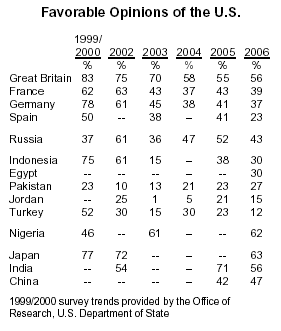
So just how do people around the world view the United States, and how has that opinion changed since 2000?  Well, look no further than this report here:


favorable_opinions_of_the_us.gif

Now, if a student were to write, according to widely available survey evidence, Europeans  (at least in Great Britain, France, Spain, and Germany) hold a much less favorable view of the US in 2006 than they did in 2000 (Pew Global 2006), then that would be more compelling.

McClatchy–Kenyan president lost election, U.S. exit poll indicates

The McClatchy Washington Bureau is an excellent resource for news on political events around the world. Here they report on the results of an exit poll commissioned by a US-government backed foundation, which claims to show the incumbent Kenyan president was soundly defeated in the recent disputed election that has set off rioting and inter-ethnic killing sprees.

NAIROBI, Kenya — An exit poll carried out on behalf of a U.S. government-backed foundation indicated that Kenyan President Mwai Kibaki suffered a resounding defeat in last month’s disputed election, according to officials with knowledge of the document.

The poll by the Washington-based International Republican Institute — not yet publicly released — further undermines Kibaki’s claims of a narrow re-election victory. The outcome has sparked protests and ethnically driven clashes nationwide, killing hundreds.

Opposition leader Raila Odinga led Kibaki by roughly 8 percentage points in the poll, which surveyed voters as they left polling places during the election Dec. 27, according to one senior Western official who’s seen the data, who spoke on condition of anonymity because of the sensitivity of the issue. That’s a sharp departure from the results that Kenyan election officials certified, which gave Kibaki a winning margin of 231,728 votes over Odinga, about 3 percentage points.

U.S. and European observers have criticized the official results, which came after long, unexplained delays in counting the votes, primarily from Kibaki strongholds. Jendayi Frazer, the assistant secretary of state for African affairs, said over the weekend that there were “serious irregularities in the vote tallying, which made it impossible to determine with certainty the final result.”

It wasn’t clear why the International Republican Institute — which has conducted opinion polls and observed elections in Kenya since 1992 — isn’t releasing its data. A spokesman for the U.S. Embassy in Kenya confirmed that a poll was conducted but referred questions to the institute, where officials couldn’t be reached for comment.

Kenyan activists called on U.S. officials to release any data that would shed light on election fraud.

Croatia: A Human Trafficking Victim Speaks With RFE/RL

The extent of human trafficking, for prostitution mainly, but also for indentured servitude has increased dramatically since the collapse of communism in eastern Europe. A more interdependent and globalized world leads to opportunities for many, but also to horror and destitution for an increasing number of the world’s most vulnerable. Here is an account of a Croatian victim from Radio Free Europe/Radio Liberty (RFE/RL–an excellent website for information on the former communist world, the Middle East, and parts of western Asia).

ZAGREB, June 15, 2006 (RFE/RL) — Trafficking in women for the purpose of sexual exploitation is becoming increasingly widespread in countries undergoing transition. Many young women seeking better jobs and better lives find themselves against their will in secret brothels of Western countries. Such is the warning of nongovernmental women’s unions in Croatia, where 45 victims of trafficking have been identified in the last four years. Unofficial numbers are many times greater.

“It happened abroad,” says Martina, a 29-year-old trafficking victim from Zagreb. “I was sold for 3,500 euros [$4,400]. I was beaten, raped, forced against my will. They would put out cigarette butts on me and cut me with razors.

It was like a horror movie, she says. Martina was 19 years old at that time, trained as a cook. She lived in the suburbs of Zagreb and desired a better job and a better life. She met a young man who told her about his brother who had a restaurant in Italy, but who had a hard time finding good employees.

‘It Sounded Rather Convincing’

“He told me that if I really wanted to work I could come with him, but that if I did not intend to pursue work there I could be back in Croatia in three days,” Martina said. “It sounded rather convincing. Given that my life had been miserable since I was born — my father was an alcoholic and my mother ill — I went there without a second thought.”

“As soon as I arrived and as soon as he brought me to his apartment, everything started. He told me there was no work and that I had crossed the border in order to work as a prostitute, that he had paid a ton of money for me and that he will come for me in three days, and that I had to be ready by then,” she continued. “I told him to get his mother ready instead, and then he hit me on the head with his fist. Since we were in the kitchen I turned around and struck him with a pot. Naturally, I was no match for him physically. He beat and raped me constantly for three days, to the point where I was lying in blood and urine while tied to a bed. He then brought two of his friends who raped me, put out cigarette butts on me, and cut me with razors.”

Martina was locked in a Rome apartment for two months. Instead of working in a restaurant, she was beaten and raped daily until she was “broken” and had become a sexual slave. Then, she says, the man who bought her took her out to the street.

Four Passports

“That man was from Bosnia,” she said. “We found in his apartment four passports and another girl from Croatia who was also a mother of three. That was a complete horror. They beat me endlessly. A girl of 16 from Albania almost bled to death in my arms because they had pushed a car antenna into her vagina. A girl from Bosnia was found dead. That is when I completely broke down.”

Two prostitutes appearing in a World Cup-related advertisement in Halle, Germany (epa)She said she had been completely dulled, as if separated from her own body. Even when there was a chance of escape she remained a prostitute.

“There was no way for me to be freed from what had happened to me,” Martina said. “I endured this for six years. I went to the street with prostitutes, not in order to work, but to see the people who come to them and who force them to do this. Then I would throw a bottle of gasoline on their car or puncture their tires. I didn’t care what would happen. I did one or three customers — I didn’t care. I didn’t look at those people.”

Martina was a typical, vulnerable young woman without steady employment or family support. Nobody wondered about her disappearance. After all, even her own father beat her from a very young age. Sadly, that experience prepared her for what she endured in Rome.

Globalization, Economic Development and Indentured Servitude

We will be addressing the topic of globalization later in the semester and will be viewing this video on the use of what amounts to slave labor in the silk industry in India.

I found this on the Human Trafficking and Modern-day Slavery website.

Human Trafficking Website 2007-2008. Country by country reports of human trafficking, modern day slavery, contemporary slavery, debt bondage, serfdom, forced labor, forced marriage, transferring of wives, inheritance of wives, and transfer of a child for purposes of exploitation.

Worldwide Governance Indicators from the World Bank

Probably the best compilation of data related to governance can be found here .  The data can be viewed interactively (this is how I created the world map above that is being used as the page header for my website) here. The data include measures for most of the world’s countries on the following:

The Worldwide Governance Indicators (WGI) project
reports aggregate and individual governance indicators for 212 countries and territories over the period 1996–2006, for six dimensions of governance:

Voice and Accountability

Political Stability and Absence of Violence

Government Effectiveness

Regulatory Quality

Rule of Law

Control of Corruption

The aggregate indicators combine the views of a large number of enterprise, citizen and expert survey respondents in industrial and developing countries. The individual data sources underlying the aggregate indicators are drawn from a diverse variety of survey institutes, think tanks, non-governmental organizations, and international organizations.

The six aggregate indicators and the underlying data sources can be viewed interactively on the Governance Indicators webpage of this site. Documentation of the latest update of the WGI can be found in “Governance Matters VI: Governance Indicators for 1996–2006.” Further documentation and research using the WGI is available on the Resources page of this website or at www.worldbank.org/wbi/governance.

What is governance? From the website we find this definition of governance:

Governance consists of the traditions and institutions by which authority in a country is exercised. This includes the process by which governments are selected, monitored and replaced; the capacity of the government to effectively formulate and implement sound policies; and the respect of citizens and the state for the institutions that govern economic and social interactions among them.

De-baathification and Democratic Transition / Consolidation in Iraq

There are many challenges during in the transition from an authoritarian regime to one based on democratic principles. In single-party dictatorships, the issue of what to do with the “shock troops” of the regime–the rank-and-file (and some not so rank-and-file) party members who were not leaders in any sense of the word but did provide the regime with the labor and muscle power necessary for the quotidian functioning of the society. These would include civil workers, police, teachers and professors, enlisted soldiers, etc.

Upon eliminating the Saddam Hussein regime in 2003, the United States was faced with the task of what to do with the hundreds of thousands of Baath Party members who were viewed as having intimate ties to the Hussein regime. In what is widely considered one of the biggest mistakes of the post-overthrow occupation, Paul Bremer fired, and otherwise had removed from their jobs, hundreds of thousands of these lower ranking Baath party members. In a potentially positive sign (the devil, as always, is in the sectarian details), Iraq’s parliament has recently passed a law allowing many of these individuals to return to their former jobs. From the Associated Press:

Iraq’s parliament passed a benchmark law Saturday allowing lower-ranking former members of Saddam Hussein’s Baath party to reclaim government jobs, the first major piece of U.S.-backed legislation it has adopted…

The seismic piece of legislation had been demanded by the United States since November 2006 and represented the first legislative payoff for Bush’s decision to deploy 30,000 additional troops to the country to quell violence…

It was not immediately clear how many former Baathists would benefit from the new legislation, titled the Accountability and Justice law. But the move was seen as a key step in the reconciliation process.

Continue reading “De-baathification and Democratic Transition / Consolidation in Iraq”

Weber’s Theory of Social Action

Weber’s theory of social action is important because it sets out, I believe, more clearly than any other theorist the idea behind social action, and the foundations for explanation in the social sciences.

Andrew Roberts, at the University of Middlesex, has written a critical commentary on Weber’s concept of social action:

Continue reading “Weber’s Theory of Social Action”

World Economic Forum Releases Global Risks Report for 2008

The World Economic Forum, a Swiss-based NGO whose motto is “entrepreneurship in the global public interest”, has recently released its Global Risks Report for 2008.  They view four main issues as presenting the most potential global risk over the next twelve months and beyond.

The present report looks at global risks from a range of different perspectives. The first part of the report focuses on four emerging issues that are shaping the global risk landscape: systemic financial risk, food security, supply chains and the role of energy. On systemic financial risk, we put current market turmoil in the historical context and ask how the transformation of the global financial system over the last two decades may require us to rethink our expectations and understanding of systemic risk in the future. On food security, we discuss how the subject has moved from the periphery of the global risk landscape to its centre, and ask whether the world is ready to cope with the various trade-offs that the new food economy is generating. On supply chains, we investigate a potentially hidden set of vulnerabilities in the global economy to supply chain disruptions. Finally, on energy, we outline the emergence of a range of energy-related risks and ask if the world can move towards secure and sustainable energy.

Design a site like this with WordPress.com
Get started